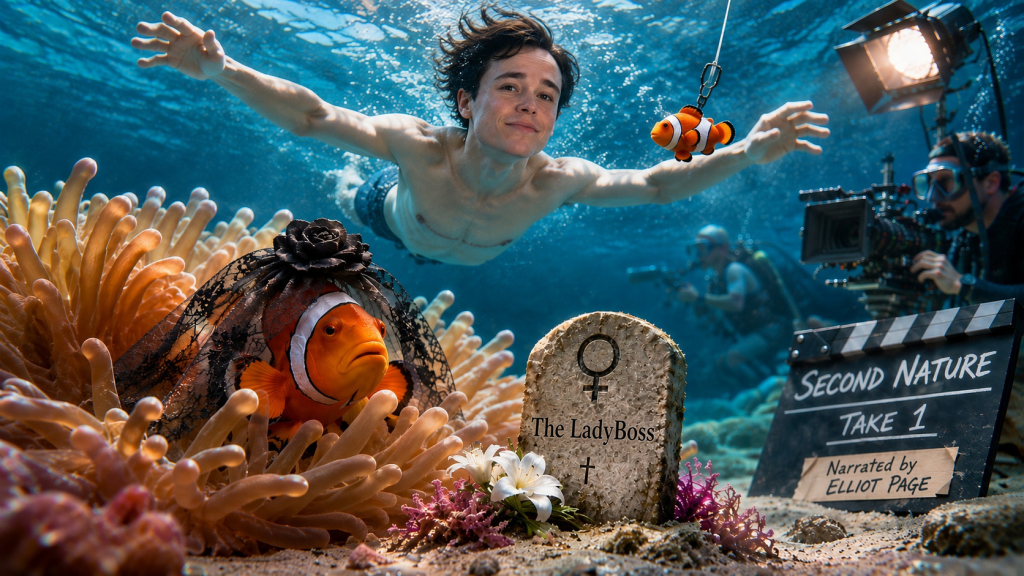
How Second Nature takes real findings from animal behaviour and bends them into activism
When ABC News devoted a segment to promoting Second Nature [1], the introduction found room for a piece of dinner-party trivia: did you know clownfish can change sex? They can, and biology has understood how and why for the better part of half a century. Clownfish live in small groups on a sea anemone, with one dominant female, one breeding male and a few juveniles waiting their turn. When the female dies, the male becomes female and the largest juvenile is promoted to breeding male [2; 3]. The change is triggered by the group’s hierarchy, runs in one direction only and reaches the gonad itself: the animal stops producing sperm and starts producing eggs. Rendered in human terms, what befalls the clownfish has rather more in common with widowhood than with transition.
This essay examines how the documentary takes verifiable facts and bends them until they say what the narrative requires. Sexual behaviour between animals of the same sex is documented in hundreds of species [4; 5], and sex change in certain fish is a well-studied phenomenon. From this material Second Nature manufactures something else entirely: that sex is a spectrum, that animal sexuality is «fluid», that the animal kingdom has something called gender, and that science has been hiding it. The result has the look of a nature documentary and the architecture of a pamphlet. It is activism in a zoologist’s borrowed coat.
1. What Is Being Judged
This is not a review of a film its author has not seen. It is a judgement of the premise its makers chose to sell it on, in their own words. Second Nature: Gender and Sexuality in the Animal World (gender in the title, naturally) is directed by Drew Denny, narrated by Elliot Page, and produced by Annapurna Pictures and Pageboy Productions, Page’s own company. Page and Megan Ellison are among its executive producers. It reached cinemas in June 2026 with a promise on the poster: everything you didn’t learn in high school biology [6].
The material under examination is the official trailer [7] and the interview ABC News conducted with Page and Denny ahead of the release [1]. In the trailer, one voice announces that «homosexual behavior in nature is one of the best kept secrets», and another that «biologists now know sexuality is fluid». A scientist describes how she resolved the conflict between what she had been taught and what she wished to find: «it can’t be the people who are defective, it’s got to be the science.» On ABC, the film is presented as the work of scientists pushing back against censorship to uncover truths about love, identity and evolution. Page tells viewers that biology shows gender and sexuality lie on a wide spectrum, and that the binary is «a quaint little myth». Denny adds that the behaviour is observed all the time, but that filmmakers used to frame it out.
A trailer and a press campaign are the thesis the producers chose to put in the shop window. If that thesis contradicts what biology knows, no amount of footage of capuchin monkeys will rescue it inside the cinema; a false premise is not corrected by good cinematography. And should the film turn out to be more careful than its campaign, the criticism still stands against those who chose to sell it this way. Most people who hear of Second Nature will meet the trailer, the interviews and the clownfish anecdote, not the eighty-odd minutes of the documentary itself.
2. Congratulations, Columbus: You’ve Discovered America
One should begin by granting the documentary what it has in its favour, which is a fair amount. Sexual behaviour between individuals of the same sex has been recorded in more than 1,500 animal species, across every major vertebrate clade and a wide range of invertebrates [8]. As early as 1999, Bruce Bagemihl compiled the scientific documentation of same-sex courtship, sex, pair bonds and co-parenting in some 450 species [4]. Among mammals, the broadest survey to date found records in 261 of 6,649 living species, roughly 4 per cent [5]. The facts are not in dispute. What deserves care is what these figures actually measure. They count species in which the behaviour has been seen at least once, not how often it occurs within each one, and the true denominator is the species someone has studied closely enough to notice it, not the millions that exist. The numbers therefore license neither the claim that the behaviour is rare nor the trailer’s assurance that it is «absolutely everywhere». Four per cent of mammals is some distance from everywhere. Nor is the evolutionary explanation settled. Monk and colleagues propose that indiscriminate sexual behaviour towards both sexes is the ancestral condition of animals; Gómez and colleagues conclude that among mammals it arose many times independently, mostly recently within each lineage. Where the literature sustains an open debate [9], the trailer offers a revelation.
What it does not offer is anything new. On the page, the subject is a quarter of a century old. Biological Exuberance appeared in 1999 from a commercial New York house, and Joan Roughgarden, one of the scientists who appear in Second Nature, published Evolution’s Rainbow with the University of California Press in 2004 [10]. On screen, likewise. In 2001 the French company Saint Thomas turned Bagemihl’s 450 species into a documentary, Animal Homosexuality (also released in English as Out in Nature), which already promised to reveal a phenomenon that had gone unnoticed [11]. In 2002, The Truth About Gay Animals toured captive animal collections with the comedian Scott Capurro [12]. In 2004, National Geographic went looking for same-sex behaviour in wild animals for Girl Power, an episode of Ultimate Explorer [13]. In 2017 the BBC filmed, for Blue Planet II and in David Attenborough’s voice, a female kobudai turning into a male [14]. In June 2024 Peacock released Queer Planet, narrated by Andrew Rannells: gay penguins, bisexual lions, the 1,500 species and, naturally, the clownfish, with a researcher quipping that Nemo’s father might have become his mother [15]. In May 2025 the CBC broadcast Animal Pride on The Nature of Things, complete with biology’s blind spot, nature coming out of the closet and Levick’s penguins [16]. And the Nemo joke is older than all of them: the press made it in July 2003, when Buston published his clownfish paper in Nature and the Pixar film was still in cinemas [17]. Congratulations, then: Second Nature has discovered America, much as Columbus did, finding it already full of people who lived there.
Not even the tale of censorship is new. In 1911 the naval surgeon George Murray Levick observed sexual behaviour between male Adélie penguins at Cape Adare, and his pamphlet, printed in 1915, was left out of the expedition’s official reports. We know this because in 2012 three researchers recovered it and published it in full in Polar Record [18], and the British press ran the story that same year. Bagemihl had already devoted whole chapters, in 1999, to the generations of naturalists who explained such behaviour away as mistaken identity, rehearsal or displays of dominance [4]. In 2013 Brett Mills published his analysis of three Attenborough series for the BBC, which took their subjects’ heterosexuality for granted and described as bonding or intimidation scenes between males that admitted a sexual reading [19]. Animal Pride, for its part, brought Levick to television a year before Second Nature did. The censorship the trailer announces as a scoop has its own subgenre, its own papers in Nature journals and even a fixed slot in the release calendar: Pride Month.
3. Gender Goes on Safari
Second Nature carries gender in its very title: Gender and Sexuality in the Animal World. The trailer speaks of «gender multiplicity» among animals [7], and Page explained to ABC that biology shows gender to lie on a wide spectrum and the binary to be «a quaint little myth» [1]. For such sentences to mean anything, one must first know what «gender» means, and the film uses the word in two senses that exclude each other.
The first comes from the humanities. When Ann Oakley separated sex from gender in 1972, gender was the cultural elaboration of sex, what a society makes of biological difference [20]. Judith Butler went further and described it as a repetition of acts regulated by social norms [21]. On that definition, animals have no gender for the same reason they have no law of inheritance. Many species display social behaviour, and some even possess learned traditions that ethologists call culture in a minimal sense, such as tool-using customs that vary from one chimpanzee population to the next [22]. What none of them has is a normative system that assigns roles and punishes those who stray, which is precisely what gender theory attributes to human society. If gender is a social construction, finding it in a fish is a contradiction in terms.
The second sense belongs to Joan Roughgarden, the biologist the film presents as its scientific authority. Roughgarden proposed «widening» the word to cover the morphology, behaviour and life history of a sexed body, and she defines the sexed body by the size of the gametes it produces: males make small ones, females large ones, «that’s it» [10, p. 27; 23]. On that definition, a species with two sexes may have «more than two genders». Her examples are males of different sizes and colours that reproduce by different strategies, such as those of the bluegill sunfish or the three throat-colour morphs of the side-blotched lizard, Uta stansburiana [24; 25]. Biology already had a name for this: alternative reproductive tactics. Gross titled his 1996 review, without a trace of irony, «diversity within sexes», and all three types of male bluegill produce sperm. Roughgarden’s «gender multiplicity» is variation within a sex defined by its gametes, and to assert it she must take for granted the very binary the documentary claims to dispel.
Second Nature must choose between these two definitions, and neither will do. On Oakley’s and Butler’s, animals have no gender and the film’s title has no subject. On Roughgarden’s, animals have «genders» only because their phenotypes have been renamed; the sexual binary stands untouched, and nothing follows about anyone’s identity. The documentary uses both at once: it borrows the word from the humanities, passes it through a biologist’s authority and returns it to the humanities bearing the conclusion that the binary is a myth. The word crosses the border between disciplines with one meaning and comes back with another, and the conclusion is smuggled through in its luggage.
4. Rock, Paper, Scissors
In the deserts of western North America, male side-blotched lizards, Uta stansburiana, come in three throat colours, and each colour goes with a way of breeding. Orange-throated males carry the highest testosterone and the greatest stamina, and hold large territories with several females; Sinervo calls them usurpers [26]. Blue-throated males guard one female or a few, and ally themselves with genetically similar blue neighbours, unrelated though they are, to defend them jointly [27]. Yellow-throated males hold no territory at all: they mimic females and slip into the orange males’ harems. Orange beats blue, blue beats yellow and yellow beats orange. Each strategy pays best when rare, and the frequencies of the three morphs come full circle every four or five years, as in the game of rock, paper, scissors that gives the case its name [25]. Throat colour and everything that goes with it are inherited through a single genetic locus that drags a long list of physiological and behavioural traits along with it [27].
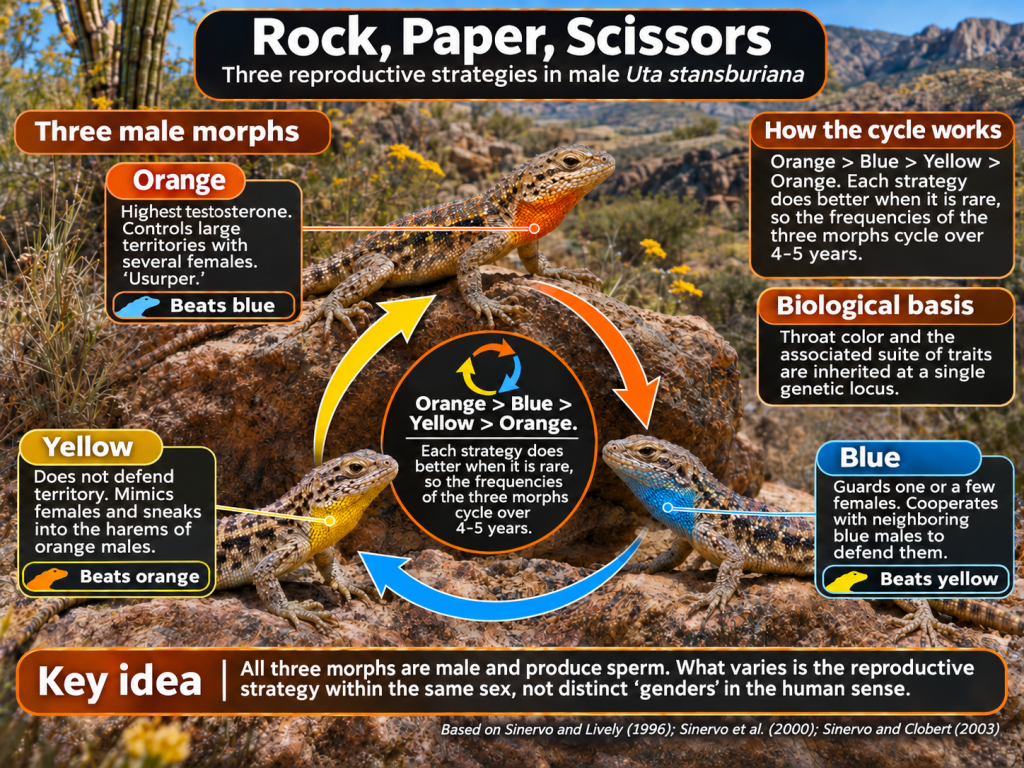
To Roughgarden, these lizards have genders: the case sits at the heart of the chapter Evolution’s Rainbow devotes to «multiple-gender families» [10, pp. 90–93]. Sinervo himself quipped that the blues were «the sensitive male lizards of the new millennium» [28]. Let us take the vocabulary seriously and see where it leads. If gender is a social role, the orange male embodies hegemonic masculinity, the blue is the deconstructed man, and the yellow, who passes himself off as a female to get in, is the group’s non-binary member, or, in the trailer’s own phrase, gender non-conforming. The orange male ought to be asked to check his privilege. But the orange male can check nothing: his role is written by an allele and a dose of testosterone, there is no script to rewrite and no norm to transgress, and no society of lizards rewards or punishes him for playing it. The vocabulary also carries a price the makers of Second Nature would rather not pay. If morphs are genders and genders are found in nature, then the dominant male is found in nature too, and any conservative may cite the orange lizard with exactly the same right Page claims in citing the clownfish. The documentary’s argument serves equally well to naturalise patriarchy.
The palette adds an irony of its own. Among these lizards, blue, the colour Western culture reserves for boys, is worn by the monogamous, cooperative, mate-guarding male; the dominant one dresses in orange, and the one who passes himself off as a female, in yellow. And the association of blue with boys is, for once, a social construction in the strict sense: until the early twentieth century there was no agreement on which colour belonged to which sex, and the pink-and-blue convention settled only around the middle of the century [29]. In the lizard, the colour of the throat is set by a gene; in the human, the colour of the layette is set by the shop. The first is biology and the second is gender, and the documentary moves from one to the other as though they were the same thing.
What the lizard actually shows is what the bluegill showed in the previous section. All three morphs are males and all three produce sperm; the variation lies within a sex and is sustained by selection that depends on each strategy’s frequency, not by any norm. Gender, in the sense the humanities give the word, has no business here. When the documentary takes the argument into nature, it invites the orange lizard to the debate, and the orange lizard has not come to vote for deconstruction.
5. Sex Change by Bereavement
The trailer assures us that many species, besides homosexuality and gender multiplicity, «illustrate sex transition» [7], and ABC chose the clownfish as its example [1]. It is worth looking at what actually happens to the fish. Species of the genus Amphiprion are protandrous hermaphrodites: every individual matures as a male, and the breeding male’s gonad is an ovotestis, a mature testis alongside immature ovarian tissue held in reserve [30]. When the anemone’s dominant female disappears, the male receives the social cue, the brain relays it down the hypothalamic–pituitary–gonadal axis, the testis degenerates, the ovarian tissue proliferates and, once the transition is complete, the animal lays eggs [2; 30]. The largest juvenile in the group then fills the vacancy and becomes the new breeding male [3]. The process runs in one direction only and is set off by someone else’s death; the fish decides nothing. If any animal has its sex settled for it by the group, it is this one.
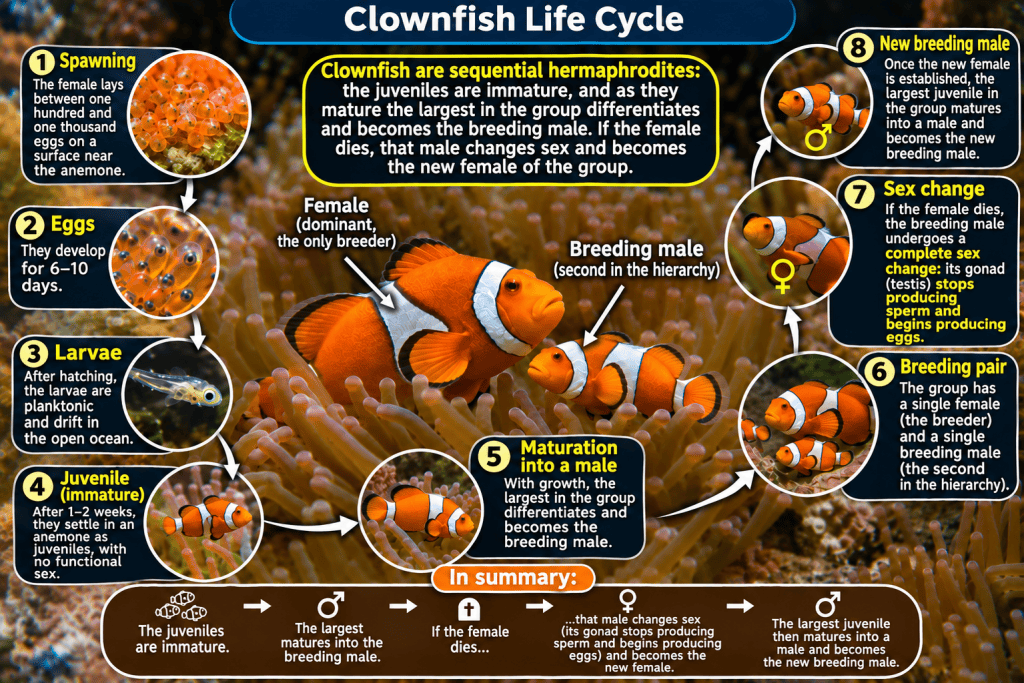
The film sees a transition where there is precisely its opposite. By its own scientist’s definition, a body’s sex is the size of the gametes it produces [23]. The clownfish changes exactly that: it stops producing sperm and begins producing eggs. Human transition alters hormones, secondary sexual characteristics and, with surgery, genital morphology, but no transitioned person produces the gamete of the other sex. Measured by Roughgarden’s yardstick, the fish changes sex and the human does not. Far from showing that human transition is found in nature, the clownfish shows what a change of sex would actually require, and that medicine cannot supply it.
Zoological distance makes the analogy worse. Hermaphroditism is a derived condition found in about 2 per cent of teleost fishes, scattered across more than twenty families [31]. Sex determination is labile in fishes and strikingly conservative in mammals and birds [32]. No mammal changes sex. Invoking the clownfish to understand a primate is rather like invoking the lizard’s tail, which grows back, to explain a prosthetic limb: in one case the body makes the organ anew, in the other technique imitates its shape.
The press most sympathetic to the film had grasped this nearly a decade ago. When Blue Planet II showed a female kobudai turning into a male in 2017, The Telegraph announced that a «transgender fish» had been filmed [33]. PinkNews, a British LGBT outlet, replied that same week with a piece whose title said, in substance, that some people seem to think fish can be transgender and that they cannot [34]. In 2026, after eleven years in production, Second Nature finds itself behind PinkNews in 2017.
6. Penguins Don’t Come Out
The trailer declares that «biologists now know sexuality is fluid» [7], and Page told ABC that science shows sexuality to lie on a wide spectrum [1]. Such sentences blur levels worth keeping apart: behaviour, which is what an animal does on a given occasion; orientation, which is the sex towards which desire is steadily directed; and identity, which is how a person names themselves and takes a place among others. The researchers the film enlists do not blur them. Monk and colleagues write «same-sex sexual behaviour» rather than «homosexuality» precisely to avoid confusing animal behaviour with the terms for human identities [8]. And Gómez cautioned that the behaviour his team analysed is so unlike the human kind that the study cannot explain human orientation [35].
In most species the behaviour is situational. Domestic rams display both phenomena at once. On the one hand, non-exclusive mounting between males that follows social rank or overcrowding. On the other, some 8 per cent of rams that prefer other males steadily and exclusively across repeated tests over two or three years, and that show a difference in the size of a hypothalamic nucleus organised before birth [36; 37]. This is the closest thing to an orientation known in any animal, and the literature treats it as exceptional. Laysan albatrosses show the other face. On Oahu, 31 per cent of nests are tended by pairs of females, but the colony is 59 per cent female because more females than males arrive, and the chicks of these pairs are fathered by males from other nests. The authors describe it as a cooperative strategy that emerges when males are scarce [38]. The documentaries of the genre tell it as a story of lesbian mothers. The paper tells the story of females who could not find a male.
This leads to the film’s central paradox. Among animals, «fluid» means facultative: a behaviour that comes and goes with circumstance. For decades, much of the public defence of homosexuals rested on the opposite, on the claim that orientation is stable and not reducible to occasion or circumstance. If human sexuality is fluid like the albatross’s, homosexuality becomes what happens when women are in short supply, which is precisely what those who regarded it as a vice of prisons and boarding schools always maintained. A documentary that claims to defend homosexuals ends by dissolving them into the conduct of a seabird short of males. And identity is nowhere to be found. No penguin names itself, joins a community or marches in a parade. Nor does it come out of the closet, since the closet presupposes a norm, a secret and a story about oneself, and penguins have none of these. Identity is a human, cultural category, the one territory where the tools of gender theory have anything to say. Among animals there is behaviour, seldom a stable preference, and never an identity.
7. Aesop at the Zoo
The genre to which Second Nature belongs works as Aesop did: it picks an animal, tells a scene and pins a human moral to it. To see what is lost along the way, it is enough to set each fable beside what the literature says.
Stable pairs of males that raise cygnets have been recorded in the Australian black swan [39; 4]. The fable tells a story of two dads. What is described is rather different: to obtain eggs, the male pair takes over the nest of a mixed pair, or forms a passing threesome with a female, mates with her and, once she has laid, drives her off the nest. If a moral must be drawn, it is one of surrogacy with the mother’s eviction thrown in, which is not quite the message of a Pride campaign.
Roy and Silo were two male chinstrap penguins at the Central Park Zoo who began courting in 1998 and went so far as to incubate a stone. Their keepers gave them another pair’s egg, they raised the chick, Tango, and the story reached The New York Times [40] before becoming a children’s book prized and banned in equal measure [41]. In 2005 Silo left Roy for Scrappy, a female newly arrived from SeaWorld [42]. The fable stopped short of that chapter. The full case shows what ethology says about pairing in captivity: with few options it accommodates itself to what is available, and changes when the supply changes. There is no orientation to defend here. There is a penguin who left with the first female to turn up.
Male red flour beetles, Tribolium castaneum, mount other males frequently and sometimes leave a spermatophore on them. When the hypotheses of dominance and rehearsal were put to the test, neither held. Indirect sperm transfer through the other male occurred in 7 per cent of pairs and accounted for less than 0.5 per cent of offspring, and the authors proposed that the male is simply disposing of old sperm [43]. A 2024 study found neither costs nor benefits, and put the behaviour down to males telling the sexes apart poorly and paying nothing for the mistake [44]. This beetle counts towards the 1,500 species with the same weight as the dolphin, and what it teaches is that sometimes it cannot tell the difference.
Whiptail lizards of the desert grasslands, Cnemidophorus uniparens, turn up in the press as «lesbian lizards». The species has no males: it arose from the hybridisation of two sexual species and reproduces by parthenogenesis, each female laying eggs that are clones of herself [45]. Even so, the females mount one another and adopt the full copulatory posture of the males of the ancestral species [46]. The casting is decided by the ovary. Before ovulation, with oestrogen high, a female allows herself to be mounted; after ovulation, with progesterone high, she does the mounting [47]. Each lizard plays male and female in turn as her cycle proceeds, and the one playing male performs the same function as the male of the species from which she descends: females that receive the pseudocopulation ovulate more often and sooner [45]. To call the members of an all-female species lesbians makes no sense, since there is no other sex against which one’s own could be a choice. And the scene leaves gender theory with an irony hard to swallow. The only case in nature of a sexual role performed without the sex to which it belongs is a choreography inherited from the males of ancestral species and set in motion by hormones. Not even in a species made entirely of females does the binary disappear: it survives as a script.
Among bonobos, females rub their genitals together very frequently, and males also have sexual contact with one another. Frans de Waal described this sex as a social currency: it eases tension when food appears, reconciles rivals after a fight and smooths entry into a new group [48]. Reading that as lesbianism is to mistake a handshake for a declaration of love.
The scenes are true and the morals are invented. The swan, the penguin, the beetle, the lizard and the bonobo do different things for different reasons, and ethology takes the trouble to tell them apart. The fable gathers them under a single word so that they all say the same thing, and to do so it must keep quiet about the part of the story that contradicts it.
8. The Other Half of the Catalogue
The trailer promises a diverse, joyful, inclusive nature from which we are to learn respect. Sustaining that picture requires some care over what is filmed, since animal sexual behaviour also includes coercion, which behavioural ecology has studied for decades as one reproductive strategy among others [49].
Bottlenose dolphins are stars of the genre. As early as 2001, a documentary on animal homosexuality noted that in some species, «most notably dolphins», same-sex pairs mate for life [50]. In Shark Bay, Western Australia, males form pairs and trios that may stay together for twenty years [51]. These alliances exist to capture a female in oestrus and keep her: the males chase her when she tries to escape, attack her and hold her under control for hours or weeks, and two alliances sometimes combine to take a female from a third [52]. The researchers themselves describe the behaviour with an unambiguous verb: the males cooperate to «sequester» females. The enduring male friendship the fable celebrates is, in good part, a partnership in abduction.
In Monterey Bay, between 2000 and 2002, nineteen cases were recorded of male sea otters dragging harbour seal pups into the water, gripping them by the head and penetrating them by force. Necropsies found vaginal and rectal perforations, several seals died, and the males went on copulating with the carcasses for up to seven days [53]. The bed bug, Cimex lectularius, does not even use the genital tract: the male pierces the female’s abdomen with a needle-like organ and injects sperm into her body cavity, and females pay for this mode of mating in wounds and infection [54]. Males mount any newly fed individual, other males included, who lack the protection females have evolved and are left scarred. In self-defence, the mounted male releases an alarm pheromone that the other reads as a sign he has mistaken the sex [55]. The bed bug qualifies, with every right, for the tally of species showing same-sex behaviour, and whoever includes it will have to explain what lesson in respect is to be drawn from a puncture by mistake.
In 1995, outside the Natural History Museum in Rotterdam, a male mallard flew into the glass and died. Another male copulated with the corpse for seventy-five minutes, and the museum’s curator documented it in a paper that went on to win an Ig Nobel Prize [56]. Technically, this too is same-sex behaviour. And there remains Levick’s pamphlet, which the genre displays as proof that science concealed the homosexuality of penguins. What Levick recorded at Cape Adare, and what the official reports left out, did include behaviour between males, but also necrophilia, sexual coercion and the sexual and physical abuse of chicks [18]. From that suppressed document, the genre has rescued only the part it could use.
None of this is an argument against homosexuals, nor one for rape. It is the documentary’s own argument, applied honestly. If nature teaches, it teaches all of this as well; and if we choose which lessons to accept and which to discard, the choice is made by a moral criterion that does not come from nature. The full catalogue contains no lesson in tolerance. Tolerance is supplied by whoever decides which half to show.
9. It’s Got to Be the Science
The trailer displays its method without the least embarrassment. A scientist explains how she resolved the conflict between what she had been taught and what she was finding: «I realized it can’t be the people who are defective, it’s got to be the science» [7]. The sentence has the form of an argument and the content of a decision taken in advance. First one settles which conclusion is morally acceptable; then one decides which evidence must be revised to reach it. Social psychology has a name for the procedure, motivated reasoning: whoever wishes to arrive at a conclusion scrutinises what contradicts it with rigour and what confirms it with indulgence [57]. The sentence also stages a false dilemma. The ethology that describes same-sex behaviour never pronounced anyone defective, since «defective» is a value judgement and the description of a behaviour passes none. The only ones who confuse the description of nature with a moral verdict are those who use nature as a court, and the documentary is among them.
Another voice in the trailer assures us that it knows of no species in which same-sex sex or gender non-conformity is taboo, «except when it comes to humans». This is true, and it proves nothing. A taboo is a cultural prohibition: it exists only where there are norms, which is why it exists only among humans. By the same token, no species has an incest taboo, although many avoid mating with kin through mechanisms that require no prohibition whatever [58]. As an argument, the sentence proves too much. No species forbids eating one’s own young either, and in many fish parents routinely consume part of their own clutch [59]. Nobody concludes from this that the human taboo against filial cannibalism is a prejudice awaiting revision.
The third sentence belongs to the director, on ABC [1]. She explained that she chose the nature-documentary format because such programmes usually teach us how the world is through a male voice that tells us how we came to be, and that this behaviour was always left out. She capped it with a joke: once again a man’s voice was needed to tell us how to think, and this time it was Page’s. The joke confesses more than it intends. The project leaves the authority of the voice-over perfectly intact and merely changes its owner. What that voice has come to do, by the director’s own account, is tell us how to think. A work of popular science shows what is known and lets the viewer draw conclusions. This one arrives with its conclusion ready-made and chooses whichever fish illustrate it best.
10. Hostages to the Penguin
There is a legitimate use of animals in this debate, and it should be conceded at the outset. Against anyone who claims, as a matter of fact, that same-sex sexual behaviour does not occur in nature, ethology supplies a counterexample. One species suffices; the other 1,499 are surplus. But this negative use reaches less far than the documentary supposes. The classical argument against homosexuality, that of Thomas Aquinas, calls the act «against nature» because it runs contrary to the natural end of the sexual act, generation, not because animals abstain from it [60]. The argument is teleological, not zoological, and no penguin lays a finger on it. Whoever wishes to contest it must do so on the ground of moral philosophy, where it is won or lost. Second Nature never leaves the zoo.
The positive use is another matter. That something occurs in nature does not make it good. Hume observed nearly three centuries ago that one cannot pass from «is» to «ought» without an argument in between [61, Book III, Part I, Section I], and Moore gave the confusion its name, the naturalistic fallacy [62]. The film supplies its own counterexamples. Patricia Brennan, one of its scientists, is known for showing that the shape of duck genitalia evolved through an arms race between males that copulate by force and females that defend themselves [63]. Were naturalness a moral credential, rape among ducks would carry the same credential as a pair of penguins. The documentary must decide which animals count as examples and which as mere zoology, and that criterion of selection is moral from the start. Nature does not provide it.
Staking legitimacy on animals, moreover, leaves it at the mercy of the data. Were a review tomorrow to lower the 1,500 species, or to confirm that among mammals the behaviour is recent and absent from the ancestors of the major lineages, as Gómez and colleagues already suggest [5], would homosexuals lose anything? Nothing, because their rights never depended on it. Bagemihl himself understood as much when he presented his book in 1999: one should not have to look to the animal world to decide what is normal [64]. The foundation lies elsewhere, in the principle that the conduct of consenting adults who harm no one else concerns themselves alone [65]. That principle needs no penguins, and would hold just as well in a world where no other animal resembled us.
Therein lies the harm. By placing the defence in the hands of zoology, Second Nature hands its opponents the ground on which they wish to fight, and throws in, free of charge, the errors it commits there: the gender of fish, the clownfish’s transition, the albatross’s «fluidity». Each can be refuted with a biology textbook, and each refutation carries off, unjustly, the credibility of the very people the film claims to represent. A homosexual has no need of a penguin for counsel, least of all one that lies about fish.
11. The Clownfish, Again
ABC asked whether we knew that clownfish can change sex, and the question can now be answered in full. They can. When the anemone’s dominant female dies, the breeding male stops producing sperm and begins producing eggs, deciding nothing and with no way back, and the largest juvenile in the group takes his place. No human being can do anything of the kind. That is the part of the answer Second Nature leaves out, since it spoils the moral.
The rest of the documentary follows the same procedure. It starts from facts nobody disputes, which have spent a quarter of a century in books and on screens, and presents them as a newly revealed secret. It uses «gender» in two incompatible senses and draws from the mixture the conclusion that the binary is a myth. It sees transition where there is hermaphroditism, orientation where there is behaviour of opportunity, and a lesbian couple where there are females who could not find a male. It picks the agreeable half of the catalogue and keeps quiet about the other. And it does so by the method its own scientist confessed before the camera: decide first what must be true, then revise the science until it agrees. That is called activism, however much it wears the clothes of zoology and the voice of an Oscar-nominated actor.
The gravest thing is that none of it was needed. An adult’s freedom to desire whom they desire, and to live in their body as they choose, does not depend on penguins doing likewise. It rests on a principle that owes nothing to nature and does not collapse if the next review lowers the count of species. Second Nature ties that freedom to a zoology of fables, and every time someone opens a biology textbook, the ridicule falls not on the director or the producers but on the people in whose name the film was made. The clownfish was widowed, Hollywood made him trans, and those of us who never needed a fish to know who we are are left to explain the difference.
References
- ABC News (22 April 2026). Perry Russom’s interview with Elliot Page and Drew Denny on Second Nature . YouTube. https://www.youtube.com/watch?v=k6n0-70Z9-8
- Fricke, H. and Fricke, S. (1977). Monogamy and sex change by aggressive dominance in coral reef fish. Nature, 266, 830–832. https://doi.org/10.1038/266830a0
- Buston, P. (2003). Size and growth modification in clownfish. Nature, 424, 145–146. https://doi.org/10.1038/424145a
- Bagemihl, B. (1999). Biological Exuberance: Animal Homosexuality and Natural Diversity. New York: St. Martin’s Press.
- Gómez, J. M., González-Megías, A. and Verdú, M. (2023). The evolution of same-sex sexual behaviour in mammals. Nature Communications, 14. https://doi.org/10.1038/s41467-023-41290-x
- Second Nature: Gender and Sexuality in the Animal World (2026). Film listing (director, producers, release). Moviefone. https://www.moviefone.com/movie/second-nature/p9A1QlA4iLyqldyk7V21S6/main/
- Second Nature (2026). Official trailer . YouTube channel «Second Nature».
- Monk, J. D., Giglio, E., Kamath, A., Lambert, M. R. and McDonough, C. E. (2019). An alternative hypothesis for the evolution of same-sex sexual behaviour in animals. Nature Ecology & Evolution, 3, 1622–1631. https://doi.org/10.1038/s41559-019-1064-2
- Bailey, N. W. and Zuk, M. (2009). Same-sex sexual behavior and evolution. Trends in Ecology & Evolution, 24(8), 439–446. https://doi.org/10.1016/j.tree.2009.03.014
- Roughgarden, J. (2004). Evolution’s Rainbow: Diversity, Gender, and Sexuality in Nature and People. Berkeley: University of California Press.
- Loyer, B., Menendez, J. and Alexandresco, S. (dirs.) (2001). Animal Homosexuality / Out in Nature: Homosexual Behaviour in the Animal Kingdom [documentary]. Saint Thomas Productions.
- Littleboy, H. (dir.) (2002). The Truth About Gay Animals [documentary]. Presented by Scott Capurro. United Kingdom.
- National Geographic (2004). Girl Power [documentary], Ultimate Explorer. Correspondent: Mireya Mayor.
- BBC (2017). Blue Planet II, episode 1, «One Ocean» [documentary series]. Narrated by David Attenborough. Produced by Jonathan Smith.
- Watkins, E. (dir.) (2024). Queer Planet [documentary]. Executive producer Martha Holmes; narrated by Andrew Rannells. Peacock. Released 6 June 2024.
- Handful of Films / CBC (2025). Animal Pride [documentary], The Nature of Things. Directed by Rio Mitchell; presented by Connel Bradwell. Broadcast 28 May 2025.
- Associated Press (10 July 2003). Studies show clownfish change size, sex when group is disrupted. Southeast Missourian. https://www.semissourian.com/news/studies-show-clownfish-change-size-sex-when-group-is-disrupted-113878
- Russell, D. G. D., Sladen, W. J. L. and Ainley, D. G. (2012). Dr. George Murray Levick (1876–1956): unpublished notes on the sexual habits of the Adélie penguin. Polar Record, 48(4), 387–393. https://doi.org/10.1017/S0032247412000216
- Mills, B. (2013). The animals went in two by two: Heteronormativity in television wildlife documentaries. European Journal of Cultural Studies, 16(1), 100–114. https://doi.org/10.1177/1367549412457480
- Oakley, A. (1972). Sex, Gender and Society. London: Temple Smith.
- Butler, J. (1990). Gender Trouble: Feminism and the Subversion of Identity. New York: Routledge.
- Whiten, A., Goodall, J., McGrew, W. C., Nishida, T., Reynolds, V., Sugiyama, Y., Tutin, C. E. G., Wrangham, R. W. and Boesch, C. (1999). Cultures in chimpanzees. Nature, 399, 682–685. https://doi.org/10.1038/21415
- Roughgarden, J. (2004). Evolution and the embodiment of gender. GLQ: A Journal of Lesbian and Gay Studies, 10(2), 287–291.
- Gross, M. R. (1996). Alternative reproductive strategies and tactics: diversity within sexes. Trends in Ecology & Evolution, 11(2), 92–98. https://doi.org/10.1016/0169-5347(96)81050-0
- Sinervo, B. and Lively, C. M. (1996). The rock–paper–scissors game and the evolution of alternative male strategies. Nature, 380, 240–243. https://doi.org/10.1038/380240a0
- Sinervo, B., Miles, D. B., Frankino, W. A., Klukowski, M. and DeNardo, D. F. (2000). Testosterone, endurance, and Darwinian fitness: natural and sexual selection on the physiological bases of alternative male behaviors in side-blotched lizards. Hormones and Behavior, 38(4), 222–233.
- Sinervo, B. and Clobert, J. (2003). Morphs, dispersal behavior, genetic similarity, and the evolution of cooperation. Science, 300(5627), 1949–1951.
- UC Santa Cruz (June 2003). Cooperation between unrelated male lizards adds a new wrinkle to evolutionary theory [press release]. https://news.ucsc.edu/2003/06/cooperation-between-unrelated-male-lizards-adds-a-new-wrinkle-to-evolutionary-theory/
- Paoletti, J. B. (2012). Pink and Blue: Telling the Boys from the Girls in America. Bloomington: Indiana University Press.
- Casas, L., Saborido-Rey, F., Ryu, T., Michell, C., Ravasi, T. and Irigoien, X. (2016). Sex change in clownfish: molecular insights from transcriptome analysis. Scientific Reports, 6, 35461. https://doi.org/10.1038/srep35461
- Avise, J. C. and Mank, J. E. (2009). Evolutionary perspectives on hermaphroditism in fishes. Sexual Development, 3(2–3), 152–163. https://doi.org/10.1159/000223079
- Mank, J. E., Promislow, D. E. L. and Avise, J. C. (2006). Evolution of alternative sex-determining mechanisms in teleost fishes. Biological Journal of the Linnean Society, 87(1), 83–93. https://doi.org/10.1111/j.1095-8312.2006.00558.x
- Knapton, S. (October 2017). Transgender fish filmed changing sex for BBC’s Blue Planet II. The Telegraph.
- PinkNews (27 October 2017). Some people seem to think that fish can be transgender (they can’t). https://thepinknews.com/2017/10/27/some-people-seem-to-think-that-fish-can-be-transgender-they-cant
- Zimmer, C. (3 October 2023). Same-sex behavior evolved in many mammals to reduce conflict, study suggests. The New York Times. https://carlzimmer.com/same-sex-behavior-evolved-in-many-mammals-to-reduce-conflict-study-suggests/
- Roselli, C. E., Larkin, K., Resko, J. A., Stellflug, J. N. and Stormshak, F. (2004). The volume of a sexually dimorphic nucleus in the ovine medial preoptic area/anterior hypothalamus varies with sexual partner preference. Endocrinology, 145(2), 478–483. https://doi.org/10.1210/en.2003-1098
- Roselli, C. E. and Stormshak, F. (2009). The neurobiology of sexual partner preferences in rams. Hormones and Behavior, 55(5), 611–620.
- Young, L. C., Zaun, B. J. and VanderWerf, E. A. (2008). Successful same-sex pairing in Laysan albatross. Biology Letters, 4(4), 323–325. https://doi.org/10.1098/rsbl.2008.0191
- Braithwaite, L. W. (1981). Ecological studies of the black swan. III. Behaviour and social organization. Australian Wildlife Research, 8(1), 135–146.
- Smith, D. (7 February 2004). Love that dare not squeak its name. The New York Times.
- Richardson, J. and Parnell, P. (2005). And Tango Makes Three. New York: Simon & Schuster.
- Miller, J. (24 September 2005). New love breaks up a 6-year relationship at the zoo. The New York Times. https://www.nytimes.com/2005/09/24/nyregion/24penguins.html
- Levan, K. E., Fedina, T. Y. and Lewis, S. M. (2009). Testing multiple hypotheses for the maintenance of male homosexual copulatory behaviour in flour beetles. Journal of Evolutionary Biology, 22(1), 60–70. https://doi.org/10.1111/j.1420-9101.2008.01616.x
- Martens, B. M., Martin, O. Y., Janicke, T. and Winkler, L. (2024). No fitness effects of same-sex copulations in male red flour beetles. Ecology and Evolution, 14(3), e11027. https://doi.org/10.1002/ece3.11027
- Crews, D., Grassman, M. and Lindzey, J. (1986). Behavioral facilitation of reproduction in sexual and unisexual whiptail lizards. Proceedings of the National Academy of Sciences, 83(24), 9547–9550. https://pmc.ncbi.nlm.nih.gov/articles/PMC387177
- Crews, D. and Fitzgerald, K. T. (1980). «Sexual» behavior in parthenogenetic lizards (Cnemidophorus). Proceedings of the National Academy of Sciences, 77(1), 499–502.
- Crews, D. (2005). Evolution of neuroendocrine mechanisms that regulate sexual behavior. Trends in Endocrinology & Metabolism, 16(8), 354–361.
- de Waal, F. B. M. (1995). Bonobo sex and society. Scientific American, 272(3), 82–88.
- Clutton-Brock, T. H. and Parker, G. A. (1995). Sexual coercion in animal societies. Animal Behaviour, 49(5), 1345–1365.
- Saint Thomas Productions (n.d.). Animals Like Us: Animal Homosexuality [programme page]. https://saint-thomas.net/programs/animals-like-us-animal-homosexuality/
- Connor, R. C. and Krützen, M. (2015). Male dolphin alliances in Shark Bay: changing perspectives in a 30-year study. Animal Behaviour, 103, 223–235. https://doi.org/10.1016/j.anbehav.2015.02.019
- Connor, R. C., Smolker, R. A. and Richards, A. F. (1992). Two levels of alliance formation among male bottlenose dolphins (Tursiops sp.). Proceedings of the National Academy of Sciences, 89(3), 987–990. https://pmc.ncbi.nlm.nih.gov/articles/PMC48370
- Harris, H. S., Oates, S. C., Staedler, M. M., Tinker, M. T., Jessup, D. A., Harvey, J. T. and Miller, M. A. (2010). Lesions and behavior associated with forced copulation of juvenile Pacific harbor seals (Phoca vitulina richardsi) by southern sea otters (Enhydra lutris nereis). Aquatic Mammals, 36(4), 331–341. https://doi.org/10.1578/AM.36.4.2010.331
- Stutt, A. D. and Siva-Jothy, M. T. (2001). Traumatic insemination and sexual conflict in the bed bug Cimex lectularius. Proceedings of the National Academy of Sciences, 98(10), 5683–5687.
- Ryne, C. (2009). Homosexual interactions in bed bugs: alarm pheromones as male recognition signals. Animal Behaviour, 78(6), 1471–1475. https://doi.org/10.1016/j.anbehav.2009.09.033
- Moeliker, C. W. (2001). The first case of homosexual necrophilia in the mallard Anas platyrhynchos (Aves: Anatidae). Deinsea, 8, 243–248. https://natuurtijdschriften.nl/pub/538662
- Kunda, Z. (1990). The case for motivated reasoning. Psychological Bulletin, 108(3), 480–498. https://doi.org/10.1037/0033-2909.108.3.480
- Pusey, A. and Wolf, M. (1996). Inbreeding avoidance in animals. Trends in Ecology & Evolution, 11(5), 201–206.
- Manica, A. (2002). Filial cannibalism in teleost fish. Biological Reviews, 77(2), 261–277.
- Thomas Aquinas. Summa Theologiae, II-II, q. 154, aa. 11–12.
- Hume, D. (1978). A Treatise of Human Nature (L. A. Selby-Bigge and P. H. Nidditch, eds.). Oxford: Clarendon Press. (Originally published 1739–1740.)
- Moore, G. E. (1903). Principia Ethica. Cambridge: Cambridge University Press.
- Brennan, P. L. R., Prum, R. O., McCracken, K. G., Sorenson, M. D., Wilson, R. E. and Birkhead, T. R. (2007). Coevolution of male and female genital morphology in waterfowl. PLoS ONE, 2(5), e418. https://doi.org/10.1371/journal.pone.0000418
- Time (1999). The gay side of nature. https://time.com/archive/6735212/the-gay-side-of-nature
- Mill, J. S. (1859). On Liberty. London: John W. Parker and Son.


Deja una respuesta