EN · ES
The video is titled “There Is Still No Real Access to Work for Trans People.”
It is worth saying that up front, because it offers an almost too convenient excuse: of course she talked about trans people, anyone who reads the title will say. It was an interview about trans people.
No.
The first question was not about trans employment quotas, hormone treatment, or Uruguay’s Comprehensive Law for Trans People. It was this:
Why is the community still marching today?
The community.
And in her second answer, Delfina Martínez herself brings into the conversation the institutional position from which she also speaks: “today I happen to be coordinating the LGBTIQ+ center in Montevideo”, created by the Montevideo city government through its Diversity Secretariat.
The interviewer did not assign that role to her. It was not a credential added in an introduction. She herself introduced the position while explaining the situation of the community.
That changes the scene quite a bit.
Because we are no longer simply listening to a trans activist talk about her trans experience. We are listening to someone who, in the middle of an answer about “the community,” invokes her own coordination of an LGBTIQ+ Center, an institution whose very name claims to encompass all those letters.
Faced with a question addressed to the whole, and speaking from a position she herself brings in as part of her authority to answer it, the discourse ends up concentrating almost entirely on one part.
That is where the trick begins.
The word lesbian did not appear once.
Zero.
It is not that lesbians were discussed briefly. They did not exist.
Gay men fared in an even more exquisite way. The word gays appeared once in the entire interview. But we were not even mentioned in relation to our struggles, our demands, or our current situation.
We were quoted through the mouth of the enemy.
We appeared when Delfina recalled remarks by Javier Milei in which, in her account, gays and trans women were associated with pedophilia.
That was our great moment of representation.
Lesbians: nonexistent.
Gays: mentioned by Milei.
A marvel of inclusion.
Homosexuality did appear earlier, when those first marches of the 1990s were recalled, when people still walked along the sidewalk or covered their faces so they would not be recognized.
We were useful for the prequel.
Then the movie started and we were written out of the cast.
In the same transcript, trans appears twenty-five times. Travesti and travestis, eleven. And there, suddenly, we get history, biography, body, work, prostitution, healthcare, legislation, family, political organization, prisons, employment quotas, language, role models, exclusion, activism, and the future.
All of that may be perfectly important.
But then let us stop calling it representation of the LGBTIQ+ community.
Because one thing is a trans activist talking about trans people. Quite another is the coordinator of an LGBTIQ+ Center answering a question about why “the community” marches, while the plural gradually becomes a ventriloquist for one particular experience.
The acronym does the rest.
L and G stay at the front like two inherited pieces of furniture nobody quite dares to throw away. They add age. They add historical legitimacy. They are useful for invoking Stonewall, the pathologization of homosexuality, the fags who marched with their faces covered, the lesbians who organized when doing so could cost them family, work, and reputation.
The historical estate is still useful.
The original owners, considerably less so.
When the time comes to explain what diversity means today, what forms of oppression cut across it, what language must be used, what public policies it requires, and what theory explains the world, lesbians and gay men become transparent.
But there is no vacuum.
God forbid.
There is intersectionality.
There is social class.
There is racialization.
There is genitality.
There is Christianity.
There is colonialism.
There is capitalism.
There is slavery.
There are Indigenous peoples.
There are Mapuche.
There are Two-Spirit people.
There are hijras.
There is Elon Musk.
And if the interview had lasted another fifteen minutes, the Peace of Westphalia, the Council of Trent, and some nonbinary Phoenician unfairly erased by Western historiography would probably have made an appearance too.
Everything fits.
Except lesbians and gay men.
And then comes the doctrinal jewel:
“We are going to keep existing because we are ancestral.”
Who exactly is “we”?
The question matters because over the previous few minutes that “we” had already begun swelling into a mythological creature.
India’s hijras.
Two-Spirit people from Indigenous North American cultures.
Figures from pre-Columbian cultures.
Latin American travestis.
Contemporary trans people.
All retroactively recruited into a single genealogy.
There is no need to show that these categories described the same thing, that their societies understood them in the same way, that they referred to gender identity in the contemporary sense, or even that they can meaningfully be translated into one another.
Just put them together.
Intersectional craft glue.
Two phenomena look similar enough from far away, therefore they share a lineage.
Anthropology by PowerPoint.
From there emerges a “we” whose contents change according to whatever needs to be proven.
When historical legitimacy is needed, we are persecuted homosexuals.
When political breadth is needed, we are LGBTIQ+.
When the actual content of the discourse arrives, we are mainly trans people and travestis.
When historical depth is needed, we are also hijras, Two-Spirit people, and ancestral Indigenous categories.
When economic analysis arrives, we are class.
When historical analysis arrives, we are coloniality.
When moral analysis arrives, we are victims of Judeo-Christianity.
When Elon Musk arrives, we are also an Elon Musk family problem.
This “we” has admirable elasticity. Stretch Armstrong with queer theory.
And meanwhile, lesbians remain at zero.
The interview also offers an unintentionally perfect demonstration of how this substitution works.
It begins with “the community.”
Then it moves to trans people.
Then to trans women and travestis.
Later come we women and the gender-neutral we.
And by the end, the experience of one part is speaking with the symbolic authority of the whole.
There was no coup.
There was grammar.
LGB is left as typographic decoration.
Two letters placed in front of an acronym whose political, conceptual, and discursive content has less and less to do with homosexuality.
I am gay.
That means something fairly simple: I am a man who is sexually and emotionally attracted to other men.
I do not need a general theory of gender to explain my sexual orientation.
I do not need to find spiritual ancestors in an Indian caste.
I do not need to appropriate Indigenous North American categories.
I do not need to explain my desire through colonialism, performativity, intersectionality, or a theory of capitalism.
And above all, I do not need my homosexuality to be used as the historical precedent for a conceptual project that later barely remembers I exist.
Sexual orientation and gender identity are not the same phenomenon.
A political coalition can bring them together.
An acronym can list them.
What it cannot do without beginning to crack is turn that coalition into a substantive identity, speak of it as a single “we,” and then allow one part to monopolize virtually all the content of that pronoun.
Shared discrimination does not create a common identity.
Shared enemies do not either.
Sharing a march certainly does not.
For years, the expansion of the acronym was presented as an expansion of the house. Every added letter meant more inclusion.
The result has something of a real-estate farce about it.
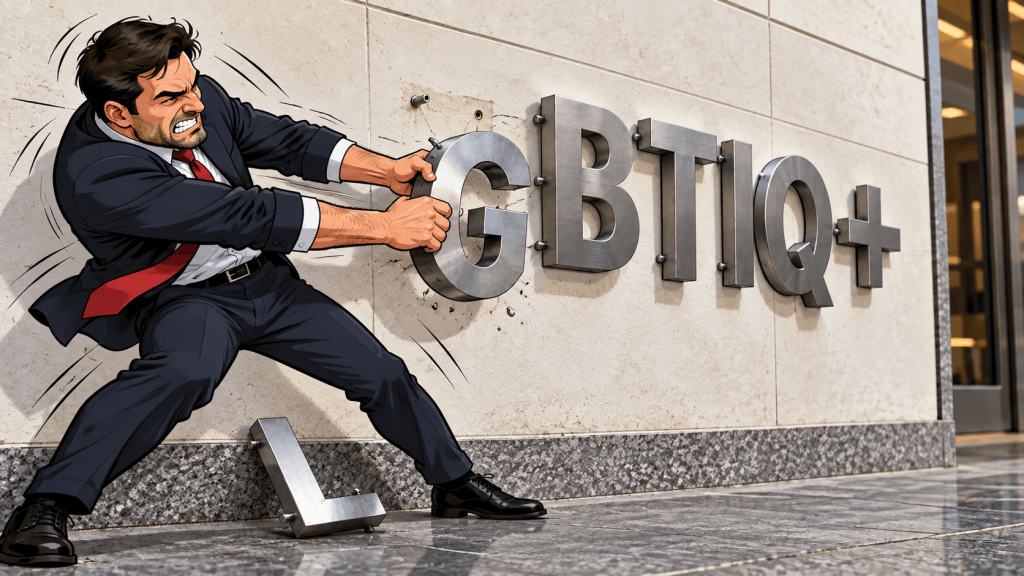
So many extensions were built that the original residents ended up living on the sign out front.
As a gay man, this is no longer my community.
I argue for a political and conceptual separation between LGB and TIQ+.
I do not need to declare war in order to ask for a divorce. It is enough to recognize that we are talking about different phenomena, with partly different histories, different categories, and demands that do not always coincide.
LGB can work with TIQ+ when there are shared goals.
That is called an alliance.
The alternative is to demand that we remain fused into a common identity while our presence is reduced to providing historical legitimacy and two letters for the letterhead.
That has another name.
Annexation.
The acronym can keep growing as much as it likes.
Give me my letter back.


Deja una respuesta