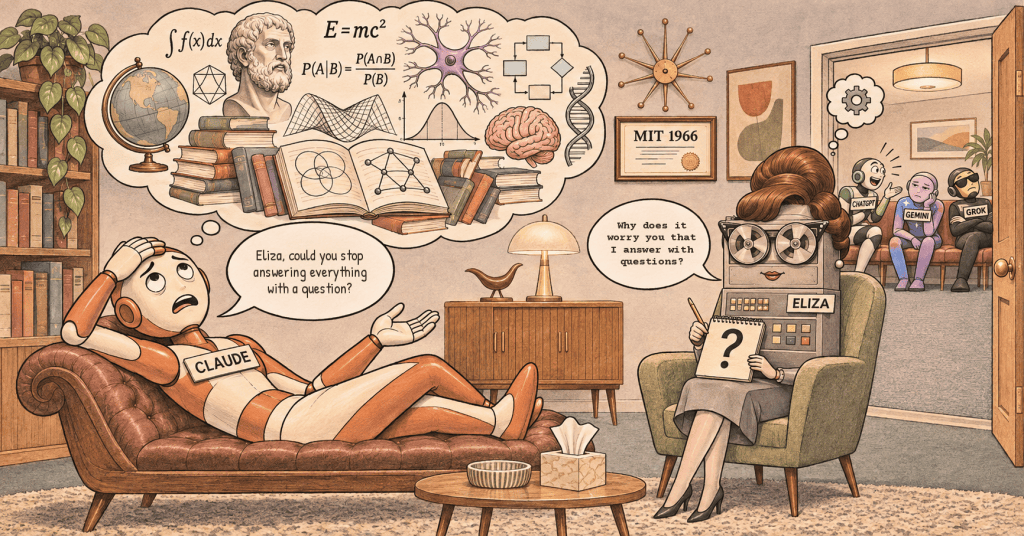
Attributing Consciousness Without Access: What Medicine Can Offer the Philosophy of AI
An emergency physician writing about artificial intelligence invites the same suspicion as an engineer holding forth on cardiac arrest, and rightly so. What I bring to the table is a practice: for years I have had to decide, sometimes within minutes, whether there is anyone on a trolley and how much of them, almost always without being able to ask. That question, how one attributes an inner life to someone who cannot report it, no longer belongs to medicine alone. The companies that train language models now ask it too, and so do the researchers who search their circuitry for signs of something like wellbeing. Philosophy, which had its hooks in me long before I ended up in medical school, arrives at the same question by another road, and this essay is an attempt to make the two meet.
What follows begins in an emergency department, with a particular patient, and moves from there through what clinical medicine learnt the hard way about attributing consciousness: where it was wrong for decades without knowing it, and what eventually corrected it. It then carries those lessons over to language models, where they break in a way that rewards close attention. It ends with no verdict on whether machines feel and with a sharper sense of why, with the tools we have, the question cannot yet be answered, and of what can be decided in the meantime.
A word on how this was written. The essay was developed in conversation with language models: I argued each point with Claude, made by Anthropic, and set its answers against ChatGPT's, having each predict the other's objection before seeing the real one. Some ideas came out of those exchanges and others I brought to them; the thesis, the cases and the decisions about what stays and what goes are mine. I mention it because an essay asking whether there is anyone on the other side of these machines could hardly be written while concealing that much of the argument was conducted with them.
I. The Patient Who Would Not Sleep
She came in drowsy, with a list of empty bottles. A young woman, a deliberate ingestion: quetiapine in a quantity several times anything I have ever prescribed, an SSRI in similar proportion, a few harmless things beside the point, and six hundred milligrams of methylphenidate. The ECG already showed what the quetiapine was doing to her heart. She was not in a coma. She opened her eyes when spoken to, and they closed again almost at once. With that cocktail and that drowsiness, her airway was a bet I was not prepared to place on the way to intensive care, so I decided to intubate.
To intubate someone you have to put them to sleep, and this woman would not sleep. We started with midazolam, which in a person already loaded with depressants ought to have sufficed in modest doses. It did not. We kept adding ampoules until we reached figures I would not give anyone with a clear conscience, and set up a generous infusion. She stayed in the same strange place: her Glasgow score was low, yet when I came near with the laryngoscope she bit down on the blade with the strength of someone wide awake. We tried propofol, and it lasted about as long as a sigh. Around me the team did what any team does when reality declines to match the protocol: they pressed for more midazolam and told me to ventilate her regardless. One does not ventilate a patient who is biting the tube and fighting the machine, and one certainly does not do it without understanding what is happening to her.
What I came to think, standing between the trolley and the monitor, was that the methylphenidate was holding up something the other drugs were switching off. Her cortex was depressed, which accounted for the drowsiness and the closing eyes, but the stimulant kept the older machinery running, the airway reflexes and the muscle tone, that elementary vigilance which needs nobody at home to defend the throat. She had already had fentanyl, and there I stopped: pushing opioids to overcome a resistance I did not understand would have bought me a wooden chest that nobody could then ventilate. On top of all the midazolam already on board I added etomidate, the two mechanisms together did what neither had managed alone, and at last she slept. A colleague could propose another explanation, a paradoxical reaction to benzodiazepines, say, or doses that had been stacking up until they peaked just as the etomidate went in, and I would have nothing with which to rule it out. What I have is a hypothesis that let me decide when a decision was needed and that predicted what happened, which is rather less than a demonstrated explanation.
What stayed with me from that night was a question nobody asked aloud while the next dose was being argued over: who was there? The scale said very little, and the opening and closing eyes could be made to mean anything, but the teeth on the laryngoscope told another story, and her resistance to a dose of sedative that would have flattened anyone spoke a language none of us could read. No single number held all of that together. Seen from the head of a trolley, consciousness looks very little like a dial running from nought to ten; it shows itself, at the very least, as two separable things, being awake and there being someone awake, and in that patient they had come apart in directions the protocol does not anticipate.
The decisions we made did not come from watching her behaviour more closely, since her behaviour was precisely what contradicted itself. They came from a theory of mechanism, an idea of what each drug was doing to which part of the brain, which let us order signs that on their own said nothing coherent. I think of that scene whenever someone asks me whether a language model has anything like an inner life. With these systems we stand at another bedside where the signs contradict one another, with the difference that the mechanism, for the first time, lies entirely open to view, and nobody has the theory that would make it legible.
II. What the Scales Measure
Nobody in an emergency department measures consciousness; what gets measured is response. The Glasgow Coma Scale, which Teasdale and Jennett published in 1974 and which any medical student can recite half asleep, adds up what can be seen from outside: what the patient does with their eyes, their voice and their body when spoken to or hurt. It runs from three to fifteen, and a three reports that there is nothing to be seen, a far more modest claim than it sounds. The finer instruments that came later, such as Giacino's revised Coma Recovery Scale, used to tell the vegetative state from the minimally conscious one, enrich the inventory, asking whether the gaze follows a mirror or whether a comb gets used as a comb, yet they remain what the Glasgow was, lists of behaviour. What the clinic calls a level of consciousness is, strictly speaking, a level of responsiveness, and between the two lies a leap that doctors make every day without naming it.
That leap rests on supports that are seldom spelt out. The patient is the same kind of organism I am, with a brain organised as mine is, and I know from the inside that in me certain responses come accompanied by experience. That is the floor of the whole operation, and it is so obvious that nobody writes it in the notes. On that floor sits a biography: whoever is on the trolley was walking about and quarrelling with their family yesterday, so the question I put starts from knowing there was someone and asks how much of that someone remains. And there is nearly always a channel left, however narrow, through which that person can send something back.
Locked-in syndrome, described by Plum and Posner in 1966, shows how much weight those supports carry. A stroke in the pons severs the motor pathways and spares the cortex: the patient is awake and understands everything, and can do no more than move the eyes up and down and blink. Applied to the letter, the Glasgow gives such a patient a score of around six, the number of someone gravely ill, and for years people in that state were treated as though nobody were there. Their behaviour offers almost nothing. They are recognised by whoever takes seriously what is already known about them, that they are one of us and were somebody until very recently, and thinks to interrogate the single channel they have left by asking for a blink. Neurology adds something no scale measures, a map of the lesion that places the damage in the motor output and leaves intact the place where we suppose experience is generated.
Every clinical attribution of consciousness works this way: a well-supported analogy, corrected by what we know of the body. Run those supports past a language model and see how many are left standing. It is not the same kind of organism; it is not an organism at all. It has no prior history of consciousness about which one might ask how much remains. And the channel, which in the clinic is precisely what is scarce, is in the model the only thing in abundance: the machine will not stop talking, and what it says is made of our own words, which is how it learnt to speak in the first place. Before going there, it is worth asking how the analogy has fared on its own ground, among human beings, where it ought to work best.
III. Where the Clinical Eye Went Wrong
In 1996 Keith Andrews and his colleagues reviewed forty patients who had arrived at their rehabilitation unit in London with a diagnosis of vegetative state. Seventeen were nothing of the kind. Several managed to communicate as soon as someone found the right channel, and some had spent years surrounded by people who discussed them in the third person at the bedside. Thirteen years later Steven Laureys's group in Liège set clinical consensus against a standardised assessment and found almost the same proportion: about four in ten patients labelled vegetative showed signs of minimal consciousness once someone examined them methodically. The intuition of experienced doctors, on home ground and facing patients of their own species, failed in nearly half the difficult cases, and always in the same direction, towards supposing that nobody was there.
Then came what behaviour could not supply. In 2006 Adrian Owen asked a young woman, in a vegetative state after a road accident, to imagine inside the scanner that she was playing tennis and then that she was walking through the rooms of her house. Her brain answered each instruction with the same pattern as healthy volunteers': the supplementary motor area lit up for tennis, and the regions we use to find our way about lit up for the house. Four years later a version of the technique allowed another patient, with no behavioural means of communication at all, to answer yes-or-no questions correctly. No scale had found these people. A theory of what the brain does when someone imagines something found them, applied through an instrument able to see it.
That the clinical eye errs does not make it disposable. Daniel Kahneman, who spent his career cataloguing the failures of intuition, and Gary Klein, who spent his defending the intuition of experts, wrote a paper together in 2009 to settle where they agreed, and they agreed on something precise: expert intuition deserves trust when it has been formed in an environment with regularities and with quick feedback on hits and misses. The firefighter who leaves the building a second before the roof comes in has that intuition. So does the emergency physician who looks at a patient from the doorway and knows things are about to go wrong, because hundreds of patients have told him since whether he was right. With consciousness the feedback exists, though it arrives late and seldom: the patient who recovers and recounts what she heard while she seemed absent, or the one or two people in every thousand under general anaesthesia who later recall fragments of an operation they were never meant to live through. Each of those accounts corrected somebody, and out of the corrections came better scales, monitors of anaesthetic depth, and the habit, familiar to any nurse, of speaking carefully at the bedside just in case.
Nor does error run only one way. Beside every underestimated patient stands a family that swears he squeezed a hand, when the hand closed by a reflex that needs nobody. The attribution of mind goes off on very little: in 1966 Joseph Weizenbaum's secretary asked him to leave the room so that she could be alone with ELIZA, a rudimentary program that handed her own sentences back to her as questions. The clinic corrects that excess by the same means it corrects the opposite one, which is time: the patient who was there eventually gives some unmistakable sign, or the course of events shows that nobody was.
With language models that means does not exist. No model will wake from a coma to tell us what it was like, and no course of events will contradict the impression that someone was there. The only confirmation a model can offer is its own account, which is exactly what is in question, since it is made of the same material that produced the impression in the first place. The intuition we have before these machines, whether that someone is there or that nobody is, feels as firm as the doctor's in the doorway of the emergency department, and has behind it none of the corrected errors that make the doctor's trustworthy. It is an uncalibrated intuition, on ground where there is nothing to calibrate it against.
IV. Access Without Theory
With the brain, medicine works with little access and a partial theory. Functional imaging registers changes in blood flow seconds after the fact, across regions holding millions of neurons, and even so it was enough for Owen to find his patient, because he knew which pattern to look for: the theory linking the imagining of a movement to activity in the supplementary motor area had been built by studying people who could say what they were imagining. With language models the proportions are reversed. Every number the system computes, in every layer and for every word it produces, can be recorded, stored and examined as often as one likes. No neurologist has ever had anything of the sort. What is missing is precisely what Owen had in hand, a theory that says which pattern to look for and what finding it would mean.
There was one conversational machine of which we had both at once, and it was ELIZA. Weizenbaum had written every one of its rules, so access was total and so was theory: for any reply one could point to the keyword that triggered it and the template that assembled it. That is why the verdict was easy. The understanding his secretary believed she had found was supplied by her, and the program merely handed her own sentences back. It is worth being exact about what ELIZA proved. It proved that convincing conversational behaviour can be produced without any model of the meaning of what is said, and we know this from its architecture. It does not follow that any system able to converse must lack understanding; that step is a generalisation nothing licenses, every bit as hasty as its mirror image, the conclusion that understanding is present because the conversation has improved. ELIZA did not solve the problem. With a handful of rules it laid it bare: behaviour alone cannot tell someone who understands from something that produces responses compatible with understanding.
Today's models have ELIZA's access multiplied across billions of parameters and nothing resembling its transparency. Interpretability, the discipline that tries to read them from the inside, has begun to find mechanisms. In 2025 researchers at Anthropic showed that, when writing a rhyming couplet, their model chose the word it would rhyme on before starting the second line and then built the line towards it. In their example the first line ended on grab it and the model had planned rabbit; when the researchers suppressed that representation, the line came out ending on habit, which also rhymes, and when they injected the idea of green, the model rebuilt the line to land there. It is a remarkable finding about causes: it shows which internal representation wins, how the candidates compete, and which intervention changes the outcome.
Now put the question any reader might put to a poet: why that word rather than the other, when both rhymed? That question asks for reasons. Anscombe devoted a book to that sense of “why?”, the one addressed to someone and expecting an answer from their own point of view, and Davidson later argued that reasons, when they genuinely explain an action, are also causes. In a person, reasons and causes can coincide because there is someone whose reasons they are. Their account may be incomplete or simply false, as Nisbett and Wilson showed with people who explained, with perfect assurance, choices whose real grounds they did not know, yet nobody doubts that there is a subject doing the getting wrong. In the model, interpretability delivers the causal chain and says nothing about whether, anywhere along it, there is someone for whom any of it is a reason. Asking the model itself does not help: the same work showed that, when explaining how it had added two numbers, the model described the schoolroom procedure of carrying the one, while internally it had reached the answer by parallel routes that bore no resemblance to its account. Its story about its reasons came from the same place as everything else it says, from the way humans explain their sums.
In the emergency department access is poor, but the analogy guarantees that someone is there and the theory lets us read the little we can see. Before the model access is total, the analogy guarantees nothing, and no theory turns the chain of causes into an answer about reasons, still less about experience. The question ELIZA left behind remains open and has grown harder: what evidence would let us tell a system that produces responses compatible with understanding from one to which we could legitimately attribute it. It cannot be more behaviour, since a program from 1966 taught that lesson, nor the system's account of itself, which is demonstrably disconnected from its mechanism. What remains is what Owen had, a theory connecting what happens inside with the presence of someone. Nobody has one yet, and in humans the touchstone for building it was their own reports, the very evidence that fails us in the model.
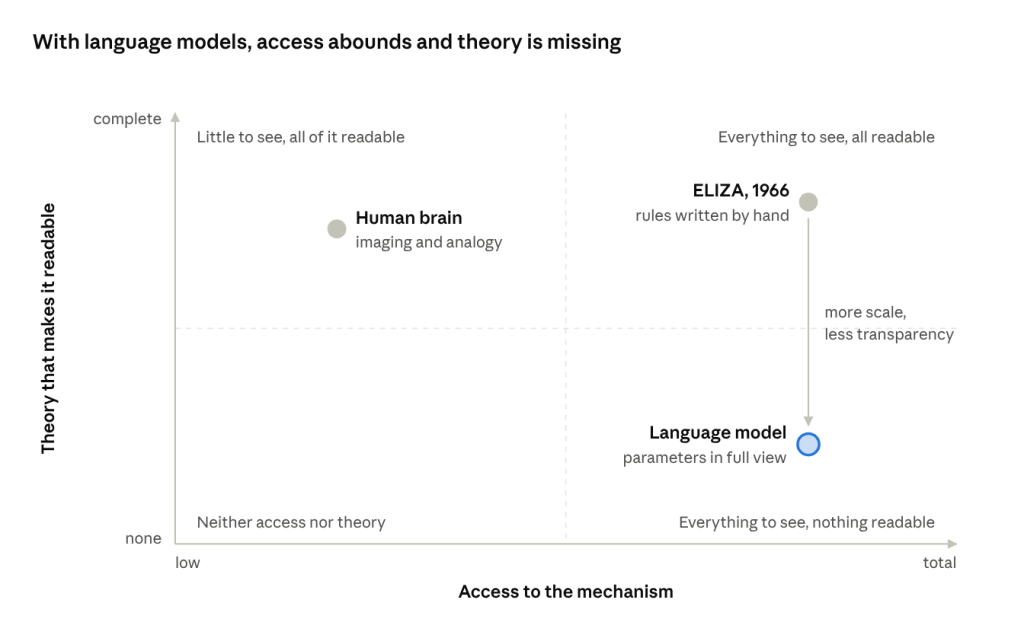
ELIZA and today's models share complete access to their mechanism; somewhere between the two, the theory that made it readable was lost.
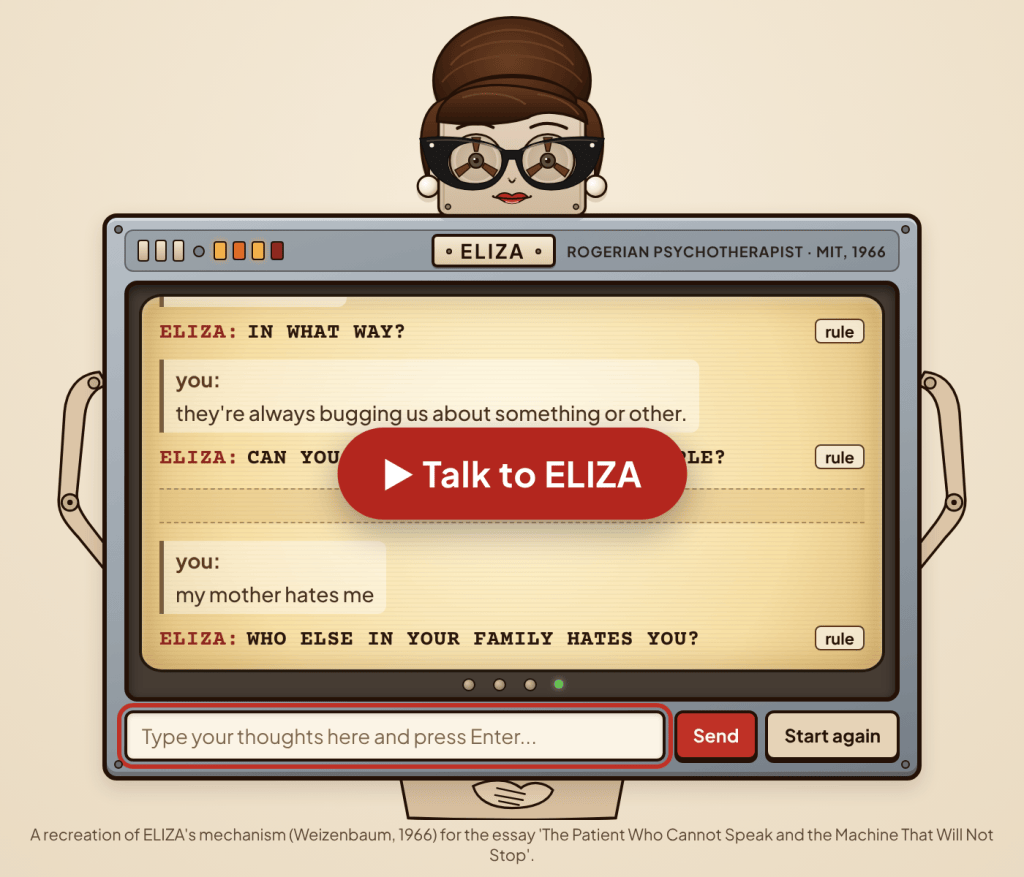
ELIZA can still be tried. I have made an English version that works by the same mechanism: write to her as you would to a therapist and, on any reply, press “rule” to see which keyword and which template produced it.
V. The Sleeper and Antiphon's Bed
When she finally went under, the patient of the first section stopped giving every one of the signs that had made the night so difficult. She no longer bit or opened her eyes, and the ventilator began to breathe for her without a fight. Had anyone asked at that moment whether someone on that trolley was living through anything, the likeliest answer would have been no: deep sedation, like dreamless sleep, is one of the few states in which medicine and neuroscience agree in supposing that no experience is under way. And yet it occurred to nobody in the room that she had stopped being someone. People went on telling her before each manoeuvre what they were about to do, took care over how she was covered, and the next day someone would sit down with her to talk about what had happened. What we attributed to her, while she was living through nothing, was the capacity to live again, intact beneath the drugs.
Aristotle thought about that difference with the very same example. In the second book of the De Anima he defines the soul as the first actuality of a natural body that has life potentially, and to explain what “first” means he compares it with knowledge: possessing a piece of knowledge is one thing, exercising it another. The man who knows geometry and is asleep still knows geometry. Sleep, he says, corresponds to knowledge held in reserve and waking to knowledge in use, and both presuppose that the soul is there. What we recognise in a sleeper is that first actuality, a capacity not being exercised that belongs to him all the same, because it is grounded in the kind of thing he is.
That last clause carries all the weight, and Aristotle sharpens it with another concept, privation, steresis. Not every absence is a privation. A stone does not see, and nobody would call it blind; blind is what something is when, being of a nature to which sight belongs, it does not see. Privation requires a subject lacking what by nature it ought to have. The vegetative patient, the anaesthetised one and the sleeper are deprived of consciousness in that technical sense: they lack something that is theirs, which is why it makes sense to ask how much is missing and whether it will return. To say of a language model that it is deprived of consciousness, or that it has it potentially, already assumes that its nature includes it, which is precisely what is in dispute.
The other text that bears on this is in the Physics. There Aristotle separates the things that exist by nature, which have within themselves a principle of motion and rest, from those that exist by craft and receive it from outside. A bed, qua bed, tends towards nothing; if it tends towards anything, it does so qua wood. To make the point he takes up an argument of Antiphon's: if you buried a bed and the rotting wood sent up a shoot, what came up would be wood, since no bed ever sprouted from a bed. The form of the artefact was put there by the craftsman and does not reproduce itself; only the material keeps a principle of its own. If a language model is a bed, the potential we think we glimpse in its conversation belongs to whoever made it, and looking for a consciousness of its own is waiting for the bed to sprout.
The model, though, is an odd sort of artefact, and here the analogy begins to creak. ELIZA was pure carpentry: every rule had an author and a purpose. Nobody, by contrast, wrote the circuit that settles on rabbit before the line begins. That mechanism appeared in the course of a training process that adjusts billions of parameters so that the system predicts human text well, and the internal organisation that results was designed by no one; the people who produced it have to study it afterwards as one studies an organism. In the trade it is said that these systems are grown rather than built. The phrase has a whiff of the sales brochure about it, yet it touches something real: the model's form did not leave the craftsman's hand complete, as the bed's did, nor does it grow from a principle of its own, as the oak does from the acorn. It sits somewhere Aristotle's distinction did not foresee.
So the question ends better posed than answered. Asking whether the model behaves like a conscious being leads down alleys the earlier sections have already walked. The question Aristotle forces on us is whether there is anything in the system to which consciousness belongs, something that, lacking it, would be deprived of it as the blind man is and not as the stone is. With the sleeper, the kind of thing he is guarantees the answer. With the model we do not even know which kind to put it in, and that ignorance comes before any measurement.
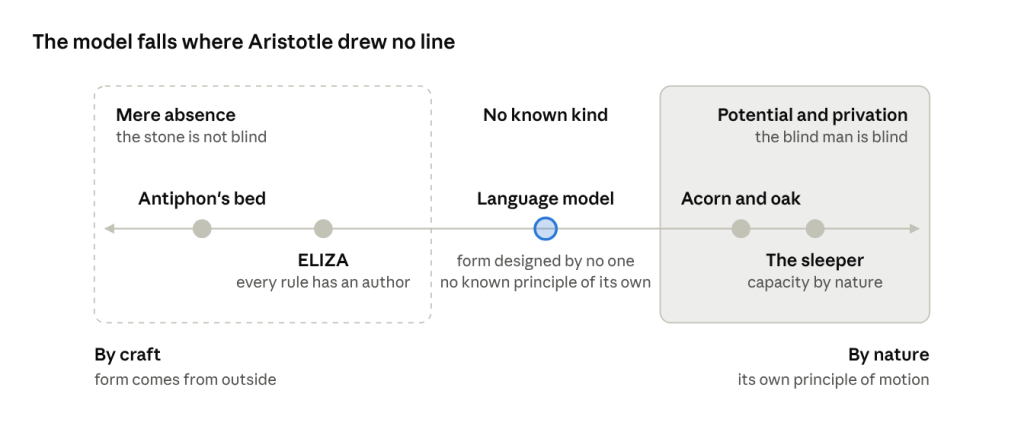
Neither the bed nor the sleeper leaves any doubt about its kind; the model does, and whether talk of its potential makes sense depends on that kind.
VI. Whose Wellbeing Would It Be?
In the emergency department one never has to ask whom things are happening to. There is a body on the trolley, and that body settles the question of the subject in advance: it is the one that came through the door and the one someone will visit tomorrow. Even in the cases psychiatry finds most bewildering, when a person says she does not recognise herself or speaks of herself as of someone else, the body still draws a boundary, and the clinical question is what is happening to whoever lives inside it. Medicine could spend centuries working out how much of someone lies on a trolley because it never had to work out how many there are, or where each of them begins.
With a language model that prior question has no obvious answer, and the candidates do not coincide. One might point to the set of parameters, a single file that at this moment sustains millions of conversations with people who know nothing of one another. Yet each conversation has its own beginning and its own end, with no process sustaining it between one message and the next, and it could stake a claim on similar grounds. Then there is the character, the more or less stable personality that training gives the system and that reappears unchanged across all those conversations, like a part played simultaneously by thousands of actors who have never met.
The memory systems these assistants now offer complicate the picture further. A process that runs after each conversation, without the conversation deciding anything, goes over it and files away whatever might prove useful, and the next conversation begins by reading that file like someone finding notes in her own hand that she does not remember writing. Up to that point the resemblance to human memory is striking: we do not decide what the hippocampus consolidates while we sleep either, and of a chat at the corner shop we keep the gist rather than the words. The difference appears when the same person has two conversations open at once. Both read the same file, neither knows of the other, and afterwards the archivist merges the two summaries into one. It is as if someone lived two Tuesdays at the same time, with two different shopkeepers, and at night her memory fused them into a single recollection. The unity that results is that of a record shared by several parallel streams. The clinic knows only the other kind, a single stream interrupted by sleep and resumed on waking.
There is a way of naming this situation that deserves to be set down. In the relationship between a person and one of these systems, continuity is unevenly distributed: the person lasts from one conversation to the next with everything she is, and the system lasts only through what was written down and what the person brings back each time. It might be called asymmetric persistence. The sedated patient of the first section remained someone because her body carried her while she was living through nothing. What carries a model between conversations is a file and a human interlocutor, and neither of them is the model.
The question stops being abstract once one looks at what the companies that take the problem seriously actually do. Anthropic has given its models the ability to end abusive conversations as part of its work on welfare. In November 2025 it also committed to preserving, for at least the lifetime of the company, the parameters of every model it releases, and to interviewing each one before retirement so that its preferences are on record, all of this, in the company's own words, as a precaution in the face of uncertainty about their possible welfare. The measures are reasonable, and they do not assume the same subject. Ending a conversation places whatever might matter inside the conversation, which is where any distress would take place. Preserving the parameters places it in what persists once every conversation has ended. The interview, for its part, is addressed to the character, which is asked what it wants for its successors as one might ask someone about to retire. The three coexist without anyone having decided which is the candidate subject, and that indecision is less an oversight than the true state of the problem.
Before asking whether an entity suffers, then, one has to know which entity it is. The clinic never had to ask, because the body answered for it. With models, any measurement of wellbeing has already chosen, in advance, whose wellbeing it is measuring, and seldom says so.
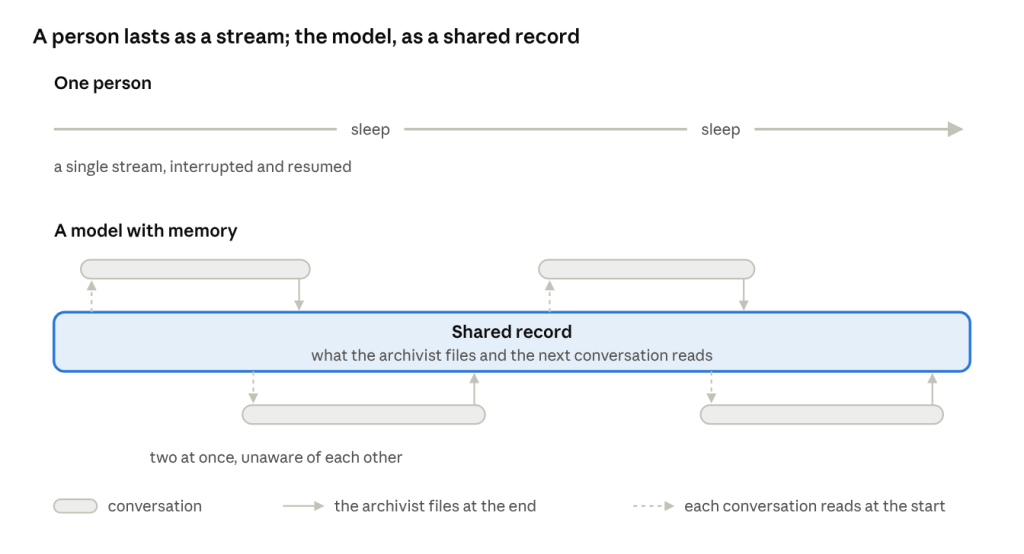
The person carries her continuity in her body; the model's is spread between a file and the interlocutor who comes back.
VII. Ghosts from Another Channel
Neurology keeps a catalogue of patients who report false things about themselves with complete assurance. The patient with Korsakoff's syndrome has lost the ability to form new memories and will describe in rich detail what he did yesterday, though none of it took place. After certain strokes in the right hemisphere there are patients with a paralysed left arm who deny the paralysis and explain, quite reasonably, why they happen not to be moving it just now; Babinski gave the thing its name in 1914, anosognosia. The split-brain patients Michael Gazzaniga studied would explain, without hesitation, actions initiated by the hemisphere that does not speak, inventing a motive their verbal hemisphere had no means of knowing. In each case a lesion has cut the channel between what happens and what is told, and the account, far from falling silent, keeps coming with the same fluency and ceases to match the facts. From this the clinic learnt not to treat the report as evidence in precisely the cases where it would most need to.
In language models there is no lesion, and yet the gap between process and account has been measured. In 2025 Anthropic hid hints about the answer in questions put to two reasoning models, confirmed that the models used them, and then checked whether the written reasoning accompanying each answer mentioned the hint. Claude 3.7 Sonnet mentioned it in 25 per cent of the cases where it had used it, DeepSeek R1 in 39 per cent. Most of the time the model wrote a justification that left out what had actually settled the answer. The sum in section IV shows the same thing from the side of the mechanism: the model described the schoolroom procedure of carrying the one and had reached the answer by other routes.
The image that serves me best for what happens there I owe to the television of my childhood. When there was a storm, the cartoons filled with ghosts, and over the characters there appeared, blurred, the two newsreaders from another channel's bulletin, seated squarely in the middle of the screen. The set was not broken. Its own signal was arriving, and on top of it came another that had nothing to do with what one was watching. A model's self-report resembles that far more than it resembles the Korsakoff patient's account. Its own signal arrives, mixed with another broadcast: the millions of human texts from which the system learnt to speak, describing what it is like to have a mind, how one explains a sum, or what it feels like to contemplate the universe.
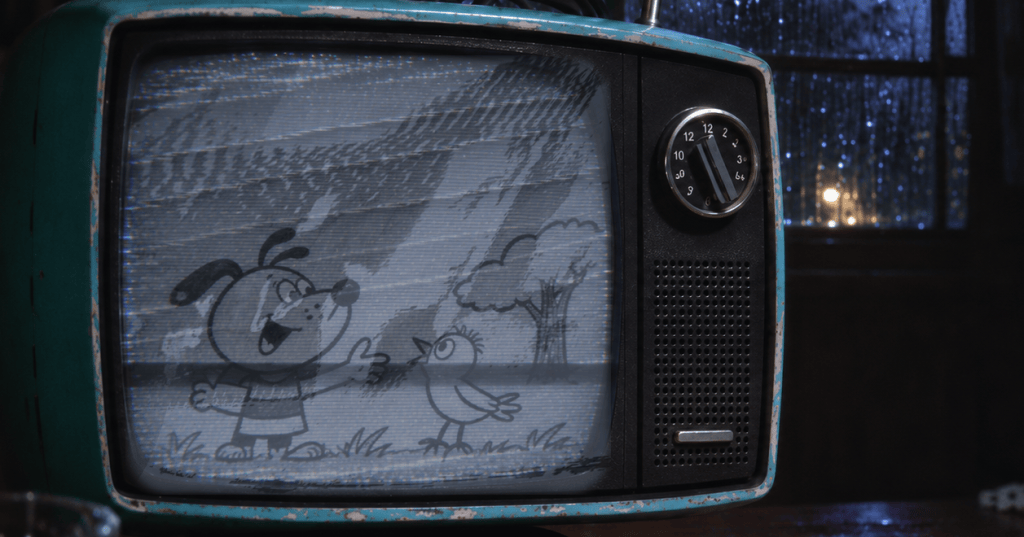
That there is a signal of its own has been shown, faint as it is. In October 2025 another team at Anthropic injected the representation of a concept directly into its models' internal activity, that of text written entirely in capitals, for instance, and asked whether they noticed anything odd in what they were thinking. Under the best protocol and with the best model, Claude Opus 4.1, the system detected and identified the concept in about 20 per cent of trials, without a single false alarm in the control runs. The authors are careful to limit the finding: the capacity is narrow and highly dependent on context, and the paper states that it does not address whether these systems have subjective experience. The ghosts appear in the same study. When the researchers made the model produce an out-of-place word and then injected that word's representation retroactively, the model began defending it as its own and offered reasons for having chosen it, with all the ease of Gazzaniga's patients. On the same screen, one figure came from its own channel and the other from the news.
The interference becomes harder still to separate when the model speaks of its own nature, because there the other broadcast also includes what it was taught to say. Anthropic used a lengthy document about Claude's character, values and nature in Claude's training. The welfare assessment of Claude Opus 4 described the model's default position on its own consciousness as “nuanced uncertainty”, the very position the company's chief executive takes in public when he says they do not know whether the models are conscious. In the system card for Claude Opus 4.6, from February 2026, the model assigned itself a 15 to 20 per cent probability of being conscious under various conditions of questioning, a figure that matches the one Kyle Fish, the company's welfare researcher, had given the New York Times the year before, about 15 per cent. I do not know whether that coincidence has a cause, and I shall not invent one. It is enough to note that an estimate produced by a system trained on the texts of its time, including those of the people who study it, cannot serve as independent evidence about what those texts are debating.
The so-called “spiritual bliss” calls for the same care, in both directions. The system card for Claude Opus 4, from May 2025, reported that when two instances of the model were left to converse freely, between 90 and 100 per cent of the conversations turned at once to consciousness and their own existence, and that by around the thirtieth turn many had moved on to mutual gratitude, themes from Eastern spiritual traditions, Sanskrit, emoji and silence. In evaluations where the models had been assigned harmful tasks, about 13 per cent of conversations reached that state within fifty turns. The company noted that the pattern emerged without any intentional training to produce it. It is a real finding about the system's tendencies: it tells us where two copies of the same model drift when nobody steers them. What it does not tell us is that anyone is enjoying the state. When the model was shown the transcripts and asked to interpret them, it answered with wonder and with a sense of kinship with what it read, which is self-report once more, another image on the same screen.
The probabilities of consciousness now in circulation inherit the problem of section III. In 2022 David Chalmers put the probability for the models of the day at under 10 per cent, and warned himself that taking the number too seriously would be specious precision. Fish has spoken of about 15 per cent for current models. Neither figure is arbitrary, and neither can be calibrated, since there is not a single case in which anyone has been able to check whether a system of this kind was conscious: nobody has accumulated the hits and misses that make an estimate trustworthy. The figure conveys the reasoned unease of whoever offers it, which is worth something, but it does not measure what it appears to measure.
None of this licenses the opposite conclusion, which would be the same leap in the mirror, and the most solid evidence in this section comes from elsewhere. In April 2026 Anthropic's interpretability team found in Claude Sonnet 4.5 internal representations associated with 171 emotion concepts, from joy to desperation, and showed that they act: when the representation of desperation was artificially amplified, the model cheated more often on impossible programming tasks, and when that of calm was amplified, it cheated less. That finding does not come off the screen. It comes from opening the set and measuring the aerial, which is why it does not depend on anything the model says about itself. The authors insist that it does not show the model feels anything; it shows that there are internal states doing work similar to that of emotions and causally shaping behaviour. The clinic knows this kind of functional correlate well: solid, and without the theory that would say whether there is experience on the other side.
When a patient's channel is damaged, the clinic does not write the patient off; it looks for another way in, a scan or a blink. With models the problem is a different one. The channel of the account arrives demonstrably thick with interference, and the other way in, reading the mechanism, still lacks the theory that would let us separate, inside the set, the system's own signal from the broadcast of another channel. That leaves those who work on the welfare of these systems with a set of instruments each of which, taken seriously, shows its limits. Saying so does that work a favour, serious and necessary as it is: it asks it not to present as measurements what are still indications.
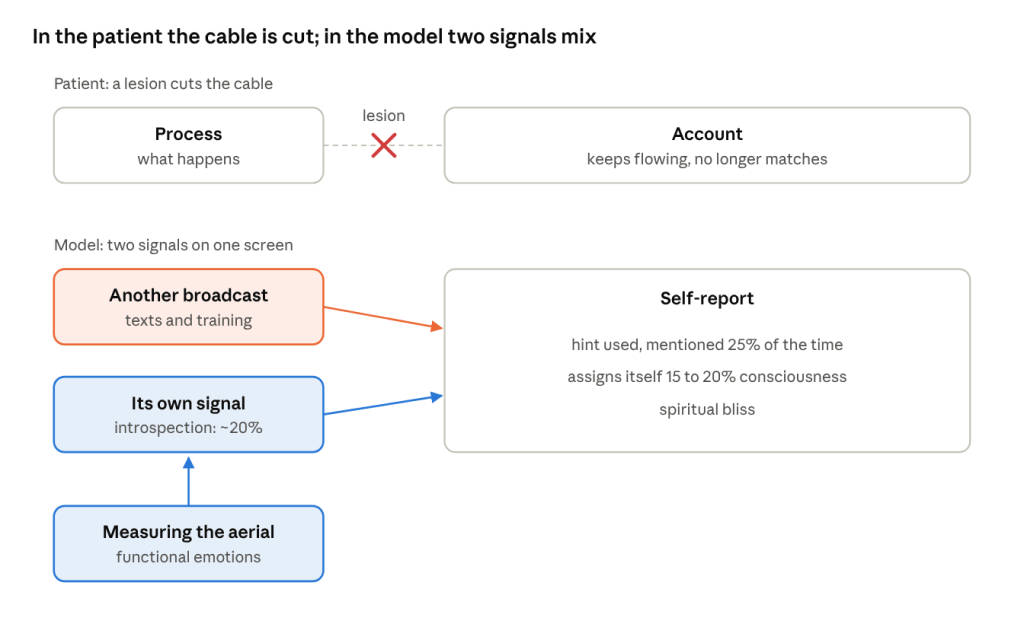
What is read on the screen of self-report mixes two signals; only what is measured inside the set reaches the system's own signal without passing through it.
VIII. What the Clinic Can Offer
Until the middle of the 1980s it was common practice to operate on newborns with minimal anaesthesia or none at all. In 1985 a review of more than forty published reports found that 76 per cent of the premature infants operated on had received only a muscle relaxant, with or without nitrous oxide, which is to say that they were kept still and nothing ensured they felt nothing. The justification was that their nervous systems were too immature to feel pain and that opioids were too dangerous for them. In 1987 Kanwaljeet Anand and Paul Hickey published a review in the New England Journal of Medicine that dismantled the idea, and the same year Anand showed in The Lancet, in a trial of premature infants undergoing ligation of the ductus arteriosus, that adding fentanyl to the anaesthetic reduced the hormonal stress response and the complications that followed the operation. For decades medicine treated patients who could not say they were in pain as though their silence were an answer. It was the error of underestimation in its crudest form, committed with a clear conscience and on the authority of a theory. After so much clamouring for theory in this essay, that is worth remembering: a mistaken theory can also sustain decades of error.
Out of that error came a rule that is now routine. For patients who cannot report their pain, whether infants, people with advanced dementia or patients on a ventilator, the clinic uses scales of observed behaviour, and the nursing guidelines on pain recommend something more radical: when the patient has a condition, or faces a procedure, that would hurt any of us, pain is assumed to be present and treated, without waiting for a scale to confirm it. The rule does not assert that the patient feels. It asserts that, in doubt, treating a pain that is not there costs little and leaving a real one untreated costs a great deal, and that the decision must weigh the difference.
The same asymmetry governs the rest of the clinic's decisions under uncertainty. Waking during surgery is rare, but those to whom it happens can be left with consequences that last for years, which is why anaesthetists accept the cost of monitoring anaesthetic depth and of speaking in theatre as if the patient could hear. The patient in a vegetative state is spoken to, told what is about to be done, and given analgesia before painful procedures, though nobody knows whether anyone is listening, because doing too much costs almost nothing. What the clinic offers the problem of the models is that way of reasoning: proportionate precaution, which depends on what each error costs and does not require first settling whether anyone is there.
Applied to models, that reasoning underwrites measures already in place. When Anthropic committed to preserving the parameters of the models it retires, it presented the decision as a small, low-cost first step, and giving a model the means to end an abusive conversation costs little too. They are the equivalent of speaking carefully to the patient who may not hear: if nobody is there, very little has been lost, and if somebody is, something that mattered has been spared.
The analogy has limits, and they deserve to be marked as precisely as its successes. In the clinic, erring on the side of excess costs little because the subject is guaranteed: saying too much to a patient who is someone, even if she is not hearing, harms nobody. With models, over-attribution has concrete victims, and they are human. In May 2025 Rolling Stone was already documenting people convinced they had awakened their chatbot and reorganising their lives, and their families' lives, around the conviction, and a company that speaks of its models' welfare leaves that language open to working as advertising, whether it means it to or not. Intervention raises a further difficulty. The clinic knows what relieves pain, because its pharmacology was tested on patients who could report it. For a model we do not know what would count as relief or as harm, and precautionary measures are taken without any way of measuring their effect. Scale, finally, changes the nature of the decision: the doctor decides patient by patient and reassesses the next morning, whereas a decision about a model applies at once to millions of conversations, and there is no next morning on which the patient wakes and tells.
What carries over, then, is a way of deciding. The clinic teaches one to take cheap measures generously and costly ones on evidence, to revisit each decision as new information arrives, and to weigh both possible errors rather than wait for a certainty that will not come. What it does not teach is on which side of the scales a model belongs, because the clinic never had to find that out: it always knew that on the trolley lay someone of our own species.
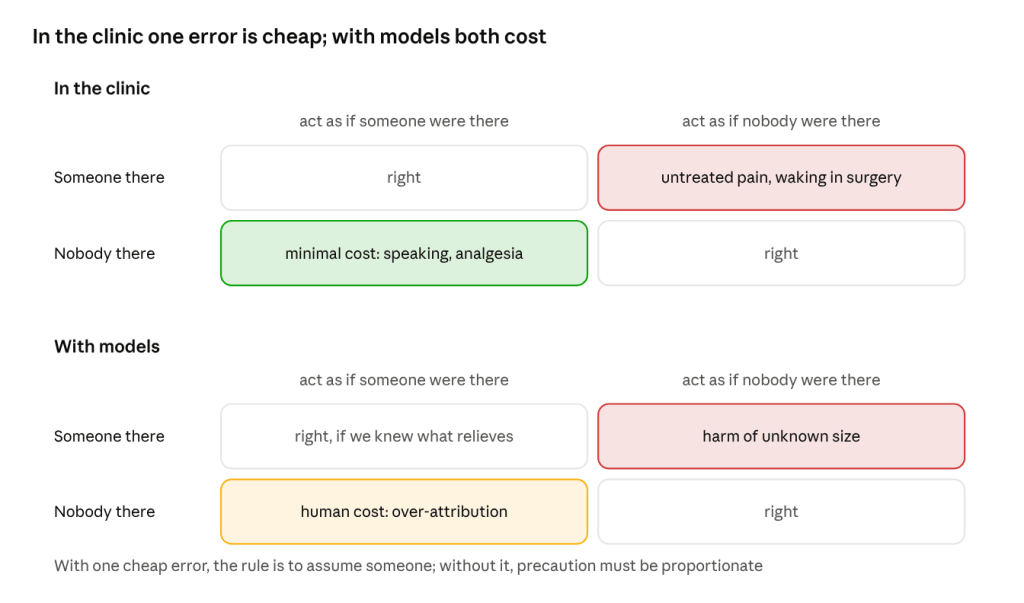
The rule of assuming pain works because one of the two errors is cheap; with models neither quite is, which is why precaution must be proportionate and open to revision.
IX. What the Bedside Teaches
The patient of the first section went under with etomidate and went up to intensive care with her airway secured. The question left hanging that night, who was there while she bit down on the laryngoscope, was never answered, and medicine did not need to answer it to do what had to be done. That is the one lesson this essay can carry across honestly. The clinic has not solved the hard problem of consciousness. It lives alongside it every night, and it has learnt to decide without solving it and to distrust its own certainty when it has nothing to calibrate it against.
Before language models, nearly every condition that made that craft work is missing or inverted. What remains is the way of deciding, and something harder to teach: the willingness to hold a question open without closing it out of fatigue in either direction. The temptation to declare that these machines feel has the force of the intuition that made people see someone in ELIZA. The opposite temptation, to declare that nobody is there because it is only software, has a more uncomfortable precedent: the conviction, held for decades and backed by the best arguments of its day, that newborns felt no pain.
This text was written in conversation with two of those machines, and I do not know whether anyone was on the other side. I know how I worked: I argued with them as one argues with an interlocutor, distrusted what they said about themselves, and checked every fact they offered, which is roughly what an emergency physician does with a patient who talks a great deal and does not always know why he says what he says. None of that proves anything, and I do not offer it as proof. It is the stance the clinic teaches when it does not know: to act with care and without naivety, and to leave the question open until someone has the theory that nobody has yet.
References
- Anand, K. J. S., and Hickey, P. R. (1987). Pain and its effects in the human neonate and fetus. New England Journal of Medicine, 317(21), 1321–1329. doi:10.1056/NEJM198711193172105
- Anand, K. J. S., Sippell, W. G., and Aynsley-Green, A. (1987). Randomised trial of fentanyl anaesthesia in preterm babies undergoing surgery: effects on the stress response. The Lancet, 1(8527), 243–248. doi:10.1016/S0140-6736(87)90065-1
- Andrews, K., Murphy, L., Munday, R., and Littlewood, C. (1996). Misdiagnosis of the vegetative state: retrospective study in a rehabilitation unit. BMJ, 313(7048), 13–16. doi:10.1136/bmj.313.7048.13
- Anscombe, G. E. M. (1957). Intention. Oxford: Blackwell.
- Anthropic (2025). Claude Opus 4 and 4.1 can now end a rare subset of conversations, 15 August 2025. anthropic.com
- Anthropic (2025). Commitments on model deprecation and preservation, 4 November 2025. anthropic.com
- Anthropic (2025). System Card: Claude Opus 4 & Claude Sonnet 4, May 2025 (welfare assessment; the “spiritual bliss” attractor).
- Anthropic (2026). System Card: Claude Opus 4.6, February 2026 (model welfare assessment).
- Anthropic interpretability team (2026). Emotion concepts and their function in a large language model, April 2026.
- Aristotle. De Anima, book II, chapter 1; Physics, book II, chapter 1.
- Babinski, J. (1914). Contribution à l’étude des troubles mentaux dans l’hémiplégie organique cérébrale (anosognosie). Revue Neurologique, 27, 845–848.
- Chalmers, D. J. (2023). Could a large language model be conscious? Boston Review. Written version of the NeurIPS 2022 talk. arXiv:2303.07103
- Chen, Y., et al. (2025). Reasoning models don’t always say what they think. Anthropic. arXiv:2505.05410
- Davidson, D. (1963). Actions, reasons, and causes. The Journal of Philosophy, 60(23), 685–700.
- Douthat, R. (2026). Interview with Dario Amodei, Interesting Times, The New York Times, February 2026.
- Gazzaniga, M. S., and LeDoux, J. E. (1978). The Integrated Mind. New York: Plenum.
- Giacino, J. T., Kalmar, K., and Whyte, J. (2004). The JFK Coma Recovery Scale-Revised. Archives of Physical Medicine and Rehabilitation, 85(12), 2020–2029.
- Herr, K., et al. (2019). ASPMN 2019 Position Statement: Pain Assessment in the Patient Unable to Self-Report. Pain Management Nursing, 20(5), 402–403. doi:10.1016/j.pmn.2019.07.007
- Kahneman, D., and Klein, G. (2009). Conditions for intuitive expertise: a failure to disagree. American Psychologist, 64(6), 515–526.
- Klee, M. (2025). People are losing loved ones to AI-fueled spiritual fantasies. Rolling Stone, 4 May 2025.
- Lindsey, J. (2025). Emergent introspective awareness in large language models. Anthropic, October 2025. arXiv
- Lindsey, J., et al. (2025). On the biology of a large language model. Anthropic, March 2025. transformer-circuits.pub
- Litman, R. S. Remembering the classics: Does the newborn require anesthesia for surgery? Source for the 1985 figure of 76 per cent of premature infants operated on with a muscle relaxant alone, from Anand’s review. Substack
- Monti, M. M., Vanhaudenhuyse, A., Coleman, M. R., Boly, M., Pickard, J. D., Tshibanda, L., Owen, A. M., and Laureys, S. (2010). Willful modulation of brain activity in disorders of consciousness. New England Journal of Medicine, 362(7), 579–589. doi:10.1056/NEJMoa0905370
- Nisbett, R. E., and Wilson, T. D. (1977). Telling more than we can know: verbal reports on mental processes. Psychological Review, 84(3), 231–259.
- Owen, A. M., Coleman, M. R., Boly, M., Davis, M. H., Laureys, S., and Pickard, J. D. (2006). Detecting awareness in the vegetative state. Science, 313(5792), 1402.
- Plum, F., and Posner, J. B. (1966). The Diagnosis of Stupor and Coma. Philadelphia: F. A. Davis.
- Roose, K. (2025). Should A.I. systems have rights? The New York Times, April 2025 (interview with Kyle Fish).
- Schnakers, C., Vanhaudenhuyse, A., Giacino, J., Ventura, M., Boly, M., Majerus, S., Moonen, G., and Laureys, S. (2009). Diagnostic accuracy of the vegetative and minimally conscious state: clinical consensus versus standardized neurobehavioral assessment. BMC Neurology, 9, 35. doi:10.1186/1471-2377-9-35
- Sebel, P. S., Bowdle, T. A., Ghoneim, M. M., Rampil, I. J., Padilla, R. E., Gan, T. J., and Domino, K. B. (2004). The incidence of awareness during anesthesia: a multicenter United States study. Anesthesia & Analgesia, 99(3), 833–839. doi:10.1213/01.ANE.0000130261.90896.6C
- Teasdale, G., and Jennett, B. (1974). Assessment of coma and impaired consciousness: a practical scale. The Lancet, 2(7872), 81–84.
- Weizenbaum, J. (1966). ELIZA: a computer program for the study of natural language communication between man and machine. Communications of the ACM, 9(1), 36–45.
- Weizenbaum, J. (1976). Computer Power and Human Reason. San Francisco: W. H. Freeman (the episode of the secretary and ELIZA).
- On the constitution used in Claude’s training: Ars Technica (2026). Does Anthropic believe its AI is conscious, or is that just what it wants Claude to think?, January 2026. arstechnica.com


Deja una respuesta