1. What happened
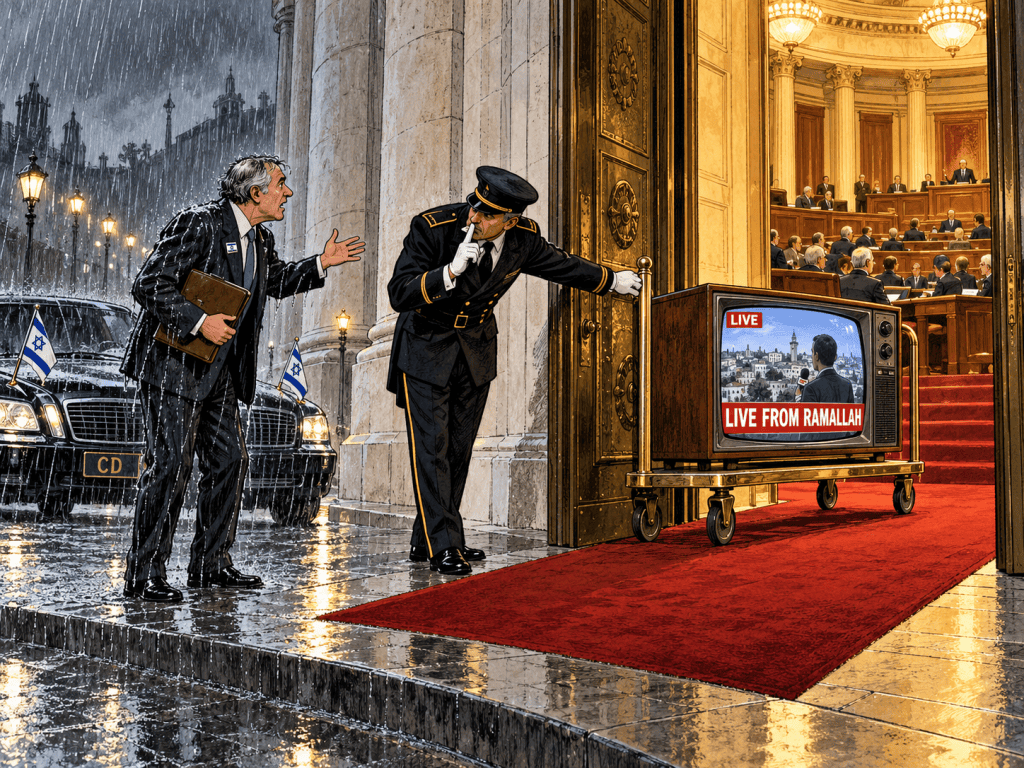
Every 26 October, Palestinians mark Palestinian Women’s Day, in memory of the first Palestinian women’s congress, held in Jerusalem in 1929. This year the Palestinian embassy in Montevideo wished to mark it inside Uruguay’s Legislative Palace, and Gustavo González, a Socialist senator from the governing left-wing Frente Amplio, was only too happy to oblige and booked the hall. The panel, open to the public, is set for the evening of Monday 26 October. It includes Mónica Xavier, head of the government’s National Women’s Institute; Lilián Abracinskas, a Frente Amplio senator; Lujain Jallad, wife of the Palestinian ambassador; the lawyer Rasha Qumsiyeh; and, by video link, the guest who managed to turn an anniversary into a scandal: Majida al-Masri, a former Minister of Social Affairs in the Palestinian Authority and currently deputy secretary-general of the Democratic Front for the Liberation of Palestine (DFLP), an organisation whose armed wing did not spend 7 October 2023 at home.
The centre-right opposition, the Coalición Republicana, took note and wrote to Vice President Carolina Cosse, who presides over the General Assembly. The signatories went to some trouble to explain that they had nothing against the commemoration and a good deal against the guest: the DFLP’s armed wing fought alongside Hamas on 7 October, and Al-Masri herself is on record defending “resistance in all its forms”, a phrase which in that part of the world covers precisely the forms one imagines, and pressing for Hamas and Islamic Jihad to be brought into the PLO. They asked that steps be taken to keep her off the programme.
Cosse replied on X with the composure of someone who is not required to decide anything: Parliament is the house of Uruguayan democracy, its doors are open to the widest range of views, no regulation governs the use of its rooms, each legislator answers for the events he or she convenes, and it was not her place to decide who may speak. A flawless answer to a question which, as we shall see, had been put the wrong way round.
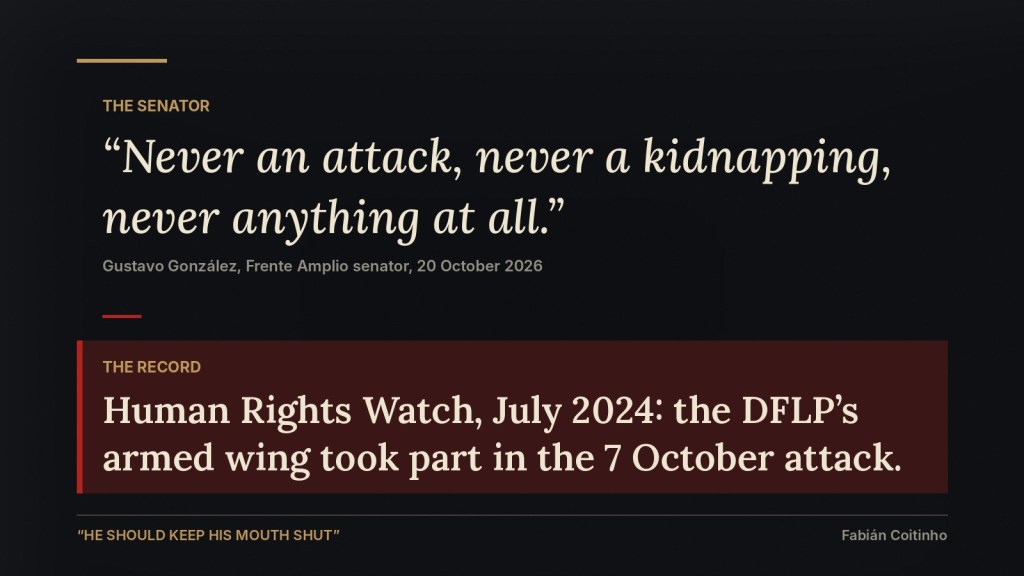
Senator González, on the other hand, took it personally. The opposition, he told reporters, was “utterly mistaken” and had “got the wrong Front”: the DFLP is not on the United States’ list of terrorist organisations, and its record is spotless, “never an attack, never a kidnapping, never anything at all”. For good measure he added that Al-Masri is not wanted by Interpol, a test the foreign minister, Mario Lubetkin, then adopted to explain who may enter the country, and which sets the bar for addressing the Legislative Palace at roughly the level of passport control. And when Israel’s ambassador, Eldad Hayet, voiced concern that Parliament was lending legitimacy to terrorist organisations, the senator at last discovered a limit to free speech: the ambassador should “keep his mouth shut and say no more”, since he “cannot speak about Uruguayan problems”.
2. What is on the record
For a woman the opposition supposedly mistook for someone else, Majida al-Masri has a remarkably distinctive CV. Born in Haifa in 1947, she came up through the Arab Nationalist Movement and then the Popular Front for the Liberation of Palestine, whose training camps in Jordan she attended; there is no record of their offering courses in conflict resolution. She later moved to the DFLP, serving as its secretary in Nablus from 1999 and sitting on its politburo from 2004. She was Minister of Social Affairs in the Palestinian Authority from 2009 to 2013, sits on the secretariat of the BDS movement, and is today the organisation’s number two. More than half a century in the armed Palestinian left, which Senator González sums up in a phrase better suited to an identity card: “the woman is legal”.
In July 2024, Human Rights Watch published a 236-page report on 7 October. It found that Hamas’s Qassam Brigades and at least four other Palestinian armed groups committed war crimes and crimes against humanity against civilians, murder and hostage-taking among them, and that the assault was designed to kill civilians and carry off as many hostages as possible. Among the participants it lists the DFLP’s armed wing, the National Resistance Brigades, also known as the Omar al-Qasim Forces. The organisation which, according to González, “never” did “anything at all” appears in that report under its name, its armed wing’s name and its alias.
That the DFLP is Marxist and secular while Hamas is Islamist is perfectly true, and a most useful distinction in a seminar on the history of ideas. On 7 October it was of no consequence whatever: both organisations crossed into Israel together, and their victims were given no opportunity to enquire into the doctrine of whoever was shooting at them. Senator Sebastián da Silva, of the opposition National Party, who spoke of “a Hamas terrorist”, got the acronym wrong; the opposition’s letter, which named the DFLP, got nothing wrong at all. González took one senator’s slip and turned it into the acquittal of an entire organisation, which, as an economy of means, is rather impressive.
Al-Masri herself does her host few favours. Last month she described 7 October as an “earthquake” and a turning point for the Palestinian cause, and called for a national dialogue embracing every faction, Hamas included. On 7 October this year, while much of the world was remembering the dead, she condemned Israel’s demolition of martyrs’ memorials in the West Bank, read it as revenge for that day, and declared that the Palestinian people take pride in the fighters of the resistance. Such is the anniversary observance of the guest who is coming to talk to us about women’s rights.
3. The wrong question
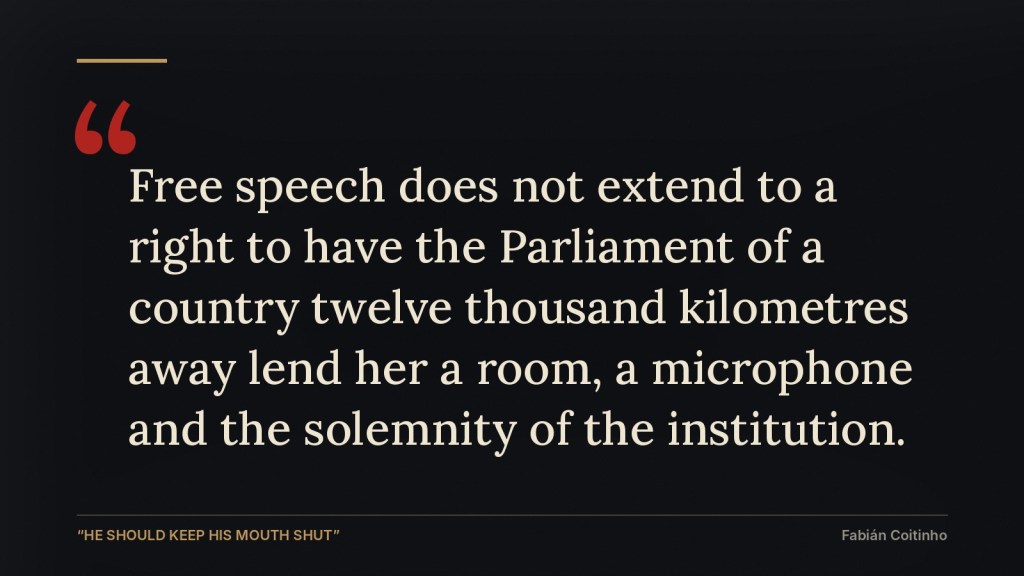
The opposition’s letter and Cosse’s reply argue about who has the power to stop Al-Masri from speaking, and on that ground the government wins without breaking a sweat. Free speech protects Al-Masri’s right to say what she thinks in Ramallah, on social media, or in any outlet willing to print her. It does not extend to a right to have the Parliament of a country twelve thousand kilometres away lend her a room, a microphone and the solemnity of the institution. She came by that room in the most earthly way imaginable: a senator asked for it on her behalf.
On procedure Cosse is right, and the opposition handed it to her on a plate. A presiding officer empowered to veto guests on the strength of their political past would be a dangerous toy in the hands of any majority, and even Felipe Schipani, a Colorado Party deputy who signed the letter, conceded that he saw no need for a regulation and preferred to trust in self-restraint. Self-restraint means trusting the judgement of the legislator who extends the invitation, and the legislator in question is González, who remains convinced that the DFLP spent 7 October watching television. By aiming at Cosse, the opposition gave her the most comfortable part in the repertoire, the democrat who refuses to censor, while the man actually responsible watched the performance from the stalls.
Nor does it make any difference that Al-Masri will appear by video, beyond the saving on airfare. The objection is to the Legislative Palace serving as a platform, and a screen does that job quite as well as a lectern, particularly with the head of a government agency and a sitting senator at the same table to complete the institutional stage set. Fernanda Auersperg, a National Party deputy, put it plainly: no one needs to be in the room for their voice to count.
4. Washington, Interpol and a list that does not exist
To clear the DFLP, González reached for an authority one does not often hear invoked by a Socialist senator: the State Department. The organisation is not on its list of terrorist organisations, he pointed out, adding with evident amusement: “Look who I’m quoting!”. He knew perfectly well that he was citing a source his own side denounces by reflex, and he cited it anyway because, for once, the empire was on his side. He omitted one small detail: Washington took the DFLP off that list in October 1999. Citing an administrative decision from 1999 to acquit an organisation of what it did in 2023 is about as persuasive as producing one’s school conduct report at a murder trial.
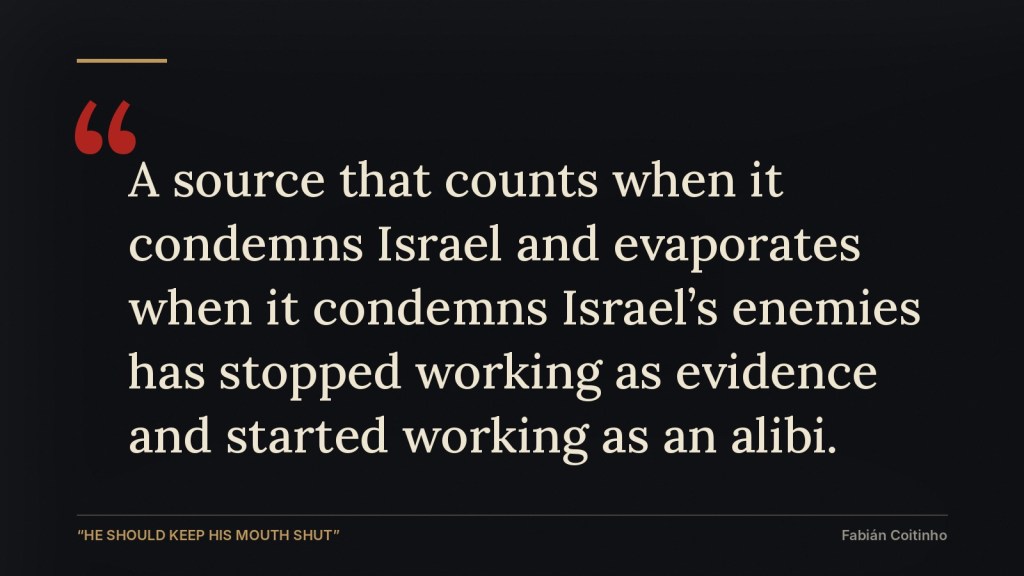
There was another source to hand for what the DFLP did that day, and González preferred not to see it. Human Rights Watch is an organisation no one in the Frente Amplio could accuse of Zionism: it was the first major international human rights organisation to accuse Israel of apartheid, and it has documented Israeli war crimes in Gaza. So long as it is condemning Israel, it serves as the conscience of mankind; the moment it records the DFLP’s part in a massacre, it drops off the radar and the State Department of 1999 takes its place. A source that counts when it condemns Israel and evaporates when it condemns Israel’s enemies has stopped working as evidence and started working as an alibi.
In a later interview González raised the stakes: the DFLP is not on any terrorist list, “nor the United Nations’ either”. The argument is flawless, save for the minor defect that the United Nations keeps no such list for the Israeli-Palestinian conflict and that Hamas does not appear on any UN list either. By the senator’s standard, the organisation that planned and led 7 October could also give a talk in the hall of the Legislative Palace. One would rather not give the embassy ideas.
His final argument was Interpol. Al-Masri is not wanted by Interpol, González said, and the foreign minister took up the same test to explain who may enter the country. Nobody had suggested that Al-Masri was a fugitive. The opposition raised a political objection, to giving a platform in Parliament to the number two of an organisation that took part in a massacre, and the government replied by producing a clean criminal record. On that standard, the Legislative Palace is open to anyone who has not yet been arrested, which widens the pool of possible speakers considerably. When the answer to a political question is the absence of an arrest warrant, the government is admitting that it has no answer to the question it was actually asked.
5. The Frente Amplio as a body
González is no lone sniper. He sits for the Socialist Party, one of the founding members of the Frente Amplio, a coalition that prides itself on its organic structure and its tradition of acting as one. In that political culture, what a senator says in public is read as the party’s position for as long as nobody disowns it, and nobody has.
Not for want of practice. In July this year, when Uruguay’s ambassador in Washington attended a meeting called by Marco Rubio, the Frente Amplio deputy Sebastián Valdomir lost no time in placing on record, in committee and in front of the foreign minister, that his party disagreed. The Frente’s organic sensibilities are set off by a photograph in Washington; one of its own senators denying an organisation’s part in a documented massacre does not reach the threshold. At the time of writing, the boldest reaction has come from Senator Daniel Caggiani, who declared himself unfamiliar with Al-Masri’s connections: the parliamentary equivalent of whistling at the ceiling, and an elegant way of leaving every word González said exactly where it stood.
More telling than the silence is the attendance. After the letter, Cosse’s reply and González’s statements, Mónica Xavier, head of the National Women’s Institute, and Senator Lilián Abracinskas are still billed to appear, and the foreign minister has adopted the senator’s Interpol test as his own. The government had a week to put some distance between itself and the event, and chose instead to show up, in one case from a post in the executive branch.
6. Responsibility for empowering
The official defence rests on a premise as convenient as it is unstated: until someone proves that Al-Masri pulled a trigger with her own hands, there is nothing to hold against her. It is the standard of a criminal court applied to an invitation to Parliament, and it confuses two kinds of responsibility. Criminal responsibility is individual and requires proof of each person’s conduct. Political responsibility works differently: whoever leads an organisation answers for what the organisation does. Nobody would dream of requiring a party leader to have personally voted for every law his caucus passed before holding him responsible for them, and nobody should require the DFLP’s number two to have personally opened fire on 7 October.
That armed wing did not act alone, nor by misunderstanding. Since 2018 it has belonged, alongside Hamas and Islamic Jihad, to the Joint Operations Room of Gaza’s armed factions, and on 7 October it fought in the same operation. When several organisations go in together to kill civilians, each carries the whole operation, not merely the bodies that can be traced to its own men. That is the logic of joint criminal enterprise in international criminal law, and anyone who has ever watched a crime drama grasps it: the man who drives the getaway car cannot plead that he did not fire.
Nor does the responsibility end on that day. The DFLP is Marxist and secular, and no one credits it with Hamas’s theology; what it is credited with are the consequences of its alliance. Hamas has ruled Gaza since 2007, and its programme reaches well beyond the war with Israel. In 2016 its own brigades executed one of their commanders, Mahmoud Ishtiwi, accused of “moral turpitude”, the organisation’s euphemism for homosexuality; his family maintained that it was an internal settling of scores, and the charge chosen to justify the execution says something all the same about what Gaza’s rulers regard as unforgivable. In 2021 a Hamas-run Islamic court ruled that unmarried women needed a male guardian’s permission to leave Gaza, and after protests it was gracious enough to soften the ruling without giving up the guardianship: the guardian keeps the power to ask that the journey be stopped. An organisation that strengthens Hamas answers for what Hamas does with that strength, to Palestinian women and Palestinian gay men included.
And Hamas did come out stronger. According to the Palestinian Center for Policy and Survey Research, by December 2023 support for Hamas in the West Bank had more than tripled compared with three months earlier; in September 2024, despite a fall, it remained the best-supported faction, and in October 2025, 53% of those polled in the West Bank and Gaza still considered the decision to attack correct. The same pollster notes that support for Hamas tends to rise in wartime and fall afterwards, which does not alter what was measured: the attack in which the DFLP took part handed Hamas a documented surge in popularity. Al-Masri, for her part, calls for a national dialogue embracing every faction, and the opposition credits her with having pressed for Hamas and Islamic Jihad to be brought into the PLO. If that is not empowering Hamas, a new word will have to be coined.
This responsibility is not shared equally among all Palestinians, and it is worth saying so before anyone attributes to this piece what it does not say. Fatah and Hamas fought each other in the streets of Gaza in 2007, and the Palestinian Authority arrests Hamas militants in the West Bank. There are degrees, and on the highest rung stand the organisations that took part in 7 October and are working to give Hamas a seat at the head of the Palestinian national project. That is where the DFLP stands, and its number two with it: Senator González’s guest.
7. Abracinskas’s own standard
Ten days before this row broke, the Legislative Palace hosted another contested event: Uruguay Dialoga, organised by Parlamento y Fe, an evangelical group whose stated mission is to transform the hearts of legislators, an undertaking anyone acquainted with the Uruguayan Parliament will recognise as an act of faith in the strictest sense. Lilián Abracinskas was the only government legislator of a critical persuasion to sit through the entire presentation, and she afterwards explained to the weekly Caras y Caretas why she objected to it. Its organisers, she said, subscribe to “the most ultraconservative and most fundamentalist positions” and seek to use the powers of the state to enforce what the holy books dictate, with specific targets: abortion, euthanasia, same-sex marriage and adoption by same-sex couples.
Abracinskas did not call for the event to be banned, which does her credit. The argument she used to discredit it, however, repays close reading, because it matches the argument of this piece word for word. She identified its promoters as “the same operators” who, in the previous legislature, had vouched for Pablo Laurta, a man who cast himself as a victim within the men’s group Varones Unidos and went on to kill. Nobody had accused those operators of killing anyone; Abracinskas held them responsible for having backed the man who did. The substance of her criticism was aimed at those who use their alliances to carry into the state a programme against the rights of women and gay people. Responsibility by association and responsibility for empowering, set out by Abracinskas herself with a clarity this piece can only envy.
On Monday, Abracinskas will share a panel on women’s rights with the number two of an organisation whose armed wing took part in an operation in which women were murdered and abducted, and in which the UN Special Representative on Sexual Violence in Conflict found reasonable grounds to believe that rape, including gang rape, took place. That organisation is, moreover, working to empower a movement that requires women to obtain a man’s permission to travel and that shot one of its own commanders on a charge of homosexuality. If the evangelicals of Parlamento y Fe were disqualified for having vouched for a killer, it is hard to see what merit exempts Monday’s fellow panellist. Nobody is asking Abracinskas to censor anyone: applying her own standard will do.
8. The panel already had Palestinian voices
The most predictable objection to all of the above is that it amounts to silencing Palestinian women on their own day, and the make-up of the panel takes care of it. Besides Al-Masri, it includes Lujain Jallad, wife of the Palestinian ambassador, and the Palestinian lawyer Rasha Qumsiyeh, and the opposition stated in writing that it had no objection to the commemoration. The event could remember Palestinian women, denounce what they endure in Gaza and the West Bank and discuss their situation without Al-Masri. All her presence adds is the signature of an organisation that was there on 7 October, a contribution the panel could have done without and not lost a single idea.
The line-up was proposed by the Palestinian embassy, and González accepted it and defended it with a gentleman’s flourish: “I take full responsibility for the note I sent.” He had plenty to choose from. Palestine has lawyers, journalists, doctors and human rights defenders who hold no post in any armed organisation. In 2021, for instance, the Gaza activist Zainab al-Ghunaimi, who runs a women’s rights organisation, denounced Hamas’s male guardianship ruling as a step backwards that violated the Palestinian Basic Law. A voice of that kind would have done honour to Palestinian Women’s Day without bringing the shadow of 7 October into the room, with the drawback that it would have spoken ill of the guest’s allies. Of all the women available, the choice fell on the one least able to speak about women’s rights without someone asking her about the women murdered that day.
9. “He should keep his mouth shut”
Israel’s ambassador did not ask to speak in Parliament. He told a newspaper he was concerned that a Uruguayan institution was lending legitimacy to armed organisations, which is precisely what ambassadors are for. González’s answer was that he should “keep his mouth shut and say no more”, since he cannot speak about Uruguayan problems. The rule that emerges from the senator’s two decisions has an admirable consistency: the DFLP’s number two may speak about Palestine from the Legislative Palace, while Israel’s representative may not offer an opinion in the press on a Uruguayan controversy that turns on Israel. The house that stands open to the widest range of views turns out to have a door that swings one way only, and a Socialist doorman deciding who comes in and who keeps quiet.
Uruguay is home to Jewish Uruguayans with family and friends in Israel, for whom 7 October was a wound close to home rather than distant news. None of them has any right to veto anyone in their country’s Parliament, and none of them has asked to. They are, however, entitled to expect their representatives to take responsibility for what they do with an institution that belongs to them too. On Monday they will watch a senior official of the executive and a senator share a table with a leader of an organisation that took part in that massacre, while the senator who invited her tells the man who objected to keep quiet. Tolerance, it seems, also reserves the right of admission.
The argument of this piece does not depend on them, for all that. The invitation would be just as objectionable if not a single Jew lived in Uruguay, because the principle at stake is that a republic’s Parliament does not give a platform to someone who leads an organisation that went in to kill civilians, whoever those civilians may be. Which is why the final question goes to Lilián Abracinskas, and it is a simple one. Would she share a panel on women’s rights, in the Legislative Palace, with a leader of an organisation whose armed wing had taken part in a massacre of Palestinian women? If the answer is no, it falls to her to explain what changes when the murdered women are Israeli. If she cannot, the principle she wielded against Parlamento y Fe was never more than a preference, and her feminism one that checks the victims’ passports.
This piece is also available in Spanish.
Sources
- Caras y Caretas – Abracinskas on Parlamento y Fe (Spanish)
- Caras y Caretas – Gustavo González: “The aim is to annoy” (Spanish)
- Caras y Caretas – González on Israel’s ambassador (Spanish)
- El Observador – González defends the Palestinian Women’s Day event (Spanish)
- El Observador – The opposition’s letter to Cosse (Spanish)
- El Observador – Valdomir questions Lubetkin (Spanish)
- la diaria – Row over the event in the Legislative Palace (Spanish)
- la diaria – Lubetkin’s Interpol test (Spanish)
- Telenoche – Political clash over the Palestinian guest (Spanish)
- Infobae/EFE – Controversy in Uruguay over Al-Masri (Spanish)
- Palestinian Museum Digital Archive – The Majida al-Masri Collection
- Quds News – Majida al-Masri: 7 October was an earthquake (Arabic)
- Al-Hourriah – Majida al-Masri statement, 7 October 2026 (Arabic)
- Human Rights Watch – Palestinian Armed Groups’ October 7 Assault on Israel
- Human Rights Watch – Questions and Answers
- AP via GV Wire – Global rights group finds Hamas-led militants committed war crimes on Oct. 7
- ITV News – UN report on sexual violence on 7 October
- Wikipedia – Palestinian Joint Operations Room
- The Media Line – Hamas Executes Commander Accused of Being Gay
- AP via Washington Times – Hamas court says women need guardian’s approval to travel
- EuroMed Rights – Court in Gaza rules that male guardians can limit unmarried women’s travel
- PCPSR – Poll No. 90, December 2023
- PCPSR – Poll, September 2024
- The Jewish Chronicle – PCPSR poll, October 2025


Deja una respuesta