I work in emergency medicine, which means I have spent a good part of my life explaining things to people who were frightened, in a hurry, or both, and who had no patience whatever for elegant phrasing. One learns quickly that a word the patient understands is worth more than a word a committee has approved. Which is why a short clip from a Canadian parliamentary hearing struck me as so absurd that I felt obliged to write about it.
The subject is a small family of phrases that has settled into the documents of health ministries on both sides of the equator: “pregnant person”, “person who menstruates”, “person with a cervix”. Their defenders present them as a courtesy. I intend to show that they are something rather less modest: an attempt to go on talking about the female body while forbidding oneself the word for it, with results that range from the comic to the clinically careless.
1. A person who is pregnant
The committee in question was the House of Commons Standing Committee on Science and Research, and it was, in theory, studying threats to Canadian research. A Conservative MP used his time to put to the president of the Public Health Agency of Canada, Nancy Hamzawi, what ought to have been the easiest question of her career: could she offer Canadians a plain-language definition of “pregnant person”? She could, after a fashion. “A pregnant person,” she said, “is a person who is pregnant.” The room laughed, which was unkind and entirely deserved.
He pressed on. How does a pregnant person differ medically from a pregnant woman? She began a sentence about what a person may choose and abandoned it halfway. How does a pregnant person who is not a woman become pregnant? This took several attempts, separated by a good deal of stammering, before she reached her final formula: a person who chooses to identify themselves as a man and has the biological ability to be pregnant.
In a single sentence the head of a national public health agency managed to say, without quite meaning to, nearly everything that is wrong with this vocabulary, and she said it more economically than any of its critics have managed.
2. Two dictionaries in one sentence
The first answer hardly needs comment. To define a term by repeating it is a failure every logic textbook warns against, and the president of the agency committed it in front of the cameras. It can at least be said in her favour that it was true: a pregnant person is indeed a person who is pregnant. It was also useless, which is a different charge, and the one that matters to anyone who has to write a leaflet.
The second answer is the interesting one, because it is built from two classification systems at once. The subject of the sentence, “a man”, belongs to the vocabulary of identity: it names what the person chooses to be called, and she was careful to say “chooses”. The qualifying clause, “the biological ability to be pregnant”, belongs to another vocabulary altogether. That ability does not exist outside the female body. No organism carries a pregnancy without a uterus and the hormonal machinery that goes with it, so the clause is a description of the female sex that declines to name it. Put the two halves together, translate the sentence out of its own idiom, and it reads: a person who calls himself a man and is female.
Sex has not disappeared from the sentence, and it could not, because pregnancy is the phenomenon in which it is hardest to argue away. It has been relegated to the subordinate clause, where it does all the work while the noun takes the credit. That is the thesis of this essay: the vocabulary the president was defending still sorts people by sex and forbids itself the words that say so. “Pregnant person” keeps the female category intact and carries it about under a description, and every time someone asks what the description means, the contraband has to be unpacked in public.
3. The same women under another name
It would be convenient, and wrong, to say that these institutions have replaced biology with identity. “Pregnant person” names no new physiological class. Nobody has discovered a population of gestating organisms distinct from pregnant females: the set of human beings the phrase picks out is exactly the set that “pregnant women” picked out a generation ago, without adding or removing anyone. What has changed is the route by which the word reaches its object.
Frege drew this distinction more than a century ago with the morning star and the evening star, two expressions for a single planet presented in two different ways. “Pregnant woman” presents its referent through sex; “pregnant person” presents the same referent through a physiological state, and the state happens to be one that only the female sex can be in. The defenders of the new term are therefore right when they say that nobody’s biology has been denied, and the critic who accuses them of denying it can be dismissed in a sentence. The objection that survives is a different one, and harder to wave away: why should a health agency prefer the mode of presentation that hides the very variable its own discipline depends on?
The answer begins with a small detail. The two phrases coincide only if “woman” still means what it has always meant. Under the institution’s own definition, in which “woman” names an identity, a pregnant man is not a pregnant woman, and the two expressions no longer pick out the same people. The referent stayed where it was. What moved was the old word.
4. A word put out of service
In the language people actually speak, “woman” still names a sex. The Royal Spanish Academy’s dictionary opens its entry, as it always has, with “a person of the female sex”, and nobody on a ward who hears that a woman has been admitted to maternity wonders what is meant. English lexicography has gone a little further: in 2022 the Cambridge Dictionary added a sense for an adult who lives and identifies as female, and it did so by addition, leaving the old sense where it was. That is what dictionaries do. They record a new usage once enough people use it, and they do not delete the old one because a minority has stopped liking it.
The health institutions did something different. They promoted one of the senses to exclusive status within their own documents, by stipulation, and then discovered that the word so redefined no longer covered the population their discipline exists to look after. A ministry cannot write “women” if, by its own rules, some of the people it means are not women and some of the people the word now includes cannot become pregnant. So it needed a replacement, and since the replacement could not mention sex either, it had to be assembled from organs and functions: a person who gestates, a person who menstruates, a person with a cervix.
The order of events matters. Nobody arrived at “pregnant person” because “woman” had grown ambiguous in the mouths of patients. It grew ambiguous on the institution’s own letterhead, as a result of the institution’s own decision, and the periphrases are the price of that decision. Breaking a perfectly serviceable word and then complaining of its imprecision is a curious way to run a public health service, though it has the merit of self-sufficiency: the problem and the remedy come out of the same office.
5. Seventeen words
To be fair to the periphrases, they work wherever there is an organ or a function to hold on to. A leaflet about antenatal care can address “pregnant people”, a screening programme can invite “people with a cervix”, a campaign about sanitary products can speak to “people who menstruate”, and in each case the reader who belongs to the group will, with a little effort, recognise herself. The device depends on the phenomenon being tied to a particular organ or state.
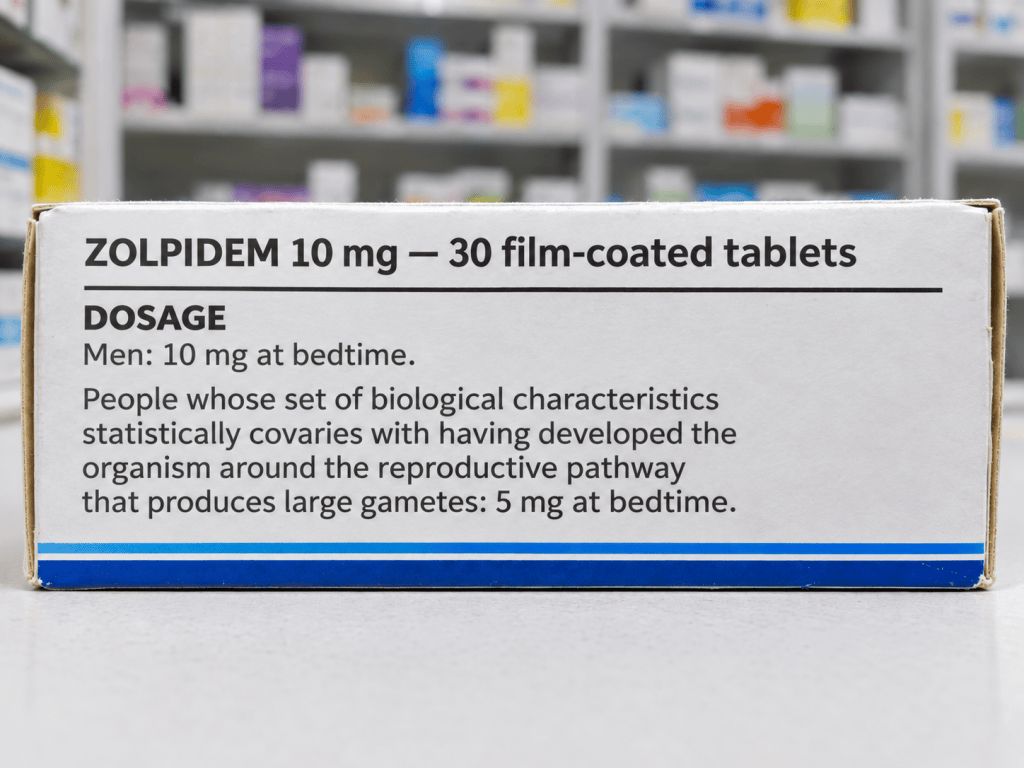
Much of the difference between the sexes is tied to no organ at all. Women clear certain drugs more slowly, which is why in 2013 the American regulator halved the recommended starting dose of zolpidem for them. The standard equation for estimating kidney function from serum creatinine carries a coefficient for sex, because muscle mass differs; when it was revised in 2021, race was removed and sex was kept. Myocardial infarction presents differently in women, and autoimmune disease is considerably more frequent among them. None of these differences has an organ to which a periphrasis might attach itself. What, then, is the inclusive phrasing for the lower dose of zolpidem? Something along the lines of “people whose organisms developed along the reproductive pathway organised around producing large gametes, with all that follows”. Seventeen words, and a terminology committee to approve them, to say what English has said for centuries in one: female.
The periphrases also fail on their own ground, because the sets do not match. A girl of eight, a woman of sixty, a woman who has had a hysterectomy and a woman infertile from birth all belong to the female sex, and none of them is a “person who can become pregnant”. The vocabulary’s answer is to conjugate. Postmenopausal osteoporosis becomes a disease of “people who used to menstruate”, and a paediatric guideline would have to address people who will menstruate in future, should nothing intervene. By that point the phrase has abandoned the function it was meant to describe and set about reconstructing an entire life history in order to avoid a noun.
6. Closer to home
Closer to home, the substitution can be watched while it happens. Uruguay’s Ministry of Public Health has carried it out in stages, and the stages are easy to date. In 2007 its guidelines were the “Standards of Care for the Pregnant Woman”, issued, without the slightest discomfort, by the National Programme for Women’s Health and Gender. In 2015 the clinical guide on congenital syphilis still spoke of “pregnant women”. By 2025 the ministerial order on syphilis and antenatal care had moved to personas gestantes, gestating persons, and the technical guidelines for the 2026 vaccination campaign against respiratory syncytial virus carry the same phrase in their title.
The interesting part happens inside the documents. The 2025 order, having promoted “the accompaniment of gestating persons by their partners”, refers the reader in the same text to the ministry’s “Manual of care for the woman during pregnancy, childbirth and the puerperium” of 2024. The RSV guidelines, which vaccinate gestating persons on the cover, report in their tables the coverage of live births “according to maternal vaccination”. The woman has been removed from the title page, and the mother has reappeared in the statistics.
She reappears there for a reason. The vaccine is given during pregnancy so that antibodies cross the placenta and protect the newborn through its first months; the whole mechanism is a relation between a female body and the child it carries, and epidemiology has a word for that relation, which the tables go on using. The cover is written for the public and the tables for the specialist, and only one of the two audiences is spared the word “mother”. That division of labour deserves a section of its own.
7. Two registers
Research never stopped saying “female”. When the American National Institutes of Health began requiring, in 2016, that the studies they fund account for sex as a biological variable, they did not ask anyone to consider gestating persons; and the SAGER guidelines, published that same year to standardise how journals report sex and gender, ask authors to keep the two apart and to report their results by sex. The specialist literature allows itself every refinement it needs, and it has kept the word.
An equation, in any case, does not accept a periphrasis. The formula for kidney function mentioned earlier multiplies its result by 1.012 “if female”, and no committee has yet found a way to make a coefficient depend on how a person describes themselves. The pressure shows only at the margins. The page on which the American institute for kidney disease explains these equations announces that they are based on “sex assigned at birth”, a phrase I do not accept, since sex is observed at birth and assigned by nobody, and in the same sentence reports coefficients “for female and male”. The vocabulary of identity has reached the preface, while the arithmetic is still done in the old language.
The result is a division of labour that inverts the most elementary rule of health communication. The reader best equipped to decode a periphrasis is the one who is never asked to: a nephrologist would understand “persons with a cervix” without difficulty, and the nephrologist is the one who gets “female”. The riddle is reserved for the woman who left school at fourteen and reads the ministry’s leaflet in the waiting room, in what may well be her second language. Plain-language standards exist to prevent exactly this, and health agencies profess them; the Canadian agency’s own accessibility plan lists them among its obligations. They are applied to every word in the leaflet except the one that would tell its reader the leaflet is about her.
8. Who pays
The cost of all this does not fall evenly. Where the periphrasis is most at home, in antenatal care, it is also most expensive, because antenatal care depends on reaching women early, and the women hardest to reach are the ones least able to decipher a leaflet that declines to say whom it is for: the adolescent who has kept the pregnancy hidden for four months, or the woman who reads with difficulty in a language she only half knows. “Gestating person” asks its reader for an act of self-classification. She has to recognise herself in a function described in the vocabulary of a seminar, at the very moment she is least inclined to read anything at all.
How many women fail to make that recognition is not known. The evidence on whether these terms are understood is almost non-existent, and the few committees that have looked for it say so themselves. Changes to clinical language that might affect who turns up for care would ordinarily be tested before being imposed; this one was imposed on the strength of a principle, and the absence of a measurement has been treated as the absence of a problem.
Why should an institution accept such a trade? There is no need to suppose a conspiracy; the arithmetic of complaint explains it well enough. If a leaflet leaves out a trans man, there is a complaint with a name and a surname, and possibly a newspaper, attached. If it confuses a thousand women, nothing happens. None of them writes to the ministry to report that she did not realise the leaflet was meant for her, since not realising is exactly what the failure consists of. A bureaucracy steers by the costs it can see, and this one has arranged its vocabulary so that one kind of cost is always visible and the other never is. The resulting language is admirably adapted to the institution that produced it, and only incidentally to the women it was meant to serve.
9. Objections
The first objection is that language evolves, and that resisting the new terms is as futile as resisting any other change in usage. Language does evolve, but it is speakers who evolve it. Dictionaries record what people say; a ministry that decides by circular what its staff will write is legislating a change in usage, and it can hardly then appeal to usage for its authority.
The second is that the new terms cost nothing. That claim would need evidence, and the evidence is missing. The Canadian advisory committee on immunisation, reviewing the literature in 2026 before recommending its own wording, found little original research on language in immunisation settings. In 2022 a group of midwives, obstetricians and public health researchers led by Karleen Gribble argued, in an opinion piece in Frontiers in Global Women’s Health, that desexed language puts comprehension at risk precisely among the women with least access to care; the piece drew a published reply, and neither side had a trial to show. A cost that has never been measured cannot be declared to be zero.
The third, and the most serious, is that the terms exist to include people who would otherwise be left out. That aim justifies adding words, and it does not justify removing them. Argentina’s abortion law of 2020 addresses “women and persons of other gender identities with the capacity to gestate”: a baroque phrase, but one that keeps the word “women” and sets the minority beside it, although a few articles further on the same law slips into “gestating persons” and leaves the women behind. A ministry that wants to reach trans men can do what the law does in its opening articles, at the cost of a few syllables. What it will not do is name the group plainly, and the reason is instructive. The obvious formula, “women and trans men”, is redundant if “woman” names a sex, since trans men are female, and absurd if “woman” names an identity, since the antenatal leaflet would then be addressed to trans women as well. It works only if the first word is read with the dictionary of sex and the second with the dictionary of identity, which is to say only if one admits out loud that the category in question is the female sex. That admission is precisely what the periphrasis was invented to avoid.
10. A map without the sea
The pattern that runs through all of this is easily stated. The harder a medical vocabulary works to remove sex from its words, the more sexual characteristics it has to list in order to recover what it removed: a cervix here, menstruation there, a capacity to gestate further on, and, for anything that concerns the organism as a whole, seventeen words about gametes. It ends by describing the female sex with remarkable precision for the sole purpose of not naming it.
The arrangement is also more stable than it looks, and for an unflattering reason. Any formula precise enough to be useful ends up naming sex, because that is what the phenomenon demands, and any formula that names sex is inadmissible by definition. Each new proposal therefore fails for the same reason as the last, and the only phrasing that survives is one vague enough that nobody has to see what it refers to. “Gestating person” has lasted precisely because it is imprecise; a little more precision and the sex shows through, and then the trouble starts. A system that rewards imprecision in a discipline whose entire business is precision has a curious notion of progress, and it calls the result inclusion. What it has produced is a map drawn to the highest standards of cartography, every road and contour line in its place, on which nobody is permitted to mark where the sea is.
The president of the Canadian agency said all of this in a single sentence, before a parliamentary committee. A person who identifies as a man and has the biological capability to be pregnant: the identity sits in the noun and the sex in the subordinate clause, and what holds them together is an institution that knows perfectly well what a woman is and has forbidden itself to say so.
References
- House of Commons of Canada, Standing Committee on Science and Research, Meeting 51, 3 November 2026. Video (ParlVU) · Notice of meeting.
- Frege, G. (1892). “Über Sinn und Bedeutung”. Zeitschrift für Philosophie und philosophische Kritik, 100, 25–50.
- Real Academia Española. Diccionario de la lengua española, s.v. “mujer”.
- “Cambridge Dictionary expands its definition of ‘woman’ to include transgender women”. ABC News, 15 December 2022.
- U.S. Food and Drug Administration (2013). Drug Safety Communication: FDA requires lower recommended doses for zolpidem.
- Inker, L. A., et al. (2021). “New Creatinine- and Cystatin C–Based Equations to Estimate GFR without Race”. N Engl J Med, 385, 1737–1749.
- Ministerio de Salud Pública, Uruguay (2007). Normas de Atención a la Mujer Embarazada. Programa Nacional Prioritario de Salud de la Mujer y Género.
- Ministerio de Salud Pública, Uruguay (2015). Guía clínica para la eliminación de la sífilis congénita y la transmisión vertical del VIH.
- Ministerio de Salud Pública, Uruguay (2025). Ordenanza N.º 912/025. Sífilis, sífilis congénita y controles de embarazo.
- Ministerio de Salud Pública, Uruguay (2025). Lineamientos técnicos para la campaña de vacunación contra el VRS en personas gestantes 2026.
- National Institutes of Health (2015). NOT-OD-15-102: Consideration of Sex as a Biological Variable in NIH-funded Research. In effect from 25 January 2016.
- Heidari, S., et al. (2016). “Sex and Gender Equity in Research: rationale for the SAGER guidelines and recommended use”. Research Integrity and Peer Review, 1, 2.
- National Institute of Diabetes and Digestive and Kidney Diseases. Demographics & eGFR Accuracy.
- Public Health Agency of Canada. 2026–2028 Accessibility Plan and 2025 Progress Report.
- National Advisory Committee on Immunization (2026). “Summary of approach to inclusive language in vaccine guidance”. Canada Communicable Disease Report, 52(4).
- Gribble, K. D., et al. (2022). “Effective Communication About Pregnancy, Birth, Lactation, Breastfeeding and Newborn Care: The Importance of Sexed Language”. Frontiers in Global Women’s Health, 3, 818856.
- “Commentary: Effective communication about pregnancy, birth, lactation, breastfeeding and newborn care: the importance of sexed language”. Frontiers in Global Women’s Health.
- República Argentina. Ley 27.610 de Acceso a la Interrupción Voluntaria del Embarazo (2020).


Deja una respuesta