EN · ES
The Nurse in the Room
When I examine a female patient and the consultation approaches the breasts or genital area, I call a nurse to be present. It is good practice, recommended long before any gender law, and protects the patient as much as the doctor. When I began practising, in 2016, I did not experience it as insurance against an accusation. Today I do.
I do not have a female partner. I am a gay man. My biographical exposure to heterosexual couple conflict is, shall we say, fairly modest. If the risk I perceive cannot arise from someone misreading my desire, what I fear is not a misunderstanding: it is the accusation itself. The fact that even from that position my perception of professional risk has changed ought to provoke some curiosity. It does not prove an epidemic of false allegations, nor does it need to. It says something more elementary: there is a social climate in which an accusation of a certain kind is perceived as capable of producing serious consequences before anyone determines whether it is true.
The usual response to this kind of concern often has all the intellectual subtlety of a slogan mug: men are frightened because they are losing privileges. It is a convenient explanation because it turns every objection into confirmation of the theory used to dismiss it. If a man does not complain, the system works; if he does, he misses his privileges. Magnificent epistemological device: the house always wins.
But losing privileges and losing guarantees are different things. A man no longer being able to control his wife economically is the loss of a privilege. An accused person having a right to a defence, proportionality, review of the measures imposed on him and the presumption of innocence belongs to another category. A guarantee limits the power that others, including the state, can exercise over a person before responsibility has been established. Calling both things privilege saves us the bother of distinguishing them and allows any concern about guarantees to be interpreted as nostalgia for an era when the man of the house decided everything. As rhetoric, effective. As legal analysis, rather less so.
The Written Law and the System It Produces
There is a recurring claim that Law 19.580 prohibits questioning the complainant’s testimony. It does not. Article 8, paragraph H, recognises a woman’s right not to have her testimony devalued through gender stereotypes based on women’s inferiority or subordination, or on other discriminatory factors. It prevents testimony being discredited because “women exaggerate”; it does not prevent evidence from being tested, contradictions from being identified or testimony from being subjected to the rules of procedure.
The stronger restriction appears when the victim is a child or adolescent: the accused cannot be present at the hearings, and questions from the defence require authorisation by the court and the intervention of specialised technical personnel.
Reading only those provisions leaves out a considerable part of the phenomenon. Institutions produce far more than what the legislature wrote. They generate administrative practices, incentives, linguistic categories, defensive behaviours and social consequences. Some were intended and others appear afterwards, that awkward relative nobody invited to Christmas who is already sitting at the table asking what is for dessert. Evaluating public policy requires looking at those things too.
The Conviction That Needs No Verdict
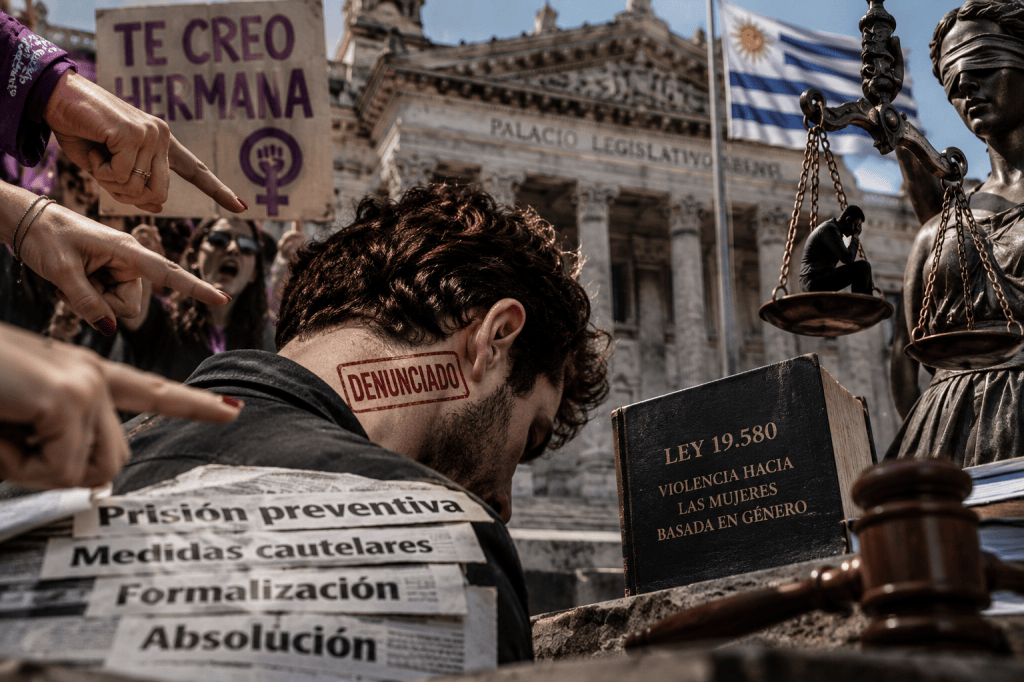
The system operates in stages that have different legal functions. Socially, that neatness evaporates rather quickly. First there is a complaint. Protective measures may follow. There may be a criminal investigation, formal charges and eventually pre-trial detention. Much later, where appropriate, a judgment will arrive. In law these are different events. To Juan’s neighbour, probably rather less so.
Juan was reported by his partner. Precautionary measures were imposed. Later he was formally charged and spent a period in pre-trial detention. His family knows, his colleagues know and the neighbourhood knows. Google probably knows too, because its memory is considerably more persistent than an acquittal.
Two years later Juan is acquitted. We know what happened to his case file. We know much less about what happened to Juan. Did he recover his job? What happened to his family ties, reputation, later relationships, health, finances and social integration? How many acquitted people continue to be “the man who was in prison for domestic violence”? How long does the stigma last? Does it vary according to media coverage? Did the precautionary measures produce employment, family or housing consequences?
These are empirical questions. They do not have a penis.
Yet asking them can appear suspicious because for a few minutes they shift attention from the victim to the accused. Here a phenomenon appears that is considerably more interesting than the usual war of slogans: when a public policy acquires a very strong moral identity, studying its adverse effects begins to be confused with attacking the objective it pursues.
Nobody would seriously think that studying postoperative complications means being against surgery. False positives are part of evaluating any screening programme without the researcher having to begin the paper by solemnly declaring that they favour diagnosing cancer. With some social policies something different happens: before asking about an adverse effect, one seems required to present a certificate of ideological good conduct.
That reflex matters because it ends up determining what we know and, above all, what we do not know.
The Academic Blind Spot and the Statistical Blind Spot
The state knows how to count what it has decided to look at. It can report complaints, measures adopted, formal charges, convictions and femicides. It is far harder to find systematic accounting of what happens to people who pass through a substantial part of the machinery and end up having proceedings dismissed or being acquitted.
But the problem begins before state statistics.
The state does not spontaneously invent every phenomenon it ought to measure. The categories of public policy, its indicators and many of the questions later used to evaluate it arise from knowledge produced beforehand. Academia identifies problems, formulates hypotheses, constructs variables, studies associations and points to consequences that may previously have gone unnoticed. Administration then turns some of those questions into registers, indicators and monitoring systems. Expecting a ministry to discover through bureaucratic illumination every unintended effect of a law is to demand capacities it normally does not possess and, frankly, to attribute to bureaucracy a scientific curiosity it rarely displays unless someone gives it a shove.
There are therefore two different responsibilities. Academia has to study. The state has to measure.
The first should ask what happens in the medium and long term to people subjected to precautionary measures, formally charged or placed in pre-trial detention who are later dismissed from proceedings or acquitted in cases involving gender-based violence. There is material here for cohorts, qualitative studies and longitudinal follow-up: employment, income, housing, family relationships, contact with children, mental health, new relationships, economic costs, social reintegration, media exposure and persistence of stigma. It would also be useful to compare the duration and intensity of measures, pre-trial detention, public exposure of the case and the time taken to reach a resolution.
We do not need to know the result in advance in order to justify that research. That is precisely what research is for, a methodological detail that occasionally seems to have gone missing somewhere between activism and the ethics committee form.
The problem arises when the question itself becomes morally contaminated. Studying an acquitted accused person can be read as “centering men”, “displacing victims” or relativising gender-based violence. That reaction has a concrete epistemological consequence: some objects become less attractive to study, less fundable, less publishable or simply less comfortable for someone starting an academic career who quickly discovers which questions confer prestige and which produce strange faces at a seminar.
There is no need to imagine a conspiracy of professors in purple scarves meeting on Tuesdays to ban topics. Disciplines also select their questions through incentives, dominant theoretical frameworks, funding agendas and moral consensus. That is how much knowledge production works. And when an object falls outside those agendas, the later absence of literature can acquire a rather perverse function: because there is little evidence of the phenomenon, the phenomenon appears unimportant; because it appears unimportant, there is even less reason to study it. A small machine for manufacturing ignorance with peer review.
That is where the second blind spot begins. If academia does not construct the problem, the state is unlikely to construct the indicator.
The state should record how long precautionary measures actually last, how many are later linked to criminal proceedings, how long those proceedings take and how they end. We should know what proportion of people subjected to measures are ultimately convicted, dismissed from proceedings or acquitted. With appropriate safeguards, those outcomes could also be linked to employment, health, family and economic variables capable of detecting persistent consequences.
A spreadsheet can report that Juan was acquitted on 14 March. Qualitative research can discover that three years later he changed jobs and somebody typed his name into Google during recruitment and found the headline about his detention first. These are different levels of knowledge and we need both.
If the harms are exceptional, studies will show that and the state will be able to measure them as exceptional. If they are frequent or concentrated in certain kinds of measure, that will appear too. The scientifically interesting point is that today we should not decide the answer before asking the question.
The state statistical blind spot and the academic blind spot are therefore not the same blind spot. The second can manufacture the first. If nobody studies what might be worth observing, it is rather optimistic to expect the state to wake up one morning possessed by the spirit of Karl Popper and decide to measure it by itself.
In dubio pro reo, and Then We’ll See
An elementary rule remains formally in force in Uruguayan criminal procedure: nobody should be treated as guilty until responsibility has been established by judgment. Where doubt prevents the required standard for conviction from being met, that doubt benefits the accused. The problem is that a substantial part of the consequences that matter occur long before that point is reached.
The presumption of innocence can remain immaculate in the Code while a person spends months under restrictive measures, losing relationships, exposed publicly, regarded with suspicion at work and carrying a social label that no later acquittal necessarily reverses. The judge may ultimately acquit for insufficient evidence. The neighbourhood does not hold a review hearing, and Google, as far as we know, has still not taken Criminal Procedure II.
In dubio pro reo thus retains all its legal dignity while losing some capacity to prevent material effects that occur before judgment. A guarantee does not need to be formally abolished to lose part of its practical efficacy. It is enough for a substantial portion of the cost to arise before the moment when the guarantee can do its work.
The Six Months
Article 66 establishes a minimum of 180 days for certain no-contact and distancing measures, although the provision itself allows them to be modified or terminated. The minimum therefore does not operate as an absolute six-month padlock. The more interesting question lies elsewhere: what criteria are used to review those measures, how frequently review occurs, and to what extent their intensity and duration respond to the concrete evolution of risk.
Urgent intervention may be justified by a degree of uncertainty that would be unacceptable for conviction. In intimate-partner violence, waiting for certainty can mean arriving too late. But precisely because the initial standard is preventive and comparatively low, subsequent review becomes more important. If the indications strengthen, there may be reasons to maintain or modify protection; if they weaken, the system should respond in that direction too. A precautionary measure that is legally reviewable but rarely reconsidered in practice raises a different problem from one that is legally incapable of review, and the two should not be confused.
A precautionary measure does not become harmless merely because the law does not call it punishment. It can alter living arrangements, housing, family contact, employment and reputation. The legal classification describes its function; it does not anaesthetise its consequences. The more intensive the preventive intervention a policy considers necessary, the greater its interest should be in studying the effects it produces and what happens when the suspicion that gave rise to it does not ultimately lead to conviction.
The War of the Numbers
In the debate over false allegations, numbers circulate with a confidence inversely proportional to the quality of what they measure. The famous Spanish 0.01% periodically reappears as though Moses had come down from Sinai carrying a third tablet.
The figure has a real source, but in public debate it often travels transformed into something else. Spain’s Fiscalía General del Estado reported that for the period 2009–2024, convictions for making a false report represented approximately 0.0082% of all complaints of gender-based violence. That figure allows us to say exactly this: convictions for false reporting are extraordinarily rare. Turning it into the proportion of complaints that are false requires an additional step, because “false complaint” and “complaint that resulted in a conviction for false reporting” are not the same variable.
Studies that have attempted to classify specific allegations directly offer another approach. Lisak, Gardinier, Nicksa and Cote analysed 136 reports of sexual assault recorded over ten years at a US university and classified eight as false, 5.9%. The authors placed that result within an approximate range of 2% to 10% found in previous research. Nor can that figure be cheerfully transplanted to Uruguay, domestic violence in general or any other population. It is a study of sexual-assault reports, conducted in a specific setting under particular criteria.
The true figure is therefore unknown. “We do not know” ought to be a perfectly respectable answer in an adult discussion, although it tends to cause hives once both sides have already ordered their placards. A conviction rate does not prove that false allegations practically do not exist; a study finding 5.9% does not prove that one in twenty Uruguayan complaints is false. Between declaring an epidemic and decreeing nonexistence lies that deeply unsexy territory called uncertainty.
Femicide and Anticipating the Verdict
In Uruguay, femicide is not an autonomous criminal offence. Law 19.538 incorporated it as a very special aggravating circumstance of homicide when a woman is killed for reasons of hatred, contempt or disdain on account of her being a woman.
The provision establishes indications from which that motive may be presumed. Among them is the prior existence of physical, psychological, sexual, economic or other violence committed by the perpetrator against the woman. Prior violence can be an excellent predictor of the risk of intimate-partner homicide. It is another matter whether it demonstrates by itself that the homicide was committed out of contempt for the victim’s condition as a woman. Risk prediction and proof of motive answer different questions.
There is also partial redundancy. Article 311(1) already aggravates homicide committed against a spouse, cohabiting partner, former spouse or a person with whom there was an affective relationship of a sexual nature. Article 312(7) aggravates homicides motivated by discrimination related to sexual orientation, gender identity, race, ethnic origin, religion or disability. Sex does not appear in that neutral enumeration: for homicide motivated by sex there is a specifically female aggravating circumstance.
The symbolic value of that legislative choice has another side. “Femicide” contains a claim about motive and, when the category leaves the case file and enters public communication before trial, that claim travels with it. Using it before that motive has been proved discursively anticipates a conclusion the proceedings must still establish. The legal characterisation may later be corrected in court; a headline that circulated for months does not automatically receive the corrective judgment. Once again, the case file contains review mechanisms that social life does not.
Liberal Feminism and Guarantees
My objection starts precisely from assumptions I consider compatible with liberal feminism. If one of its achievements was to demand that a woman be treated as a full individual before the law rather than as a representative of her sex, it is difficult to justify making that principle negotiable when the protagonist changes.
An accused man does not represent “men” either. He is not answerable for the history of patriarchy, unjust acquittals in 1950 or the judge who asked what a victim had been wearing. He is answerable for what can be proved that he did. Historical debt, if we want to use that metaphor, belongs to the institutions that produced the injustice. Collecting it by distributing the bill among contemporary individuals selected by sex resembles liberal legal individualism rather little and tribal accounting on official letterhead rather more.
That is why I am especially interested in the ease with which certain male concerns are translated into “loss of privilege”. The device allows the concrete question to be avoided. If a man fears a false accusation, privilege; if he questions a disproportionate measure, privilege; if he asks what happens to those acquitted, privilege again. At a certain point “privilege” stops being an analytical category and begins functioning like the kitchen drawer where we put everything we do not know where else to store.
There are male privileges that deserved to disappear and individual guarantees that should survive any public policy. Distinguishing them does not require extraordinary intellectual heroism.
What to Change
- Proportionate and reviewable measures. Replace the fixed 180-day minimum with a duration determined according to the available indications, with mandatory periodic review. Urgent protection can begin under uncertainty; its continuation should respond to how the risk evolves.
- Neutrality in aggravating circumstances. Add “sex” to the list in Article 312(7), so that homicide motivated by the victim’s sex receives the same treatment regardless of what that sex is, and then assess what function Article 312(8) retains alongside Article 311(1).
- Separate risk from motive. Review the indications in Article 312(8) so as to distinguish what predicts risk of violence from what permits inference of the specific motive required by the aggravating circumstance.
- A charging review that actually reviews. Aggravating circumstances require evidence of their own. If evidence appears later, there should be mechanisms for incorporating it while guaranteeing that the defence can respond. Judicial review loses much of its charm if its principal activity consists in checking that the form exists.
- The same evidentiary standard for subjective elements. If a mental state attributed to the accused increases punishment, proving it deserves the same rigour we demand when a subjective element might reduce punishment.
- Institutional communication with procedural sensitivity. Before judgment, official communication should describe the procedural posture and the legal characterisation under dispute instead of turning a legal hypothesis into the public identity of the case. Google is not going to learn criminal procedure; the state can.
The State Pays the Bill
A serious public policy is also evaluated by the harms it produces while trying to prevent others. The problem begins when some of those harms acquire ideological immunity: mentioning them is interpreted as an attempt to take rights away from women; studying them, as suspicious concern for men; demanding guarantees, as nostalgia for lost privileges. The result is a blind spot that then feeds itself, because what is not studied produces no data, and what produces no data is unlikely to reach the agenda of those designing policy.
Historical injustices against women were real, as was the institutional indifference that for far too long surrounded domestic and sexual violence. That history explains many current institutions; it does not turn the procedural guarantees of contemporary men into compensatory currency. Juan is not answerable for a collective historical debt. He is answerable for what can be proved that Juan did.
If, after passing through the system, he is acquitted, the state should not simply close the file satisfied that technically it never declared him guilty. It needs to know what happened along the way. And in order to measure it, someone first has to have dared to turn that journey into an object of research.
Academia and the state have different but linked responsibilities here. The first must allow itself to ask questions even when they are politically unfashionable. The second must turn relevant knowledge into indicators and review its policies when those indicators reveal avoidable harms. If either decides that certain effects are too uncomfortable to look at, ignorance ceases to be an absence of information and becomes part of the design.
A judgment can acquit a person. It cannot rewind time and automatically undo everything that happened before it. That remainder belongs to public policy too, even if there is not yet a box for it on the form.
References
- Uruguay. Ley N.º 19.580, 22 December 2017. Ley de violencia hacia las mujeres basada en género. Especially Articles 8, 65 and 66. IMPO.
- Uruguay. Ley N.º 19.538, 9 October 2017. Amendment of the Criminal Code incorporating femicide as a very special aggravating circumstance of homicide. See Código Penal, Articles 311 and 312. IMPO.
- Uruguay. Código del Proceso Penal, Ley N.º 19.293. Especially Articles 4, 217 and 223, concerning treatment and the status of innocence and pre-trial detention. IMPO.
- Lisak, D., Gardinier, L., Nicksa, S. C. & Cote, A. M. (2010). “False Allegations of Sexual Assault: An Analysis of Ten Years of Reported Cases”. Violence Against Women, 16(12), 1318–1334. DOI: 10.1177/1077801210387747.
- Fiscalía General del Estado de España (2025). Memoria de la Fiscalía General del Estado 2025. Violencia sobre la Mujer. Aggregate 2009–2024 data on proceedings and convictions for false reporting.


Deja una respuesta