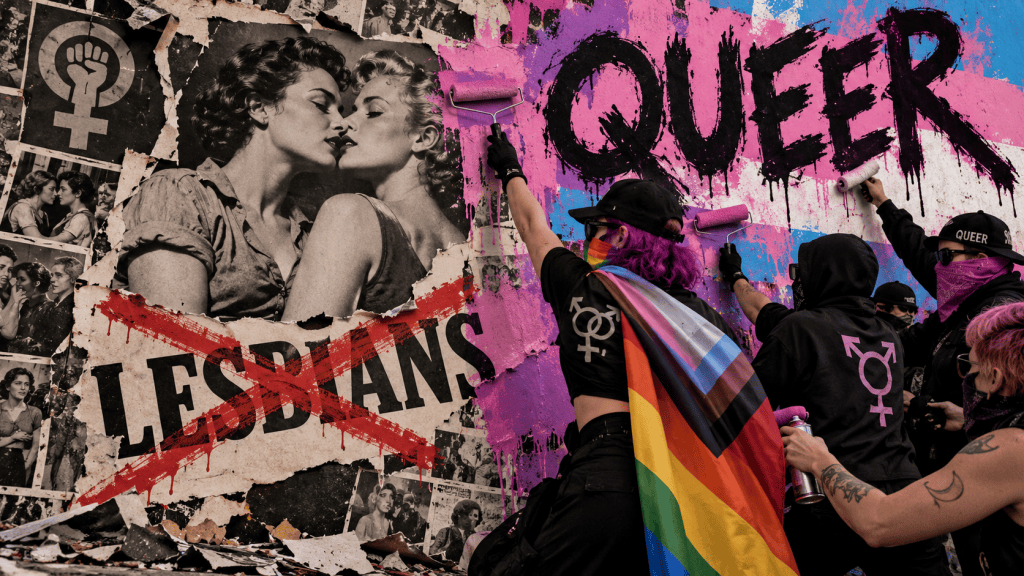
EN · ES
What ‘Lesbian’ Means
A lesbian can be masculine to the point of caricature, hate dresses, wear her hair shaved, buy her clothes in the men’s department and have a relationship with femininity comparable to a bricklayer’s with classical ballet. She may be called Margaret, introduce herself as Mags, adopt a masculine nickname or spend half her life hearing that she ‘looks like a bloke’. None of that makes it mysterious what the word lesbian tells us about her. She is a woman who is sexually attracted to women.
The definition does very little work, and that is one of its virtues. It describes no personality, aesthetic, ideology, sexual practice or emotional project. Two lesbians can resemble each other so little that the only possible conversation over dinner is deciding who asks for the bill. One may be femme, the other butch; one a radical feminist, the other a liberal; one looking for a stable partner and the other suffering a severe allergy to any sentence containing the phrase ‘life plan’. They share an orientation, not a collective personality.
In terms of the model developed earlier, we are talking about female homosexuality: a human female whose erotic-sexed field is oriented towards the bodies of human females. ‘Woman’ here designates the adult human female. Adulthood belongs to the noun in ordinary language; the orientation can show itself long before it is reached, as any teenager knows who discovered far too early that her female classmates produced a kind of nervousness the boys never managed to provoke.
Sex takes part at both ends of the relation. There is a sexed body from which desire is felt, and there are sexed bodies capable of appearing as erotic objects. Between those two poles lies an enormous diversity. A lesbian may be attracted exclusively to very feminine women, to butch women, to large bodies, small ones, young ones within her own age range, mature, muscular or delicate ones, or to combinations that defy any attempt to turn sexual taste into an Excel spreadsheet. The Individual Space of Erotic Possibilities (ISEP) begins precisely there, inside a shared orientation that leaves almost everything else open.
Lesbian history contains enough examples of that diversity to make any attempt to deduce a person’s sex from their gender expression look strange. Butch/femme cultures made the decoupling of sex and presentation an everyday fact long before universities needed thirtypage vocabularies to describe it. A woman could adopt masculine codes, court, wear a suit, take on particular sexual roles and still be recognised as a woman within a relationship between women. Masculinity never needed to turn her into a man in order to acquire erotic force.
That point lets us see how much an orientation really tells us. A lesbian can desire masculinity without desiring male bodies; a gay man can be attracted to extremely feminine men without that femininity opening his erotic field towards women. Expression and sex interact within desire without becoming the same variable.
The word lesbian later added many things to that initial structure. It can offer belonging, memory, sexual culture, political genealogies, spaces of one’s own, literature, humour, codes of recognition and a history marked by forms of persecution different from those experienced by gay men. For some women that density fills an enormous part of their lives. Others use the word barely at all, just to explain who they go out with, and then get back to more pressing matters, such as persuading a plumber to turn up on the day he said he would.
Historical accumulation makes it tempting to confuse layers. A woman can take part intensely in lesbian culture and be bisexual; she can have had relationships exclusively with women for decades and retain an erotic capacity towards men. Conduct does not by itself settle orientation. A bisexual woman who has been married to a woman for twenty years does not turn biologically homosexual through sheer marital perseverance, just as a lesbian who went through a heterosexual marriage before recognising herself does not become retrospectively heterosexual because wedding photographs exist.
It can also happen that a homosexual woman rejects the word lesbian. She may prefer gay, homosexual, no label at all, or any formulation she finds less loaded. The orientation is still there. A classification describes a property even if the person classified does not find the available vocabulary especially congenial. In medicine we are used to the difference between a phenomenon and its name; it would be odd to demand of sexuality a metaphysics in which things begin to exist once they agree to be named.
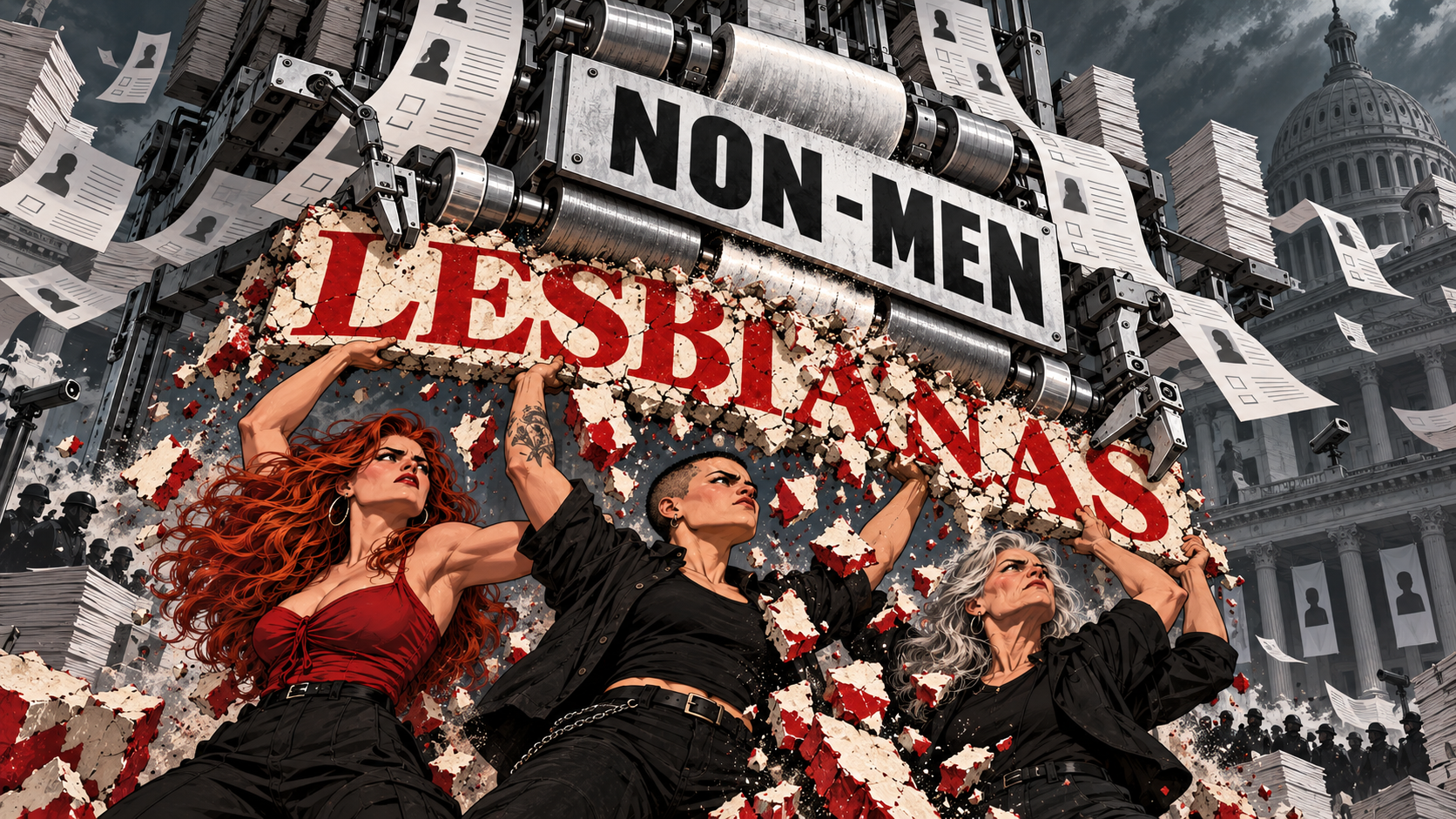
This separation matters in the face of a recent transformation of the vocabulary. In some contexts, lesbian has come to be defined by gender identity rather than by sex. The old formulation ‘a woman attracted to women’ keeps the same words while woman changes referent: it stops naming the adult human female and comes to designate whoever identifies as a woman. In other versions even that noun disappears and the formula ‘non-men loving non-men’ appears.
The change looks inclusive because it enlarges the extension of the category, at the cost of drastically reducing the information the word carries. ‘Non-man’ can include human females who identify as non-binary, people of the male sex who adopt non-masculine identities and an open-ended number of self-descriptions. Subject and object of the orientation are no longer defined by a positive sex class.
A sexual category built out of two negations begins to depend on what it claims to exclude. Lesbian, a word whose history was organised around women desiring women, ends up explained as a relation between people who are not men. The male, expelled from the erotic scene, quietly reappears as the unit of semantic measurement. Some ironies come preassembled.
Self-ascription also introduces a strange property. If belonging to the category depends on recognising oneself within it, lesbian risks becoming circular: a lesbian is whoever identifies as a lesbian because she identifies as the kind of person who can be a lesbian. The definition no longer allows an experience to contradict the name. A heterosexual woman could be mistaken about her orientation; a homosexual one could deny it for years; the history of homosexuality is full of people who needed a long time to understand what was happening to them. When the category no longer admits that kind of error, it works less as a description of desire than as a declaration.
Lesbians have particularly strong historical reasons to distrust a sexuality organised by declaration. Their orientation became significant because desire could dig its heels in against expectations, convenience and conscious decisions. A woman could try to love a man, marry, have children, obey her family or spend years interpreting her attraction to other women as an overly intense friendship. Sexuality became visible precisely where the will ceased to govern effectively.
Reducing that structure to identity produces a curious inversion. What once needed a word because it persisted even against the way the person wanted to think of herself begins to be defined by the way someone decides to describe herself. The name no longer arrives after the desire, and acquires the power to reorganise it.
An adult female exclusively attracted to other females still has a homosexual orientation even if she prefers to call herself non-binary, a trans man or captain of the Enterprise. Her selfdescription may matter enormously for her social life, for the way she presents herself and for the relationships she builds; it does not alter the sexual structure we are classifying. To grant identity the power to remove her from female homosexuality would be as incoherent as granting it the reverse power to bring a male person into it.
Consistency requires accepting both results.
A male person exclusively attracted to women has a heterosexual orientation with respect to sex, even when he identifies as a woman and uses lesbian to describe himself. Within a gender-based framework there is a lesbian identity, and that person takes part in spaces that adopt that criterion, where he will find others who recognise the category. That definition and the female-homosexual definition classify different things.
The contemporary dispute tends to hide behind the illusion that we are merely deciding who deserves a kind word. In reality what is being decided is which property the word classifies. Sex and identity produce different extensions. The difference appears immediately when a category leaves the screen and organises a space, an association or a meeting network.
A lesbian who looks for other lesbians is not formulating a general theory of human dignity. She looks for women because they constitute the sexual field towards which her orientation is directed. She can find one woman attractive and reject a thousand others; she can be fascinated by an extremely masculine butch and completely indifferent to a femme who looks as though she has stepped out of a perfume advert. Individual selectivity begins after a more elementary delimitation.
The body takes part in that delimitation without having to appear as an anatomical chart. Nobody walks into a bar and asks for a karyotype before asking for a phone number. We perceive whole bodies: face, voice, proportions, smell, build, movement, skin, distribution of fat, musculature and an infinity of signals that arrive together long before consciousness decides to list them. Some of them can be profoundly altered by hormonal or surgical transition. Perception can be mistaken. Desire can also surprise us.
A lesbian may initially feel attraction towards someone she perceives as a woman and only later discover a male body. The episode does not automatically turn her erotic field bisexual. The salience arose within a configuration perceived as female; learning later about relevant bodily characteristics may keep it, alter it or destroy it. Orientation classifies a pattern; it does not hand out fines every time perception gets it wrong.
The reverse experience is just as instructive. A declared female identity does not oblige a male body to acquire erotic force for a lesbian. She may acknowledge the name, the pronouns and the identity around which that person organises their life; none of those operations installs desire where there is none.
Arousal doesn’t work in HR and never signed the diversity policy.
Around that sexual direction an immense culture accumulated: women who shared something quite concrete ended up finding one another, organising, loving one another, falling out, creating places of their own and arguing for decades about what to do with them. When the word stops saying who those women were and what they shared sexually, it also becomes harder to explain who those places were built for.
When the Word Changes Its Object
For decades, the ordinary definition of lesbian could vary in its details and keep a recognisable structure. A woman desired other women sexually or emotionally; the disagreements began afterwards, over how much desire was required, what place conduct occupied, how bisexuality fitted in, or how much weight identity should be given. Even contemporary institutions still use definitions close to that structure: the US CDC describes a lesbian as a woman who is primarily attracted to other women, while academic work on sexual orientation continues to treat the sex of the possible objects of attraction as a central variable.[1]
The apparent stability depended on a word that carried almost all the weight without drawing much attention to itself: woman. As long as it designated the adult human female, ‘a woman attracted to women’ described a relation between the sex of the subject and that of those who could occupy her erotic field. The formula remained compatible with endless variations of personality, gender expression and sexual life. A masculine lesbian was still a woman; a femme was no more of a woman for wearing heels; a butch/femme couple did not magically reproduce a heterosexual relationship because one of them could bleed a radiator and the other had better eyelashes.
The referent began to move when woman came to be used also as a category determined by gender identity. The sentence stayed written the same way and began to classify something else. A male person identified as a woman could now enter both places in the definition: as a lesbian subject and as a possible object of a lesbian orientation. The change did not visibly occur inside lesbian. It occurred first inside woman and came back to sexual orientation with the furniture rearranged.
Kathleen Stock framed this dispute in especially useful terms by defending a conception of orientation as a sexual disposition directed towards a particular biological sex. On her analysis, classification depends on the sex of the person who desires and on whether the disposition is directed towards people of the same sex or the other; from this it follows that homosexuality and heterosexuality remain informative categories even when identity, conduct and self-description do not perfectly coincide.[2]
In some spaces the contemporary transformation went further. The formula non-men loving non-men began to circulate, presented as an inclusive definition of lesbianism. It can be found in current educational and popular resources, alongside variants that explicitly include non-binary people within both the subject and the object of the category.[3]
The expression has a strange architecture. Where before there were two positive terms, woman and woman, there are now two negations built around the man. The female sexual category par excellence ends up defined as whatever is left when the male is removed. Lesbianism thus achieves a semantic pirouette that would have fascinated a logician and probably irritated quite a few lesbians: making women disappear in order to make the definition more inclusive, while keeping the man as the indispensable point of reference for what they supposedly are.
‘Non-man’ is not a sex class either. It can cover a woman, a female person who describes herself as non-binary, a male person who adopts a non-masculine identity and any future category whose only relevant property is not containing the word man. Two members may have no sex in common, no shared relation to their own bodies and not even the same structure of orientation. The unity appears at the level of declared identity.
That radically changes the amount of information transmitted. If a woman said she was a lesbian under a female-homosexual definition, the word allowed us to infer at least two things: she belonged to the female sex and her orientation was directed towards that same sex. Not much more. We did not know how she dressed, what practices she liked, how she voted, whether she wanted to get married or whether she could assemble an IKEA flat-pack without phoning an ex.
The category gains breadth at the cost of resolution. That trade can be useful for building a cultural umbrella, but it becomes costly when the same word has to name a specific sexual orientation. The more different experiences the label absorbs, the less information it retains about the property it once isolated.
Nor did the dispute arise because a handful of gay people decided to guard the dictionary obsessively. Sheila Jeffreys was already describing, in 2003, a loss of lesbian specificity within the expansion of queer politics. Her historical explanation and much of her programme belong to a far broader feminist tradition that will appear later; a single observation is enough here: concern about the absorption of lesbians into wider political categories long predates today’s arguments about pronouns, TikTok or diversity forms.[4]
The word queer had offered a real advantage to heterogeneous coalitions. It allowed people to come together without presenting every experience as identical. That indeterminacy worked as long as the umbrella stayed above the particular categories. A lesbian could be a lesbian and also queer, if she found political or cultural value in the second word. The relationship changes when the language built to question borders begins to supply the criterion by which whatever lies underneath must be reinterpreted.
Lesbians find themselves in a peculiar position within that operation. Gay men may also see the extension of gay altered when man is defined by identity, but male spaces and categories have more often retained a gravity of their own. In the lesbian case, the expansion of woman and the circulation of queer women, sapphic, non-men and other formulas take place over a numerically small population whose name already coexisted with a long history of subordination within wider coalitions. Organisations created specifically for lesbians have begun to describe that loss of focus as a distinct political phenomenon.
The Lesbian Project emerged in the United Kingdom precisely around that concern and defines its population of interest as same-sex-attracted females. Its work maintains that specifically lesbian needs have often been subsumed under wider LGBTQ+ categories, and one of its declared aims is to rebuild lesbian communities and social spaces.[5]
There is a considerable difference between that operation and simple nostalgia for an old word. If a term changes but keeps the same population and describes it just as well, the terminological fight may be little more than a generational squabble. Here the modification alters the set. People who were previously outside are now inside; some homosexual females who reject the identitarian framework discover, at the same time, that their own definition is beginning to be treated as insufficient or exclusionary.
The category is no longer enlarged only at its edges. The principle that decides where the edges lie changes.
That explains the noise around an apparently small word. A lesbian can accept that another person uses queer, sapphic, transbian, non-binary or any other available label to make sense of her experience. That does not settle what lesbian should name. The conflict begins when that proliferation turns back on the historical word and modifies the experience it designates.
There is a tendency to treat any resistance to this movement as irrational attachment to linguistic purity. Human categories change, of course. Gay has not always meant the same thing; queer went from insult to political reclamation; homosexual has passed through medicine, law, activism and everyday speech. The history of a word allows enormous modifications.
It also allows replacements.
If tomorrow widower began to include someone who had lost a friend, the word would have changed legitimately within the language and would at the same time stop isolating an experience that could previously be named with precision. Semantic evolution does not guarantee that the function is preserved. Sometimes a language gains breadth and loses discrimination.
With lesbian it is precisely that discrimination that is at stake. Female homosexuality is a specific and minority sexual configuration: there are females whose sexual attraction is directed only towards other females. That population does not disappear when the vocabulary changes; it can end up, instead, more poorly named.
The Lesbian Project deliberately uses ‘same-sex-attracted females’ to avoid that ambiguity and declares that its interest is directed at the group even when some of its members prefer another name. Its formulation has an epistemological advantage that is awkward for a politics based on self-ascription: it makes it possible to identify the phenomenon before knowing the label the person uses for herself.[6]
A category that describes something must retain some independence from the will of whoever bears it. We can get it wrong when applying it; its borders may need discussion; there will be ambiguous cases. The very possibility of error is what lets us distinguish classification from declaration. If every self-ascription automatically produces a true instance of what it names, the word ceases to be tested against experience.
Homosexuality was particularly resistant to that kind of voluntarism. A woman could spend years insisting she was not a lesbian while her fantasies, crushes and arousal piled up evidence that was a good deal less obedient. She could sleep with men and remain homosexual; she could never have slept with a woman and be one all the same. The category was useful precisely because conduct, consciousness and orientation could come apart.
The identitarian model reverses that relation when it makes declaration a sufficient condition. A male person can become a lesbian without his sex having changed or the sex towards which his attraction is directed having changed; it is enough to shift the category woman used in the definition to the level of identity. The same sexual relationship, previously classified as heterosexual, can acquire another name after a change in the self-description of one of the people involved.
The scene lets us see it without much abstraction. A couple consists of two people of different sexes who have known for years which bodies attract them. One of them begins to identify as a woman. From an identity-based taxonomy, the couple can come to describe themselves as lesbian; from a sex-based taxonomy, each orientation continues to be classified by the relation between the sex of the person who desires and the sex towards which the desire is directed.
No sexual organ received the memo about the change in terminology.
The expression sounds brutal because the body is usually brutally undiplomatic. Sexual orientation never promised that its classifications would coincide with every way in which we would like to understand ourselves. A gay man can fall in love with a straight man who will never reciprocate; a lesbian can be attracted to a woman who detests her; a bisexual, to someone whose sex she had never imagined bringing into her life. Desire distributes possibilities before asking whether they make for an elegant autobiography.
The identitarian redefinition also adds a peculiar expectation about those who were already using the word. A lesbian who understands her orientation as attraction to females may then find herself explaining that her criterion does not coincide with gender identity. The category that once summed up the explanation now needs an appendix: lesbian, but same-sex attracted; lesbian, but ‘sex, not gender’; lesbian in the old sense; lesbian, the real kind, some will say with less patience. When those adjectives are needed to recover the original distinction, something has shifted at the centre of the word.
The consequences show up outside the dictionary. Categories are used to look for partners, find communities, organise research, create associations and build places where certain people can find one another. A broader definition can seem generous while it is discussed in the abstract; the cost becomes visible when someone needs to know exactly who belongs to the group.
Lesbians have begun to rebuild some of that precision through new organisations. Scottish Lesbians, for example, defines itself explicitly around females exclusively attracted to the same sex and upholds the right of lesbians to meet and to build their own spaces and communities. The Lesbian Project makes a similar demand in the United Kingdom and speaks directly of revitalising separate lesbian networks and social spaces.[7]
These initiatives contain a simple political response to semantic expansion: if lesbian no longer guarantees that an organisation is made up of female homosexuals, some female homosexuals gather again using criteria that do guarantee it. The border reappears because the population continues to exist even if the dominant language would prefer to make it porous.
It is hard not to notice the historical irony. Homosexual women built a word and spaces capable of making visible an orientation that had for a long time been ignored, pathologised or treated as a secondary deviation from male homosexuality. After managing to make lesbian name something recognisable, a politics obsessed with destabilising categories discovers that the border itself is an injustice.
A Space of One’s Own
A woman walks into a lesbian bar on her own. She does not need to work out beforehand who is available, explain that she is looking for women or calculate how much male attention she will have to fend off during the evening. She may fancy just one of the women there, or none, and end up chatting with a friend, having a drink and going home early. The place has already performed a function before any sexual encounter takes place: for a few hours, heterosexuality has stopped being the ambient assumption.
Lesbian spaces did far more for decades than provide partners. Friendships, information, sex, conflicts, literature, activism, codes and networks of support circulated there. They offered an uncommon experience for a small sexual minority: being surrounded by other women for whom desire towards women needed no explanation either. A lesbian could walk in with her girlfriend, look for someone else, forget both of them and start dancing. The criterion that organised the place was modest, and that is precisely why it worked.
Those places have become scarce. In its review of public life in the United Kingdom, The Lesbian Project found a sustained loss of bars, bookshops and other lesbian spaces; its first report noted that only two permanent venues predominantly aimed at lesbians remained. Its later review maintains the disappearance of specifically lesbian spaces as a probable finding and treats with greater caution one particular explanation: that the shift towards queer identities is one of the causes of that loss.[8] In the United States, The Lesbian Bar Project currently maintains a directory of thirty-six lesbian bars, a figure that on its own gives some idea of how exceptional an establishment specifically dedicated to that population has become in a country of more than three hundred million people.[9]
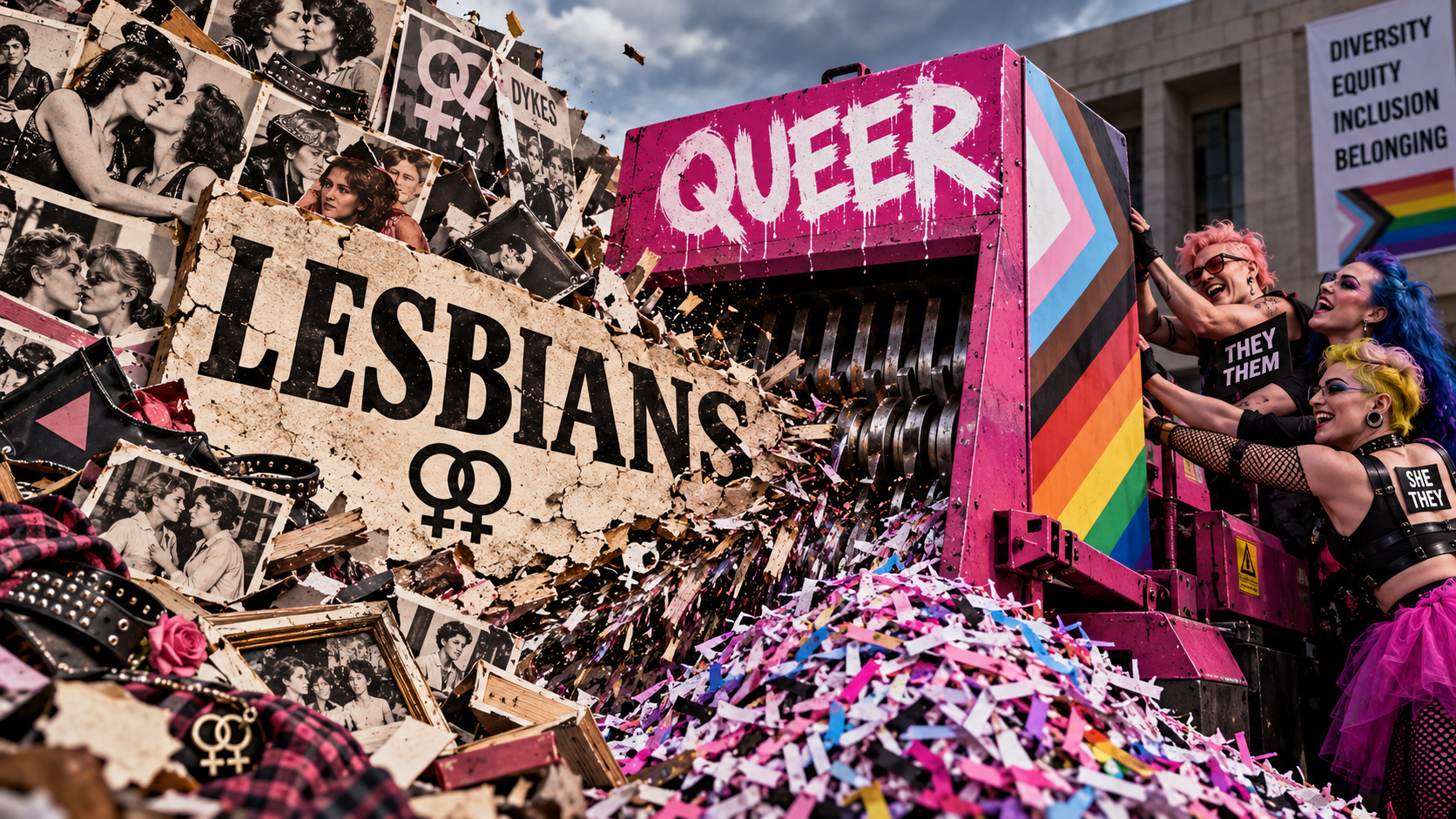
The disappearance has too many causes to be tidily pinned on a single theory. Urban rents changed, as did apps, the ways of meeting partners, the social integration of gay people, the night-time economy and the habits of generations who no longer need to travel to a particular neighbourhood to discover that there are other people like them. Gay bars have also gone through similar changes. The redefinition of lesbian intervenes somewhere else: it alters what it means to try to create, once again, an exclusively lesbian space.
An association announces a dinner for lesbians. For years the phrase would have been enough to indicate whom it was aimed at. If lesbian comes to include anyone who identifies as a woman and is attracted to women, the organisation has to choose between criteria that no longer produce the same set: it can keep sex as the border or use gender identity. There is no magical third definition that makes both universes coincide when a case arises where they differ. At the door, a controversy that stays gaseous on the internet becomes material.
Scottish Lesbians puts it bluntly: it describes itself as an organisation run by lesbians, for lesbians, understands them to be females exclusively attracted to the same sex and asserts its right to meet, organise and create spaces of its own.[10] The Lesbian Project adopts a similar criterion and explicitly centres its work on same-sex-attracted females; besides research and political representation, it declares among its aims the rebuilding of lesbian networks and communities.[11]
The precision of those organisations is revealing. Where it once would have been enough to write ‘lesbians’, they now need to add ‘same-sex-attracted females’. The definition gets longer because the short word no longer guarantees the referent.
A space like this offers something different from a party for women in general, a queer event or an LGBT evening. The selection of participants is part of what is being sought there. Whoever walks in knows that the others share an orientation comparable to hers, even if they differ in age, appearance, politics, class, sexual practices or ways of living it: the forty-fiveyear-old butch who has spent half her life fixing motorbikes, the twenty-year-old undergraduate who still doesn’t know how to talk to a woman she likes, the sixty-eight-yearold who arrived with her wife, and a femme capable of turning five minutes in front of the mirror into an Olympic discipline.
The widening into queer space produces a different, perfectly recognisable kind of space. Gay men, bisexuals, trans people, non-binary people, asexuals, heterosexual couples with queer identities and any other configuration accepted by the organisers can all meet there. The result can be enormous, fun, sexually exuberant and politically interesting. It ceases, however, to do the specific work of a place where a lesbian assumed she was among other lesbians.
The substitution is hard to notice when it is described as simple inclusive evolution. A lesbian bar turned queer space can keep the décor, a good part of its clientele, the history of the venue and even a night called lesbian night. From the outside it looks as though it survived and became broader. For the woman who came precisely because she wanted to find herself within a female sexual population, the property that made the place singular has gone.
The difference recalls any association built around a specific characteristic. A Deaf club offers something different from an open community centre where deaf people also take part. Think of an association of British expats in Madrid: it will collaborate with other organisations and yet still hold meetings where an argument about the price of a decent box of tea bags needs no historical background. Breadth increases certain possibilities of encounter; specificity creates others.
In the lesbian case, specificity also has an immediate relation to sexuality. A heterosexual woman does not need to enter places reserved exclusively for heterosexuals: almost all social space operates on the expectation that men and women will meet erotically. A lesbian lives in that same world as a minority. To have an environment in which potential sexual availability is delimited by her orientation, someone has to draw a border; that border does not guarantee attraction among those present, it only delimits the universe in which desire makes sense for those who share the orientation.
The difference seems insignificant until it disappears. A lesbian opens an app, a group or an activity advertised for lesbians and finds profiles of male people included by way of gender identity. She may respect perfectly well the way those people describe themselves, and still find that the space has stopped doing what she was looking for. For her sexuality the change is concrete: she is once more filtering by sex inside a place whose category had served precisely to spare her that work.
The usual reaction shifts the burden on to her: to state on her profile that she is looking only for female-sexed women, to create an activity with additional criteria or to add same-sex attracted to her description. Each solution confirms the transformation. A new specification is needed to recover, inside lesbian, the information the word used to provide.
That shift has a particularly strange effect on an orientation historically punished for excluding men from its desire. Compulsory heterosexuality never consisted solely in prohibiting relationships between women; it also organised the expectation that a man should one day be able to occupy the central erotic place in a woman’s life. Lesbianism broke that expectation in a brutally simple way. No man was ever going to show up.
Within an identity-based definition, male bodies return to a category whose characteristic sexual feature was that they lay outside its field. The language changes and a familiar demand reappears: the homosexual woman once again finds herself explaining why a particular male body does not enter her desire.
Sometimes the scene takes the form of a moral accusation. A lesbian says she would not have sex with a trans woman who has retained male genitals, and her preference is treated as a political position that must be examined, justified or corrected. What for her functions as an erotic limit receives a doctrinal reading; desire finds itself before a sort of tribunal of inclusion where it must present its grounds. Before that tribunal, female homosexuality has little paperwork to offer.
A lesbian may have no attraction whatever to a penis. It may also be sexually irrelevant to her how much social, hormonal or aesthetic work has modified other characteristics of the body that bears it. The limit appears before, after or alongside genitality because sex is perceived through a bodily constellation and not through a single anatomical piece. Each ISEP will distribute those signals in its own way. The shared characteristic remains at the most austere level: her orientation is organised towards the female sex.
Orientation never granted a right of access to every individual belonging to the appropriate sex. Being a woman does not oblige anyone to be desirable to a lesbian either; it merely places her within the class in which desire appears. After that, taste intervenes: too masculine for one, too feminine for another, too young, too old, too tall, unbearable after thirty seconds of conversation or identical to an ex whose shadow still ruins weekends.
For a female homosexual, a male body is placed before that individual selection. Turning the identity of the person who inhabits it into an argument about another person’s orientation once again confuses two experiences: how someone understands herself and which bodies acquire erotic value for someone else.
Lesbian spaces make that delimitation collective. In her private life, a woman rejects whoever she does not desire without any need to create an institution. When several want to meet precisely because they share that orientation, an association appears around the same criterion; a minority property in everyday life acquires centrality there.
Freedom of association loses a good part of its content if a group is only admissible as long as the criterion that created it remains open to those who do not meet it. An association of lesbians that redefines lesbianism in order to incorporate male people keeps the name but alters the group. It can voluntarily turn into something else; many organisations have done so and their members may prefer it. The change of criterion deserves to be described as such.
The question acquires a different texture among young women. A teenager who begins to recognise her homosexuality today has an immense amount of identitarian vocabulary at her disposal and far more sexual visibility than earlier generations. She can find explanations in seconds, meet women through an app and watch lesbian couples in dramas where nobody is obliged to die before the credits. She also arrives at spaces where the word she believed described exclusive attraction to women uses a different criterion from the one she had understood.
For some it will be irrelevant. Others will embrace queer language with enthusiasm. Some will look for exactly what earlier lesbians looked for: other homosexual females. The Lesbian Project explicitly places the rebuilding of communities among its priorities, with particular attention to young lesbians and to women who find fewer social resources available.[12] Its 2024 review returns to the loss of bars, bookshops and social spaces, while acknowledging the limitations of the available evidence and classing as still uncertain the specific causal contribution of the shift towards queer.[13]
That empirical caution leaves the normative dispute intact. Even if five hundred lesbian bars appeared tomorrow and the property market were miraculously fixed, the question would remain of who creates a space organised around female homosexuality, and by what criterion. Scarcity makes the discussion urgent; it does not manufacture it.
Recovering spaces of one’s own does not need to restore a golden age that never existed either. Lesbian bars had conflicts, hierarchies, snobbery, racism, fights between butch and femme, unbearable codes and toilets whose very existence called the achievements of Western civilisation into question. They were human places, and people found one another there.
That function takes on a different texture when the population is small. According to The Lesbian Project’s demographic review, around 1.2% of women in the United Kingdom identified as lesbian in the data analysed, with significant differences by age and region.[14] A minority of that size can easily be diluted within a much broader category even when all its members are welcome and nobody means it any harm.
Breadth has its arithmetic.
An LGBT event with twenty lesbians in a room of three hundred people and a lesbian event with twenty attendees contain the same absolute number of lesbians. The social experience is not much alike.
The specifically lesbian organisations that have emerged in recent years seem to respond to that difference. Scottish Lesbians explicitly demands spaces of its own; The Lesbian Project speaks of a community with little specific representation and of the need to revitalise networks of women attracted to the same sex.[15] Their analyses, strategies or political positions are open to debate. Their very existence already tells us something: some lesbians consider that the general umbrella has stopped meeting needs that only appear when they are seen as a group in their own right.
The old acronym promised cooperation among differences; for that cooperation to exist, the differences needed to keep their names.
Within a lesbian space there is room for politics or none, for monogamous couples and for women who would rather burn down the register office, for feminists and for women who flee any conversation containing the word patriarchy. What brought them there occupies a tiny fraction of each biography. From there on, even the choice of music is material for a ferocious argument.
The Right to Desire without Pedagogy
A lesbian does not need a theory of woman before a woman appeals to her. Nor does she consult a definition of gender before feeling indifferent towards a man. Her orientation works with an economy far less sophisticated than the vocabulary built up around it afterwards. A body enters the erotic field or it doesn’t. From there begin the preferences, the accidents, the disappointments, the fantasies and all the rest of that artisanal industry of desire, which rarely produces two people alike.
For much of homosexual history, that disobedience was exactly what had to be defended. A woman received, for years, every instruction needed to become heterosexual: available boyfriends, family expectations, marriage, religion, cultural models and an entire life prepared for men to occupy the corresponding erotic place. The pedagogy was complete. Desire remained stubbornly elsewhere, and sexual emancipation consisted, too, in accepting that failure.
Homosexuality ceased to be a task awaiting correction. The homosexual no longer had to learn to desire properly; society had to learn to live with the fact that some desires did not follow the expected programme. That achievement was especially elementary for lesbians, because their orientation excluded from the sexual field precisely the sex whose presence had organised, for centuries, a good part of the expectations about women’s lives.
A man could be a friend, brother, colleague, doctor, neighbour, political opponent, boss or the bloke who turns up to fix the fridge and leaves the kitchen worse than he found it. None of those relationships needed to turn him into a possible sexual object.
That limit now comes under peculiar pressure when gender identity determines which bodies should be included within an orientation. If a male person identifies as a woman, an identity-based definition can place him within the set of possible objects of a lesbian. The operation works perfectly well in language. Desire keeps its right of veto.
A homosexual woman can acknowledge that identity in social interaction and experience no change whatever in her sexuality. She can use the requested name, share public spaces, work, talk, build friendship or affection and still feel not the slightest attraction. Another person’s body does not acquire erotic salience because a social category has changed; nor does her refusal need to turn into a case file.
In much of sexual life we accept a simple fact: nobody is obliged to want to go to bed with anybody. The principle becomes strangely more complicated when the refusal meets a politically sensitive category. Then questions about reasons appear. Is it the genitals? The sex? Prejudice? Would something change after surgery? What if the person were indistinguishable from a woman? The lesbian ends up subjected to an admissions interview in order to explain why her homosexuality works as homosexuality.
Sometimes she will know how to answer. At other times she will simply register an absence of desire. Human sexuality is full of decisions that consciousness receives once they have been taken somewhere else. We can know with extraordinary precision that someone does not attract us and lack a decent theory as to why.
The demand to justify it sets up a curious asymmetry. Nobody usually asks a heterosexual woman for an ontological theory of why she feels no desire for another woman. Nor do we expect a written defence from the gay man each time an attractive woman fails to arouse him. The category of orientation settles a good part of the paperwork. The lesbian should enjoy the same economy.
Nor is her orientation open to negotiation because an exclusion is painful for the person left outside. Being sexually rejected can be unpleasant, humiliating or devastating. Romantic rejection has produced poetry, alcoholism, atrocious songs and phone calls that some responsible authority ought to have prevented. None of that intensity turns the desired person into a debtor.
Human dignity and sexual desirability belong to different registers. If desire is turned into confirmation of identity, every rejection acquires a gravity unbearable for any erotic life: a person stops being someone who simply wasn’t fancied and becomes the victim of an invalidation; on the other side, whoever rejects is burdened with explaining what they are politically asserting through their lack of arousal.
The bedroom ends up as a certification office.
Lesbians also know an older version of that operation. For a long time their lack of interest in men was interpreted as immaturity, trauma, hatred, inexperience or the result of not yet having met the right one. The right man acquired almost pharmacological properties: sufficient exposure was supposed to correct the deviation. The phrase ‘you just haven’t met the right man yet’ condensed, quite efficiently, an inability to accept that perhaps the set of right men was empty. Sometimes, quite simply, that was the orientation.
Changing the basis of the expectation does not change what is being asked of desire. Where a man once claimed that the lesbian should give him a chance because she didn’t yet know what she was missing, an identitarian grammar comes to treat sex-based sexual exclusion as a moral defect. The political content and the historical circumstances are different; the uncomfortable resemblance lies in once again instructing female desire about the limit it ought to abandon.
A woman may decide to explore her sexuality, unexpectedly discover an attraction to someone she believed to be outside her field, change the word she uses to describe herself or realise that her history was more bisexual than she had supposed. All of that belongs to her experience. The discovery has value precisely because it happens, and not because someone managed to convince her that it should.
A lesbian who never experiences that opening does not have a less developed version of sexuality, nor has she failed in some contemporary obligation to be fluid. Stability is as authentic as change and, for many homosexual women, it is exactly what led them to recognise themselves as lesbians.
The idea that every rigid sexual boundary deserves suspicion contains a curious hostility towards homosexual specificity. Bisexuality allows openness towards both sexes; some people go through variations over the course of their lives and others show patterns hard to order with simple categories. None of that diversity makes the woman whose desire remains directed exclusively towards women conceptually suspect.
An orientation does not work as public policy either. Justice can aspire to distribute rights, opportunities and protection through general rules. Desire distributes attention in a brutally unequal way. One body gains access and another doesn’t; someone fixates for months on an inexplicable obsession while an objectively delightful person produces the erotic intensity of a lampshade. To try to turn that distribution into a system of inclusion would be an enterprise doomed to failure and, quite probably, a rather tedious form of authoritarianism.
Sexual categories arose to describe regularities in that distribution. Homosexual, heterosexual and bisexual tell us towards which sex the erotic field opens; the particular biographies begin afterwards. When the category is subordinated to a criterion of identity foreign to desire, it stops describing what originally made it intelligible.
In lesbians, the loss takes on a special clarity because the male body is precisely what the orientation excludes. Hormones, surgery, presentation, clothing and other techniques profoundly transform social and bodily perception. Each lesbian will respond to those configurations according to her own ISEP; some may experience attraction towards individuals whom others would not register sexually. The individual case creates no general obligation and does not alter the structure that defines the female homosexual population.
One lesbian meets a trans woman and feels attraction. Another experiences indifference from the start; a third, interest until she learns of certain bodily characteristics. Those experiences belong to the women who live them. The existence of one does not prescribe the response of the others.
Where moral coercion appears, sexual pluralism starts to become paradoxically narrow. A growing number of identities is celebrated while an orientation that maintains a clear sexual limit is viewed with suspicion. Diversity seems to admit innumerable ways of naming oneself and to struggle with someone who simply answers: women.
It is also enough to organise a group, a date, an association or a night at the bar around women who share the same kind of orientation. Sexual freedom loses its meaning if it protects only the individual choice of partner and begins to feel uncomfortable when several people want to build together a space compatible with those choices.
A lesbian association does not exist to offer proportional representation to every contemporary form of sexual and gender diversity. Other organisations do that work, and do it magnificently. The lesbian association has a different purpose: it brings together homosexual women.
Precision irritates when a political culture has grown used to interpreting every border as a wound. A border also allows something to exist. Without limits it is impossible to distinguish an association from its surroundings, one category from another or a specific space from a place open to anyone. Every form of belonging operates some selection; discussing whether the criterion is pertinent requires looking at what activity the group means to carry out.
At a gathering of lesbians, sex and orientation are not arbitrary details. They are what the participants came to share.
The loss of that possibility sometimes appears wrapped in a vocabulary of greater inclusion. More people come in, more identities are recognised, the language gains breadth and the old restriction disappears. From the outside it looks like an expansion at no cost. From the inside, the homosexual woman discovers that she has just lost one of the few places whose existence depended precisely on not letting everybody in.
For decades lesbians were asked to accept that their desire was real when others preferred to consider it an error, a phase or a pathology. Now they face a different pressure: to accept a definition of their orientation that incorporates bodies they do not desire, and to give up organising certain spaces according to the criterion that gave rise to the category.
There are lesbians who live their whole lives without hating anyone, without developing a political theory of sex and without spending much time on these questions. They fall in love, they split up, they shag a lot or a little, they raise children, they hate nightclubs, they spend years with the same woman or change partners with a frequency that obliges their friends to take notes. At some point, perhaps one of them will want to walk into a room and know that she is among other homosexual women.
She shouldn’t need a new word to ask for it.
References
- Centers for Disease Control and Prevention (2024) Terminology. Adolescent and School Health, 29 November. Available at: https://www.cdc.gov/healthy-youth/lgbtq-youth/terminology.html (Accessed: 29 September 2026); Stock, K. (2019) ‘Sexual orientation: what is it?’, Proceedings of the Aristotelian Society, 119(3), pp. 295–319. Available at: https://doi.org/10.1093/arisoc/aoz015 ↩ Back
- Stock, K. (2019) ‘Sexual orientation: what is it?’, Proceedings of the Aristotelian Society, 119(3), pp. 295–319. Available at: https://doi.org/10.1093/arisoc/aoz015 ↩ Back
- Kassel, G. (2021) ‘How do you know if you’re a lesbian?’, Healthline, 1 June. Available at: https://www.healthline.com/health/am-i-lesbian ↩ Back
- Jeffreys, S. (2003) Unpacking queer politics: a lesbian feminist perspective. Cambridge: Polity Press. ↩ Back
- The Lesbian Project (no date) Principles. Available at: https://www.thelesbianproject.co.uk/principles (Accessed: 29 September 2026); The Lesbian Project (no date) Work. Available at: https://www.thelesbianproject.co.uk/work (Accessed: 29 September 2026) ↩ Back
- The Lesbian Project (no date) Principles. Available at: https://www.thelesbianproject.co.uk/principles (Accessed: 29 September 2026) ↩ Back
- Scottish Lesbians (no date) Scottish Lesbians [Website]. Available at: https://scottishlesbians.org.uk/ (Accessed: 29 September 2026); The Lesbian Project (no date) Work. Available at: https://www.thelesbianproject.co.uk/work (Accessed: 29 September 2026) ↩ Back
- The Lesbian Project (2023) Lesbian erasure in the UK, 9 March. Available at: https://www.thelesbianproject.co.uk/resources/lesbianerasure; Gosling, M. and Stoianov, D. (2024) Lesbians in the UK in 2024: public life. The Lesbian Project, 17 October. Available at: https://www.thelesbianproject.co.uk/resources/lesbians-in-the-uk-in-2024-public-life ↩ Back
- The Lesbian Bar Project (no date) The 36 bars. Available at: https://www.lesbianbarproject.com/bars (Accessed: 29 September 2026) ↩ Back
- Scottish Lesbians (no date) Scottish Lesbians [Website]. Available at: https://scottishlesbians.org.uk/ (Accessed: 29 September 2026) ↩ Back
- The Lesbian Project (no date) Principles. Available at: https://www.thelesbianproject.co.uk/principles (Accessed: 29 September 2026); The Lesbian Project (no date) Work. Available at: https://www.thelesbianproject.co.uk/work (Accessed: 29 September 2026) ↩ Back
- The Lesbian Project (no date) Work. Available at: https://www.thelesbianproject.co.uk/work (Accessed: 29 September 2026) ↩ Back
- Gosling, M. and Stoianov, D. (2024) Lesbians in the UK in 2024: public life. The Lesbian Project, 17 October. Available at: https://www.thelesbianproject.co.uk/resources/lesbians-in-the-uk-in-2024-public-life ↩ Back
- Gosling, M. and Stoianov, D. (2024) Lesbians in the UK in 2024: demography. The Lesbian Project, 10 October. Available at: https://www.thelesbianproject.co.uk/resources/lesbians-in-the-uk-in-2024-demography ↩ Back
- Scottish Lesbians (no date) Scottish Lesbians [Website]. Available at: https://scottishlesbians.org.uk/ (Accessed: 29 September 2026); The Lesbian Project (no date) Work. Available at: https://www.thelesbianproject.co.uk/work (Accessed: 29 September 2026) ↩ Back


Deja una respuesta