EN · ES
I am homosexual, a doctor, pushing forty, and apparently I belong to “the community”. The small inconvenience is that I do not share a substantial part of what that community seems to think on my behalf. Out of that discomfort came first a question, then a book, and finally a philosophical theory of my own about sex, desire and identity. This is the story of the problem.
For quite a long time I thought being gay was a relatively simple characteristic to explain. I am a man and I am sexually attracted to other men. After that could come personality, politics, fetishes, profession, number of partners, monogamy, saunas, neurosis and all the other misfortunes that make a person interesting.
Homosexuality did very little work.
That seemed to me a virtue.
Over the years I began to discover that, in certain spaces, being homosexual apparently came with an additional ideological package nobody had shown me when I signed the contract. Sex, gender, identity, feminism, language, sport, children, legal categories, even what exactly the thing towards which my desire is directed was supposed to mean.
And if you asked too many questions, a response appeared that will be familiar to almost any minority: perhaps the problem was not the argument, but you.
You had failed to understand. You were not sufficiently deconstructed. You had internalised something. You were reactionary. You were transphobic.
Or simply that contemporary political wildcard capable of explaining everything from Mussolini to a fag who asked an inconvenient question: fascist.

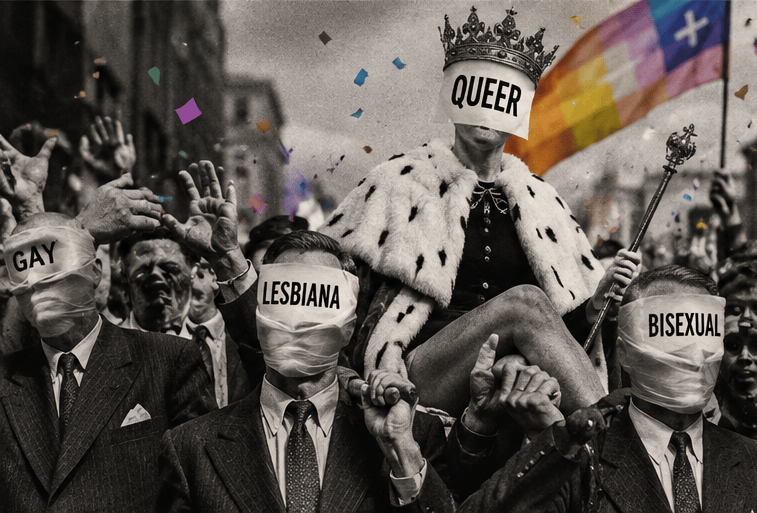
That was the beginning of my second closet.
The first was the classic one. The one so many homosexuals knew: monitoring how we spoke, what we said, whom we looked at, whether it was wise to mention the boyfriend, whether a display of affection might buy us trouble.
The second is rather more elegant. It has a rainbow flag on the door.
It consists in learning which opinions are best left unspoken inside the spaces that supposedly exist to represent you.
I am not comparing the two experiences in severity. That would be idiotic. But the mechanism feels far too familiar: measure your words, nod along, decide that a particular conversation is not worth having because you already know the diagnosis you will receive.
Some of us fags are still going into the closet.
Only what we hide has changed.
My problem is not with trans people either. This clarification has become so compulsory that one day Microsoft Word should probably insert it automatically alongside the spellchecker.
I do not want to take rights away from anyone. I do not want anyone to lose a job, a home, protection from violence or the freedom to organise their life as they see fit. I can also recognise that trans experience contains real problems that deserve study, legal protection and serious attention.
My disagreement begins elsewhere: I do not believe that recognising those problems obliges me to accept every theory built around them.
In particular, I continue to regard sex as an important material category, and gender, gender identity and sexual orientation as non-interchangeable names for different things.
That seems like a fairly modest sentence.
In 2026, depending on where you say it, it can have roughly the social impact of walking naked into a parents’ meeting.
And then something unexpected happened.
Because the available answers did not satisfy me, I started reading.
At first, to argue better. Then because the problem became intellectually interesting. Philosophy, phenomenology, hermeneutics, psychology, biology, feminist theory, queer theory, writers who persuaded me and others who gave me an extraordinary desire to argue with them despite the inconvenience of their having been dead for decades.
The original question changed too.
It was no longer simply: “who is right in this rather exhausting culture war?”
It became something more basic:
what kind of phenomenon is sexual orientation, and what kind of phenomenon is gender identity?
Because perhaps part of the conflict emerged before politics.
Perhaps we were gathering under similar words experiences that operate at different levels.
Sexual orientation, as I began to think about it, does not seem to begin with the subject reflecting on who they are. Desire arrives first. An adolescent can discover that another boy is doing remarkable things to his nervous system long before he possesses a coherent theory of homosexuality, identity or even himself.
Later he may name it. Interpret it. Deny it for years. Turn it into pride.
Or do what so many of us did: look back at our own biography and think, “Christ, that was fairly obvious.”
Identity works differently. It requires some degree of reflective relation to oneself, to the body, to the available categories and to the way one wishes to understand oneself and be recognised.
Out of that distinction came a theory I am developing, one that occupies a substantial part of the book from which these texts emerge.
It is my own construction.
I did not find it fully formed in any author, nor do I intend to perform the academic trick of burying somebody else’s intuition under enough bibliography and then declaring it my biological child.
I use other people’s tools, obviously. That is how thinking works. But the architecture I propose, the distinction between levels and the way I explain the relations among desire, sex, identity and experience are my attempt to solve a problem the available categories explained badly.
And the further I went, the more uncomfortable another discovery became.
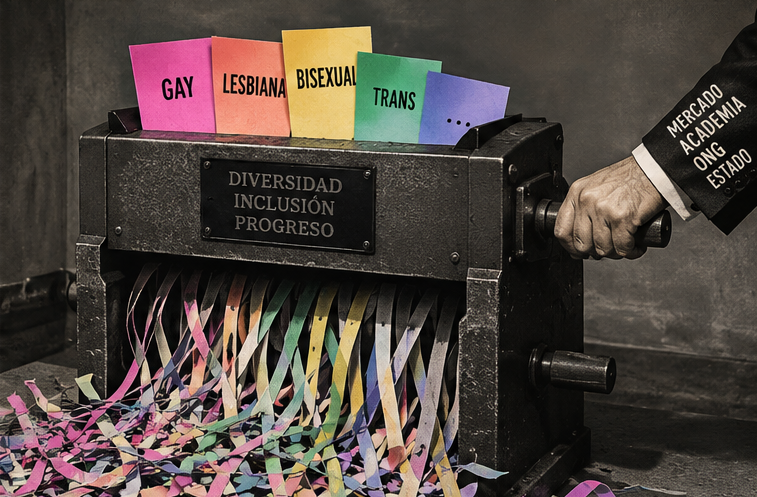
The acronym that supposedly represents me contains different phenomena, yet its spokespeople often talk as though belonging to it also entailed a shared interpretation.
It does not.
Being homosexual does not tell me what I ought to think about queer theory.
Nor does it tell me which party to vote for, which feminism to accept or which definition of gender to use.
In fact, my sexual orientation tells you surprisingly little about almost everything else.
I am a doctor, gay, liberal about quite a few things, materially fairly bourgeois and, whenever convenient, a self-identified proletarian. Unlike certain contemporary theories, I recognise that my proletarian self-perception does not do much to alter my bank account.
Materiality has those vulgar little habits.
This series comes from there.
From the discomfort of belonging biographically to a community that often does not represent me intellectually.
From the suspicion that a political coalition ended up becoming a compulsory identity.
From homosexuals and lesbians who support equal rights for everyone but do not accept that solidarity means doctrinal obedience.
And also from exhaustion.
Because after spending decades explaining to the heterosexual world that our orientation was not a choice, it would be rather ironic to end up accepting another theory telling us which bodies ought properly to enter our desire.
The next texts will develop that argument.
There will be biology, philosophy, queer theory, feminism, homosexual history and probably the occasional obscenity required by the method.
There will also be a theory of my own.
I wrote it because I could not find another that explained well enough what I was trying to understand.
It may be wrong.
That is precisely the point of formulating a theory: someone can read it, understand it and argue with it.
What I am not going to do is keep quiet in order to keep belonging.
I already came out of one closet.
One was enough.


Deja una respuesta