EN · ES
A Genealogy of Erasure
Before “homosexual” existed, there were already men desiring men. Then came the medical file, the diagnosis, the community, liberation, AIDS, queer and the bureaucracy of diversity. This is the story of how a word that once allowed us to find one another ended up doing more and more work, until it risked no longer saying with precision what once needed to be named.
Before the Name: Ulrichs Already Had a Riding Instructor
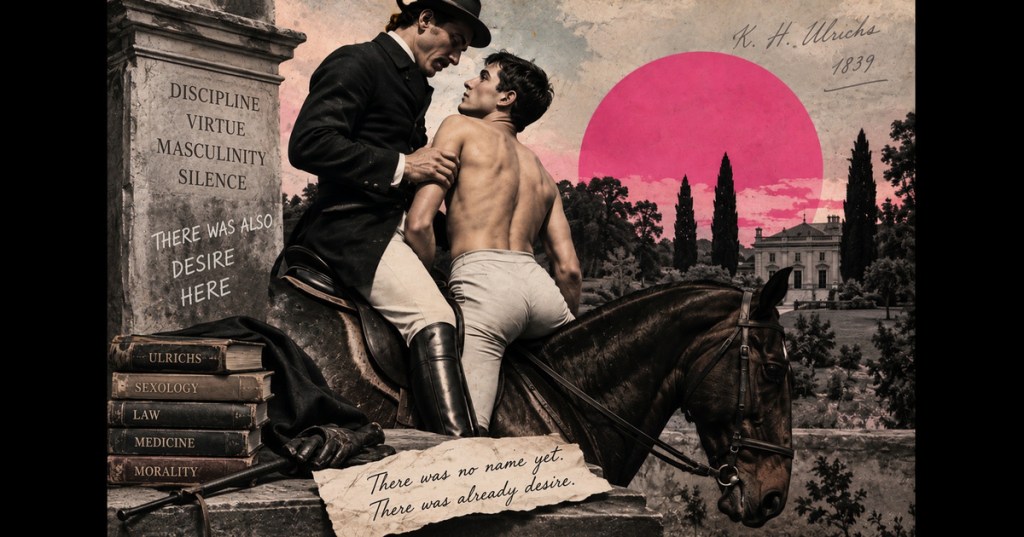
In 1839 Karl Heinrich Ulrichs was fourteen years old, and the word that would later come to name what was happening to him did not yet exist. Decades still had to pass before Kertbeny used Homosexualität, and before medicine, law and politics turned certain forms of desire into attributes of a particular class of people. What was not missing was desire.
Biographical reconstructions place an erotic experience between Ulrichs and his riding instructor around that time. The episode reaches us through Ulrichs’s own later accounts and does not allow much more reconstruction without the historian beginning to fantasise on his behalf. What we know is enough: before possessing a stable category, a fourteen-year-old boy had found in another male something he would later need to explain.
Over the following years Ulrichs produced his own vocabulary. He used Urning for a male attracted to males and built around the term a theory rather stranger than our contemporary notion of sexual orientation. Like other nineteenth-century sexologists, he tried to explain the difference through combinations of psychic masculinity and femininity. The theory aged; the question it was trying to answer did not. His case exposes something inconvenient for any genealogy too enchanted by names: what a person feels and the classification available for understanding it do not necessarily arrive together.
Desire, of course, does not appear in a chemically pure state either. A boy learns what a man is, what behaviour is expected of him, which things should make him ashamed and which should arouse him. He can interpret what he feels as sin, illness, misfortune, discovery or simply a secret; he can pray for it to disappear, police himself, marry or invent a parallel life. But if Francisco occupies the erotic place Marta does not, morality arrives late. The body, fantasy and attention have already selected an object before consciousness manages to complete the paperwork.
Modern homosexuality would later organise that desire in a historically specific way. Men who desired men and women who desired women existed before “homosexual” or “lesbian” offered shared categories through which to understand what was happening to them. Ancient history is enough to remind us that not every same-sex relation fits neatly into our vocabulary: in Greece age, citizenship and social position intervened in ways that sit awkwardly with classification by orientation. The erastēs and the erōmenos were not a modern gay couple in togas. Different categories do not make desire nonexistent; they make its classification historical.
That gap between experience and name will be central to what follows. During the nineteenth century, doctors, jurists, reformers and writers increasingly began turning certain practices and attractions into information about the kind of person who engaged in them. The word that arrived late to the event then acquired a new power: it enabled more precise surveillance, but it also offered the surveilled a way of recognising one another.
None of those names arrived clean. “Homosexual” circulated through medicine and law, serving as diagnosis, insult and description, and eventually lost ground to “gay” in much everyday language. Each generation inherited words already handled by doctors, police officers, activists, lovers and families. That historical dirt does not make categories useless; it explains how they can carry information, shame, memory and an exit all at once.
Ulrichs stood at the hinge. First he tried to understand something that had happened to him; then he helped construct a language for speaking publicly about men like himself, using categories that now seem partial, eccentric or simply wrong. His importance does not lie in having discovered the definitive taxonomy. He did not. It lies in the sequence he makes visible: experience, attempted explanation, name, recognition. Long before Pride, universities and administered diversity, another man could already occupy that strange place that remains perfectly recognisable to the person experiencing it.
He did not yet have homosexuality. He already had a riding instructor.
From the File to the We
If Ulrichs lets us look at the problem from the standpoint of someone trying to understand what is happening to him, Foucault forces the scene to turn towards the institutions that observe, describe and convert that desire into information about the person. For a long time, sodomy in Christian Europe had been treated primarily as a prohibited act. It could be punished with enormous violence, but the sin referred, in principle, to something someone did. In the nineteenth century another logic becomes increasingly visible: sexual conduct begins to be read as the symptom of a personality, a constitution and even an entire biography. Sex no longer says only what a man did; it begins to say who he is.
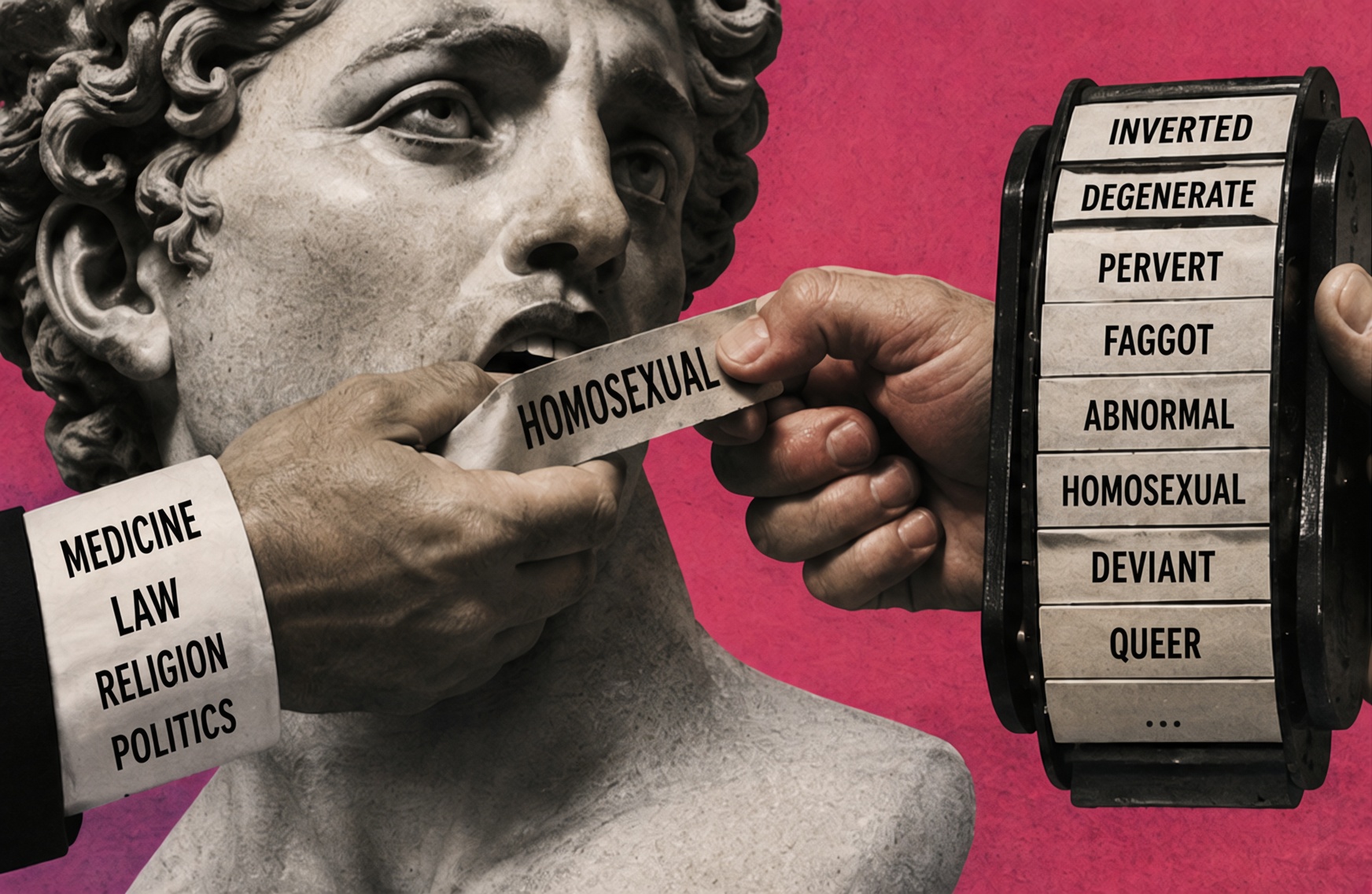
Foucault’s formulation became famous because it captures that transformation so well: the sodomite had been a recidivist; the homosexual became a “species”. Once the category had been produced, any detail could acquire diagnostic value. Childhood, voice, gestures, dreams, clothing, friendships, the relationship with the mother, a body that was too masculine or insufficiently masculine: desire had left a clue and now specialists were willing to reconstruct the crime scene.
There was no single moment and no committee that met to invent the homosexual. Ulrichs spoke of the Urning; Kertbeny proposed other terms; medicine moved among inversion, homosexuality, third sex, degeneration and contrary sexuality. Some theories aimed to cure; others tried to demonstrate that this was an innate disposition in order to argue against criminal persecution. The same naturalism could open the consulting-room door or try to close the prison door.
Magnus Hirschfeld embodies that ambivalence well. A doctor, sexologist and activist, he used the categories of the sexual science of his time to fight criminalisation. If homosexuality was a natural disposition rather than a chosen vice, punishing it began to look less like a defence of morality and more like legal cruelty. The strategy could free someone from one accusation and lock him inside another: the homosexual ceased to be guilty and became a patient. A considerable improvement if the alternative was prison, even if victory still smelled of the consulting room.
The consulting room did not hold a monopoly on classification either. Outside it there was a much cheaper diagnosis: you could see the fag. Sometimes a voice or a gesture of the hands was enough. An effeminate boy could fall under suspicion years before knowing what an orientation was, regardless of whether he had ever had sex with a man. The family did not need Krafft-Ebing in the library to set up its little domestic clinic. The popular diagnosis was considerably cheaper.
Turning practice into nature also changed secrecy. Concealing an encounter required precautions; hiding a supposed essence meant policing the whole personality. The voice, friends, photographs, the glance that lasts half a second too long, excessive enthusiasm for a certain actress, the way one sits: all required supervision. The modern closet was built around sex that had to remain invisible, but also around a personality that might betray it. Once the key was known, biography began to be reread backwards: the solitary child, the adolescent who never talked about girls, the friend who was too close, the fondness for theatre. Some of those connections could be real; others were pure retrospective montage. A category that helps explain can also produce the temptation to explain everything.
Here the Foucauldian genealogy remains indispensable, but it does not need to become a genealogy of desire. Doctors and jurists could debate for hundreds of pages what exactly the homosexual was because they encountered people who desired others of their own sex, some of whom came to them trying to explain precisely that. The theories varied around a problem that did not disappear when the previous explanation expired. Ulrichs is uncomfortable for any overly strong version of constructivism for this reason: he was not passively waiting for medicine to tell him what he ought to desire. He arrived at language from a prior conflict and then produced categories to explain himself and recognise others.
Modern classification did enormous harm precisely because it made that desire legible to institutions capable of punishing, confining or “curing”. But legibility had a consequence the classifiers did not control for very long: the classified began finding one another. The archive accumulated cases until the supposedly exceptional monster discovered he had neighbours. A word that marked the individual as deviant could, in the hands of the person being marked, reveal that the private anomaly repeated itself in other lives.
That required more than sharing a diagnosis. A man in Hamburg, another in Paris and another in Montevideo could be described in similar terms and still live as though theirs were a strictly personal oddity. Community appears when those inside the classification begin looking at one another. Cities increased that possibility. Streets, boarding houses, parks, public toilets, cafés, certain kinds of work and nocturnal circuits allowed people to recognise others before a perfectly articulated political identity existed. Long before the clean aesthetic of corporate diversity, there was already a fairly sophisticated social technology for finding one another.
There were risks too. The same bar that solved the problem of where to go also solved the police’s problem of where to look. Visibility and danger often grew together; community did not appear after persecution ended but inside it. Magazines, associations, private correspondence and urban networks expanded that infrastructure. The word began serving not only the doctor writing about the patient, but the patient learning that other patients existed and eventually ceasing to think of himself as one.
That passage from being named to naming oneself did not erase the earlier violence of the term. It dragged it along. But it changed who could use it and for what. A classification imposed from outside could become a password, not because everybody classified under it accepted the same identity, nor because a unified community had been waiting to be discovered, but because some people began recognising a shared pattern and building around it relations the medical file had never anticipated.
Ulrichs had taken the unusual step of speaking publicly on behalf of men like himself. Hirschfeld and other reformers expanded that possibility. Later, “gay” would in many places offer a less clinical and more affirmative alternative; “fag”, “queer” and their equivalents would have even more turbulent careers, capable of wounding in one mouth and functioning as conspiratorial recognition in another. No term came with universal instructions. Communities did what they could with them.
Through accumulated use, words acquired biographies. Someone could remember when he first heard “homosexual” applied to himself, how long he spent trying to prove he was not one, and when he finally managed to say “gay” without lowering his voice. The category could point towards the object of desire, but it could also lead towards bars, books, friendships and people who knew roughly what was being discussed. It did not make its members homogeneous. A twenty-year-old gay man in a tolerant capital and a seventy-year-old who learnt to hide under hostile legislation could share the word and inhabit almost incompatible histories. An effeminate man and another obsessed with never being mistaken for one could recognise themselves under the same orientation and loathe one another over dinner. Community never required equality of character.
What it did need was a sufficiently stable point of recognition. With remarkable verbal economy, one man knew what another meant when he said he was gay. A lesbian could recognise a similar structure from the other side of the same phenomenon: not the same biography or the same sexual culture, but the fact that one’s own sex occupied the erotic place heterosexual expectation reserved for the other. That minimum was enough to build organisations, newspapers, circles of friendship, sexual codes, activism and literature on top of it. Those who had been studied as a population were beginning to behave like one.
It was not an orderly march. Some organisations preferred respectability, others demanded legal reform, and others merely wanted somewhere to live under less surveillance. Women built networks that did not always coincide with male ones; class differences and ways of life could be enormous. What mattered was not uniformity, but that the secret was beginning to have interlocutors. Finding one other person was enough to erode the idea that this was a strictly individual failure; finding many turned private oddity into a social problem.
The direction of the question changed with them. It was no longer enough to debate what caused homosexuality, how to recognise it or what society should do with those who exhibited it. Homosexuals themselves could ask what society should stop doing to them. The medical category was becoming political because a population sharing an orientation also discovered common forms of surveillance, exclusion and risk. The diagnosis had found a voice; the next step was to make it public.
From the Suit to the Street
For quite a long time, much homosexual politics spoke the language of respectability. There were reasons for that. If a society regards someone as sick, corrupting, degenerate or criminal, presenting oneself as a reasonable citizen can be a sensible strategy: we work, pay taxes, care for our families, do not attack children and do not destroy Western civilisation. Mid-century homophile movements often operated within that tension. They demanded legal reform, fought pathologisation and tried to improve the public image of gays and lesbians; some organisations even recommended deliberately conventional presentation at demonstrations: men in suits, women in dresses, sober manners, no temptation to look too pleased to be there.
The strategy had an obvious limit. If the condition for obtaining rights was resembling the respectable heterosexual as closely as possible, the question remained of what to do with those who could not, would not or had no interest in passing the good-conduct examination. The acceptable homosexual could enter. The fag was still waiting at the door.
By the late 1960s that patience began to deteriorate in a context shaped by civil-rights struggles, feminism, opposition to war, youth radicalisation and growing distrust of institutions accustomed to administering social normality without too many questions. Homosexuals were not watching all this from another planet. They had raided bars, police officers recording names, lost jobs, psychiatric treatments, families that preferred not to know, and sexual lives organised around places that could disappear overnight. Clandestinity had opening hours, addresses and back doors.
Stonewall later became an origin myth, and origin myths simplify. It was not the first homosexual resistance to police action, nor did it single-handedly produce the gay liberation movement. There had already been protests, riots, organisations and publications. What Stonewall did well as a symbol was condense a transformation already under way: moving from asking for tolerance to contesting the right to exist without apology. “Liberation” meant more than a less brutal police force. If the politics of tolerance asked how much space the majority might grant a deviation, liberation began asking why that majority had the right to administer the space at all.
In that climate, “gay” acquired a different force. It offered distance from the clinical tone of “homosexual” and produced a more affirmative identification. It described not only what somebody did in bed or what a psychiatrist believed he could find in childhood, but a form of belonging that could be spoken aloud. Coming out of the closet required, in addition to the closet, an outside. That outside had to be built from bars, newspapers, organisations, marches, bookshops, friendships, codes and neighbourhoods where finding one another did not depend exclusively on providential coincidence or having a very well-informed cousin.
Not everyone inhabited that world in the same way. A white middle-class man in New York did not live the same homosexuality as a Latino worker, a Black lesbian or someone in a small town; class, race, sex and generation cut through the movements themselves. Nor did everyone want to march, live in gay neighbourhoods or make orientation the centre of identity. Even so, the accumulation of places and institutions made it increasingly difficult to maintain that homosexuality was merely a collection of isolated cases.
And a community is not built from manifestos alone. It needs places to dance, find a partner, find sex, read a magazine, have a drink without inventing a girlfriend, or find a doctor who does not turn the consultation into a moral interrogation. It also needs somewhere one can be bored in company. That everyday life explains why gay identity acquired a density no dictionary definition contains: it produced humour, codes of recognition, aesthetics, idols, hierarchies, prejudices, internal fights and memory. It also produced a sexual politics that cannot be retrospectively scrubbed clean until it resembles a meeting of citizens requesting marriage. For an important part of liberation, freedom included the body, promiscuity, refusal of shame and the possibility of exploring practices dominant morality preferred to keep in the basement with the pornography and inconvenient relatives.
The respectable homosexual could say: I am just like you, except I love another man. Liberation added a less reassuring answer: perhaps I do not want to be like you. From there came durable tensions between assimilation and difference, civil rights and cultural transformation, stable partnership and criticism of monogamy, entry into existing institutions and suspicion that some of those institutions did not deserve to survive intact. There was no single homosexual politics, and turning each decade into an inevitable station on the way to the next erases much of the conflict that actually moved it.
Psychiatry was one of the arenas where that conflict became most visible. For years homosexuality had appeared in diagnostic classifications and justified treatments designed to change it. Activists began disrupting conferences, arguing with psychiatrists and challenging the authority with which a profession declared pathological an orientation they experienced as constitutive of their lives. The removal of homosexuality from diagnostic systems was not simply a gift bestowed from above by a science that suddenly acquired better manners: evidence and professional standards changed, but there was also organised pressure from people who no longer accepted being silent objects of medical knowledge.
The scene captures the reversal. A century earlier, the homosexual was interrogated so that others could decide what he was; now those who appeared in the manual were entering the room to argue with those who wrote it. First they had been sinners, then patients. Now they could become inconvenient interlocutors and, on occasion, they had placards.
Public visibility also changed the horizon for those who came after. An adolescent could discover that there were bars, couples, writers, men who spoke openly about wanting other men and women building lives with other women. That did not solve adolescence, a miracle no known social theory has managed either, but it broadened the imaginable future. Heterosexual marriage, a double life or loneliness ceased to be the only available endings. A collective identity did not merely explain what was happening to you; it could show you what to do with it.
That future did not come in a single model either. It could mean a stable relationship, activism, promiscuity, neighbourhood life, a chosen family or simply the possibility of not lying in every conversation. The novelty was not that everyone wanted the same thing, but that visible examples of lives previously difficult even to imagine were beginning to exist. The category had ceased to function only as retrospective explanation and was beginning to produce expectations towards the future.
By the end of the 1970s, that community was already accumulating a past while trying to conquer a future. It remembered riots, activists, closed bars and places where it had danced. Nothing guaranteed that memory could be transmitted intact. Within a few years an epidemic would strike gay men with particular brutality and turn those networks of sex, friendship and activism into networks of information, care and mourning. When it arrived, it did not find isolated individuals. It found a population that had learnt to say “we”.
When the Dead Had to Be Counted
Gay liberation had achieved something that only a few decades earlier seemed improbable: it had transformed a condition administered by doctors, police and families into an identity capable of speaking for itself. There were bars, organisations, newspapers, codes, neighbourhoods, friends, lovers and a politics that no longer asked permission to exist. Then people began to die.
In 1981 unusual cases of pneumonia, sarcomas and other opportunistic diseases began to be recorded in the United States among young men who, given their age, should not have suffered them in that way. Many were homosexual. For a brief period even the expression GRID, gay-related immune deficiency, circulated. The agent, transmission and scale of what was happening were not yet well understood, but the social procedure was familiar: first find the group, then turn the group into the explanation. “Gay plague”, “gay cancer”, “homosexual disease”. The scientific name changed before the moral association did.
The epidemic fell on a community that was only just learning to live its sexuality publicly. That historical coincidence was especially cruel. Sex that had just come out of the basement could once again be presented as a threat; promiscuity, bars, saunas and anonymous sex, reclaimed against decades of shame, reappeared as evidence of irresponsibility, degeneration or punishment. For many men the diagnosis also revealed two secrets at once. A family could learn about the illness and the homosexuality in the same hospital room, when very little time remained to do anything with either piece of news.
And then there was death, not distributed abstractly across a population but concentrated in concrete networks. In some circles partners, former lovers, friends, men known from the bar, neighbours and fellow activists began dying; young men became accustomed to visiting hospitals, organising funerals and emptying the flats of people their own age. A community built around desire had to learn to organise itself around mourning as well.
That changed the thickness of “gay”. Until then much of its political memory could be narrated through persecution, liberation and the conquest of spaces. AIDS added institutional abandonment, illness, care, rage and a familiarity with death that marked a generation of homosexual men in particular. HIV was never exclusively a gay disease: it also affected intravenous drug users, haemophiliacs, transfusion recipients, heterosexual women and men, and in time devastated entire populations outside the first circuits in which it had been detected. But in certain Western urban contexts it struck networks of gay men with enough concentration to transform collective life.
The word no longer pointed only to a subjective preference. It could name a social network through which infection, information and care circulated. Someone’s lover knew the current boyfriend; the bar owner knew the activist; the activist knew the doctor, who might also be gay. That material structure accelerated the disaster and at the same time made a response possible when institutional reaction proved insufficient. Community organisations produced prevention information, accompanied the sick, found doctors, organised networks of care, pressed for research and publicly discussed sexual practices that until then might have remained within informal codes.
The history of gay AIDS is not only the history of a population turned into victims. It is also that of a population forced to acquire a frankly indecent amount of knowledge about immunology, clinical trials, regulatory protocols and pharmaceutical bureaucracy while burying friends. ACT UP turned that combination of mourning and fury into a particularly effective politics: it disrupted events, occupied spaces, pressured health institutions and challenged the slowness with which treatments were researched and approved while people continued dying. A century after the files of sexology, the object of knowledge was entering the medical institution to argue about how a trial should be designed, who should gain access to an experimental drug and how long a public agency could take to approve it. When necessary, it could become an administrative nightmare.
Sexual ethics inside the community changed as well. Sex did not disappear, but it could no longer be lived with the same epidemiological innocence. There were safer-sex campaigns, arguments about condoms, numbers of partners and higher- or lower-risk practices, accompanied by resistance, conflict and moralism of their own. Not every gay man greeted the news cheerfully that a newly launched sexual revolution now came with a prevention manual. Yet desire had to be preserved without turning it back into shame, while behaviours whose consequences could no longer be ignored had to change. Speaking about sex precisely ceased to be merely cultural provocation and became a tool for survival: some fantasies could remain fantasies, but it was sensible to introduce latex into the logistics.
The crisis also showed how much a community could function as a structure of care when other institutions failed. Friends who legally were not family ended up making decisions, accompanying hospital admissions, cleaning bodies, organising medication or supporting someone for months. Partners of many years could lack recognition while a barely present relative retained rights the partner did not have. Questions that in another context might have sounded like legal abstractions became scenes: who enters the room, who receives medical information, who inherits the flat, who arranges the funeral, who keeps the photographs when the family decides to erase what it finds inconvenient.
The struggle for legal recognition of homosexual couples was not born exclusively from AIDS, but the epidemic made many private inequalities impossible to disguise. It also left an absence that is difficult to measure. Artists, writers and activists died, but so did bar owners, lovers, employees, neighbours and men who probably would never have done anything historically notable, and precisely for that reason formed an indispensable part of any real community. History preserves works; friends preserve the one who cooked a good dinner, told terrible jokes or knew where to go out on a Tuesday. An epidemic takes both.
That is why AIDS was also a war over memory. Names written on panels, photographs, archives, films, testimonies and rituals of mourning tried to prevent thousands of lives from ending up reduced to epidemiological figures. The AIDS Memorial Quilt performed that operation almost literally: each panel restored scale, name and objects to someone who could disappear inside a statistic. Enormous, domestic and political at once, it forced people to see individuals where administrative language preferred “risk groups”.
That memory was not distributed identically. A gay man born in 1970 in New York and another of the same age in Montevideo did not live through the same epidemic, nor did they have equal access to information, treatment or community. National chronologies differed. Even so, AIDS entered international homosexual culture and left marks that still organise memories and ways of telling the past. For a young gay man today, HIV may present itself as a preventable and treatable infection, surrounded by testing, antiretroviral therapy, PrEP and a life expectancy unimaginable at the beginning of the epidemic. He may enter sexual life without ever having personally known anyone who died of AIDS. That is a victory, and it also creates historical distance.
A man of sixty or seventy can use the same word, “gay”, carrying within it dead people the younger man never knew. He may remember names, hospitals, rumours, funerals and fear of a diagnostic test while much of the world watched from a fairly comfortable distance. The word is the same; its biographical thickness is not. For one it may be an option on a contemporary menu of identities. For another it was the name under which he found lovers, friends, persecution, activism and the dead.
That generational difference matters because a category accumulates not only definition but use. It serves to find a partner and name an orientation, but it can also store an era, a kind of fear and a network of obligations known to later generations only through stories. Memory does not confer ownership of the word; it does prevent us from treating it as though it had just appeared on a form.
When antiretroviral treatments radically changed prognosis, especially from the mid-1990s for those who could access them, the landscape shifted again. People survived who only a few years earlier would probably have died, and the story became easier to tell as a march from persecution towards equality: depathologisation, visibility, anti-discrimination laws, recognition of couples, marriage. That narrative had real facts behind it, but it was too clean. The community that had fought to build a recognisable identity was entering another debate at the same time, born partly from its own struggles: whether that identity should remain so stable, and who was left out when “we” was spoken.
Queer: From Critique to Checkbox
Gay identity had proved useful. It allowed people to recognise one another, organise, contest diagnoses, demand rights, build spaces and respond to an epidemic that turned the community into an involuntary expert in mourning, medicine and bureaucracy. Above all, it had made it possible to say “we” without depending on the gaze of the doctor, police officer or priest. That we had borders, as every form of belonging does, and by the late 1980s and early 1990s a significant part of activism and sexual theory began asking what sat badly within them.
The critique did not arise from an academic whim. Gay politics had its respectabilities, hierarchies and models of the presentable citizen. The white, urban, middle-class, relatively masculine homosexual man, capable of forming a recognisable couple and demanding access to institutions such as marriage, could easily occupy the place of a much more heterogeneous community. Lesbians had long pointed out that an experience organised among women could not be treated simply as the female version of male gay life; racial, economic and generational differences also existed that an overly tidy representation tended to erase. The category had helped people escape isolation. It was reasonable to distrust it when it began presenting itself as a complete photograph of everyone living under it.
AIDS widened the problem on the organisational terrain. Gay men, lesbians who took on work of care and activism, bisexual people, transsexuals, sex workers, drug users and other groups coincided in concrete struggles against institutions capable of ignoring them all with considerable efficiency. ACT UP did not need to prove that its members shared sexual orientation, intimate history or relationship to gender. There were medicines, protocols, funding, prevention and dead people at stake. That breadth was not yet a theory about the identity of the participants; it was the practical consequence of having urgent things to do together.
In those same years, queer began circulating with a different force. It had been an insult, and its reclamation preserved something deliberately unpleasant: rather than presenting oneself through the respectable category society had become willing to tolerate, one could throw back the word used to humiliate as a defiant identification. Queer Nation captured the tone well. This was not the proper homosexual patiently explaining that he could pay a mortgage and keep the lawn reasonably short; there was anger, sex, theatricality and a decision not to hide what an assimilationist politics preferred to keep off camera.
Part of queer’s usefulness lay precisely in not demanding too much precision before allowing someone into the meeting. It could bring together people with different relations to sexual and gender categories without turning them into bearers of one identical experience. Someone could be gay and participate in a queer coalition; a lesbian could preserve the specificity of her orientation and use the term in certain political contexts; a transsexual person could share a struggle against sexual or gender norms without having to claim that their experience was identical to that of a homosexual. The imprecision that made queer an awkward taxonomic category served alliance rather well.
Academia found an irresistible problem there. The historiography of sexuality, feminism, post-structuralism and literary criticism had already weakened the idea that categories such as man, woman, homosexual or heterosexual were transparent names applied to self-evident social realities. Foucault had shown the history that made it possible to speak of “the homosexual” as a human type. Feminism had spent years debating what made “woman” a political category and who could speak in its name. Eve Kosofsky Sedgwick examined the extent to which the homosexual/heterosexual opposition organised literature, secrecy, knowledge, masculinity and relations between men beyond a list of individual sexual preferences.
Judith Butler directed suspicion towards the stability of gender identities. If the categories through which we recognise ourselves are produced and reiterated within social norms, they cannot simply be treated as foundations that precede history. The argument had enormous influence and an even larger progeny, some of which Butler probably would not have requested even with legal counsel. For this story, resolving the whole of gender theory matters less than observing what that style of thought did to identity politics: it made it possible to ask about the exclusions of a category that, after having served liberation, might begin fixing the correct kind of person who was supposed to occupy it.
Joshua Gamson formulated the dilemma well. Movements need some kind of boundary in order to mobilise people, make claims on their behalf and make visible who is being discriminated against. At the same time, those boundaries leave people out. There was no elegant solution because both needs were real. A homosexual movement requires some idea of what “homosexual” means; a lesbian association needs to know whom it is naming. If the category becomes too rigid, it can end up policing the people it was meant to gather. If it ceases to discriminate anything at all, it loses much of its descriptive and political usefulness.
For a time that tension was productive. Categories continued to be used, but no longer with the innocence of someone who believes they have discovered an eternal essence. Queer could offer a language of alliance and critique without requiring the differences among those allied to be erased. A gay man does not need to know from inside what a persistent incongruence with one’s sex or gender means in order to defend a trans person against discriminatory treatment; a trans person does not need to experience the way a homosexual grows up expecting a heterosexual desire that never arrives. Having partly shared adversaries was enough for many things.
That was one of queer’s most fertile impulses: enabling cooperation without demanding equivalence. The problem began when suspicion of categories stopped targeting their claim to be absolute and started targeting any boundary as such. An identity could be historical, incomplete and porous and still need some principle by which the thing being discussed could be recognised.
The critique of boundaries also has an unsettling property: it can always find another one. If categories are historical and potentially exclusionary, every criterion of membership becomes available for renewed interrogation. That did not automatically produce contemporary taxonomies, and it would be intellectually lazy to blame Butler for every checkbox that appeared thirty years later. Between the queer theory of those years and a contemporary form lie activism, the internet, youth culture, organisations, public policy and bureaucratisation. What had changed was the intellectual climate: for much of the twentieth century the task had been to secure a category capable of making an experience intelligible; now it could also become necessary to justify why that category should retain any stability at all.
The paradox becomes especially visible when queer leaves the political gesture and the seminar room and enters institutions that need to count people. A university has to know who belongs to a programme; an organisation, whom it represents; a survey, which options it offers. Bureaucracy can fund philosophical indeterminacy, organise a conference for it and then ask it to tick a box. A term valuable precisely because it avoided too strict a definition also began functioning as a personal definition.
Something related, though not identical, happened with the acronym. LGB had a limited but recognisable coherence: gay, lesbian and bisexual referred to the direction of desire, though they distributed it differently. Adding the T introduced another axis. A trans person can be heterosexual, homosexual or bisexual; being trans does not by itself describe towards whom desire is directed. That never prevented political alliance and, moreover, the historical boundaries among the effeminate homosexual, the transvestite and the transsexual were far from always being as clean as later taxonomies suggest. The difficulty arose when the convenience of the acronym began making it appear as though all its components belonged to a single kind of phenomenon.
“The LGBT community” is convenient for media, universities, public bodies and companies because it avoids a long enumeration. The singular easily suggests a homogeneous experience behind it even when there is none. Gays, lesbians and bisexuals enter through orientation; trans people through another relation to sex, body, gender and identity; intersex introduces sex characteristics; Q can function as identity, political position or umbrella. There are good reasons for these groups to cooperate, but there is no need to invent a single phenomenological structure in order to justify cooperation.
As the list grew, the general formulas had to become more abstract: “sexual and gender minorities”, “sexual diversity”, “sex-and-gender dissidence”, “non-normative identities”. The plus sign solved the typographic problem with accidental honesty: the list could no longer end. In some contexts that breadth does exactly the work required. In others, the more effective it becomes as an umbrella, the less it tells us about the concrete phenomenon that brought each member there.
The conflict changes nature when that general logic returns to the words that originally made up the alliance. For a long time categories could be added without requiring gay or lesbian to alter what they had been naming. If the umbrella’s common grammar begins intervening in those meanings, we are no longer merely adding new rooms to the house. We are changing the floor plan of some that were already there.
I will call that shift semantic expropriation.
When the Umbrella Enters the Word
For much of this history, alliances could grow without the categories composing them having to share a single principle. A gay man remained a male attracted to males; a lesbian, a woman attracted to women; a bisexual person distributed desire across both sexes. None of that prevented cooperation with people whose relation to body, sex or gender was different. The balance begins to shift when those dimensions stop being added around orientation categories and begin intervening in their definitions.
The shift can seem small because it occurs inside a sentence. A word that for decades had allowed an orientation to be recognised begins to be formulated through gender, identity or expression. The kind of information it provides then changes. “Gay” never explained a man’s personality, favourite practices, politics, degree of campness, marriage plans or tolerance for Grindr. It communicated something much more limited: other men occupied his erotic field. That descriptive poverty was, in part, its usefulness.
Bisexuality complicated the distribution without abandoning that axis. Gender identity introduces another dimension, concerning how a person understands themselves and presents socially. In a concrete relation everything can cross: appearance, voice, age, class, style, gender expression and a fairly indecent number of details that matter enormously to desire. A man may be attracted to another who is highly feminine, desire precisely that femininity or reject it. The packaging matters. The difficulty begins when what modulates desire starts being used as a sufficient criterion for redefining its direction.
Everyday life is also full of incomplete perceptions. Desire does not operate like a customs officer checking genital documentation before authorising an erection. People interpret bodies, make mistakes, discover things; sometimes attraction continues and sometimes it evaporates. No classification needs to resolve every borderline case in order to continue orienting. Grey areas do not make everything on both sides identical.
With “lesbian” the conflict acquires an additional charge because the word accumulated much more than a definition. There are spaces, arguments, codes, forms of sociability and a history in which male absence could carry a concrete erotic and political meaning. A community of women who desire women produced places where being among women was not a decorative detail. That is why disputes about criteria of membership reach beyond a dictionary entry: they also affect forms of recognition and spaces built around the word.
No generation owns the deed to a language. Words change, widen, shift and sometimes end up meaning things that would have bewildered those using them fifty years earlier. But not all such changes have the same structure. A word can incorporate new cases while keeping recognisable the principle that groups its members. It can also preserve the sign while that principle moves towards another phenomenon.
This is what I call semantic expropriation: the displacement of the criterion of membership until the experience that made a category necessary is no longer necessary in order to use it. It presupposes neither a thief nor a linguistic conspiracy. A word can change through institutions, movements, youth habits, administrative definitions and perfectly sincere everyday uses. What matters is the result: the name remains while its relation to what it historically allowed people to recognise becomes less direct.
From outside, the argument can look like a petty war over vocabulary. From inside, for some people the question is much more terrestrial: whether the word through which they learnt to find others still offers roughly the same information when someone says it. A coalition needs to know with whom it can act in relation to certain problems; a descriptive category needs to know what phenomenon it serves. Sometimes those needs coincide and sometimes they do not. Confusion appears when an institution tries to solve both through the same act of inclusion.
None of this requires denying alliances or pretending historical categories were ever perfect. What it requires is not compressing solidarity and description too quickly. An organisation may wish to gather different populations because they share adversaries, risks or demands. It does not need to prove that those populations are variants of one experience in order to do so, just as a precise description of their differences does not prevent them from cooperating.
The difference is easy to see when words function as directions. “Gay” does not only describe an orientation; for decades it also answered a very un-metaphysical question: where to find other men for whom men occupied that erotic place. “Lesbian” could lead towards bars, books, friendships, magazines and political groups where every conversation did not have to begin by explaining from scratch why certain women mattered in a particular way.
Of course, neither word supplied a detailed catalogue of desire. Two men can be equally homosexual and inhabit incompatible erotic universes. One wants Tarzan. Another wants a bear who looks like Father Christmas after three divorces and twenty winters chopping wood. A third wants the twink who needs help opening a jar and would lose a fight with the curtain. “Gay” does not tell you which one you will fancy. It merely tells you in which department of the shop the problem occurs.
That verbal economy also matters when spaces are organised. A man opens an app to find men; a lesbian enters a lesbian space expecting to find women who desire women; an association gathers people who recognise a particular conflict in their own biographies. Mathematical precision is not required. It is enough for the word to reasonably anticipate what kind of population will be found on the other side, just as a border can admit crossings, exceptions and ambiguities without disappearing altogether.
Lesbian spaces make the issue visible because their history cannot be reduced to a semantic dispute. Many have declined through an inelegant combination of rents, gentrification, apps, social integration, generational change and different nightlife habits. Capitalism, Tinder and urban planning cannot be explained by a theory of vocabulary. At the same time, a community also changes when it becomes difficult to formulate whom one of its spaces exists for. Every community needs some low-translation zone, a place where certain jokes, stories and expectations do not require an ontological manifesto before ordering a beer.
The erasure that interests me here is strange precisely because it does not require silence. There can be campaigns, diversity departments, Pride months, forms and companies that discover every June a sudden passion for sexual emancipation with discounts on selected products. Nominal visibility increases and the category remains on the signs. What may weaken is its ability to indicate, with the same economy as before, what kind of experience lies behind it.
Nor does this transformation happen all at once or in every context. The same person can use “gay” in a very conventional sense on a sexual app, accept it inside a much broader umbrella in a political organisation and later encounter an institutional definition that mixes orientation, identity and gender expression. Words tolerate a considerable amount of practical contradiction before breaking. The problem begins when we forget they are doing different jobs and treat one of those uses as though it ought to govern all the others.
Something similar happens with recognition. An institution can decide that a certain definition is best suited to its internal policies; a movement may prefer language capable of accommodating as many participants as possible. Those decisions have real consequences. They do not, however, automatically unify the experiences now placed under one label. Administrative grammar can group them much faster than life can.
That is why semantic expropriation does not require us to suppose that words possess eternal essences or that every modification is a loss. Some changes increase precision, others correct absurd exclusions, and others simply accompany social transformations. The question is more concrete: what information ceases to be available when the criterion of membership changes, and whether that information remains necessary in some context.
A broad coalition may not need it. A general form perhaps does not either. An erotic space, research on orientation or a person trying to find others with a similar experience may need considerably more precision. Using a single definition for all those settings saves vocabulary, but relocates the conflict.
Ulrichs had begun from the inverse problem. He felt something for which he still lacked a sufficiently stable category. Then came the file, diagnosis, recognition, community, the street, AIDS, the dead, the critique of identities and the institutional expansion of the umbrella. Each stage left something attached to the words. Contemporary conflict inherits all of it at once: categories serve to describe, gather, mobilise, administer, protect and also to debate the limits of each of those operations.
A coalition does not have to be a taxonomy in order to act, just as a category does not need to describe a person’s entire life in order to be useful. Homosexuals spent much of modernity searching for a word, appropriating it and filling it with sex, places, fear, pleasure, politics and memory. Ulrichs’s problem was not yet having a name. Ours may be stranger: keeping it, seeing it on every sign and discovering that it no longer always indicates with the same precision where the others are.
After all this history, the question is not whether the word exists. It is whether it still tells us where to return.


Deja una respuesta