
EN · ES
A Phenomenological Theory of Sex, Orientation and Gender
The model I am going to propose in these two instalments is my own. I am not presenting a theory already formulated by Merleau-Ponty, Husserl or any contemporary author on sex and gender. I use tools from phenomenology, hermeneutics and biology to try to solve a problem that the available explanations left badly framed for me: what kind of phenomenon is sexual orientation, what kind of phenomenon is gender identity, and why both can traverse the body without simply being two names for the same thing.
From phenomenology I take, among other things, attention to experience prior to explicit judgement: another person’s body can already appear charged with meaning before the subject possesses a theory about what they are feeling. From hermeneutics I take the inverse problem: an experience can later be named, reinterpreted and organised within a biography. And from biology I retain something rather less exotic than it sometimes appears in these debates: human bodies are sexed, and that materiality forms part of the world we perceive.
This does not mean that sexual orientation is a conscious inspection of genitals either. Nobody sees an attractive man and thinks, “small-gamete producer detected”. Erotic perception works with whole bodies: face, voice, smell, proportions, movement, masculinity, femininity and a fairly indecent number of details. The hypothesis is different: beneath that enormous combinatorics lies a more austere domain that delimits which sex classes of bodies can acquire erotic possibility. I call that stratum the primary erotic-sexed field. What happens afterwards within it belongs to another space, much richer and more plastic, which I call the Individual Space of Erotic Possibilities, ISEP.
It is a theory in development. I modify it often, find holes, change terms, draw diagrams, break them and start again. I do not present it as a taxonomy revealed in stone, but as a conceptual architecture open to argument. That is precisely why I want to show it before using it in the political and semantic conflicts that come later.
The Erotic Field and the Word That Arrives Later
Carlos lives in a world where desire comes already classified before he can say a word about his own. There is an ideal girlfriend, a proper future, an expected masculinity and an entire social pedagogy that teaches him which way he ought to orient himself. Everything is arranged for Marta to occupy the erotic place. Marta is the suitable woman, fits the story, slots perfectly into the grammar of family, religion, neighbourhood and the species as understood in its tidiest, most reproductive version.
The problem is that it is Francisco who appears.
Carlos can like Marta in every available cultural sense. He can find her pretty, likeable, proper, even desirable at that level where desirable means “it would be advisable for me to like her”. What he cannot manage is for Marta to acquire that particular bodily prominence, that immediate thickness through which a body stops being just any body and becomes sexually significant. That place is occupied by Francisco, before Carlos can explain it, before he dares to name it and before he has a word capable of making it socially intelligible.
That is where the problem that interests us begins. Not yet in an identity, a community or a theory about oneself, but in the way certain bodies appear. Francisco possesses a salience that Marta does not possess. Carlos can remain unaware for a long time of what that difference means and still live it with a rather undiplomatic bodily clarity.
Karl Heinrich Ulrichs offers an analogous scene in a different historical décor. Before homosexual stabilised as a modern category, before the nineteenth century had finished setting up its medical and moral zoo, Ulrichs had already described attractions for which the modern vocabulary did not yet exist. The name had not yet sedimented; the event had. Desire did not wait for taxonomy to complete the paperwork. The word arrived later, with the usual delay of institutions when they run after something that had already been happening in the body and in experience.
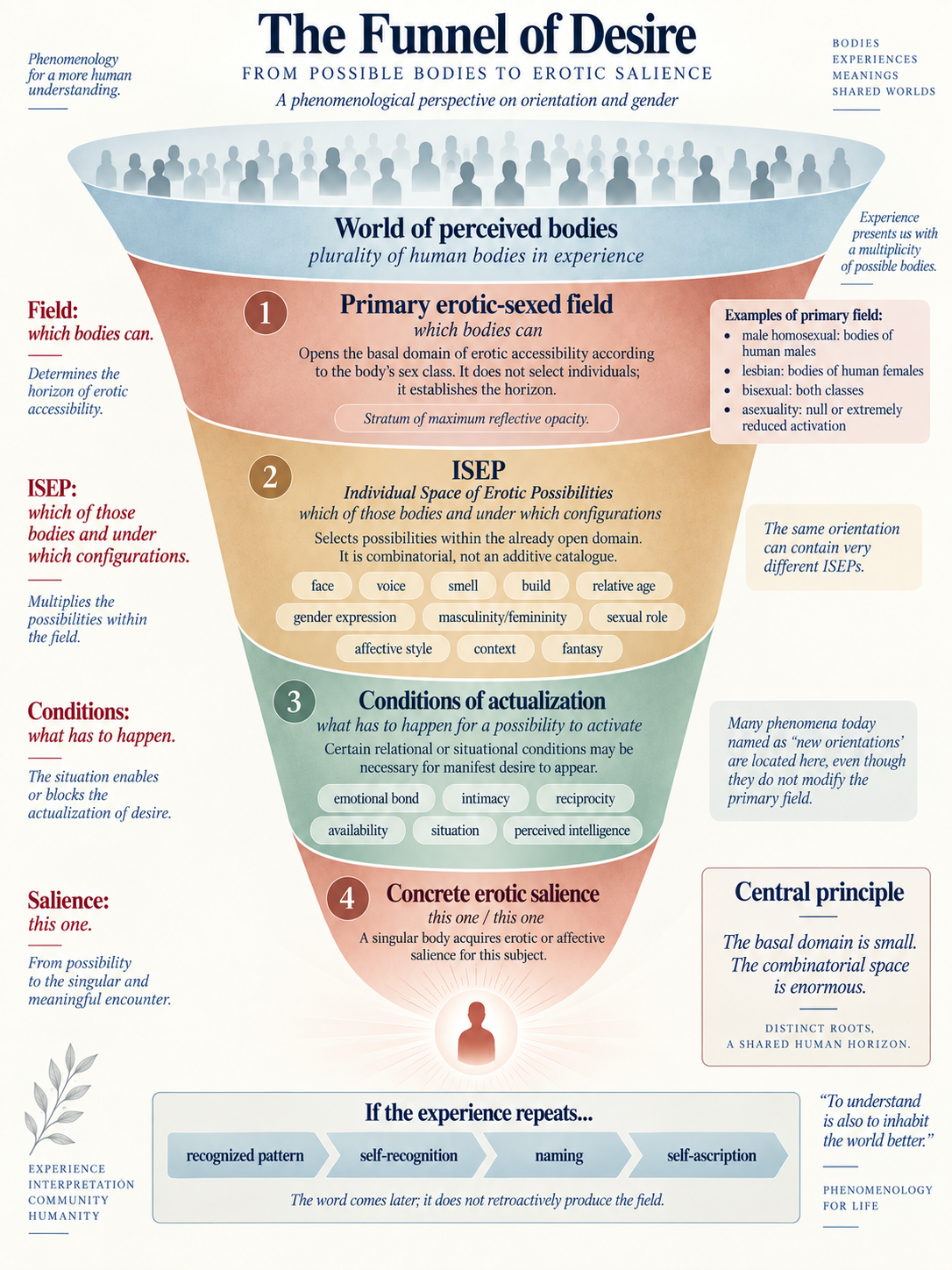
The erotic-sexed field names, in this model, that first level: the horizon within which certain bodies can acquire erotic significance for a subject. It is not yet a matter of explaining why a concrete person proves attractive, nor of enumerating the particular forms desire will take. Still less of asking what word the subject will later use to describe themselves. It is simply a matter of recognising that not all bodies present themselves with the same possibility.
Nor does experience begin as a conscious classification. A subject does not need to carry out an anatomical inspection or formulate a biological proposition for another body to acquire salience. The subject perceives a totality: a voice, a back, a way of walking, a smell, a face, a gesture, a silhouette that enters the scene whole. Orientation does not work like a committee that receives reports and then authorises desire.
That is why the field is pre-predicative. Experience is happening before it takes the form of “I like men”, “I like women” or any other sentence about oneself. The concept will arrive later and will find something already at work.
Material precision matters. The primary domain is organised around human male bodies and human female bodies. We will normally speak of men and women because that is the ordinary vocabulary of human life, but when we need to designate the body’s sex class in technical terms we will use those formulations. Masculinity and femininity will be reserved for other dimensions that will appear further on and must not be confused with bodily sex class.
Carlos does not yet know any of this. All he knows, if that, is that Francisco disturbs the air in a way that Marta cannot manage to.
Everything else will come later.
The Erotic-Sexed Field
When Carlos looks at Francisco he does not first receive a collection of data that he then assembles until he reaches a conclusion. He does not register height, voice, jaw, body hair, bodily proportions and, after a brief meeting of the executive committee of consciousness, decide that it merits an erection. Francisco appears whole. His body acquires a particular density within Carlos’s world. It can catch his attention, alter the rhythm of his gaze, elicit fantasy, curiosity, arousal or that still-formless mixture that often precedes even the capacity to recognise what is happening.
Marta appears too. Carlos can see her, talk to her, find her beautiful, admire her or love her. Her body, however, does not acquire the same kind of presence. Perception is not missing. What is missing is a specific modality of access to what is perceived. Francisco belongs to the set of bodies that can present themselves erotically to Carlos; Marta falls outside it.
That domain, prior to conceptualisation, we will call the erotic-sexed field.
The word field matters because sexual orientation does not yet select concrete individuals. It establishes a horizon of possibility. Within it, later, preferences will appear that are extremely narrow, capricious, sophisticated or downright incomprehensible even to the subject themselves. A male homosexual can walk past a crowd of men without feeling the slightest interest and suddenly stop in front of just one. The selectivity of concrete desire can be ferocious; what remains open in advance is the sex class within which that selection has the possibility of occurring.
The word sexed matters even more. What presents itself is a human body belonging to one of the species’ two sex classes: a human male body or a human female body. In everyday life we speak of men and women because we live among humans and do not draw up zoological reports during a date. The material referent, however, remains the sexed body.
A homosexual does not think: “small-gamete producer detected”. Thank God, because Grindr would be insufferable; he perceives a man.
That man appears through a concrete bodily unity: face, voice, posture, proportions, skin, smell, body hair, musculature, movement, anticipated genitality, age, gesture. Perception offers a totality before analysis can take it apart into components. Erotic experience works on that totality. The body does not arrive as a biological abstraction, even though what appears belongs materially to a sex class.
Merleau-Ponty is especially useful at this point because he allows us to think of perception as a relation to a world that already possesses meaning before it turns into explicit judgement. Perceiving does not consist in receiving neutral units and then adding an interpretation to them from some place in the mind. Something can appear as threatening, welcoming, familiar, strange or erotic before the subject formulates a proposition about it. Meaning is at work when reflection arrives.
Sexual orientation belongs to that stratum.
Carlos does not need to think “Francisco is a human male and therefore belongs to the class of objects compatible with my homosexual orientation”. He does not even need to know yet that there is something called homosexual orientation. Francisco is already available for an erotic experience. The concept will arrive later and find the phenomenon at work.
That is why we call the field pre-predicative. Experience has not yet taken the form of a proposition. It has not said “I like men”. Still less “I’m gay”. There is a mode of appearance of the other’s body that makes those later assertions possible.
The difference may seem minuscule until the order is reversed. If the category produced the field, Carlos would first have to learn what homosexual means in order to be able to experience Francisco as an erotic object. The ordinary biography of countless homosexuals shows the opposite movement: something happens first and provokes, often precisely through its persistence, the need to understand what is happening.
The field also possesses a property that distinguishes it from the later levels of sexuality: its reflective opacity. A homosexual man can remember when he first noticed that another man aroused him, which was the first body to be etched into his memory, what fantasy appeared or what he felt on discovering that other men talked about women while his own attention moved elsewhere. He can reconstruct entire years of shame, denial, secrecy, pleasure or relief. There is one question that reconstruction does not reach: why men?
He can reconstruct when he discovered it, how he lived it and which men he likes. He does not have introspective access to the mechanism that opened that sex class and closed the other.
Aetiology and phenomenology part ways precisely there. Science can investigate genetic, prenatal, neurobiological, environmental or developmental factors associated with orientation. If one day it came to describe the mechanisms involved with enormous precision, that would not turn those mechanisms into memories accessible to the subject. Knowing scientifically why a disposition occurs and knowing from within how it presents itself belong to different registers.
Thirty years from now Carlos could receive a magnificent causal explanation of his homosexuality and still be unable to say: “of course, I personally experienced that process when it happened”. What he experienced was Francisco.
That is the opacity of the primary field. We can recognise its structure by its effects without gaining introspective access to its constitution.
Primary Orientations
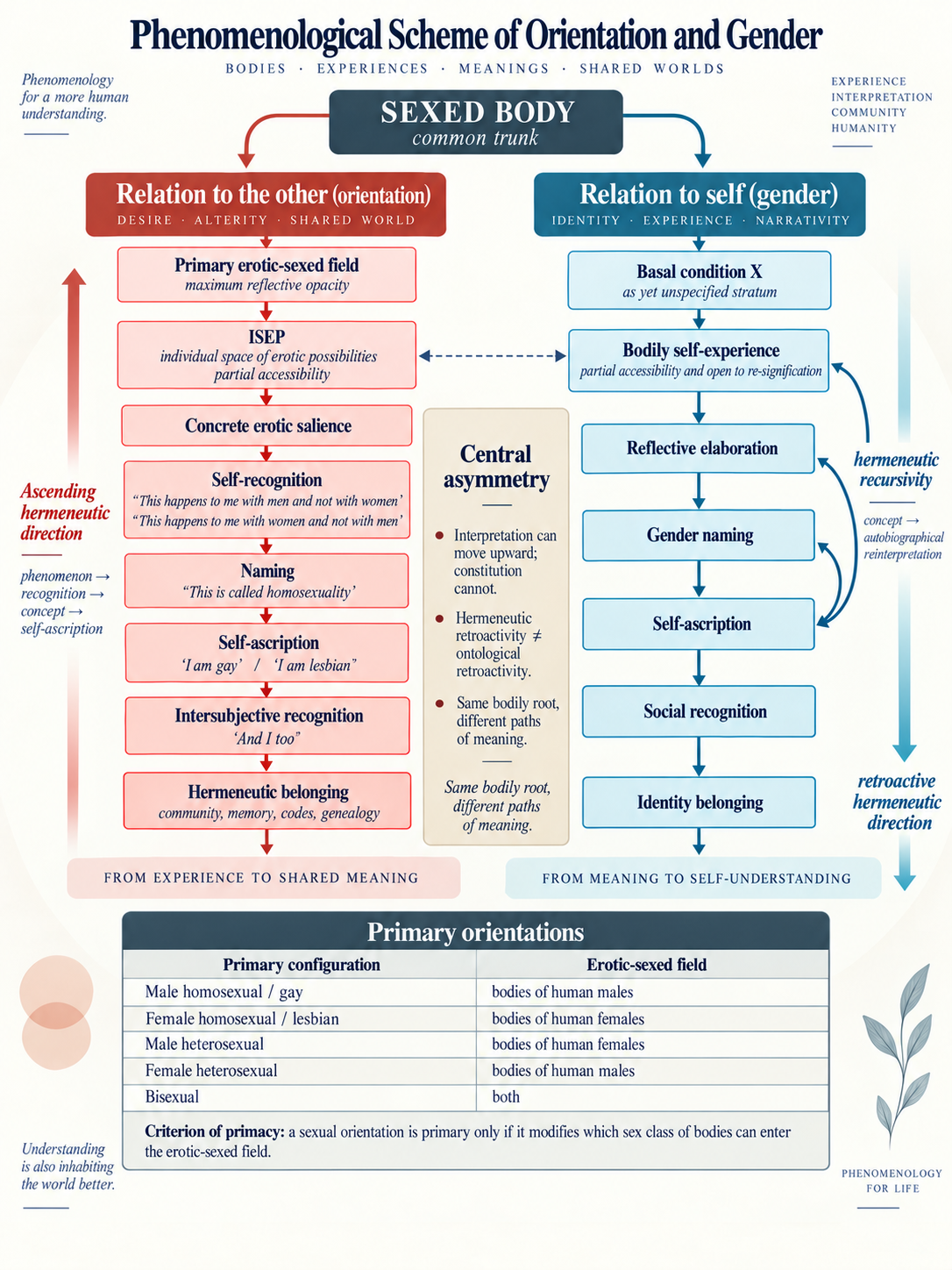
| Primary configuration | Accessible erotic-sexed field |
|---|---|
| Male homosexual / gay | human male bodies |
| Female homosexual / lesbian | human female bodies |
| Male heterosexual | human female bodies |
| Female heterosexual | human male bodies |
| Bisexual | bodies of both sex classes |
The primary structure is very simple. The field can be open towards one class, towards the other or towards both. Bisexuality widens the accessible domain; it does not create a third class of body. Nor does it imply that all the bodies included in those classes prove erotic. It only establishes that neither of the two is excluded on principle.
That basal simplicity coexists with extraordinary diversity because primary orientation does very little work. It does not yet explain why one gay man is turned on by a 50-year-old bear, bearded, broad, with the look of someone who has repaired a tractor without consulting the manual, while another gay man registers only the hairless twink who could lose an argument with a curtain. Both have the same sexual domain open to them. What they find within it belongs to the next level.
That level will be the Individual Space of Erotic Possibilities, ISEP.
The separation makes it possible to preserve at once the stability of orientation and the enormous variation of desire. The field establishes the domain in which selection can occur; the ISEP will begin to explain how possibilities are distributed within it.
Heterosexuality conforms to the same structure, though its coincidence with the statistically dominant expectation tends to make it less visible. In early erotic experience, a heterosexual person is usually surrounded by words, expectations and scenes capable of receiving attraction immediately. A homosexual person may find themselves in the reverse situation: the event is perfectly real and, at the same time, hard to place within the story they expected to live.
That friction makes something more general perceptible. Before any explanation, a selection was already at work.
Later will come the preferences, the fantasies, the encounters and the words. The first event is more elementary: a body appears and, for that subject, it can matter sexually.
From the Field to the ISEP
The erotic-sexed field establishes a very general possibility. For Carlos, human male bodies belong to the domain of what can acquire erotic significance. That openness still says very little about Francisco. It does not explain why Francisco and not another man; nor why certain bodily features, gestures, voices or ways of relating prove powerfully attractive while others go unnoticed.
To that second level belongs the Individual Space of Erotic Possibilities, ISEP.
The ISEP contains the concrete configurations capable of acquiring erotic value for a subject within the previously opened domain. Bodily features, relative age, build, face, voice, smell, modes of movement, gender expression, degrees of masculinity or femininity, sexual roles, forms of interaction, affective styles, contexts, fantasies and associations can come into play there, and their combination turns out different in each person.
Two male homosexuals can share exactly the same primary configuration of the erotic-sexed field and have almost opposite individual spaces. Both possess erotic access to human male bodies. That coincidence is enough for them to share an orientation. After that, the divergence begins.
The ISEP makes it possible to preserve both things without turning them into a contradiction: stability of orientation and diversity of desire.
Orientation answers a relatively austere question: which sex class of bodies can come to arouse me?
The ISEP answers another, rather more complicated one: what has to happen within that class for a concrete body to acquire erotic value for me?
The answer can be surprisingly narrow. A person discovers that certain body types reappear in their fantasies, that a certain voice arouses them, that they seek specific forms of masculinity or femininity, or that they need a particular combination of appearance, attitude and sexual position. Some components only work together. A beard can be attractive on one face and ghastly on another. A feminine expression can increase desire for one man and diminish it for another. A sexual practice can be arousing as a fantasy and not form part of what the subject wishes to carry out.
The ISEP is, for that reason, combinatorial. Erotic possibility emerges from configurations, not from a catalogue in which each characteristic carries a fixed score.
Here too a difference in accessibility appears with respect to the primary field. Carlos can know that he likes men without being able to explain why he likes men. Over time, on the other hand, he can recognise much more about which men he likes. He can establish patterns, remember experiences, discover associations and modify the interpretation of his own preferences.
That knowledge is never complete. A person can spend years repeatedly desiring bodies with certain characteristics before noticing the regularity. Someone else may point it out first: “you always end up looking at the same type of man”. Perhaps later they will build a convincing autobiographical explanation, or perhaps they will still not know why that particular combination acquired such potency.
The difference from the field lies in the degree of penetration possible. In the ISEP there is partial reflective accessibility. Introspection can illuminate regions, find relations and reorganise the way the subject understands their desire. Faced with the constitution of primary orientation, it meets a much harder limit.
This produces a gradient. At the most opaque end lies primary orientation. Closer to reflection appears the ISEP; after it will come concrete experiences, the recognition of the pattern, its naming and the explicit forms of self-ascription. The subject progressively gains a greater capacity to describe and interpret what happens to them as they move away from the pre-predicative stratum.
The ISEP also makes it possible to locate a good part of the diversity that today tends to be described by means of new sexual orientations. Some contemporary categories point to real and recognisable phenomena, but they do not always take as their object the sex class of accessible bodies. A person who needs to establish an affective bond before experiencing desire presents a particular condition of erotic activation. That condition modifies the way their ISEP works, but leaves the primary question open: human male bodies, human female bodies or both?
The same happens with other characteristics that can be decisive for desire without creating a new primary orientation. Degrees of masculinity or femininity, intimacy, certain forms of intelligence or personality, relational positions, sexual practices and aesthetic configurations can enormously reduce the set of bodies that are actually desirable. They still operate within a previously opened sexual domain.
A lesbian woman, for example, can feel intensely attracted to women of very masculine expression without that masculinity producing an orientation towards human male bodies. Expression forms part of the possible erotic configuration within the ISEP. Bodily sex class establishes the domain on which that configuration can acquire efficacy.
Likewise, a homosexual man can feel attracted to men whose presentation is profoundly feminine. Femininity can even constitute a central condition of his individual desire and his field still remain open towards human male bodies.
This separation makes it possible to conceive of configurations in which bodily sex, gender expression and declared identity appear decoupled. Bodily sex class belongs to the primary field; presentation, masculinity, femininity and other perceptible characteristics can acquire enormous importance within the ISEP. The specificity of attraction arises precisely from the combination.
The enormous plasticity of the ISEP, set against the austerity of the primary field, explains why human sexualities can seem infinitely diverse without needing an equally infinite number of primary orientations. A domain made up of few basal possibilities can generate an immense range of individual combinations.
This makes it possible to establish a criterion of primacy. A category describes a primary sexual orientation when it modifies which sex class of bodies possesses access to the erotic-sexed field. When it describes what conditions must obtain within an already accessible class, we are dealing with another dimension of sexuality.
The criterion does not decide which experiences are important. It decides where they are located.
The name itself, Individual Space of Erotic Possibilities, then acquires a more precise meaning. It no longer needs to contain the primary sexual direction as one of its components. That direction is given by the field. The ISEP begins to work later, selecting possibilities within what the field has made accessible.
erotic-sexed field: which bodies can
ISEP: which of those bodies and under which configurations
concrete erotic salience: this one
When that this one repeats itself often enough to become a pattern, another operation will begin. Experience will be able to look for a word and become intelligible.
When What Happens Finds a Name
For a while, Carlos has no identity to declare. He has experiences.
Francisco produces something in him that Marta does not. After that another man appears, and later another. The scenes are not identical, but they begin to form a regularity. The field was already at work; the ISEP was selecting within it concrete bodies capable of acquiring salience. What is new appears when Carlos recognises that those episodes are not isolated events:
this happens to me with men.
He does not yet need to know what that sentence means socially, nor to have a theory of sexuality at his disposal. Recognising a regularity demands much less than explaining it. Consciousness finds a pattern among experiences whose structure was already at work when each of them occurred.
That moment can be called self-recognition of orientation.
Self-recognition makes a regularity explicit without producing it. Carlos can take months or years to admit what his experiences had been showing. Shame, fear, family expectations, religion, ignorance or simple difficulty in interpreting what is happening can put an enormous distance between experience and recognition. None of those delays retrospectively transforms the structure of the field.
A homosexual man can spend years asking himself what is happening to him and still not answer a deeper causal question. “I like men” identifies the pattern. “Why do I like men?” belongs to another problem and quickly runs into the opacity of the primary field.
Starting from self-recognition, naming can appear. The pattern finds a word: homosexual, gay, lesbian, bisexual, heterosexual. That operation connects private experience with a shared conceptual system. Carlos discovers that what is happening to him has happened before, that others recognised it and that there is a category capable of gathering scattered experiences under a common form.
Ulrichs works almost as an involuntary historical experiment in this sequence. His erotic experience preceded the word that would later make it possible to stabilise that type of orientation socially. He did not need to have the sexological vocabulary of the nineteenth century at his disposal for another man to acquire sexual significance. The words came later because there was something that needed to be named.
We can call that movement hermeneutic consolidation through recognition. The concept gathers previously scattered experiences and makes it possible to interpret them as manifestations of one and the same structure. It does not turn each memory into a perfect copy of the present concept; memories can be ambiguous, incomplete and later reinterpreted. Naming offers a relatively stable way of reading the regularity.
Carlos can then go back over Francisco, someone he once looked at too much, an encounter he kept revisiting or a photograph he kept without quite knowing why. Experiences once separate acquire a common intelligibility. The category works retrospectively, but its retroactivity is hermeneutic: it reorganises the present meaning of earlier experiences.
After that, self-ascription appears. It is no longer simply a matter of “this is called homosexuality”, but of “I’m homosexual” or, probably with a different charge, “I’m gay”. Naming classifies a phenomenon; self-ascription uses that classification to say something about oneself.
This is where it is worth introducing, forcefully, the difference between analytic vocabulary and historical words. Androphilia and gynephilia make it possible to describe the direction of the field independently of the subject’s sex. They are useful tools for comparing structures. A heterosexual woman and a gay man share an openness towards human male bodies; a lesbian and a heterosexual man share an openness towards human female bodies.
Gay and lesbian do something else as well.
When Carlos says “I’m gay”, he uses a word that millions of people spoke before him to talk about their desires, to hide, to find one another, to organise, to fuck, to fall in love, to survive and to claim a place. The term does not only describe an orientation. It can become a way of inhabiting a genealogy.
That is why analytic equivalence is never complete existential equivalence. Androphilia maps a direction; gay can also produce belonging.
Self-ascription prepares the next moment: intersubjective recognition. Carlos says “I’m gay” and another man replies “me too”.
That too does not claim that both desire exactly the same bodies. Their ISEPs can be very different. Nor does it presuppose that they share character, ideology, social class, aesthetics, sexual practices or a life project. It recognises a homology of structure: what you have just named in yourself points to something I also recognise in myself.
From there hermeneutic belonging can arise. A word allows private experiences, different in content and biography, to be recognised as variations of a common structure. A we appears that does not require uniformity and that can later thicken into sociability, meeting places, codes, humour, memory, political associations, sexual culture and shared narratives.
erotic-sexed field → ISEP → concrete erotic salience → self-recognition → naming → self-ascription → intersubjective recognition → hermeneutic belonging
The usefulness of the chain lies in distinguishing operations, not in forcing every biography to behave like a form to be filled in. In some lives several moments overlap; others are barely thematised. What matters is that each level adds something different.
Heterosexuality usually requires much less hermeneutic work because the subject often has a ready-made social interpretation available before their first attractions become fully intelligible. The category heterosexual may appear late and by contrast. For Carlos, by contrast, expectation pointed towards Marta and experience insists on Francisco. That friction makes it necessary to illuminate stages that can remain transparent for others.
Homosexuality thus becomes an especially useful observatory for a more general structure. It makes visible mechanisms that statistical normality allows one to pass through without looking too closely.
And, at the upper end of all that work, someone can say “me too” and make a two-word phrase carry an entire history.
The Same Body, Two Directions
The sexed body occupies a strange position within this architecture because it takes part in two different relations at the same time. It is the body from which one desires and it is also the body the subject inhabits. One direction opens towards others; the other turns back on oneself. Both start from the same bodily materiality, but they produce different phenomena.
In the first, the subject encounters the bodies of others capable of acquiring erotic salience. That is where the erotic-sexed field appears and, within it, the ISEP. The fundamental question is other-directed: which bodies of the other can appear to me as sexually possible?
In the second direction the question changes. The subject lives their own sexed body, moves with it, looks at it, feels how it is seen, finds comfort or strangeness in certain ways of presenting it and progressively gains access to concepts capable of organising that experience. The question is self-directed: how does my own body appear to me, and what place does it occupy within the sexed and gendered world I inhabit?
The two questions can meet in one and the same person without being conflated.
Carlos can experience his human male body completely naturally and, at the same time, have his erotic field open towards other bodies of the same sex class. His homosexuality describes the direction of his field towards the other. Nothing in that structure requires him to experience a conflict with regard to his own body.
Another person can present a much more complex relationship with their sexed body and maintain exactly the same primary orientation. They can be homosexual, heterosexual or bisexual regardless of how they organise their self-experience. That makes it possible to think of orientation and gender as two branches capable of crossing countless times without either being reducible to the other.
The symmetry ends there.
In the orientation branch we find a particularly opaque stratum: the primary erotic-sexed field. We can recognise its effects, but introspection does not manage to descend as far as the mechanism that distributes the sexual accessibility of bodies.
Bodily self-experience has a different texture. It can be difficult, fragmentary and partially opaque, but it admits far greater hermeneutic activity. A person can review how they lived their body earlier in life, remember discomforts, recover pleasures, shames, gestures or aesthetic choices and, years later, find a different interpretation for them. What was initially lived without explanation can acquire a different organisation when new concepts appear.
That is why bodily self-experience does not occupy, within the gender branch, the same level as the erotic-sexed field within orientation. It lies closer to the ISEP: both are partially accessible and partially opaque territories.
About the ISEP I can know some things. I can discover patterns, notice that a certain bodily form attracts me repeatedly, recognise that a particular combination of masculinity, voice and attitude has a potency that others do not have. I can even build hypotheses about my own desire. There will be zones that remain unexplained.
Something similar happens with my bodily experience. I can recognise how certain ways of dressing modify my relationship with myself, which parts of my body concentrate comfort or discomfort, which social positions feel my own or alien to me and which ways of being looked at produce recognition or strangeness in me. I can also reinterpret those experiences as my vocabulary changes.
This places the ISEP and bodily self-experience in a zone of especially fertile proximity.
They are not the same phenomenon. The ISEP is oriented towards what can arouse me. Bodily self-experience concerns the way I inhabit and understand my own body. But the two can touch.
A person can eroticise in others a certain form of masculinity that simultaneously organises the way they wish to present themselves. Another may seek in someone else’s body features they would never want for themselves. A third discovers that what they admire, what they desire and what they identify with form a mixture that is hard to separate. The desired body can function as an erotic object, a bodily model, a surface of identification or all three at once.
The example of gender expression allows us to see this clearly. Masculinity and femininity form part of an intelligible social world. A gesture, a garment, a voice or a certain aesthetic acquires meaning because there are codes capable of turning them into recognisable signs. Once learnt, those codes can operate with enormous immediacy.
Within the ISEP those forms can prove erotically decisive. One gay man can desire very feminine men; another can feel attracted almost exclusively to markedly masculine expressions. A lesbian can seek a butch expression, femme, or configurations that do not fit neatly into either of those words. Bodily sex class establishes the primary domain; expression later takes part in individual selection.
In bodily self-experience the complementary operation takes place. That same masculinity or femininity can be lived as one’s own, as alien, as desirable for oneself, tolerable, uncomfortable or irrelevant. The phenomenon no longer consists in eroticising someone else’s body, but in inhabiting a bodily and social configuration.
Here gender begins to acquire a particular position within the model. Bodily self-experience can later be organised by means of gender categories, but those categories arrive at lived material that has its own history. Some people quickly find a word that feels stable to them; others pass through different formulations as they reinterpret their experience.
The branch can be represented provisionally as follows:
Sexed body
relation to the other
→ primary erotic-sexed field
→ ISEP
→ concrete erotic salience
relation to oneself
→ basal condition as yet unknown
→ bodily self-experience
→ reflective elaboration
→ gender naming
→ self-ascription
Between the ISEP and bodily self-experience there is a zone of exchange. The arrows can run in both directions because both strata admit learning, sedimentation, recognition and reinterpretation. Further down, an asymmetry appears. In orientation we know the basal phenomenological effect, the erotic-sexed field, but we still have no introspective access to its constitutive mechanism. In the gender branch we do not need to invent an equivalent entity merely out of a desire for symmetry.
There could be a bodily, developmental, neurobiological or other kind of condition that takes part in forming certain gender experiences. There could also be several mechanisms capable of producing subjectively similar experiences. The scheme only needs to recognise that bodily self-experience contains enough phenomenological material to be partially thematised and later reinterpreted.
Orientation shows a different structure. Carlos can go back over Francisco as many times as he likes, attribute new meanings to him, better understand his fear or reconstruct the cultural history that surrounded that experience. None of those reinterpretations changes the direction of the original event: Francisco had acquired erotic salience.
When both branches reach their conceptual levels, the difference becomes important. In orientation, the concept finds a previously constituted regularity. Gay makes it possible to understand and communicate something that had already manifested itself repeatedly. In gender experience, a newly found concept can have a much more active relationship with what it interprets and can reorganise memories that until then were scattered.
The two branches share a body and zones of interaction. What changes is the depth to which hermeneutics manages to penetrate.
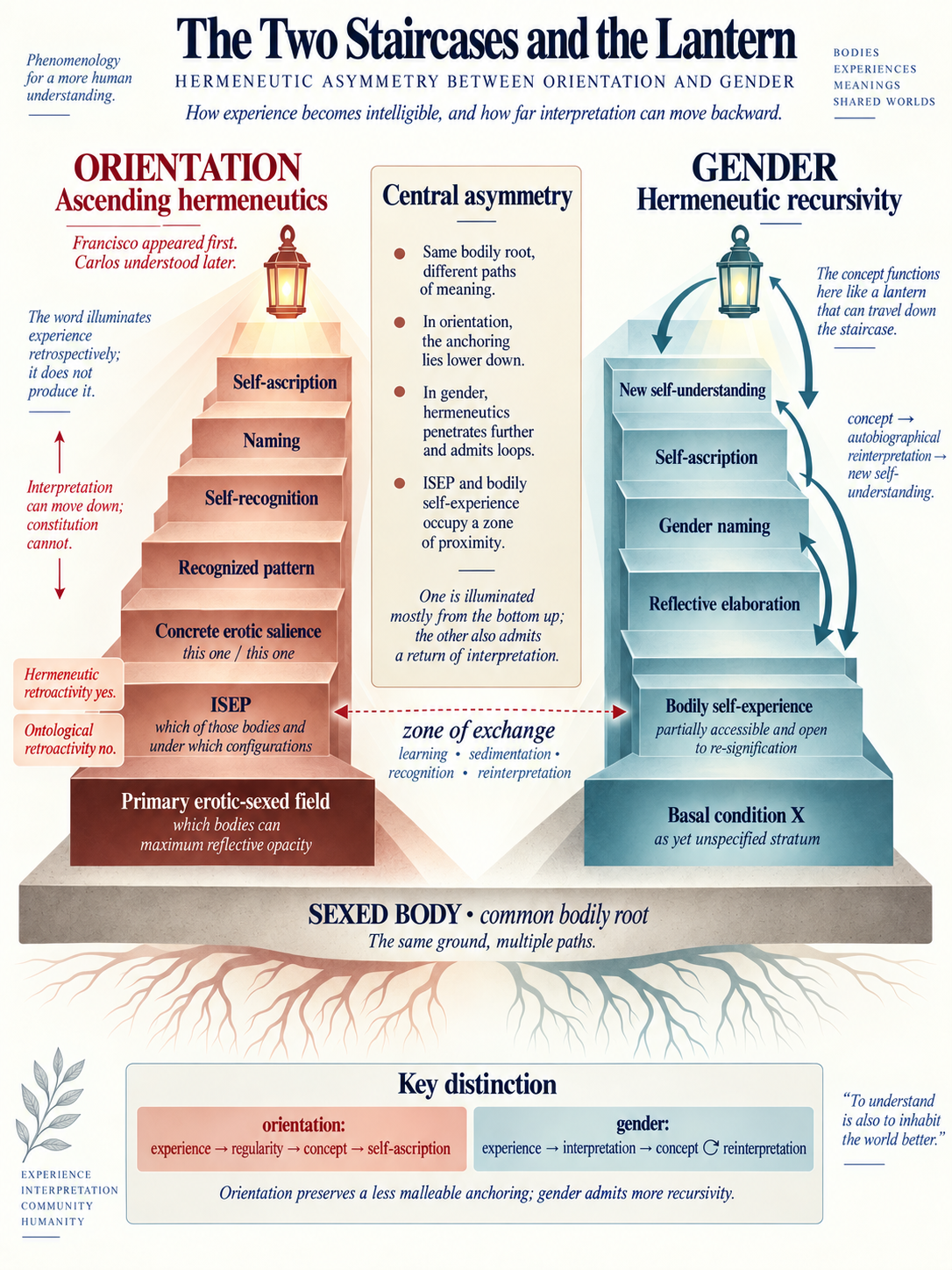
One staircase is lit fundamentally from the bottom up. The other also allows someone to switch on a light at the top and carry it back to the steps they had climbed in the dark.
The Staircase and the Lights
Carlos does not begin with a word. He begins with Francisco.
The sequence matters because the order in which an experience becomes intelligible also says something about the kind of phenomenon we are trying to describe. First a body appears with a particular salience. Then others appear. Later the repetition becomes recognisable and the words arrive that are capable of gathering those episodes together.
Orientation proceeds, in its paradigmatic form, by means of an ascending hermeneutics of recognition. Experience precedes its conceptual articulation, and each new level illuminates something that was already happening.
The image of a staircase proves useful. On the first steps there is experience with very little reflective light. As the subject climbs, they can look back down and recognise more clearly what they went through. The field was already at work when there was not yet a phrase to describe it; the ISEP introduces particular configurations; repetition makes it possible to notice patterns; naming supplies concepts, and self-ascription makes them communicable to others.
Carlos can end up saying “I’m gay”. From that step he sees much more than he did when the experience first began to become intelligible. He can go back over Francisco and understand why he unsettled him, why Marta did not produce the same effect, or why certain memories that had seemed disconnected formed a continuity. The word illuminates the experience retrospectively. What it does not do is produce it from the present.
The difference can be expressed by means of a distinction between hermeneutic retroactivity and ontological retroactivity.
Every autobiography contains hermeneutic retroactivity. Past events acquire new meanings when the subject has concepts available that they did not have before. The adult can recognise homosexuality in experiences once lived as confusion, fascination, fear or sheer bodily intensity. A scene acquires meaning within a story that did not yet exist when it happened.
That retrospective work modifies the intelligibility of the past. It does not modify which body had acquired erotic salience at that moment.
Carlos can reinterpret what Francisco meant for decades. He cannot retrospectively turn Marta into the body that aroused him.
Interpretation can move backwards; constitution cannot.
The concept gay can reorganise the understanding of an entire biography. It cannot, by declaration, open the erotic-sexed field towards a class of bodies that never had access to it. Self-ascription depends, in this model, on a prior structure that supplies it with content.
That is why someone can be mistaken about themselves, use a category provisionally, later discover that another describes their experience better, or spend years revising the words through which they try to understand themselves. Those movements take place at the reflective levels of the chain. The concept can be corrected because the concept is accessible; the field remains that with respect to which the correction tries to be adequate.
In the gender branch a different hermeneutic temporality appears.
Bodily self-experience too can precede words by a wide margin. A person can have felt discomfort, strangeness, an affinity with certain forms of presentation or a particular relationship with certain parts of their body for years before finding a category capable of organising those experiences. In those cases the movement also ascends from the lived towards its conceptualisation.
But that branch also admits an operation that meets a much more rigid limit in primary orientation: hermeneutic recursivity.
A category found later can become an instrument for exploring one’s own bodily experience. The subject goes back over ambiguous memories and asks them new questions: did that discomfort have to do with my body, with presentation, with social expectations? Was that way of dressing an aesthetic preference, a search for recognition, a way of inhabiting myself?
Here the concept works like a torch that can be carried back down the staircase.
A memory can pass through different readings. Earlier in life it was shame; later it was understood as nonconformity with a role; later still as body dysphoria, and years afterwards it may acquire yet another explanation. The event remains in the biography, but its position within the narrative changes.
Orientation also admits autobiographical reinterpretations, although the direction of the field offers a far less malleable anchor. A man can revisit why he denied for years that he liked men, change the meaning he attributes to his first sexual experience, or understand a past heterosexual relationship differently. The sexual object that had acquired salience leaves a trace more resistant to rereading.
In the gender branch, by contrast, the interpreted material includes bodily experiences, social signs, forms of presentation, expectations, identifications, roles and modes of recognition. Many of those components acquire part of their meaning within shared symbolic systems. That increases the concept’s capacity to reorganise experience retrospectively.
In orientation the dominant movement is:
experience → regularity → concept → self-ascription
In gender the following can appear:
experience → interpretation → concept
but also:
concept → reinterpretation of experience → new self-understanding
The second branch admits loops.
An interpretation can modify bodily presentation; that presentation changes the experience of self, which in turn can strengthen, weaken or transform the category used. Primary orientation shows much less recursivity at its basal stratum. A lesbian can revisit her history, her relationship with femininity, her preferences within the ISEP and the words through which she describes herself. None of those hermeneutic operations in itself contains a mechanism for opening the field towards human male bodies.
The contrast makes it possible to distinguish two kinds of relation between concept and experience. In orientation there is a strong phenomenological dependence: the concept draws its content from a prior regularity of the field. In gender there can be a reciprocal hermeneutic dependence: experience feeds the concept and the concept reorganises the way in which experience becomes intelligible.
That reciprocity does not require us to suppose that categories manufacture from scratch every bodily sensation to which they later give meaning. The concept modifies the map with which the subject travels through their own history. Some zones become visible; others lose importance; scenes previously trivial acquire an unexpected centrality.
The ISEP occupies an intermediate position. There too retrospective reinterpretation occurs: a person discovers recurring configurations, modifies preferences, finds associations or attributes different motives to one and the same regularity. Introspection goes considerably further here than it does when faced with the primary question “why male bodies?” or “why female bodies?”.
That is why the gradient of reflective accessibility is not an ornamental line within the model. It explains how far hermeneutics can reach at each stratum. The higher up a level sits, the greater its availability to language and revision. The closer to the pre-predicative stratum, the more we find a relation with the world that was already at work before the self could take it as an object of thought.
In orientation, the anchor point sits especially low.
Francisco appeared first. Carlos understood later.
And even if he lives to be a hundred, learns phenomenology, psychoanalysis, genetics, anthropology and becomes insufferable over the after-dinner conversation, there will still be a question his autobiography cannot answer from within: why Francisco could get in there and Marta could not.
In the next instalment I will put this architecture to work: how many primary sexual orientations it admits, what happens when identity categories intervene in orientation words, and why the same label can begin answering different questions.


Deja una respuesta