EN · ES
From Desire to Political Category
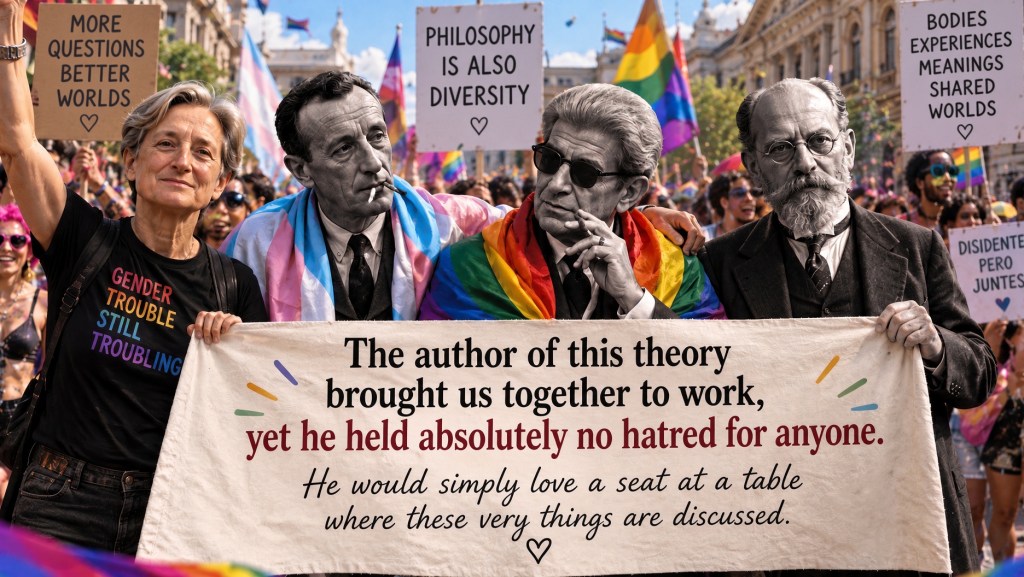
For anyone who does not recognise them, the four figures in the image are Judith Butler, Maurice Merleau-Ponty, Jacques Lacan and Edmund Husserl. A group as motley as a Pride march.
And yes: the fag read all four.
Because only a bourgeois fag with a self-perceived proletarian streak could consider it reasonable to seat Butler, Merleau-Ponty, Lacan and Husserl at the same table in order to build a theory capable of talking at once about sexed bodies, sexual orientation, gender, perception, identity, subjectivity and hermeneutics. It was either that or have normal hobbies.
None of them formulated the theory I am developing here. I am not trying to manufacture an impossible synthesis or retrospectively attribute a common position to them. I make them work on different problems. Merleau-Ponty helps me think about how a body can appear already charged with meaning before explicit judgement; Husserl, the status of experience and what can be described before it is causally explained; Lacan, the distance between experience, subject and the words through which we try to capture ourselves; Butler, the power of gender categories to organise, reiterate and render certain forms of life intelligible.
Then I do something for which the responsibility is entirely mine: I put them around a table and ask what happens when those tools are applied to one very concrete phenomenon.
Desire.
In the previous instalment I built the architecture: sexed body, primary erotic-sexed field, ISEP, concrete salience, naming, self-ascription and the asymmetry between orientation and gender experience. Now it is time to make the architecture work.
How many primary sexual orientations do we really need? Where do categories such as demisexuality or sapiosexuality belong? What happens when sex, gender identity and orientation use the same word to classify different things? What does a “me too” preserve when two people arrive at the same label through different routes?
And, finally, the point where philosophy stops behaving politely:
what happens when those categories enter politics?

How Many Sexual Orientations Are There?
Once the erotic-sexed field has been separated from the ISEP, the contemporary proliferation of sexual orientations changes its aspect. The question stops being how many words exist to describe a sexual experience and becomes which property a category must modify in order to constitute a primary sexual orientation.
The criterion follows from the model itself:
A sexual orientation is primary when it determines which sex class of bodies can enter a subject’s erotic-sexed field.
The basic positive configurations are, therefore, three: access to human male bodies, access to human female bodies, or access to both classes.
Analytically, those directions can be expressed by means of androphilia, gynephilia and bisexuality. When related to the subject’s own sex, the usual social categories appear:
| Subject’s sex | Accessible field | Usual category |
|---|---|---|
| male | human male bodies | male homosexual / gay |
| female | human female bodies | female homosexual / lesbian |
| male | human female bodies | heterosexual |
| female | human male bodies | heterosexual |
| either | both classes | bisexual |
The austerity of the primary level contrasts with the exuberance that appears immediately afterwards. Two subjects can share exactly the same orientation and have concrete sexualities that barely touch. The field opens bodies of one and the same class; the ISEP introduces practically the whole combinatorics that makes desire singular.
There, build, face, smell, voice, masculinity, femininity, forms of presentation, power dynamics, sexual practices, affective conditions, relational scripts, fantasies, certain contexts and associations can come into play, and their provenance can be partially accessible or completely opaque.
That difference offers a criterion for ordering categories that today are often gathered together under the word orientation. Consider someone who describes themselves as demisexual. The property indicated can be central to their erotic life: desire only appears after a certain kind of bond has been established. The phenomenon modifies the conditions of actualisation of an erotic possibility. We still need further information to know the sexual direction of the field.
The description then contains two levels:
which bodies can
and
under what conditions they can.
The first belongs to primary orientation. The second belongs to the ISEP or to relational configurations that take part in its actualisation.
Something similar happens with sapiosexual. Suppose a person needs to perceive a certain intelligence for desire to appear. That characteristic can function as an extraordinarily restrictive filter. The field still needs to answer whether that intelligence proves erotic when it appears embodied in human male bodies, human female bodies or both classes.
Intelligence selects. Bodily sex orients.
Countless preferences can be biographically more important to a person than the label of their orientation. Someone may experience attraction almost exclusively to a certain gender expression, need emotional intimacy, eroticise particular roles or find very specific bodily configurations desirable. Their ISEP may have an architecture so narrow that only a tiny fraction of the available bodies acquires any real possibility.
Nothing requires turning each of those filters into a primary sexual orientation.
Primary Irreducibility and Secondary Proliferation
Primary orientations display irreducibility because none of them is obtained by accumulating internal preferences from another. Exclusive openness towards human male bodies is not produced by gathering enough masculine traits within a field directed towards human female bodies.
A lesbian can desire extremely masculine women and remain within a gynephilic orientation. A male homosexual can prefer men of very feminine expression. Masculinity and femininity belong to another variable.
This shows why sex and gender expression occupy different levels within the architecture of desire.
The less work we make primary orientation do, the more diversity we can explain afterwards. If an orientation had to contain the object’s sex, body type, gender presentation, intensity of desire, need for a bond, sexual role, romanticism, preferred practices and every individual condition of arousal, we would need a different category for almost every person.
The basal domain is small. The combinatorial space is enormous.
The Problem of Compound Categories
Some contemporary terms mix variables from different levels into a single word. That can be useful for someone to describe themselves. Taxonomically it produces another kind of object: a compound category.
Imagine a woman who only experiences desire for other women after developing an intense emotional relationship. Her configuration could be expressed analytically by means of an exclusive gynephilic primary orientation and a relational condition requiring a prior emotional bond. Demisexual can describe that second property; lesbian, the first, in relation to the woman’s own sex.
Both pieces of information are real. They answer different questions.
The same separation serves to distinguish sexual orientation and romantic orientation. A person can organise what acquires sexual value differently from what they use to build loving bonds. When both dimensions coincide, their independence goes unnoticed. When they diverge, the need for additional words appears.
Those words increase the descriptive resolution of the individual. They do not necessarily increase the number of primary sexual orientations.
The Case of Asexuality
Asexuality presents a different problem because it seems to describe the degree of activation of the field rather than a direction towards a third sex class.
An asexual person may experience the absence, or a very low presence, of sexual attraction towards human bodies. In terms of the model, that could provisionally be represented as a field with no positive erotic accessibility, or with extremely reduced activation.
Studying it requires distinguishing sexual desire, physiological arousal, behaviour, romanticism and erotic possibility. Asexuality can function as the null case of the system without obliging us to postulate an additional class of bodies:
{male}
{female}
{male, female}
and, possibly, ∅
That last case describes the absence of an accessible sexual object, not a fourth direction.
A Classification with Levels
- Primary sexual orientation: which sex class of bodies can enter the erotic-sexed field?
- ISEP: which configurations within the open classes possess erotic possibility?
- Conditions of actualisation: what has to happen for a possibility to become manifest desire?
- Behaviour and bonding: what does the subject actually do, and what relationships do they form?
- Naming and self-ascription: what words does the subject use to understand and communicate that structure?
A person may need several words to describe themselves because their sexuality occupies all those levels at once. The taxonomic error appears when every difference detected at any one of them gets projected onto the first.
A new property can produce a more precise description of the ISEP, identify a relational condition, name a way of living desire or generate community around that experience. None of that makes it trivial.
Primary orientation still answers the most elementary question:
which bodies can appear?
Only after that does the carnival begin.
The Lesbian Case: When “Me Too” Fails
The word lesbian allows us to observe with particular clarity the complete chain, because it concentrates orientation, self-recognition, self-ascription, shared history and belonging. Its content begins long before the word. A woman finds human female bodies within her erotic-sexed field; within that domain, her ISEP selects certain configurations; the repetition of those experiences makes it possible to recognise a regularity, and the name can finally become a way of saying something about herself in front of others.
“I’m a lesbian.”
Another woman replies:
“Me too.”
That second utterance only looks simple. To work, it needs to preserve a sufficiently stable relation to what both words name. It does not require that the two women share the same ISEP. One can be attracted to very masculine women and the other to profoundly feminine expressions. One can fall in love easily and the other need months. The me too survives those differences because the homology lies at a prior level: both recognise the same sex class of bodies as erotically accessible.
That link between concept and experience can be called phenomenological anchoring. The word retains its capacity to produce recognition because it refers back to a prior structure. Self-ascription is not left floating above experience as a purely nominal choice. It preserves a reference.
The term then acquires a historical density that far exceeds that initial structure. There is culture, a distinctive eroticism, memory, meeting places, codes, styles, internal conflicts and whole generations that learnt to recognise one another under that word. That richness does not eliminate the basal reference that made it possible to build it.
The difficulty appears when one and the same word starts being used by means of different principles of individuation.
Think first of a trans man whose body belongs to the human female sex class. Within this model, his gender identity belongs to the branch of the relation to oneself and can profoundly organise his self-understanding, his presentation, his bodily history and his social position. For a lesbian, meanwhile, that body can lie within the primary domain of erotic accessibility. The ISEP will later decide whether that particular person proves attractive: bodily modifications, gender expression, voice, way of dressing, behaviour or sexual characteristics can increase, reduce or eliminate salience for a given lesbian.
The category trans man and the possibility of lesbian attraction describe different relations to the same body. One belongs to the self-understanding of the subject; the other to the erotic field of the desiring subject.
The inverse case makes another principle of belonging visible. A trans woman whose body belongs to the human male sex class can ascribe herself to lesbian because she understands herself as a woman and directs her desire towards those she understands as women. Self-ascription then begins from gender identity: a woman who desires women.
The phenomenological sequence we have been developing starts from another criterion: a human female whose erotic-sexed field is open towards bodies of the same sex class.
Both paths can arrive at the same word without using the same principle of individuation. What appears there is what we can call categorial homonymy.
For one definition, lesbian is individuated by one’s own sex and by the sex of the bodies accessible to the erotic field. For another, by one’s own gender identity and by the gender identity of those who constitute the objects of desire. The disagreement remains partially hidden because both architectures end up using the same signifier.
As long as the discussion stays at the level of vocabulary, it looks like a fight over who gets to use a label. If we go back down the chain, a different question appears: what relation does a category of orientation preserve with the erotic phenomenon it claims to name?
The answer within this model depends on referential continuity. A category of orientation retains its descriptive function so long as its different uses can return to sufficiently homologous structures of the erotic-sexed field. The me too does not demand identical persons; it demands that the information transmitted does not change in kind along the way.
Thus, “I like women” can use women as a sex category – persons with a human female body – or as an identity category – persons whose gender identity is feminine. The syntax is identical, and the principle of individuation is not.
In the first path, the concept ascends from a phenomenon:
field → recognition → concept → self-ascription
In the second, an identity category situated in another branch intervenes in defining which persons will count within the orientation category.
The erotic field has no reason to accompany that conceptual modification. A lesbian can socially recognise another person’s gender identity and, at the same time, maintain a field organised by bodily sex class. Intersubjective classification and the spontaneous distribution of desire belong to different levels.
That also explains phenomena that would seem contradictory if orientation were organised exclusively by the object’s gender identity. A lesbian can find a particular trans man erotically accessible and not a particular trans woman. If the primary level is organised by bodily sex class and gender intervenes afterwards, the distribution ceases to be mysterious. The sexed body delimits the basal domain; presentation, expression and bodily modifications intervene in the ISEP.
Sharing a primary direction, of course, does not produce uniformity. Some bodily changes associated with a transition can increase salience for one person and reduce it for another. The ISEP preserves all that variation.
The same logic allows us to analyse a man whose desire is concentrated specifically on trans women. The analysis begins by asking which sex class of bodies possesses erotic accessibility and then studies the configurations that acquire particular potency within that field. Femininity, a certain bodily presentation or the characteristics associated with a trans identity can occupy a central place without automatically needing to become a primary orientation.
Nor does this taxonomy distribute dignity. Whether or not a structure is described by a particular category does not establish a hierarchy between persons.
What appears here is a problem of reference: to what extent a word can modify its principle of individuation and still transport the same information. When that word also organises mutual recognition, historical memory and erotic spaces, the problem ceases to be merely lexicographic.
That will be the starting point for the political dimension.
Before the Name
The architecture developed so far can be reduced to a fairly simple intuition: in sexual orientation there is something that happens before the subject can name it.
That does not make words irrelevant. Concepts make it possible to recognise regularities, reconstruct a biography, communicate with others and build community. A category can profoundly transform the way someone understands their own life. But that hermeneutic efficacy does not imply that every level of experience is constituted by the concept that later organises it.
That is why it matters to preserve the difference between expanding an interpretation and modifying the phenomenon that interpretation tries to describe. A word can acquire new resonances, extend its uses and take part in different social systems. The erotic-sexed field preserves another logic: it does not automatically respond to every semantic transformation that takes place above it.
Carlos can learn an unlimited number of vocabularies for talking about Francisco. Francisco can also find new words for talking about himself. None of that compels us to suppose that the erotic possibility that appeared earlier in adolescence was produced by categories both of them would come to know much later.
That gap between event and name will be decisive in what follows.
Three Different Questions
One and the same body can be described from several places, and those descriptions do not necessarily answer the same question. The first is material: which body is this? The second, erotic: which bodies can acquire sexual possibility for this subject? The third belongs to the reflective and hermeneutic terrain: how does the subject understand their relation to themselves, to their body and to the categories through which a culture makes that experience intelligible?
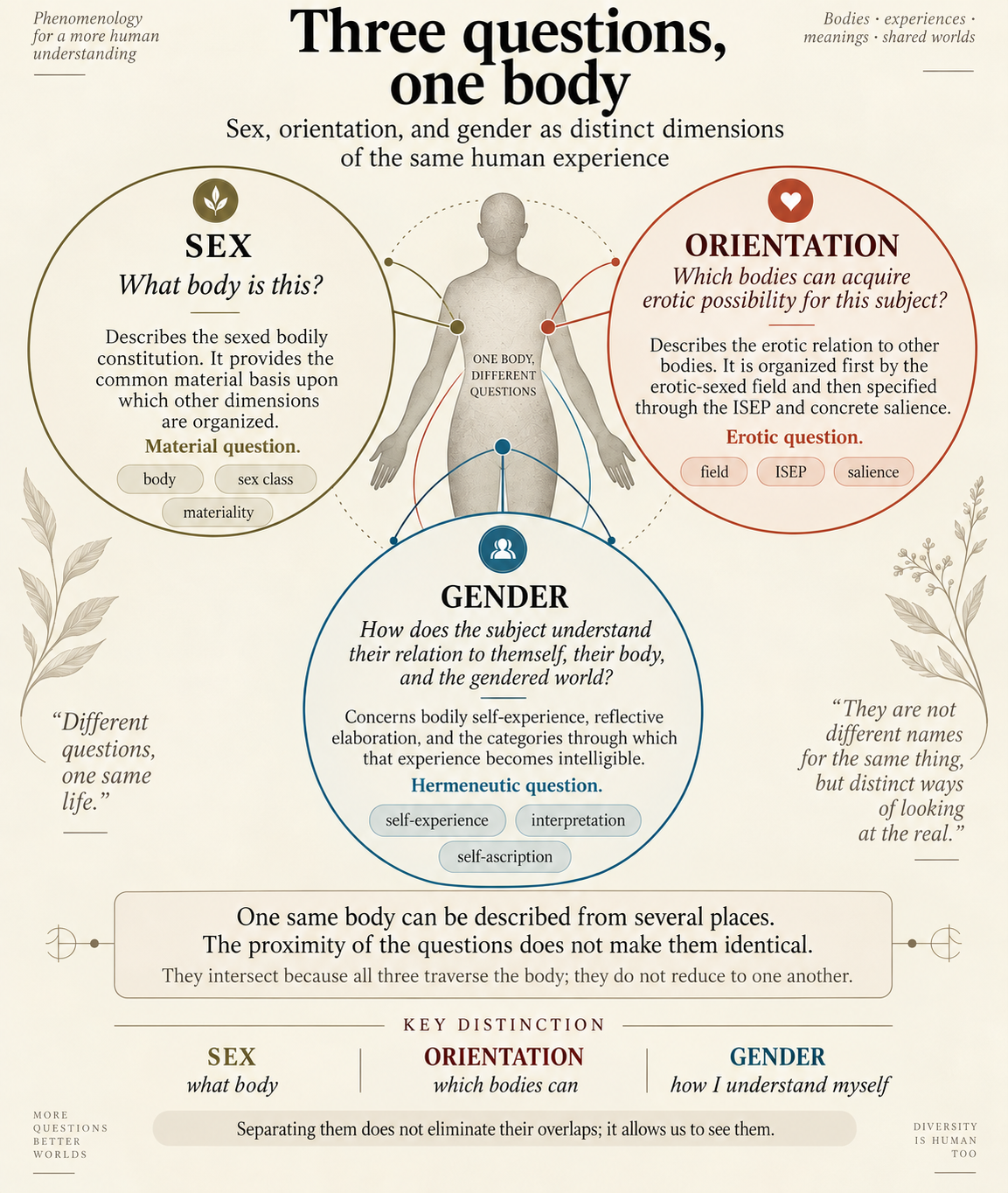
Sex, orientation and gender appear close together because all three run through the body. The body I desire is sexed; so is mine, and the categories with which I interpret both circulate in the same social world. That proximity produces constant crossings, but it does not make the questions interchangeable.
Sex belongs to bodily constitution. Orientation describes an erotic relation between the subject and other bodies. Gender concerns self-experience and a social system of bodily meanings. Homosexual self-ascription, in turn, is yet another operation: appropriating a concept in order to make a regularity of orientation communicable.
A person goes through all those dimensions simultaneously. A homosexual man has a human male body, a particular relationship with that body, a certain gender expression, an erotic field open towards bodies of the same sex class, a singular ISEP and a historical word through which he can communicate that structure: gay. None of those variables necessarily contains the others.
A man’s masculine expression does not allow us to deduce where his field is directed, and his homosexuality does not tell us how he lives his body either. Gay does not say whether he is masculine, feminine, discreet, flamboyant, top, bottom, monogamous, promiscuous, religious, atheist or incapable of choosing a decent photo for an app. It says something important and limited about the direction of his field.
A category’s usefulness depends to a large extent on preserving that modesty. When a single word claims to report at once what body someone has, how they understand themselves, who can arouse them, what bond they prefer and which community they belong to, the variables start travelling mixed together.
Sex: Which Body
Bodily sexuation provides the material trunk on which the two branches examined so far are organised. The relevant criterion for this model is not legal majority but sexual development. Hence the formulations human male body and human female body.
A great variety of hormonal, surgical, morphological, aesthetic and social modifications can take place on those bodies. All of them matter at the levels where they act. Sex class performs a more austere function here: it provides the two bodily possibilities around which the primary erotic-sexed field is organised.
It does not claim to offer a complete theory of the person. Carlos is much more than a human male; so is Francisco. Carlos’s orientation becomes intelligible, however, because Francisco’s body belongs to the class his field admits.
Orientation: Which Bodies Can
Orientation introduces a relation between a subject and the bodies capable of acquiring erotic possibility for them. Formally it can be described by means of androphilia, gynephilia or bisexuality; socially, homosexuality and heterosexuality appear when that direction is related to one’s own sex.
Here too we do not obtain a complete sexual history. A bisexual woman can be attracted to women far more often, have had only female partners and go years without any particular man acquiring salience. If bodies of both classes remain within the field as erotic possibilities, the structure is still bisexual. Frequency and behaviour provide information, but they do not by themselves define the boundary.
Understanding orientation in this way preserves something that is lost when definition and self-ascription become equivalent: the chosen word tries to describe a relation between the subject and what can become an object of desire. It can do so with enormous fidelity, do so approximately, or change as the person comes to understand their experience better. Self-recognition tries to reach the phenomenon; it does not take its place.
Gender: How I Understand Myself in Relation to My Body and the Social World
The gender branch is more recursive. The subject inhabits a sexed body within a world where masculinity, femininity, expectations, presentations, roles and identity categories already have meaning. Their experience can bring them closer to certain positions or take them further away, and the concepts they later encounter will reorganise, sometimes profoundly, the reading of their own history.
Gender identity belongs to that self-understanding. Its main reference lies on the side of the speaker: what I am, how I live myself, how I interpret my position.
Orientation asks something else: what can arouse me.
The everyday closeness between the two questions explains how easily one ends up being answered by means of the other. If someone understands herself as a woman and desires women, the formula “a woman who desires women” seems transparent until we ask what woman means each time it appears. It can designate sex class or gender identity, and can even change meaning between one half of the phrase and the other without the syntax noticing the leap.
A good part of the taxonomic confusion begins there.
The Same Word Can Travel Between Levels
Ordinary language tolerates these shifts because it was not designed to build impeccable ontologies. Words serve for living, understanding one another, falling out, seducing one another and getting to work on time. The difficulty appears when one and the same category has to perform scientific, legal, political, erotic and community functions simultaneously.
Man can designate sex, social role, identity or a contextual combination. So can woman. Gay works as a description of orientation, but also as culture and community. Queer can be a political position, a cultural sensibility, a theory or a community self-ascription. Polysemy is not a linguistic catastrophe. A taxonomy, on the other hand, needs to know which variable it is classifying at each moment.
Distinguishing levels does not impoverish experience; it makes it possible to describe more of it. A trans woman can have a feminine identity, an intensely feminine expression, a human male body with certain modifications and an erotic field directed towards one sex class, towards the other or towards both. Each statement provides different information.
A trans man can live socially as a man, have profoundly modified his morphology, experience a certain relationship with his body and still occupy a possible place within the ISEP of some lesbians. What seems contradictory stops being so when sex, orientation, expression and identity stop competing to become a single master variable.
Three Questions, Three Possible Errors
Confusion between levels produces different errors. If sex and gender are identified without remainder, a category of self-understanding ends up functioning as an exhaustive description of the body. If gender and orientation are fused, the object’s identity acquires a capacity that, within this model, belongs to the erotic field of the desiring subject. And if orientation and self-ascription become equivalent, the chosen word stops describing a structure and becomes what supposedly constitutes it.
The chain developed throughout the chapter makes it possible to keep the operations distinct:
sexed body → erotic-sexed field → ISEP → concrete erotic experience → self-recognition → naming → self-ascription → intersubjective recognition → hermeneutic belonging
The gender branch follows another trajectory and comes into contact with this one at several points, especially around the ISEP and bodily self-experience. What we eroticise, what we identify with and the way we present our body can relate to one another in very profound ways. That interaction explains complexity; it does not oblige us to fuse all the variables.
Gayle Rubin argued decades ago for the value of granting sexuality an analytical domain that would not be absorbed by a general theory of gender. The distinction proves fertile here: recognising intense relations between sex, gender and sexuality does not require treating them as manifestations of a single structure.
It also makes it possible to formulate more precisely a phenomenon that matters for the next step. A person can recognise another’s gender identity without that recognition determining their erotic response. The first relation belongs to the intersubjective world of categories and recognition; the second depends on their own field.
Social courtesy is learnt, language changes and categories get revised. Desire has a different temporality.
That is the distance between the three questions:
Which body.
Which bodies can.
How the subject understands themselves.
Separating them does not eliminate the places where they cross. It makes them visible.
When the Category Enters Politics
Up to now we have treated categories as tools for distinguishing phenomena. Politics introduces another function. An institution, an association or a community can decide that a word should cover more cases than it originally covered because it seeks to produce recognition, build a coalition, legally protect certain people or establish a common rule of belonging. The problem appears when, along with the extension of the word, the criterion by which someone enters it also changes.
A taxonomy tries to discriminate phenomena. A politics of recognition can use the same words to organise belonging, distribute protections or build alliances. Nothing requires the two uses to coincide perfectly. The more phenomena organised by different principles that get included under one category, the less information can be inferred from mere membership in it.
The lesbian case makes this especially clear. Within the model developed in this chapter, lesbian primarily designates a human female whose erotic-sexed field is open towards human female bodies and closed towards human male bodies. After that will come the ISEP, preferences, practices, gender expression, culture and the historical forms of belonging.
An identity-based definition starts from a different criterion: a woman who desires women, understanding woman in both places as gender identity. The two formulations will coincide in an enormous number of situations. The conflict appears where they stop doing so.
A trans woman whose body belongs to the human male sex class can be included within the political or community category lesbian if an institution adopts the second definition. That changes the rule by which the institution distributes belonging, but that same operation does not change the erotic-sexed field of lesbians whose desire remains organised exclusively towards human female bodies.
The inverse case shows the decoupling from the other side. A trans man whose body belongs to the human female sex class can remain erotically accessible to a lesbian. His gender identity is masculine; his body remains within the sex class towards which that woman’s field is directed. After that the ISEP comes into play: bodily masculinisation, voice, body hair, surgery, presentation and other modifications can maintain, increase or destroy salience for a particular lesbian. That will depend on her individual configuration.
There is no need to find a paradox here. A person can socially recognise someone as a man and eroticise his body because it belongs to the female sex class; they can equally recognise someone as a woman and not find her body erotically accessible because it belongs to the male sex class. Declared identity intervenes in an intersubjective relation; erotic salience depends on another structure.
Social recognition and erotic accessibility are not the same relation.
The political consequence is uncomfortable because a person’s self-ascription can organise the way they wish to be recognised by others without containing a mechanism capable of producing desire in them. An identity can request recognition, but it cannot demand salience: the erotic field belongs to the desiring subject.
This matters especially when orientation categories also function as communities. Lesbian is not merely a word of classification. It contains history, spaces of sociability, sexual culture, memory and forms of mutual recognition. That is why modifying the criterion of belonging affects considerably more than a dictionary entry.
Consider a space built around homosexual women. If for a certain period membership is organised according to a relation between one’s own sex and the sex of erotically accessible bodies, and identity is later adopted as a sufficient criterion, the place can keep its name and receive a different set of people. There is no metaphysical essence of the lesbian bar guarded by a Platonic tribunal; the rule by which membership is decided has simply changed.
That change can respond to deliberate political reasons. The word then begins to do a different kind of work.
A descriptive category provides information about some property or relation. When it also functions as a status of recognition, it can determine who will be considered a member of a community or institutional population. An organisation that recognises as lesbians all people who identify as women and declare attraction towards women is adopting a rule of belonging. The decision may seek inclusion, without its following from this that the term retains exactly the reference it had under a definition based on sex and orientation.
The me too examined earlier allows us to perceive what is lost. Two homosexual women could utter it without sharing an ISEP, appearance, practices or biography, because the expression referred to a primary homology of orientation. Under a category with several principles of belonging, two speakers can share the name without any longer describing the same relation between their own sex and the erotic field.
For one of them, “I’m a lesbian” can condense the fact that her body belongs to the female sex class and that she desires bodies of that same class. For another, that she identifies as a woman and desires people she identifies as women. Both can find themselves under one and the same social category. What is no longer guaranteed is the erotic information that could previously be inferred from the word.
It is a semantic cost whose weight will depend on the function the category has to perform.
Anti-discrimination legislation can benefit from a broad formulation capable of jointly protecting populations exposed to related forms of hostility. A political organisation can use equally broad terms to bring together people with common demands. In research on sexual orientation, by contrast, that same breadth can conceal precisely the variable one is trying to study. A sexual meeting space faces an even more concrete difficulty, because there the class of erotically accessible bodies forms part of the practical reason why someone comes in.
There is no reason to demand that a single definition should work equally well in all those contexts. The problem begins when the one adopted for one context tries to govern the others, and an institutional rule of recognition ends up being treated as a general theory of sexuality.
That is also why a categorial boundary can be experienced as an aggression even when its immediate function is descriptive. When belonging, recognition and dignity become closely associated, hearing “you don’t belong to this category” can feel like “you’re worth less”. Yet a person can fall outside lesbian, gay, bisexual or any other orientation category without anything following from that about their rights or their worth. It is only being affirmed that, under a certain criterion, their configuration does not belong to that class.
Categories discriminate in the logical sense before anyone discriminates in the moral sense.
A classification that entirely gave up establishing differences would lose a good part of what it is for. The political question, then, is deciding what information needs to be preserved in each context and what can be sacrificed by widening a category. Substituting gender identity for sex as the criterion of belonging to lesbian can produce a broader political community; at the same time, the word no longer by itself guarantees a particular structure of the erotic-sexed field. Depending on context, that trade-off may prove desirable, irrelevant or problematic.
The distinction between sex, orientation, gender, naming and self-ascription prevents those shifts from happening silently. A community or an institution can revise its definitions; a person can declare how they understand themselves and obtain social recognition under that declaration. None of that makes categories useless or freezes them forever, but neither does it turn a decision about belonging into a mechanism capable of reorganising someone else’s desire.
The erotic body remains subject to another jurisdiction.
No one can vote on which body produces desire in them.


Deja una respuesta