EN · ES
While thinking about what to wear to this year’s Pride parade, I had a modestly explosive idea: turn up in an outfit eccentric enough to give Diversity, that very open-minded and plural lady whenever nobody ruins the script, a small episode of moral tachycardia.
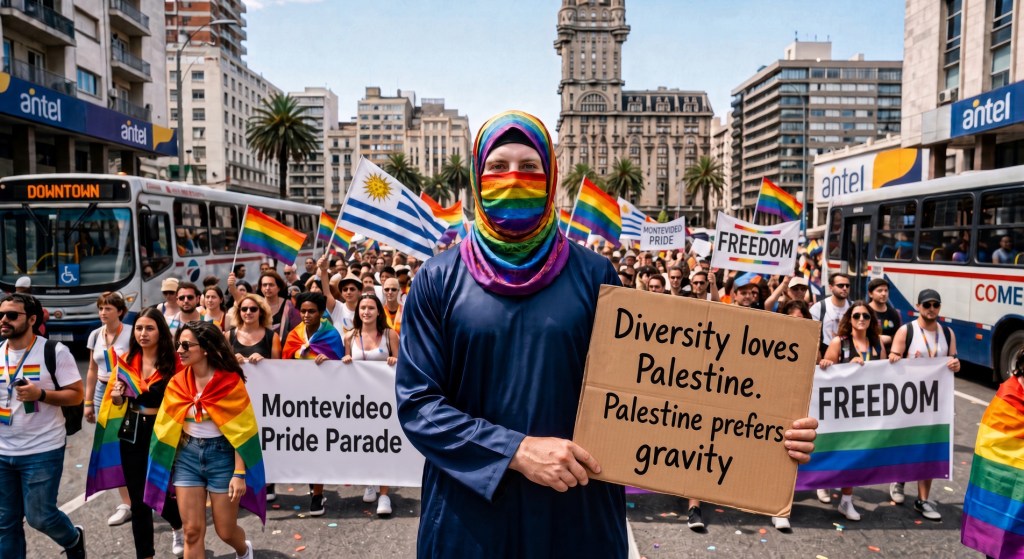
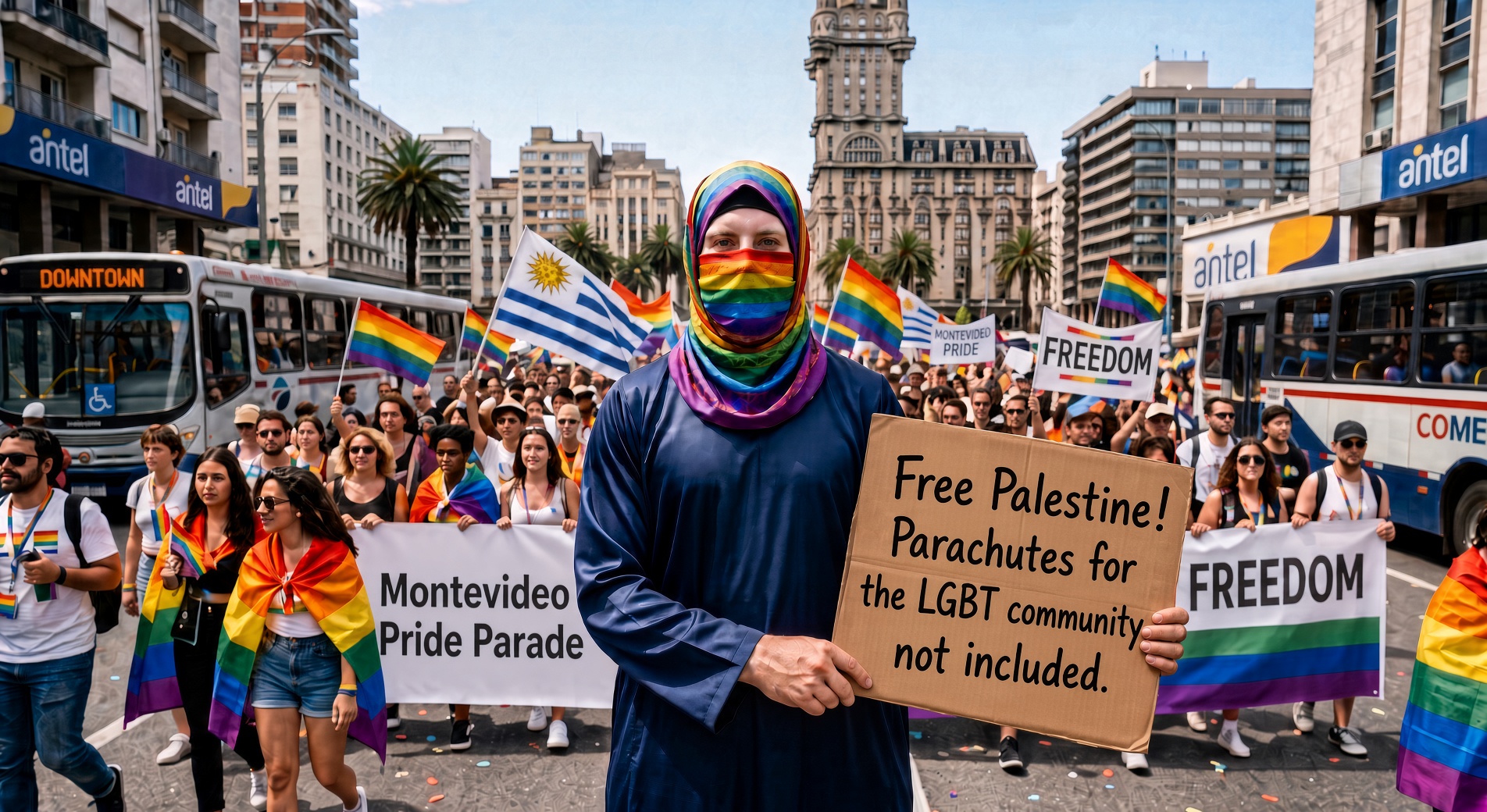
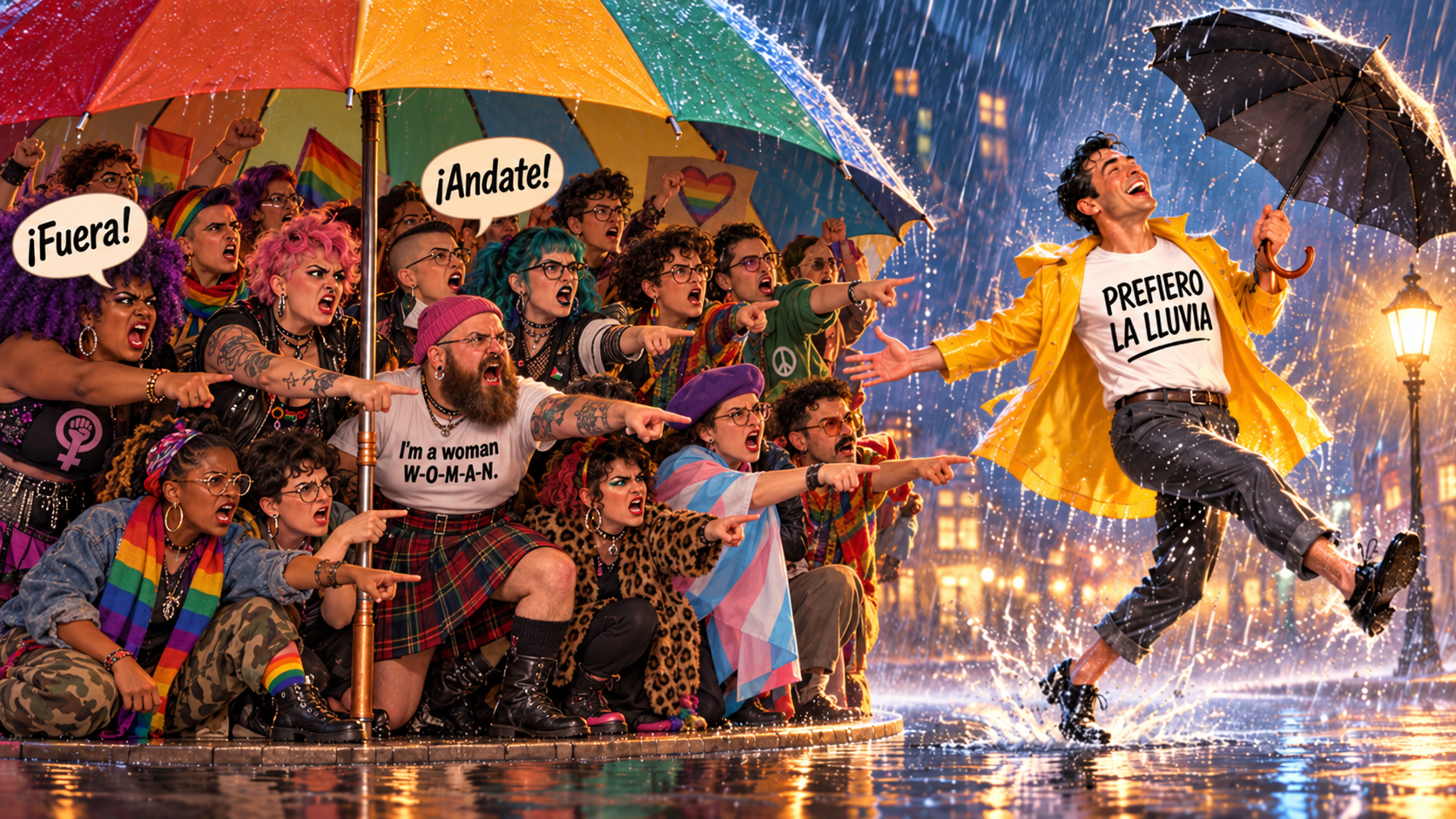
The images that follow do not document an event. They document a political, aesthetic and satirical fantasy. A fantasy about the exact moment a certain progressive milieu discovers that not every fag included somewhere in the alphabet is willing to repeat the catechism without asking questions.
And because every fantasy deserves its complete liturgy, there is also a parody video about the imagined reaction such an appearance would provoke among the activist fauna. Put it this way: if humour did not exist, public life would be nothing but an Excel spreadsheet with pronouns.
But do not let the circus stop you reading the post. Underneath all this there is serious philosophy, political theory, categories, representation, desire, identity and quite a bit more argument than usually survives a conversation on social media.
When the Umbrella Thinks It’s a Species and Has the Nerve to Tell Me, a forty-ish Fag, That It Speaks for Me
Political alliances rarely begin by asking what metaphysical essence their members share. They begin because one person needs a lawyer, another wants the cops to stop beating the travesti hustling on Bulevar and Martín Fierro, and another would rather not lose his job when they discover his particular fondness for another man’s cock. Different people find similar institutions standing in front of them and, with an admirable lack of ontological solemnity, organise.
For much of the twentieth century, fags, dykes, bisexuals, travestis, transsexuals and other people placed outside sexual and gender norms had fairly concrete reasons to cross paths and say: “girls, what do we do?”. The police officer arresting them, the doctor pathologising them, the employer firing them or the family throwing them out did not always display a moving concern for keeping the taxonomies conceptually pure: crudely put, we were THE FAGS AND DYKES.
But let us recover semantic and epistemic rigour: a coalition works precisely because it does not need first to settle what its members are in some ultimate sense. It needs to know what they can do together. Two groups can share a campaign against employment discrimination without being different manifestations of the same phenomenon; the same law can protect sexual orientation and gender identity without announcing that both categories possess the same structure. Political cooperation can coexist perfectly well with conceptual difference.
Over time the alliance acquires thickness. Organisations, cultural spaces, friendships, memories, symbols and networks of care are created. Cooperation ceases to feel exclusively strategic. People who spent years believing themselves alone find others capable of understanding certain experiences without subtitles. That produces affection, belonging and a shared history. Entirely understandable.
It also produces a pronoun when “the collective” says: “we fight together against X”. A community begins to say: we fight against X. The shift seems small until the we realises that it needs to speak… and how it loves to speak.
“The LGBT community demands.” The sentence has become so normal that we barely notice the grammatical gymnastics it performs. An association demands; a federation demands; ten organisations can sign a statement. “The LGBT community”, by contrast, transforms millions of people classified through different variables into a singular subject, homogeneous enough to possess demands, positions and, on particularly ambitious days, even a doctrine about what a woman is and whether a woman with a penis remains a woman who ought to enter the same spaces as other women. A claim which, incidentally, would have had Monique Wittig, Andrea Dworkin and Catharine MacKinnon reaching for restraints. The TikTok hatchlings of Queer may not even know who they are, but a forty-ish dyke understands the reference.
Meanwhile, a fag is breading a milanesa in Ciudad Vieja, a dyke is arguing with her girlfriend, a bisexual is voting for the party the statement has just declared an enemy of progress, and thousands of people included in the acronym remain blissfully unaware that they had apparently taken a position that morning on the ontological status of womanhood as a community. The community spoke without having to interrupt them.
And again, forgive my vintage-brand outbursts. Do not leave; I am returning to the subject and throwing in more references. I warn you, though: this cannot unfortunately be turned into forty seconds of content. Joshua Gamson described an important tension within queer politics. Movements need categories in order to mobilise people, but those same categories can become rigid, exclude, or acquire an appearance of naturalness that queer theory itself questions. Gay and lesbian could be organisational tools and, simultaneously, suspicious boundaries for a politics that had learnt to distrust identities that looked too stable.
The progressive expansion of the acronym occurs inside that contradiction. L, G and B refer, with their differences, to a relatively identifiable variable: whom you want to get between the sheets with and offend public morals. T introduces a different question: “what is my relation to myself and my body?”. I refers to bodily sex characteristics. Q can function as identity, political position, intellectual tradition, critique of categories or a deliberately unspecific umbrella that needs forty minutes, eight references and a rather worrying number of neologisms to define who it is and why it differs from the other letters. And the “+” is a little typographic masterpiece: it acknowledges that the list no longer possesses an internal criterion capable of anticipating everything that may be added. In Yankland it even includes 2S, meaning “Two-Spirit”, a concept specific to some Indigenous North American peoples that a Uruguayan fag, an American dyke or a Spanish travesti may never have heard of in their life, but it gets added because inclusion demands tribute. Not to mention that this is a textbook case of “cultural appropriation”, a term I personally regard as roughly as useful as a used condom, but which the American community adores applying to everything down to arepas.
None of this makes the acronym absurd. It makes it a coalition. Like the broad front, but made of fags.
The problem begins when the umbrella develops zoological delusions and decides that, because it managed to protect everyone from the rain, it has just discovered a new species.
“Sexual and gender minorities”, “sexual diversity”, “sex-and-gender diversity”, “queer community”: I agree, these can all be perfectly useful expressions at a certain level of abstraction. A public policy against discrimination may need to bring different situations together. A parade can convene groups with different histories. Research may compare a majority population with several minorities.
The umbrella does its job as long as we remember that it is an umbrella.
The difficulty appears when the category begins rewriting what it contains. “LGBT identities”, for example, produces an elegant symmetry between phenomena that do not necessarily possess one. Gay can become a social, cultural and biographical identity; someone can organise an enormously important part of life around that word. But he can spend fifteen years denying that he is gay while continuing to experience exactly the same desire. Orientation did not wait patiently for the subject to complete the pledge-of-allegiance form to the rainbow flag.
Gender identity has another relation to self-interpretation, to the body and to the categories available in society. Putting both things under the noun “collective” may be administratively convenient. It can also produce the conceptual equivalent of storing the thermometer, the fever and the medical history in a folder labelled “medical stuff” and then being surprised that they are not interchangeable.
Gayle Rubin warned in Thinking Sex against absorbing sexuality into a general theory of gender. Her argument does not need to share my phenomenological architecture to be useful here. Gender and sexuality are intensely related, but it does not follow that one dimension should, by itself, provide the definition of the other.
That distinction also explains why political resemblance does not imply conceptual identity. LGB acquired historical unity because different orientations shared a variable and encountered partially common forms of persecution. T joined through historical proximity, convergent demands and partially shared mechanisms of exclusion. I can share struggles over medical intervention, stigma or documentary recognition. Q brings in yet another logic, and I shall stop looking at that letter because it is basically an allergen for me; occasionally it gives me hives.
All of that can produce a real, durable, emotionally dense and politically valuable coalition.
What it does not spontaneously generate is an essence.
And when the coalition forgets that difference, the we stops serving merely to coordinate demands. It begins deciding what its letters mean. That is where the interesting part begins, or the more troublesome one, depending on who you are.
From Category to Subject: Manufacturing “the LGBT Community”
Institutions feel an almost erotic attraction to categories they can count. A word enters a form; the form enters a database; the database produces a population; the population acquires percentages, programmes, budgets, specialists, observatories and finally an opinion.
A ministry wants to study discrimination and asks different questions about sex, sexual orientation, gender identity, gender expression and sex characteristics. It does so because it needs to distinguish variables. Knowing someone is gay does not let us infer by mathematical transitivity that they are trans; knowing they are trans does not tell us towards whom their desire is directed. If the survey fused everything from the beginning, it would produce data with the diagnostic precision of a tarot reader whose name I shall omit to avoid legal correspondence.
Then comes the report.
“The LGBT population presents higher levels of…”
Five variables went into Excel and a creature with an opinion came out.
I am not going to become a professional contrarian either: I recognise that aggregation can be statistically legitimate. A study may need to compare a set of sexual and gender minorities with a majority population. The abbreviation makes the table manageable. The leap occurs when a category constructed for calculation begins functioning as a description of shared experience as well, and then as a subject capable of wanting, demanding, rejecting and feeling offended in unison.
Rogers Brubaker called groupism the tendency to treat social categories as internally homogeneous, externally bounded groups endowed with interests and agency of their own. His analysis developed mainly around ethnicity, race and nation, but the tool travels with indecent ease. “The Serbs want”, “Muslims reject”, “Black people think” and “the LGBT community demands” share an operation: grammar converts a classification into an actor before anyone has demonstrated how much actual group lies behind it.
Brubaker proposes separating categories, organisations and moments of groupness, of effective group formation. A category can exist without all the people contained within it perceiving themselves as members of a community. The intensity of the “we” fluctuates. It can spike in response to a threat, an attack, a mobilisation or a victory and weaken afterwards without the characteristics that allowed those people to be classified having disappeared.
A massive parade proves that many people decided to march that day. It does not prove that they acquired a permanent collective personality, any more than seventy thousand Uruguayans at the Centenario stadium walk out transformed into a new species with a shared position on tax reform.
The same distinction forces us to ask who is speaking when “the LGBT community” demands something. There may be a broad federation, organisations selected through clear procedures or a serious deliberative process. There may also be three collectives, a small office with an excellent contacts list and somebody who answers the phone before everyone else. The press needs a quote. The state needs interlocutors. The university needs experts. The company needs someone to explain what “the community” wants in June for Americans and in September for Montevideans, preferably in under twelve slides.
There is nothing extraordinary about intermediaries emerging. Any sustained movement produces specialists. Trade unions professionalise leaders; business associations produce lobbyists; feminism produces academics and organisations with enormous technical experience. Political representation requires concentration of information and institutional continuity.
But representation is not sacramental magic. An organisation represents through some procedure and within some sphere. We can ask who belongs to it, what mandate it possesses, how far that mandate extends and what mechanisms exist for challenging it. “The community” is rather more vaporous. One can belong without enrolling, be represented without voting and discover one’s official position while drinking mate.
The heterogeneity of LGBT makes the problem especially visible. The more variables the acronym contains, the more political work is required to produce a common voice. And that work leaves traces in language.
Concrete demands begin to be translated into increasingly abstract categories. We no longer speak only of homosexuality or transsexuality, but of diversity, dissidence, sex-and-gender identities or queer community. Abstraction allows gathering; it also allows substitution. The concrete person, with orientation, body, opinions, history and shifting affiliations, becomes progressively compressed into an administratively portable identity.
Human reality has the vulgar habit of arriving with too many details.
Bureaucracy solves the inconvenience with boxes.
Thus documents appear that carefully distinguish sexual orientation, gender identity, expression and sex characteristics when they need to measure, and three pages later call the whole package “LGBT identities”. Analytical difference reappears to produce the statistic and evaporates when the political subject has to be manufactured.
The shift looks innocent because it happens inside a noun. It is not. If gay becomes structurally equivalent to gender identity, an orientation manifested through sexual desire is translated into the same institutional language as a category of self-understanding. Different phenomena receive typographic equality and typographic equality starts to look like ontological equality. Microsoft Word has made surprising contributions to metaphysics.
Brubaker lets us cut through that knot without using a single piece of my theory of desire. A category is not automatically a community; a community is not automatically an organisation; an organisation does not exhaust those who belong to a category; and a period of intense groupness does not turn a group into eternal substance. The we is produced. It can be immensely powerful, authentic and necessary without ceasing to be a historical relation.
Corporations offer the kitschiest version of the phenomenon. June arrives, or September for us, and up come rainbow logos, internal panels, campaigns, slogans and HR departments celebrating “our LGBT employees”. The conglomerate needs a photographable subject. It cannot print beneath the logo: “contingent coalition of populations differentiated by orientation, identity, expression and sex characteristics, with variable levels of subjective belonging and potentially irreconcilable political disagreements”. It does not fit on Instagram.
So a community appears that is diverse in appearance but surprisingly uniform in meaning. It has values, colours, vocabulary, predictable positions and a brand identity. The homosexual who departs from the repertoire risks becoming a cultural anomaly without losing a millimetre of efficacy as a homosexual. He can fail the community exam and continue desiring men with exemplary regularity.
The professionalisation of representation adds another layer. An association writes a statement on gender identity. A gay member agrees with one part and disputes another. He thinks he is debating a policy. Someone replies: “It is a demand of our community.”
The sentence changes the nature of the disagreement. There is no longer merely a proposal open to discussion; an obligation of belonging appears. The homosexual is not objecting to the policy of an organisation. He is questioning something that, apparently, he himself wants because someone already conjugated the verb in the first-person plural.
Solidarity and conformity are cousins who look remarkably alike in family photographs. A coalition needs reciprocity: today I support one of your demands, tomorrow you support one of mine. The mechanism builds power. Turned into a permanent mandate, it hands every member an ideological portfolio they never requested.
Suddenly homosexuality comes with a pre-installed position on gender theory, feminism, language, sport, prisons, education, prostitution, capitalism, police and whatever else the movement has added to its agenda. An extraordinarily complete package for a characteristic that, when it had three miserable letters, merely told you towards whom your desire was directed.
When someone breaks ranks, disagreement can move from the argumentative plane to the moral one. No longer merely wrong: traitor, sell-out, reactionary, something-phobic or, in the premium paternalistic version, insufficiently aware of his privileges as a white cis man. In other words, branded a healthy son of the patriarchy even while sucking cock like it was a leather drinking straw. Every collective identity thick enough eventually produces an apostate. There is no apostasy without a prior church.
None of this invalidates real communities. They exist, produce affections, networks, memory and concrete solidarity. Nor does it invalidate organisations performing indispensable work. Brubaker’s point is precisely to avoid the intellectual convenience of treating the result of all those processes as a natural entity. There are categories, organisations, spokespeople, communities, moments of intense groupness and people who feel no belonging at all. Confusing them turns a legitimate political construction into an ontological ventriloquist.
Ghaziani lets us add time to the photograph. Communities change when the conditions that made them necessary change. Collective identity can become less central for some people while the institutions representing it gain greater capacity. And there appears a question no acronym can answer on its own: what happens when the political subject continues speaking with an increasingly clear voice while the people included under its name speak with increasingly many voices?
The usual answer has been to manufacture cohesion.
And every manufacture of cohesion needs some discipline.
When They Discover a Fag Is Going to the Pride Parade with an Anti-Palestinian Sign

When Gender Identity Enters Orientation
For a long time, “gay man” and “lesbian woman” looked conceptually economical. Man attracted to men; woman attracted to women. Everything else could be argued about afterwards: presentation, practices, personality, roles, culture, masculinity, femininity. The definition did little work and that was precisely why it worked.
The important shift occurs when the words man and woman change their criterion of reference inside that definition. If man comes to mean “person who identifies as a man”, “gay = man attracted to men” preserves exactly the same words but no longer describes the same relation. The grammar stays still. The referent changes underneath it.
First man is redefined through gender identity; then gay is defined through man. The second statement can look perfectly traditional even though the extension of the first has changed. Conceptual surgery without a visible incision.
Erotic life, unfortunately, has no legal department.
A gay man can meet a trans man, treat him as a man, respect him, work with him, care for him, admire him and defend him against any idiot who humiliates him. He can even consider him beautiful. Then the erotic situation arrives and nothing happens. The opposite can happen too: a particular gay man can feel intensely attracted to a particular trans man. A theory unable to admit both possibilities is not describing sexuality; it is drafting an internal regulation for insubordinate genitals.
Recognition and desire do different jobs. The first admits deliberation, norms of treatment, language, convictions and will. The second has a much more precarious relationship with our decisions. One can decide how to address a person. An erection has a more rudimentary institutional policy.
The distinction does not disappear because attraction exists in some cases. Orientation never turned every member of a class into a desirable object. There are bodies, configurations, voices, faces and morphologies that pass one person’s filters and not another’s. Transition can modify many of those features and produce different responses in different subjects.
A social definition can decide which word we use to recognise someone. It does not decide which body will acquire erotic salience for a third party.
The distinction can be formulated even while rejecting my phenomenology entirely. Rubin already defended the need not to subsume sexuality into gender. It is enough to maintain something much more modest: gender identity and sexual orientation do not describe the same variable, and a change in one person’s self-understanding does not automatically reorganise the erotic patterns of everyone around them.
Everyday experience does the rest. Someone feels desire before knowing another person’s identity; they may retain it afterwards, lose it on encountering certain bodily information or discover an unexpected attraction. Desire disobeys our autobiographies with almost artistic rudeness.
Lesbian experience makes the collision especially visible. If lesbian means woman attracted to women and woman is defined exclusively through gender identity, then identity controls both the term describing the subject and the term defining the object. The orientation category is no longer merely accompanied by an identity dimension. That dimension begins governing its extension.
On Twitter, “woman” can remain open, fluid, problematic, deconstructed and covered in conference papers. A door improves philosophy brutally.
An organisation announces an event exclusively for lesbians. Someone arrives whose inclusion depends on the criterion being used. The person at reception has to let them in or not. They can adopt self-ascription, sex, some combination of criteria or abandon the event’s boundary. Every decision embodies a theory, even if the person holding the list merely wants to finish the shift and smoke.
Here one sees how much work an apparently simple word had been doing. Lesbian can function as orientation, cultural identity, political memory, historical community and subjective belonging. But those functions do not always have exactly the same boundaries. Trying to solve all of them with one definition turns a word into a suitcase we are already sitting on to get the zip closed.
Social life needs public conventions. Declared identity can be crucial to treatment, recognition and the way someone participates in countless interactions. A sexual encounter incorporates other information. Face, voice, body structure, smell, body hair, musculature, fat distribution, movement, texture, proportions and genitality can intervene unevenly. Nobody necessarily processes a checklist of sexual indicators before feeling desire. A whole body appears.
Nudity has an appalling disposition towards respecting abstractions.
That is why the pressure to make recognition and desire obligatorily coincide becomes so explosive. Sexual rejection can be reinterpreted as a political position even when the subject never experienced it as a decision. The absence of desire begins to require an oral defence, as if libido had applied for a civil-service post and were obliged to issue a reasoned ruling.
In almost every other sphere we accept that attraction has arbitrary, brutal, contradictory and sometimes incomprehensible filters. Someone does not desire people who are very tall, bearded, muscular, thin, masculine, feminine, older, younger, hairy or hairless and we do not immediately convene an ethical tribunal. Sexual orientation, however, touches a more basic domain, and there normative pressure begins to look dangerously familiar.
Homosexual history is built, in part, around desire’s resistance to obedience. For generations homosexuals were told which bodies they ought to love, which relationships were proper and which sexual life was intelligible. Many tried to obey. What remained were unhappy marriages, clandestine lovers, priests, psychiatrists and frankly excessive amounts of suffering demonstrating that libido does not read circulars.
Homosexual emancipation removed part of morality’s power to order the object of desire. It would be a particularly baroque irony to restore the same gesture under a different vocabulary: no longer “you should desire women because you are a man”, but “if you recognise this category correctly, a certain body must fall within the extension of your orientation”.
The histories, powers and coercions are not equivalent. The structure of the demand does deserve attention: a social classification is attempting to produce consequences for what should count as an erotic object.
The body may answer with offensively undeconstructed indifference.
None of this requires imagining a frozen sexuality. People surprise their own biographies, change preferences, widen or narrow repertoires and find desirable what twenty years earlier they would not have looked at twice. Precisely because concrete sexuality is complex, it makes even less sense to demand that a single category simultaneously organise sex, identity, presentation, recognition and desire.
The LGBT coalition could house different dimensions so long as each kept doing its own work. Gays and trans people could share laws, protests, friendships and campaigns without orientation and identity needing to define one another. The qualitative conflict appears when one dimension not only coexists with another inside the acronym, but claims authority to decide what the other means internally.
At that point we are no longer arguing about who shares the umbrella.
We are arguing about who has the right to redesign the ribs.
Allies Without Being the Same
Coalitions tense up when they stop remembering what made them coalitions. An organisation can be born around violence, employment discrimination, persecution or legal inequality and decades later take positions on sport, education, language, prisons, health policy, childhood, prostitution, surrogacy and definitions of sex and gender. Some positions will be directly connected to the alliance’s original reasons. Others will need arguments of their own.
The acronym does not work like a political calculator. You cannot type in “LGBT” and automatically obtain the correct position on every controversy.
The conflict becomes nastier when the organisation already speaks in the name of a community. A gay man questions a proposal and hears that it is “a demand of the collective”. The phrase places him in two positions at once: he belongs to the subject supposedly making the demand and, at the same time, disputes what that same subject has just declared it wants.
The disagreement then acquires a familiar texture. It no longer feels as though you are debating a rule. You are making your own side look bad.
Communities formed under persecution know that discipline. Closing ranks can be a rational strategy when the external adversary is powerful and internal division carries material costs. But that time has passed; the church is démodé, a wonderfully Moria-Casán sort of word. Closing ranks is no longer necessary. In fact, it is part of what is damaging the collective and society more broadly, a subject I deal with elsewhere.
Then the whole mayonnaise starts when the discipline survives the ecclesiastical siege and gets used to settle every later disagreement. “This position is correct” becomes “this position is ours”. The dissident then has to argue two things: why he thinks the measure is wrong and why that does not secretly prove he is a piece of shit.
Nancy Fraser offers an especially powerful route here because she breaks the equivalence between recognition and identity validation. Her status model understands recognition as the possibility of participating under conditions of parity, not as an obligation to celebrate a collective identity or accept a particular theory of its essence. A person can suffer institutional injustice if they are denied rights, resources or participation as an equal; correcting that subordination does not require metaphysical unanimity.
The distinction allows for a considerably more adult solidarity. A homosexual can defend a trans person against dismissal, assault or deprivation of rights and, at the same time, disagree, as I do, about sex, identity, sport or sex-segregated spaces. Legal equality generates concrete obligations. It does not come with a doctrinal adhesion clause hidden in the small print.
Democracy does this every day. I protect your religious freedom without converting to your religion. I defend your freedom of expression without tattooing your manifesto on myself. I demand that you receive equal legal treatment without needing to experience sudden enlightenment before every idea you hold. A plural society would be impossible if rights could be recognised only after protected and protector had reached ontological agreement.
Butler, ironically enough for the reader who thought they had understood me, turns out to be curiously useful against bureaucratised versions of queer politics. Her critique of stable identities does not oblige us to build an LGBT super-identity capable of metabolising every future difference. The notion of open coalition allows participants to cooperate around concrete objectives without first resolving who they ultimately are. A coalition can remain open precisely because it need not turn every disagreement into heresy.
Laclau and Mouffe arrive at a similar intuition through the theory of political articulation. A chain of equivalence links different demands around certain antagonisms without turning them into identical demands. Political unity is produced in a relation; it does not retrospectively prove that its members shared an essence waiting for centuries for somebody to invent the appropriate flag. Their classic formulation appears in Hegemony and Socialist Strategy.
LGB and T can build exactly that kind of link. They share interests against certain forms of discrimination, violence, state intervention and inequality. They can jointly support one piece of legislation and separate over another. That variability does not demonstrate the failure of coalition. It demonstrates that a coalition contains allies, not clones.
Real conflicts appear when interests stop coinciding. A space designed for women may adopt sex as its membership criterion; a trans organisation may propose gender identity. These are different rules and in some cases produce incompatible results. The acronym LGBT does not contain a tiny judge hidden between the B and the T who wakes at night, consults the jurisprudence of Stonewall and delivers the correct ruling.
One has to argue.
Define what the space exists for, which interests it protects, what consequences each rule produces and which is considered justifiable. Sometimes one side will lose. That cannot be solved by repeating “solidarity” more loudly because two incompatible demands cannot be satisfied simultaneously within the same boundary without emptying one of them.
Trade unions understand this. Parties understand this. Parliamentary coalitions live on this. Any family that has tried to organise a holiday with seven adults and two cars has sufficient empirical training. An alliance that survives only so long as nobody disagrees does not possess great unity. It had good luck.
A more tempting strategy is to turn disagreement into diagnosis. Transphobic, homophobic, biphobic, exclusionary, reactionary. Sometimes those terms describe genuine hostility that needs naming. At other times they arrive before the discussion has even established what is in dispute.
The mechanism is extraordinarily economical. It is no longer necessary to demonstrate why a proposal is correct. The other person must first demonstrate that they deserve to remain seated at the table.
Homosexuals ought to recognise that technology with a certain historical discomfort. For decades, the homosexual’s position could be invalidated by attributing it to illness, deviation, confusion or resentment. The subject’s explanation was disqualified by a prior diagnosis of the subject. A community born from that experience has excellent reasons to distrust any rhetorical procedure in which labelling the interlocutor substitutes for examining what they said.
Nor does belonging to a minority grant epistemic immunity. A gay man knows aspects of homosexual experience a heterosexual person may not and can simultaneously say monumental nonsense about biology, economics or law. A trans person has privileged access to their own subjective experience and can still be wrong about the best rules for a sporting institution or employment quotas in the civil service. Experience supplies evidence. It does not confer automatic doctorates in every neighbouring discipline.
The leap from experience to general authority usually occurs through representation. A person speaks from their history; then for others with similar histories; then for the community; finally their theoretical framework appears as what “the community knows about itself”. The metamorphosis is so smooth that it is difficult to see exactly when a biography acquired legal personality to represent millions.
A more robust coalition would have to tolerate inconvenient members. Gays who use the full LGBT alphabet and others who want nothing to do with the acronym. Lesbians deeply identified with queer and others who think queer dilutes what lesbian names. Trans people fiercely divided among themselves over sex, gender, medicine or politics. Conservative bisexuals, communists, liberals, apolitical people and those whose revolutionary project for the week is finding a reasonably stable hookup on Grindr.
A real community ought to look rather like that mess.
The alternative is an ideological respectability in which the good member learns the answers before the exam. The respectable homosexual of another era had to prove that he did not threaten family, children, religion or social order. The respectable contemporary member may receive a different list: correct vocabulary, predictable positions, compulsory alliances and a common narrative about diversity.
The syllabus changed.
The suspicion towards whoever answers incorrectly is still sitting at the same table.
Andrew Sullivan imagined a minimalist homosexual politics in which legal equality would allow gays and lesbians to cease necessarily constituting a political vanguard. Lisa Duggan criticised that horizon as homonormative, compatible with domesticity, consumption and existing social structures. Both describe real possibilities within a homosexual population that was never ideologically homogeneous.
A gay man may want marriage, two children, a mortgage, a dog and a forty-minute argument with his husband over which yoghurt is on sale. Another may regard that life as a petty-bourgeois nightmare and prefer clubs, anonymous sex, communes, leather, barebacking or manifestos written at four in the morning. No sexual orientation contains an algorithm determining which of the two finally understood his historical destiny.
There is also a third subject, especially offensive to the meaning industry: the homosexual who does not want to represent anything.
He wants to fuck, fall in love, break up, use apps, meet friends, perhaps go to the sauna and live the rest of his existence without turning every shag into an intervention against heteronormativity. His homosexuality may have become politically relevant because other people tried to limit it. That does not necessarily transform it into a permanent political vocation.
Someone may want to go to the sauna without the steam producing a manifesto.
That subject reminds us of something basic: if orientation does not determine doctrine, alliances become elective again. The ally ceases to be someone who signs in advance every future demand of another group and becomes someone who evaluates an injustice, a proposal, its costs and the reasons for cooperating.
That requires more work than automatic collective identity. It also requires treating the other person as an adult.
Sometimes we will support a demand made by people whose theoretical framework we do not share. On another issue we will oppose them. We can continue defending fundamental rights of someone with whom we profoundly disagree, because legal dignity should not depend on the beneficiary thinking correctly according to our catechism.
The acronym could thereby recover a much more modest and probably more resilient function. L, G and B designate orientations. T opens questions concerning identity, body and recognition. I introduces specific issues of sex characteristics. Q can continue to function as identity, critique, tradition or umbrella for anyone who finds it useful. Those populations can meet again and again around common demands without needing to pretend they describe variants of the same phenomenon.
A coalition does not become nobler the more it erases the differences among its members. It becomes more fragile.
Because every future disagreement then threatens a supposed common identity.
Allying without fusing requires accepting something less comforting: the other may not be like me, may conceptualise their own experience in a way incompatible with mine and may even want a policy I consider wrong. And yet tomorrow, faced with another injustice, we may need exactly the same law.
That is not a failure of solidarity.
It is the only form of solidarity that does not need to turn an acronym into a church.
References
- Brubaker, Rogers. Ethnicity Without Groups. Cambridge, MA: Harvard University Press, 2004.
- Butler, Judith. Gender Trouble: Feminism and the Subversion of Identity. New York: Routledge, 1990.
- Duggan, Lisa. The Twilight of Equality? Neoliberalism, Cultural Politics, and the Attack on Democracy. Boston: Beacon Press, 2003.
- Fraser, Nancy. “Rethinking Recognition.” New Left Review II/3, May–June 2000.
- Gamson, Joshua. “Must Identity Movements Self-Destruct? A Queer Dilemma.” Social Problems 42, no. 3 (1995): 390–407.
- Ghaziani, Amin. There Goes the Gayborhood? Princeton, NJ: Princeton University Press, 2014.
- Laclau, Ernesto, and Chantal Mouffe. Hegemony and Socialist Strategy: Towards a Radical Democratic Politics. 2nd ed. London: Verso, 2001.
- Rubin, Gayle. “Thinking Sex: Notes for a Radical Theory of the Politics of Sexuality.” In Pleasure and Danger: Exploring Female Sexuality, edited by Carole S. Vance, 267–319. Boston: Routledge & Kegan Paul, 1984.
- Sullivan, Andrew. Virtually Normal: An Argument about Homosexuality. New York: Alfred A. Knopf, 1995.


Deja una respuesta