
EN · ES
Notes on an impossible cancellation, a doubtful administrative existence and other problems of being
There are moments in life when one discovers that philosophy is absolutely useless. And there are others, considerably more dangerous, when one discovers that it is useful for explaining a newspaper subscription.
It all began because I watched a video from la diaria Radio.
There is little point reconstructing the entire crime scene here. Suffice it to say that a sociologist was talking about sex, gender, binarism, intersex and other subjects capable of turning any Montevideo after-dinner conversation into an epistemological Sarajevo. I listened. Frowned. Kept listening. Rewound. Confirmed that she had indeed said what I thought I had heard.
And then I felt the need to rend my garments.
There was, naturally, an important logistical difficulty: I am a bourgeois fag approaching forty. I am too old to throw paving stones, occupy university buildings or chain myself to the door of a ministry. I have potential neck pain, professional responsibilities and a considerable appreciation for sleeping in my own bed.
I needed another form of insurrection. The only one genuinely available to a middle-class homosexual who wants to rebel against what he perceives as queer hegemony: cancel a subscription.
No Bastille, just direct debit. No barricade, just a customer-service form. No “Long live the revolution!”, just “Please ensure no further charges are made.”
Every generation gets the Fourteenth of July it deserves.
I therefore decided to withdraw my approximately four hundred pesos a month from la diaria’s economic apparatus. A devastating measure. Wall Street is still processing the shock.
I, a bourgeois fag in material terms but a proletarian in my self-perception, had made a political decision. And in this brave new world nobody gets to challenge my class self-perception. I have no intention of producing payslips.
The Subject Rebels
Before carrying out my tiny October Revolution by debit card, I made the mistake of thinking. Then I wrote.
First came YouTube comments. Long, unnecessarily argued, and seasoned with the acidic humour of a forty-ish fag who has lived through enough linguistic revolutions to know they all end by creating a committee.
I answered questions about biological sex, variables in sexual development, intersex, epistemology and categories. There was a Harry Potter Sorting Hat assigning sex at birth, Judith Butler inspecting a liver with situs inversus to determine whether it was performing too far to the left, a pentadactyl lobby and, naturally, Karina Jelinek.
I will not pretend to regret any of it.
Then I wrote a much more serious email to la diaria. It was long. Very long. So long the mail server probably needed intravenous glucose when it arrived.
I explained that I had been a subscriber for years, that historically I had valued the outlet, that they had even called me in the past to ask what I thought of their content, and that I was genuinely disappointed by that column.
I also made clear that I was not asking for censorship. I did not want anyone fired, I did not want a retraction, and I did not want to organise a TikTok Revolutionary Tribunal.
I wanted something much more subversive: invite someone who disagrees.
I even volunteered. Two people with different positions sitting in front of a microphone and talking. I am not sure whether insurance policies currently cover that sort of activity.
I sent the email, attached my comments, explained my position and formally requested cancellation. I felt that small but unmistakable satisfaction of a citizen who has just carried out an act of absolutely no importance and enormous personal satisfaction.
My boycott. My protest. My progressive moment.
And then I went to cancel the subscription.
The Ontological Revelation
I had no subscription.
I repeat: I had no subscription.
I entered the website ready to consummate the final act of rupture and discovered that, administratively, the relationship had already ended. The system did not recognise me as an active subscriber.
Perhaps a debit had failed months earlier. Perhaps they had stopped charging me. Perhaps some administrative automation had decided that our relationship had run its course and neither of us had had the courtesy to inform the other.
It did not matter. What mattered was this: I had spent hours preparing to cancel something that was already cancelled.
At that moment I understood that I was no longer facing an administrative problem. I was facing a metaphysical problem.
Husserl Enters the Billing Department
Because phenomenologically, I was still a subscriber.
My conscious experience was unequivocal. I remembered subscribing, remembered paying, remembered the calls. I still had the account logged in on my browser, entered the site, saw my username and retained an entire sedimented biography of subscriberhood.
My consciousness was consciousness-of-subscription. There was intentionality, there was horizon, there was memory, there was a complete structure of lived experience.
From inside my consciousness, I was a subscriber. But from the server: NULL.
Administrative ontology had gone on without me. I was still phenomenologically inhabiting a condition that had ceased to exist ontologically.
Husserl never anticipated Mercado Pago.
Cogito Ergo… Do I Pay?
Descartes would have struggled. His formula needed a minor update: I pay, therefore I am.
Problem: apparently I was no longer paying. So did I exist as a subscriber? I thought I was a subscriber, remembered being a subscriber, behaved like a subscriber. I even had the sort of emotional relationship with the outlet that only someone who once voluntarily handed over money can develop when he feels the product has turned to shit.
But the system said no. Cogito ergo sum had collapsed before a database.
Modernity ended when SQL got the final word.
Being-for-the-Subscription
Heidegger does not escape either. For months I had lived in a particular mode of being-in-the-world: being-a-subscriber.
It was not simply having a service. It was a relation, a way of standing before certain news, an expectation, a small cultural identity.
Until the system revealed that this mode of being had fallen into oblivion. I still inhabited the world as a subscriber, but the subscription had ceased to inhabit me.
Being had withdrawn. Nothingness had entered through direct debit. And nobody had sent me an email.
Sartre and the Condemnation to Be Free
Sartre, for his part, would have found something beautiful in my tragedy. I wanted to exercise my freedom by cancelling a subscription, but I was condemned to be free from a subscription I no longer possessed. I could not abandon it because it had already abandoned me. I could not break the bond because the bond had had the nerve to break first.
Freedom, once again, demonstrating terrible customer service.
My great existentialist act was retroactive. I was not making a decision. I was discovering a decision reality had made for me.
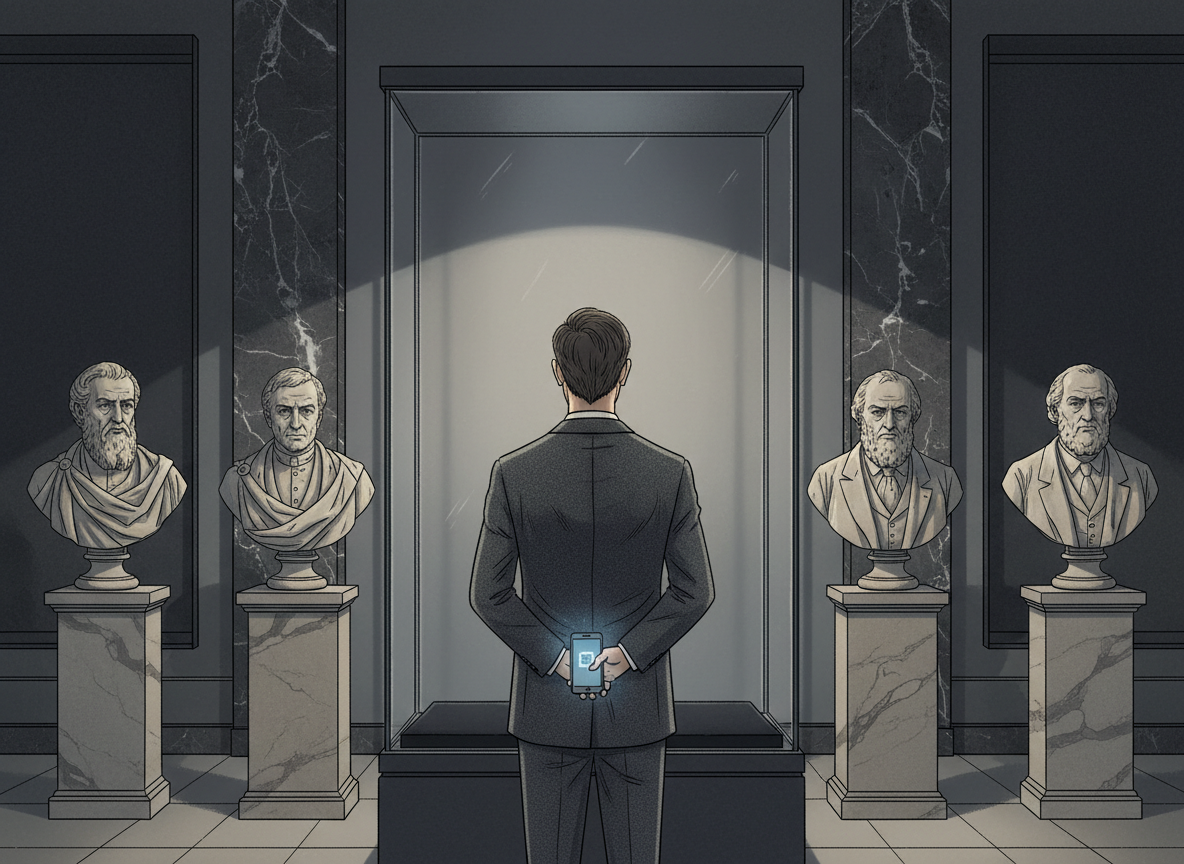
Structure, Subject, Fact
And then, inevitably, my own classificatory mania appeared.
The matter could be organised perfectly:
- Fact: there was no active subscription.
- Subject: I was convinced I was still a subscriber.
- Structure: the browser, the account and my historical relationship with the outlet continued treating me as a functional vestige of what I had been.
The result was fascinating: exo-subscription.
To be without being. To belong without belonging. To persist subjectively after having disappeared administratively.
A relational identity sustained by external stimuli even after its material foundation had evaporated.
My condition as a subscriber fitted my own conceptual model like a penis into a Freudian metaphor.
It was almost insulting.

The Problem of Self-Perception
But then something even more beautiful happened.
This entire episode had begun because I had spent hours arguing about categories, material reality, identity, recognition and the relation between what we are and what we say we are.
And suddenly reality gave me this scene: I could self-perceive as a subscriber all I wanted. I could identify as a subscriber, express my subscriber identity, remember a subscriber history, perform subscription by entering the site with my username and even experience administrative dysphoria at the possibility of losing it.
But the system said: you do not have an active subscription.
And I thought: what a bastard the universe is.
It had waited all night just to make that joke at my expense.
An Unconsented Administrative Transition
Technically, I had transitioned from subscriber to non-subscriber.
No psychological support. No informed consent. No protocol. No interdisciplinary team. Not even a notification.
One day the database simply decided that I was no longer what I believed myself to be, and I carried on living. I went to work, bought food, slept, entered la diaria. Nobody told me anything.
It is possible that for weeks I coexisted with myself without knowing my true administrative condition. A kind of intersubscription.
Perhaps I should demand a Ministry of Public Health guideline.
The Revolution That Never Happened
The most humiliating part is that my protest had been deprived of its material component.
I was thinking, “I shall withdraw my four hundred pesos.” Apparently those four hundred pesos had already been exercising their economic freedom far away from la diaria for quite some time.
My boycott was symbolic before it had even begun. More than a boycott, it was administrative necrophilia. I was solemnly breaking up with a contractual corpse.
I had written: “I have no intention of continuing to finance this outlet.”
And the bank, from somewhere remote, was probably replying: “Darling, calm down, Che Guevara of Pocitos: we haven’t been able to charge you for ages. Put some money in the account, you stingy bitch.”
My forty-ish fag identity starring in an anti-capitalist epic had been defeated by a fairly ordinary materialist detail: I was no longer financing anyone.
And with that disappeared the only truly important possibility of my protest achieving national relevance: Yanina Latorre covering the conflict and, staring into the camera, declaring: “la diaria dries my cunt out.”
The revolution had even lost its television panellist.
Thank you. It is always good to have institutional support during a protest.
Epilogue for Revolutionaries with Direct Debit
In the end, the email had already been sent. I could not take it back. Nor did I want to.
Because I realised that the matter had ceased to be a simple cancellation request. It was a breakup letter sent to a relationship that had already ended without one of the parties knowing.
Which, now that I think about it, is probably the most adult form of separation possible.
One of the two has already grieved. The other is still writing paragraphs.
So now I wait. Perhaps they will reply: “Dear Fabián, we confirm the cancellation of your subscription.”
And that would open a new philosophical problem. How can they cancel something already cancelled? Can a thing cease to be what it already was not? Is there a second ontological negation of subscription? Does cancelling a cancellation amount to subscribing?
Hegel would start ringing the doorbell.
I would not let him in. I have had enough philosophy for one week.
I only wanted to stop paying for a newspaper. And discovered that for who knows how long I had been practising, unknowingly, the most radical form of protest imaginable: paying nothing.


Deja una respuesta