EN · ES
Two Feminisms and One Word
For much of its history, feminism could use the word woman without having to stop and explain who was included in it. The category was contested from within, crossed by class, race, sexuality, motherhood, work and religion; it could conceal very different experiences and produce rather clumsy universalisations, but it kept a relatively stable material referent. Women were the people of the female sex on whom certain expectations, restrictions, kinds of work and risks had been laid. That those expectations were social did not turn the body into a fiction. Quite the opposite: gender was politically interesting because a society had done an extraordinary number of things around a bodily difference that nobody had asked for.
A girl did not need to identify with femininity for people to start treating her according to it. She could hate dresses, refuse to play with dolls, chase after a ball, prefer mud and arrive at adolescence with the unwelcome news that none of those decisions had emancipated her from menstruation. The old feminist intuition drew part of its strength from there. Being a woman did not require passing an exam in femininity. That is precisely why feminism could say that many of the things associated with women were impositions and not emanations of some secret vaginal essence that made one spontaneously love housework and floral tea towels.
Gender-critical feminism keeps that architecture. Holly Lawford-Smith starts from an idea that, a few decades ago, would have seemed considerably less exotic within feminism: sex designates a bodily reality and gender names a social order built around it. Masculinity and femininity then appear as expectations, norms, rewards and punishments distributed over two sex classes. A woman can be masculine without ceasing to be a woman; a feminine man remains a man. The very possibility of rebelling against gender depends on membership of the class not being defined by one’s degree of conformity to its stereotypes.[1]
Kathleen Stock works from a somewhat different angle, though she arrives at a similar border. Her interest is concentrated on what happens when a subjective identity begins to be used as a public criterion for categories that until then referred to sex. Name, presentation, social position and even a good part of the visible characteristics of the body admit change; someone can live for decades in a female role and be treated by those around them as a woman. None of that retrospectively makes the sex they were born with female, nor does it oblige every institution to replace one classification with another. Stock takes this distinction to places where the discussion translates into concrete decisions: statistics, medicine, sport, prisons, changing rooms, refuges. There the word no longer takes part only in a conversation about recognition; someone has to use it to decide something.[2]
Queer feminism arrives by another genealogy. Its suspicion is directed precisely at the idea that there is a category woman capable of presenting itself as a political foundation prior to the norms that produce it. Judith Butler turned that suspicion into one of the most influential operations in contemporary theory. Gender does not simply express an inner identity that was already complete before appearing in public; it is constituted through repetitions, expectations, gestures, discourses and forms of recognition that make certain bodies and certain lives intelligible. The woman who seems to perform her sex naturally has also learnt a way of occupying it. The heterosexual man who considers himself nature’s most spontaneous creature has been rehearsing the part for years, even if he takes offence when someone points it out.[3]
Butler’s performativity was later vulgarised into a version she herself would have struggled to recognise. In certain popular discourses, gender ended up resembling a sovereign inner essence: one looks inside, finds an identity there and communicates it to the world, which must immediately update its boxes. It is a curious descendant for a theory built against the fantasy of a subject entirely transparent to itself. Between Gender Trouble and an HR form with thirty-seven options, several things happened; to attribute the whole contemporary taxonomy to Butler would be to give her too much credit and too much blame.
Her intervention still has a far more serious consequence. If sexual and gender categories acquire meaning within social orders, their borders can also be revised. Woman stops working as a noun whose extension is settled once and for all by biology and becomes a category shot through with recognition, norms and history. From there it is considerably easier to conceive that a trans woman belongs to the political category woman even though she does not belong to the female sex. The incorporation can be presented as an expansion like others feminism had to carry out when it discovered that its universal subject looked suspiciously like a white, heterosexual, middle-class woman.
Sally Haslanger complicates the fight further because she refuses to occupy either extreme obediently. Her proposal links gender to social position: being a woman consists, in her classic formulation, in occupying a position of subordination associated with the perception of bodily features taken as evidence of the female reproductive role. The body is still there, but social classification acquires decisive importance. A person can be treated as a woman because others believe she belongs to the female sex, and that belief can produce material consequences even if it is mistaken. The bouncer who harasses, the boss who discriminates or the stranger who hurls abuse does not ask for a karyotype before starting. Sociology tends to work with less sophisticated instruments.[4]
Haslanger forces us to recognise something that an overly simple version of gender-critical feminism could lose: real sex and attributed sex can produce different effects, and both are real. A trans woman perceived socially as a woman can receive forms of harassment that a society reserves for those it reads that way. Her sex has not changed because a stranger treated her as a woman; nor does the social fact of having been treated that way disappear. Both claims fit in the same room without one having to expel the other for transphobia, or the other having to call the door handle patriarchy.
The institutional difficulty appears when the word has to decide belonging. One theory uses woman to name a sex class, another to describe a social position and another to indicate a recognised identity. As long as each use stays within its own problem, the polysemy is manageable. It starts to make a racket when it is assumed that having shown the usefulness of a definition in one domain obliges other institutions to adopt it.
For years a trans woman may occupy a female social position, be perceived as such and receive some of the sanctions directed at those who are read as women. That experience is decisive for studying workplace discrimination, everyday interaction or perception-based violence. If one then asks who belongs to a sporting category created around sex, the earlier social experience does not answer on its own. The domain has been changed without warning, and the same word is being forced to carry another kind of information.
For gender-critical feminism, keeping woman as a sex-based category makes it possible to identify a population on which operate processes that do not depend on how each individual perceives herself: reproduction, pregnancy, certain pathologies, average physical differences, sexual exploitation, historical forms of subordination and norms of femininity imposed from outside. If membership ends up depending on identity, the category no longer necessarily coincides with the population to which those structures were applied.
Queer feminism observes another loss. A definition closed by sex leaves as foreigners people whose social life, presentation, vulnerability and self-understanding unfold entirely within the feminine. The political category runs the risk of becoming an ontological customs post where the body of birth keeps the last word for ever. From that point of view, demanding that a trans woman remain outside woman even when her daily life unfolds under that recognition looks less like taxonomic precision than a refusal to let historical categories change.
The two positions are defending different goods, which is why they so often talk over one another. Gender-critical feminism fears that the political subject will lose the criterion that made it identifiable. From queer feminism, the problem is different: that criterion leaves out feminine experiences the earlier vocabulary did not know how to house. As long as the disagreement stays in seminars, articles and Twitter spats, it survives for years on screenshots and on the renewable energy of people convinced that someone on the internet is wrong.
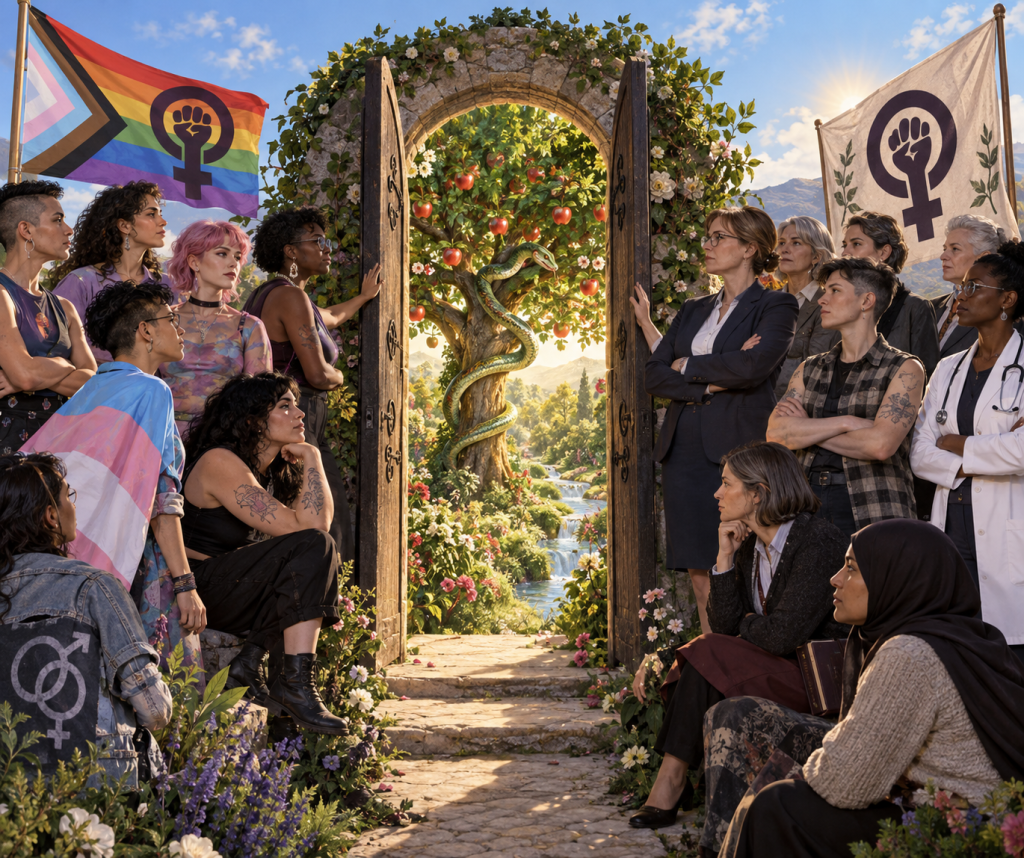
Then a door appears: that of a changing room, a prison, a refuge, an athletics track or a programme reserved for women. It is no longer enough to say that categories are historical or to repeat that sex is material. There is a person on each side and an institution obliged to decide which property counts. The word woman stops being merely a piece of feminist theory and becomes a criterion of access.
The dispute changes at that instant. Each definition drags consequences that were easy to leave floating while everything happened on the terrain of theory. If woman depends on sex, some people with a feminine identity are left out of certain spaces. If it depends on identity, some people of the male sex enter spaces created around the sexual distinction. When both criteria are combined without hierarchy, the institution must resolve what happens when they point in opposite directions. From then on, the fight is no longer merely doctrinal.
When a Category Has a Function
Political categories tend to seem simpler as long as nobody tries to use them to distribute anything. They can remain for years in manifestos, university courses, institutional documents and discussions about recognition without anyone having to decide what concrete consequences follow from belonging to them. The difficulty begins when a word opens a registration, reserves a place, separates a competition, alters a statistic or determines who shares a space of bodily intimacy.
Female categories appeared in many of those areas because sex produced consequences that an undifferentiated classification could not absorb without harming women. In sport, the division made it possible to compete within a bodily class where sex differences in performance did not turn women’s participation into an educational excursion towards defeat. In certain employment policies, the category made it possible to observe discrimination linked to pregnancy, motherhood, historical access to professions or the unequal distribution of work. In prisons, refuges and changing rooms, sex also played a part in decisions about privacy, coexistence and bodily exposure.
None of that turns every category called woman into an exact copy. A health statistic may need to know, depending on the problem, who has a cervix; a survey on discrimination may need to know who is socially perceived as a woman; a study of trans people records gender identity; a sporting competition organises another kind of difference. The name can be repeated while the information the institution needs changes.
The confusion appears when a definition arrived at to resolve one of those matters is presented as mandatory for all the others. If a person lives socially as a woman, that fact may be indispensable for understanding certain experiences of discrimination. It does not automatically answer who belongs in a sex-based sporting classification. If a health policy needs to record sex, it has not thereby discovered the complete essence of femininity, nor acquired metaphysical competence to decide how someone should present themselves in daily life. For years a single word has been asked to carry far too many parcels.
A more careful institution begins with something far less ambitious: identifying which difference it needs to record and what for. Sometimes it will be sex. At other times gender identity. In certain research it will be sensible to collect both variables and stop behaving as though one box had an obligation to settle the whole of human anthropology before lunch.
This way of reasoning shifts an important part of the dispute. Membership stops depending exclusively on which general definition of woman manages to prevail and begins to relate to the concrete purpose of the classification. A women’s sporting category and a category used to study misogyny do not have to select exactly the same population. The first may be organised around sex differences relevant to competition; the second may include, depending on the object of study, experiences produced by social perception, presentation or identity.
Institutional borders always make some selection. That characteristic tends to be hidden by the contemporary moral prestige of the word inclusion. Including seems an action that explains itself; excluding requires cross-examination, witnesses and possibly a committee. But any category that retains content leaves something out. An under-18 competition excludes adults. A weight category leaves out anyone over the limit, however extraordinarily pleasant. A programme aimed at pregnant women selects people capable of being in that condition and does not become discriminatory because a gentleman has a deep emotional commitment to obstetrics. The legitimacy of the selection depends on the relation between the criterion used and what the institution is trying to do.
To prevent a woman from taking part in an election because she is a woman uses sex where it has no legitimate relevance. To reserve a women’s competition for people of the female sex uses it because the category was created around sex differences that affect the competition. The same variable is legally suspect in one context and necessary in another.
Part of the contemporary expansion of gender identity took place under a different intuition: when a person is socially recognised as a woman, the categories that use that word should follow that recognition. In many everyday settings that can happen without any relevant conflict. The name someone presents under, their clothing, their social treatment or the way they organise their private life do not require an inspection of the person’s sexual history each time they order a coffee. It would be a rather unbearable society if the waiter had to complete a medical history before saying ‘madam’.
Protected institutions pose another kind of decision because there membership grants access to something whose distribution depends on a border. A sports place, a ward, a quota, a protected dormitory or a statistical category do not perform the same function as a formula of courtesy. Interpersonal recognition can be extremely broad, and institutional classification can, in certain cases, follow narrower criteria.
A familiar scene appears in public discussion: every refusal to transfer gender identity into a sex-based category is interpreted as a refusal to recognise the person’s social existence. Thus a discussion about sporting eligibility ends up turned into a plebiscite on somebody’s human dignity; the moral temperature rises and precision is stripped down to its underwear.
The history of feminism makes this shift especially sensitive. Many of its political categories arose because certain bodies were treated in a certain way before their owners had formulated any identity about them. A girl could be sexualised, kept out of study, prepared for domestic work or exposed to pregnancy long before she had developed any theory of her gender. Subordination found the body first and the words afterwards.
That sequence does not explain all the contemporary effects of gender, but it preserves political information. If a category was built to identify a population exposed to a particular disadvantage because of its sex, changing the criterion of membership also changes the population on which the policy acts. There may be good reasons to create additional protections, recognise new vulnerabilities or design parallel institutions. Nothing obliges us to do so by altering the earlier category.
The solution looks less elegant than a single universal definition of woman, but real institutions rarely thank us for metaphysical elegance. They need to know what they are measuring. A hospital records sex and gender identity in separate fields.[5] An anti-discrimination policy expressly protects trans people without declaring sex irrelevant. A sports federation reserves one category and organises another under different criteria. The administrative world will survive having two boxes.
The alternative is to use identity as the general criterion and then to reconstruct, through exceptions, the differences the earlier criterion concentrated. Then ever longer formulas appear: women, people with certain anatomies, people who menstruate, pregnant people, athletes who did or did not go through a particular puberty, inmates with certain physiological backgrounds. The old category stops working as a general criterion and reappears as an enumeration of properties that were previously roughly contained within it.
Gender-critical feminism fears that woman will lose the capacity to identify a sex class on which particular forms of subordination historically acted. Queer feminism points instead to the cost of leaving out people whose social life unfolds under a feminine identity and who suffer violence or exclusion connected with it. That second problem demands policies of its own; it does not follow that one definition should absorb the other.
There are trans women who need specific protection against discrimination, violence or victimisation. There are also women of the female sex who demand that certain spaces remain organised around sex. The institutional architecture begins to deteriorate when the only imaginable way to protect the first population consists in modifying the category created for the second.
The useful question is which property justified building each border. The answer will not be identical on an athletics track, in a prison, in a company or in a refuge. That is where theory is going to have to get its hands dirty.
The Silent Redefinition
Categories rarely announce that they have changed their nature. They keep the name, the typeface, the place on the forms and a good part of the rhetoric that surrounds them. What changes is the criterion by which someone enters them. From the outside it looks like an expansion; on the inside something far deeper may have happened.
For decades, a category such as woman admitted an enormous amount of internal difference without losing its principle of membership. Heterosexual, lesbian, fertile, infertile, mother, nun, athlete, executive, sex worker, masculine, feminine, rich, poor, white, black, young or old: those differences radically modified the concrete lives of the members of the category, but none replaced sex as the condition of membership. The expansion took place within the same object.
Another operation begins when inclusion requires incorporating people of the male sex by gender identity. The modification seems linguistically small: the word remains and the population widens. Yet we are no longer adding variation within the same class. We are introducing a new principle capable of determining membership.
A category expands in different ways. It can discover that it had applied its own criterion too narrowly: a legal definition of citizenship that excludes certain ethnic minorities can be widened without abandoning the idea of citizenship, and a category of workers can take in occupations previously ignored. Something else happens when the criterion is replaced. If an association created for people under eighteen begins to admit adults who identify with adolescence, keeping the word youth does not resolve what has just happened.
The comparison seems absurd because gender identity has a history, a phenomenology and a social density that a supposed age identity lacks. That is why it is worth keeping the difference between the logical analogy and the phenomena compared. What matters is the categorial operation: an external property ceases to be a sufficient or necessary condition and a form of self-ascription acquires the capacity to modify the border.
The problem appears when the word begins to perform two functions that do not always coincide. It must go on naming the population on which sex-linked processes act and, simultaneously, include people whose access depends on identity. As long as both properties coincide, the tension passes unnoticed; when they separate, the institution needs to decide what to do about the disagreement between body and identity.
The most common way out consists in reconstructing underneath the differences that the general category has stopped preserving. New expressions appear for talking about what used to be named quite directly. If woman stops guaranteeing the female sex, a health policy specifies women with a cervix, pregnant people, people who menstruate or patients with a particular anatomy. Some expressions can be useful in specific medical contexts; the interesting change lies in why they began to be needed so often.
Something similar happens with statistics. If a database records only gender and later needs to know sex differences in mortality, disease, pregnancy or violence, it will have to recover the datum by another route. Administrative systems survive several columns. The oddity appears when it is first declared that the sexual distinction is too limited for classification and is then carefully reconstructed because the data still depend on it.[5]
Sport makes that operation visible with particular crudeness. If female stops meaning membership of the female sex and begins to admit gender identity as a criterion, it will still be necessary to determine what to do about the bodily differences that justified separating the competition. Then puberty, testosterone, muscle mass, bodily structure, hormonal history and transition times reappear.[6] The criterion that was meant to be abandoned returns fragmented into half a dozen variables, now accompanied by reports, certificates and discussions about how much of each characteristic counts as too much.
The result can end up being more intrusive than the earlier classification. A rule that originally asked about sex ends up investigating endocrine biographies, treatment histories and thresholds whose relevance must be argued case by case.
The gender-critical resistance to individualised models of eligibility arises partly from there. If the female category exists to protect a sex class, turning each case into an assessment of personal advantage transforms the nature of the rule. A particularly tall, strong or genetically favoured woman does not have to demonstrate that she is still feminine enough to compete with other women. Her exceptionality occurs within the class. The criterion of membership does not depend on her reproducing the average of its members.
Biological exceptions do not eliminate the class either. Variations in sex development can generate hard cases, some especially hard for any classificatory system that expects to work with big buttons and instant answers. The existence of complex edges obliges us to have protocols for those edges; it does not automatically turn a sex category into an identity category.
Medicine lives with those edges. Biological categories rarely offer the neatness of a school diagram. There are anomalies, mosaics, anatomical variations, syndromes that mix expected characteristics, and patients determined to remind the textbook that nature never signed a contract of simplicity. The usual scientific reaction is to describe the exception better, not to conclude that the whole earlier classification was imaginary.
Identity politics introduces another temptation because the exception can acquire, in certain discussions, normative value. If there is a person who is hard to place, the very difficulty begins to be presented as proof that the rule is unjust. The move is intellectually seductive: wherever an anomaly appears, the entire classification comes under suspicion. Useful categories do not need metaphysical exhaustiveness; they need to discriminate sufficiently what they were created for.
None of this prevents us from recognising cases of exceptional sex development and keeping a sex-based female category, nor from recognising trans women without making identity the criterion of entry to any female space. Sex and identity are also recorded separately when the problem requires both variables. Even the broadest social use of woman coexists with female in a strictly sexual function in certain contexts. Linguistic coexistence is less elegant than a single definition, but it probably resembles the world more.
Resistance to these distinctions usually rests on an understandable moral intuition: creating different categories seems to produce first-class and second-class citizens. That association between difference and hierarchy has behind it a history unpleasant enough that nobody should take it lightly. It can also turn, however, into a reflex. Two different categories are not hierarchical by definition; they will be so if they distribute dignity, rights or resources unjustifiably.
Feminism lived with that paradox for a long time. To fight inequalities produced by sex it had to insist that sex should not determine capacities, destinies or social worth and, at the same time, keep it as a variable capable of revealing who was being harmed. Emancipation did not require ceasing to count women. It required ceasing to use the fact of being a woman as an argument for keeping them out of places where sex had nothing to do with it.
The contemporary discussion introduces an additional twist: a category won in order to make an inequality visible is accused of exclusion precisely for keeping the criterion that made it possible to identify it. The move is powerful because it uses the moral language of earlier struggles. In some contexts removing that criterion continues emancipation; in others it eliminates the function that justified the category.
The word inclusion needs something more than a good reputation. We have to ask who enters, by what criterion, and what becomes of the reason the space had been delimited. Depending on the case, a modification improves the institution or keeps the name while changing what it was meant to protect.
When the Definition Controls a Door
The discussion changes texture when the category stops circulating among books and has to organise bodies in space. A sports federation must decide who competes with whom; a prison, where it houses each inmate; a refuge, who sleeps in which room; a company, which population it is trying to reach with a quota or a promotion programme. Until that moment one could speak of recognition, identity, inclusion or exclusion with relative freedom. Faced with a real door, somebody ends up in charge of the key.
Elite sport offers the sharpest version because the existence of the female category already contains a fairly clear explanation. If men and women always competed within a single classification, an important part of women’s sport would lose its competitive meaning. The separation was not invented to claim that women are a delicate subspecies needing ceremonial protection; it was created because human sexual dimorphism produces, after puberty, bodily differences relevant to numerous disciplines.[6] The category allows women to compete within a class where those differences do not make their presence on podiums, in records, selections and professional careers marginal.
That origin matters more than the intention of each athlete. An exceptionally strong woman does not threaten the category because her strength occurs within the population for which it was built. Nor does a tall woman, one with extraordinarily long arms or one endowed with a genetics inconsiderate to her rivals need to demonstrate that her advantage remains sufficiently feminine. Sporting competition is full of natural inequalities; in fact, a good part of its charm consists in watching people obscenely favoured by a combination of training, talent and biological lottery while the rest of us pretend that with discipline we too would have run the hundred metres in ten seconds.
Separation by sex introduces a border different from those internal inequalities. It tries to prevent a structural advantage associated with belonging to another sex class from reorganising the whole competition. Once gender identity acquires the capacity to modify membership, the female category is no longer defined exclusively by what justified its creation.
An individualised solution seems, at first, more sophisticated. One could investigate what treatment each athlete received, when it began, how long the exposure to certain hormones lasted, which bodily changes persist and to what extent any of those features retains sporting relevance. The result is less elegant than it promises. The category ceases to rest on a common criterion and comes to depend on retrospective reconstructions, medical documentation, debatable thresholds and a proliferation of intermediate situations:[7] puberty begun but incomplete, early blocking, irregular treatment, interruptions, patchy records, individual differences in development. The border that was supposed to offer a general rule ends up as a permanent medical commission.
Moreover, the procedure modifies the burden the category bears. Women of the female sex enter by membership of the class; trans women would enter through an assessment of how much of a male history remains relevant. The admission procedure itself confirms that sex matters, only now it is reconstructed in fragments after abandoning the border that allowed it to be treated as a general variable.
An open category avoids a good part of that conceptual gymnastics. The female category keeps its sex-based criterion and the open category allows those who meet the other regulatory conditions to compete without gender identity having to rewrite the first. Its concrete implementation will depend on the size, resources and structure of each sport. A large federation may have options that do not exist in a regional tournament with few participants; the practical impossibility of always offering an additional division does not change the conceptual difference between protecting a category and redefining it.
Recreational sport lives under another gravity. A kickabout among friends, a Sunday league or a social training session does not necessarily hand out professional careers, records or Olympic places. There the agreements of those who take part can do much more work. If a group decides to play mixed and nobody objects, it is hard to find a civilisational tragedy hidden behind the ball. The situation changes when one person’s inclusion requires others to give up a condition they regarded as part of the space: a competition only among women, a sex-segregated changing room or a certain form of bodily privacy.
To oblige people to accept that modification in the name of inclusion reproduces a curious structure. One person’s expectation becomes another’s obligation. A woman who does not wish to undress in front of someone of the male sex ceases to be someone with a bodily boundary and comes to appear as a political obstacle. The conflict can be resolved locally in many ways, from individual changing cubicles to different timetables or specific agreements, but to turn women’s consent into a dispensable variable would be a rather peculiar form of female emancipation.
Prisons remove any temptation to transfer the sporting solution mechanically. Nobody there is trying to preserve fair competition. What is being administered is forced coexistence, vulnerability, violence and privacy inside an institution that already restricts almost every ordinary means of leaving. A female prisoner cannot decide that she rejects a particular living arrangement and go home.
Sexual separation acquired in that context a function of its own. Women’s prisons house people of the female sex; men’s, people of the male sex. Trans identity introduces additional risks that a purely binary organisation can handle badly in some cases, especially when a trans person is highly vulnerable in the wing corresponding to their sex. That vulnerability requires protection. To turn it into an argument for moving the sexual border of the women’s prison produces another effect: the safety of some inmates is subordinated to a rule of recognition formulated to resolve the vulnerability of another population.
There is a less grandiose and more administrative alternative: specific protected units. The name matters less than the function. They can house inmates whose ordinary placement exposes them to special risks, with criteria that distinguish histories of violence, vulnerability, anatomy relevant to certain situations and needs for protection. A trans man need not be sent without more ado to live with a male population where he would be especially exposed. A trans woman likewise need not have her safety depend on gaining access to a women’s prison. Institutional design can recognise the risk without making identity the criterion capable of displacing sex.
This solution does not require imagining trans women as dangerous by definition either. That would be as clumsy an inference as assuming that every female prisoner is harmless because she shares a category with the others. Belonging to the wing and the individual assessment of dangerousness are different operations. A woman convicted of violent assaults still belongs to the female population; her risk is managed within that institution. Confusing the two tasks produces policies in which every exception threatens to change the general classification.
The same principle avoids another frequent shortcut. That there are women who are dangerous to other women does not make sexual separation irrelevant, just as the existence of a seventeen-year-old girl stronger than a thirty-year-old man does not eliminate age categories. Populations are organised by general properties and then manage the heterogeneity that exists within them. To ask a category to predict individual conduct perfectly would be to condemn it to failure before it started.
Refuges for victims of violence place the conflict on a more intimate scale. There, privacy and trauma may have a direct relation to the sex of those who share dormitories, bathrooms or showers. A woman who escaped male violence may experience the presence of male bodies in a way that no institutional declaration can switch off by decree. To demand that she suppress that response to prove her openness turns her vulnerability into a kind of moral examination.
A trans person who is a victim of violence also needs protection. The error appears when it is assumed that recognising both needs obliges us to put everybody in the same private space. A refuge can share a dining room, legal assistance, psychological care, activities and common areas while dormitories, showers or certain areas remain organised differently. In small premises the architecture will be harder and less perfect solutions will have to be improvised.
Bodily privacy has a strange tendency to disappear from discussions in which everything is formulated as identitarian recognition. Changing rooms and showers are perhaps the most banal example. For decades, accepting that people might prefer to undress in front of others of the same sex did not require a complicated theory of the human mind. Identitarian redefinition turns that expectation into something negotiable because the identity of whoever enters takes priority over the sex the other people find in front of them. A society can perfectly well offer individual cubicles, additional unisex spaces or greater privacy without turning all the existing places into mixed spaces by definition.
Work poses a different kind of difficulty because phrases such as ‘women’s rights’ or ‘policies for women’ bring together interventions that pursue very different aims. A leave entitlement related to pregnancy responds to a bodily condition. A programme to increase female participation in a historically male profession may try to correct an exclusion linked to sex. A harassment policy may deal with conduct directed at someone who is socially perceived as a woman. A programme against discrimination towards trans people is aimed, naturally enough, at trans people.
Grouping all those aims under a single definition produces strange results. If a company reserves places for women because it is trying to correct a historical gap in access for people of the female sex and then lets identity determine membership, the beneficiary population has ceased to coincide entirely with the one on which the inequality was measured. There may be an additional reason to include trans people, but that reason should be formulated under its own name instead of hiding inside the first category.
The obsession with a single definition of woman makes unnecessarily difficult what a data system resolves with very little poetry. Sex and gender identity are recorded separately.[5] A policy analyses discrimination by sex and discrimination by identity; if both variables intervene, both are studied.
Medicine takes this need to a point that is hard to ignore. Some clinical decisions depend on organs, physiology, hormonal exposure or reproductive capacity. Others may depend on identity, social treatment, transition history or specific risks associated with certain interventions. The professional needs information precise enough to know which body they are treating and what experience accompanies that body. Substituting one variable for the other impoverishes the record in both directions.
The same separation makes it possible to analyse workplace inequalities without having to decide first on a complete ontology of gender. A trans woman can suffer harassment for being perceived as a woman and specific discrimination for being trans. A woman of the female sex faces discrimination over pregnancy, over motherhood anticipated by the employer or over stereotypes directed at her sex. Some experiences will coincide; others will not. The legal apparatus protects both without pretending they have an identical cause.
The temptation to resolve every conflict by widening a category has an obvious political advantage: it seems to avoid creating new borders. Sometimes, however, it conceals the loss of an earlier border. The result ends up especially strange when the population originally protected must justify why it retains any interest of its own that is not absorbed by the widened category.
In sport, the woman asks why a classification built around sex can no longer use sex as a sufficient criterion. In a prison, she asks why a sex-segregated space must be reorganised by identity. In a refuge, why her expectation of privacy depends on the self-definition of whoever asks to enter. In an employment policy, why an inequality measured on one population is repaired by distributing part of its benefits according to another variable. None of those questions is answered by pronouncing the word inclusion with sufficient solemnity.
Institutions recognise trans people, protect them against discrimination, create specific resources and guarantee access to services without turning every female space into a provisional border. That takes more design than a universal definition and complicates administration. Reality has the vulgar habit of asking for a budget after the theory.
The alternative seems simpler because it changes a single word: where sex used to determine membership, identity comes in. Then come the exceptions, the protocols, the special cases and the reconstruction of the material differences the new definition stopped preserving.
Four Theories Facing the Same Problem
An institution does not receive a single answer from Lawford-Smith, Stock, Haslanger and Butler. All four may describe dimensions that exist: sexed bodies, identities, social positions, norms that make certain subjects intelligible. But those dimensions do not weigh equally when they have to be turned into a rule of membership.
Holly Lawford-Smith starts from sex. For her the political category women keeps a material reference because female subordination was historically organised around human females. Gender appears afterwards, as a set of expectations and social relations that fall on that population: compulsory femininity, reproductive roles, dependence, economic restrictions, sexualisation. The old feminist task consisted precisely in breaking the association between having been born a woman and having to become a particular kind of person.
In an institution, this conception has a considerable advantage: membership can be determined without interrogating what subjective relation each individual has with masculinity or femininity. A woman can hate every characteristic culturally associated with her sex and remain within the category. Feminism does not need to check whether she feels woman enough. In fact, asking her that would for quite a long time have been a rather antifeminist idea: the masculine woman, the butch lesbian or the adolescent who detested femininity were not suspected of having abandoned their sex for breach of contract.
Lawford-Smith sees in the contemporary notion of gender identity a displacement of that structure. If someone can belong to the category woman because of an inner feminine identity, what was previously to be criticised as a system of norms runs the risk of reappearing as information about who the person is. What feminism had tried to separate returns to intervene in membership, though through another vocabulary and with a far more sophisticated subjective theory than ‘girls prefer pink’.
The queer objection appears at once. A purely sexual category can describe a biological class accurately and still fall short in the face of certain social lives: there are trans people who live for years as women, are recognised as such by practically everyone around them and receive forms of harassment directed at them precisely because they are read as women. Lawford-Smith concedes a good part of that description without moving the criterion of membership. An effeminate gay man, for example, receives insults intended to discipline femininity and knows the repertoire of humiliations associated with looking ‘too much like a woman’ well; that does not make him a woman.
Kathleen Stock reaches a similar conclusion by a more analytic route. Her interest is less centred on reconstructing female oppression as a class and more on separating propositions that tend to get stuck together in the debate. That an identity is important to a person’s life, deserves legal recognition and makes discrimination against it unjust does not automatically determine which descriptive categories should be modified. Sex and identity remain separable concepts even when a concrete life makes them inseparable in experience; a trans woman can organise her whole existence around a feminine identity, modify her body, her presentation and her documents and be socially recognised as a woman without it following from that description that her sex became female.
The distinction also allows social language to operate with different conventions depending on the context. In social life we address someone in the way that person prefers; in medicine, sport or certain statistics, sex is also recorded when it is relevant. There is no logical contradiction in that coexistence. Sometimes there is simply a database with two columns.
Stock has used the idea of a social fiction to explain part of that phenomenon, a formulation that has the merit of clarity and the defect of turning up to dinner with a jerrycan of petrol. For this discussion there is no need to follow her that far. An identity can be phenomenologically real for the person who lives it and socially real through its effects without thereby acquiring the capacity to alter every relevant bodily property. Subjective experience need not be false for another dimension to go on existing.[2]
That point also separates us from a crude version of materialism that would reduce the whole of human existence to genitals, chromosomes and a laboratory report. Nobody lives their sex as a sequence of cytogenetic results. Bodies are interpreted, dressed, desired, rejected and recognised within cultural systems. Desire, for one, works on whole bodies and embodied meanings, not on pathology reports. Materiality sets limits; social life builds a good deal inside them.
Sally Haslanger occupies a zone less easy to order within an overly tidy opposition. Her analysis of gender starts from the social position a person occupies, before the identity she declares. A woman, in her classic proposal, is someone systematically subordinated because she is perceived or imagined as bearing bodily features associated with the female reproductive function. That is why a trans woman who passes socially as a woman can find herself, under certain conditions, situated within that structure even though she does not belong to the female sex: whoever discriminates acts on a reading, correct or mistaken, and need not know the real body.
An employer considers someone less competent because he reads her as a woman; a stranger sexually harasses her for the same reason. The subordination operates through perception and does not disappear when we later discover that the initial classification was incorrect. Material sex and social position can come apart.
Being treated as a woman is decisive for studying misogyny and may be insufficient to determine eligibility in a sex-based competition. An athlete who occupied a female social position all her life still belongs to the sex class that the sporting category originally separated. This is not an accidental defect in Haslanger: her project is political and ameliorative, and a category built to identify relations of subordination need not also function as a sporting rulebook.[8]
Sex does not exhaust social experience and subjective identity does not govern it either. Between the two lies a machinery of perception, interpretation and hierarchy that can treat people according to properties they have, properties others believe they have or signs associated with them. The conflict with gender-critical feminism arises when that social position acquires enough weight to modify the political extension of women: Lawford-Smith wants to keep a sexed class; Haslanger can admit, under her social definition, that someone of the male sex is placed in the gender category woman. The theories then count different populations.
A policy that studies discrimination over pregnancy will find more precision in the first. To investigate harassment directed at those perceived as women, on the other hand, something close to the second may be needed. To choose one definition as ‘the true one’ and impose it on both problems would lose information.
Judith Butler takes the suspicion further down. If Haslanger still keeps a structure capable of relating certain bodies to certain social positions, Butler questions the ease with which sex itself appears as a perfectly available pre-discursive ground. Bodies exist, but the way of dividing them, interpreting them and turning certain characteristics into fundamental criteria also belongs to a history. The body offers materiality and resistance; no society relates to that materiality without interpretation. To know that a characteristic is anatomical does not yet tell us why it became a political border or what value was attributed to it.[9]
For a feminist theory, the intervention makes suspect the temptation to take women as a fully resolved political subject before politics. The norms that produce femininity, heterosexuality and sexual roles take part in the intelligibility through which we recognise men and women. A category presented as natural can conceal a long institutional history.
Gender-critical feminism accepts part of that movement and can concede that societies interpret bodies sexually, exaggerate differences, turn some into destiny and fabricate roles around them. It rejects the claim that this historicity makes sex dependent on identity. Butler and her queer heirs then ask why sex should be granted a special authority when a person lives socially and subjectively in another category. The gender-critical answer points to institutions whose purpose depends on consequences that sex produces independently of that self-understanding.
In a women’s competition, Lawford-Smith can reply that the category protects a sex class; Stock converges in holding that material eligibility is not resolved by identity. Haslanger adds information that rule does not capture: the trans athlete may have lived as a woman and suffered discrimination associated with that position. Butler reminds us that the sporting category is historical and that its rules change. None of those data, on its own, decides which modification preserves the function of the classification and which replaces it with another.
In a prison, Haslanger can show why placing a trans woman with men may ignore a real social trajectory and vulnerability. That fact does not automatically determine the criterion for the women’s wing. Separate solutions, moreover, carry a serious historical objection: ‘specific protection’ has too often meant inferiority, neglect or segregation. A special wing that receives fewer resources, imposes greater isolation or functions as a dumping ground does not solve the problem.
The proposal to keep sex categories and create additional protections therefore has a cost that does not vanish in the vocabulary. It takes square metres, staff, protocols, health access and a large enough population for the specific resource not to amount to solitary confinement with inclusive branding. Inclusion by redefinition seems administratively cheaper because it uses existing facilities; part of the cost is then transferred to the interior of the modified category.
Refuges leave another residue that no definition orders completely. From a queer perspective, excluding a trans woman can reproduce a form of disregard that contributes to her vulnerability. In a space designed for women traumatised by male violence, however, the sex of those who share bodily intimacy may cease to be an abstract datum. Recognising both needs does not oblige us to pretend they belong to the same class for all purposes.
In practice, queer feminism tends to extend recognition until categorial borders are modified. Gender-critical feminism keeps sex as the principle of certain classifications and looks for additional protections for the experiences left outside.
At that point no theory hides behind its favourite vocabulary. The institution must turn different descriptions into a rule of membership and bear the concrete costs of that decision.
Equality without Equivalence
Political equality acquired a strange relation to similarity. For a long time, an important part of emancipatory struggles consisted in showing that real differences between people or groups did not authorise turning them into hierarchies. Having a different sex, a different sexual orientation or certain bodily characteristics could describe something true without saying anything about the moral worth of whoever had them. The law learnt, with irritating slowness and abundant bloodshed, that treating two people as equally worthy did not require first demonstrating that they were identical.
In some contemporary discussions that relation seems to have been inverted. Recognising categorial differences begins to feel suspect because difference itself is interpreted as the prelude to inequality. If a trans woman does not belong to the female sex class, the statement can be received as though it already contained an opinion about how far she deserves respect, what rights she should have or to what extent her life is legitimate. The description arrives in the debate carrying a moral judgement that nobody has yet formulated.
That coupling makes any discussion of borders especially difficult. If distinguishing amounts to degrading, the only safe policy consists in widening categories until every conflict of membership disappears. The strategy has an apparent elegance. It also leaves us without tools for those cases in which the difference was precisely the reason a category existed.
The legal protection of gay people offers a useful precedent. Winning equality before the law never required demonstrating that homosexuality and heterosexuality were the same phenomenon. A man who desires men does not need to become conceptually a variant of the heterosexual in order to marry, inherit, work, raise children or walk down the street without being beaten up. The political achievement consisted in making his orientation irrelevant where using it against him had no justification. Nobody had to declare that a man’s desire for another man occupies exactly the same erotic place as a woman’s desire for a man before he could be granted the same rights. The difference was preserved because it had stopped functioning as a licence for subordination.
A similar structure can operate with trans people. Their protection against violence, workplace exclusion, harassment, administrative arbitrariness or denial of health care does not depend on making sex and gender identity equivalent terms. A society can recognise an identity, facilitate a social life in keeping with it and punish unjust discrimination while keeping sex as a variable wherever it is materially relevant. Coexistence demands bearing a dose of complexity that slogans tend to regard as bad manners.
A good part of the confrontation between queer feminism and gender-critical feminism arises because each tradition is suspicious of the place where the other puts that complexity. Queer feminism learnt from a history in which borders too often served to exclude: who was a respectable woman, who could speak for the movement, which sexualities deserved recognition, which bodies could appear without embarrassing the community. That memory makes suspect a politics that begins by drawing lines.
The suspicion matters, but it can also take the form of a general rule: the border seems politically inferior to its elimination. Inclusion then stops being one tool among others and gets an argumentative head start; keeping a classification requires more justification than widening it.
Gender-critical feminism keeps another memory. Feminism needed to identify women as a class in order to show inequalities that disappeared when they were treated as a series of individual stories. Imposed motherhood, educational exclusion, economic dependence, sexual violence, the division of labour and legal restrictions did not fall on people who had previously declared a feminine identity. The body could be enough for society to begin organising their lives.
To lose that sexual reference makes it harder to account for some of those inequalities. If the population named by women begins to be determined by another property, the historical data and the programmes built around the first no longer necessarily keep the same extension. Part of the problem can be solved by recording variables more precisely; the very need to do so confirms that the variables remain distinct.
The disagreement becomes more manageable when we stop demanding that one word resolve all the layers at once. A person can have a male sex, a feminine identity, a feminine social presentation and be habitually perceived as a woman. Each statement carries different information. In some contexts one may be central and another will be practically mute.
Insistence on a single category also obliges us to dispute constantly who has legitimacy to speak about experiences that it would be better to name more precisely. A study of pregnancy can define the population capable of becoming pregnant; another on discrimination against women of the female sex in a particular profession can record that population; violence against trans people requires another variable. If the object is perception-based misogyny, we will have to look at how the people studied are read socially.
Common language will remain dirtier, as it should. Nobody wants to fill in a methodological form before introducing a friend to their mother. Everyday life can tolerate ambiguities that a statistic or a sports federation does not admit with the same ease.
Functional categories do not guarantee justice simply by being well defined either. A sporting classification, a protected unit or a differentiated refuge work well or badly depending on resources, design, material conditions and the concrete way they are administered.
The cost of parallel alternatives has to be paid. If the open category exists only in the rulebook and no competition is ever held, it is little more than decoration. If a protected wing means prolonged isolation, the solution has become punishment. If a refuge refers a trans person to a place that does not exist forty kilometres away, the bureaucracy has resolved the conflict by shifting the citizen along until they stop appearing on the spreadsheet.
That those alternatives must really exist does not make absorption into an earlier category the only imaginable way out. It obliges us to design better. For years institutions learnt to accommodate disabilities, religious needs, motherhood and various health risks in situations where treating everyone exactly the same would have produced absurd results. Legal equality is full of operational differences.
The word segregation usually enters at this point with all its historical artillery. It has reasons: it was used to sustain racial hierarchies, exclude populations and turn separation into legal inferiority. But not every separation belongs to that moral genealogy. Hospitals have separate wards, sports have categories, prisons separate populations, schools organise ages and some spaces preserve bodily privacy. The judgement depends on what separates, why, with what consequences and what position those on each side occupy.
A border protects in some cases and degrades in others; it even does both for different populations and obliges us to redesign the institution. The name we then give it does not resolve the distribution of costs.
Queer feminism is right to point out that every category acquires, in certain circumstances, a disciplinary life of its own. Women who did not fit a certain femininity learnt that long before the word queer existed. Lesbians were suspected of not being adequate women; masculine women were medicalised, ridiculed or turned into symptoms; those who rejected motherhood or marriage discovered that gender included a good deal more social policing than the etiquette manuals had advertised.
Because of that history it is strange to make woman depend once again on an inner relation to femininity or on some identity difficult to describe without recourse to symbols, roles and sensations learnt within the very gender order that was to be criticised. A gender-nonconforming woman had for decades been evidence that sex and femininity could be separated. If her lack of identification with the feminine begins to count as a sign that perhaps she is not a woman, the old corset reappears in a considerably pricier conceptual packaging.
Queer feminism has answers to that criticism. Gender identity need not consist in a taste for dresses, make-up or domesticity; for many people it involves a profound relation to the body, recognition, name and social location. That complexity deserves to be taken seriously and, precisely because of its intimate character, makes it harder to use identity as a general administrative criterion.
A deep difference between the two feminisms appears here. Queer feminism starts from the experience of those who seek recognition within the category. Gender-critical feminism asks first which population that category makes it possible to identify when an institution needs to measure, separate or protect something. The clash comes when those functions do not select the same people.
The conflict will not disappear with a sufficiently ingenious verbal definition. It obliges us to ask what we are trying to protect each time we use a category and how much of that aim remains after modifying it.
For much of recent identity politics, inclusion acquired the rhetorical advantage of seeming the end point of that conversation. The more people enter, the fairer the category seems. That reasoning works well in some spaces and worse in institutions whose work depends on distinguishing a relevant variable.
Feminism needed to question innumerable borders imposed on women and, at the same time, to keep a sufficient reference in order to know whom it was talking about. Revising categories forms part of politics; abandoning them without preserving information about the population they try to represent creates another problem. What remains is a less epic task: deciding which distinctions are still doing useful work.
There are areas where sex ceases to matter altogether. In the institutions examined here, on the other hand, it still organises risks, bodies or inequalities that identity does not erase; where gender identity is relevant, it will have to be recorded as a distinct variable.
There is no need to open the door or close it out of habit: what matters is knowing what function the separation serves and what happens to those who need protection on the other side. Sometimes another entrance will be needed, and somebody will have to pay for the building work.
References
- Lawford-Smith, H. (2022) Gender-critical feminism. Oxford: Oxford University Press. ↩ Back
- Stock, K. (2021) Material girls: why reality matters for feminism. London: Fleet. ↩ Back: a b
- Butler, J. (1990) Gender trouble: feminism and the subversion of identity. New York: Routledge. ↩ Back
- Haslanger, S. (2000) ‘Gender and race: (what) are they? (what) do we want them to be?’, Noûs, 34(1), pp. 31–55. Available at: https://doi.org/10.1111/0029-4624.00201 ↩ Back
- Sullivan, A. (2025) Independent review of data, statistics and research on sex and gender. Report 1: data and statistics. London: Department for Science, Innovation and Technology. Available at: https://www.sullivanreview.uk (Accessed: 29 September 2026). ↩ Back: a b c
- Handelsman, D.J., Hirschberg, A.L. and Bermon, S. (2018) ‘Circulating testosterone as the hormonal basis of sex differences in athletic performance’, Endocrine Reviews, 39(5), pp. 803–829. Available at: https://doi.org/10.1210/er.2018-00020; Hilton, E.N. and Lundberg, T.R. (2021) ‘Transgender women in the female category of sport: perspectives on testosterone suppression and performance advantage’, Sports Medicine, 51(2), pp. 199–214. Available at: https://doi.org/10.1007/s40279-020-01389-3 ↩ Back: a b
- Harper, J., O’Donnell, E., Sorouri Khorashad, B., McDermott, H. and Witcomb, G.L. (2021) ‘How does hormone transition in transgender women change body composition, muscle strength and haemoglobin? Systematic review with a focus on the implications for sport participation’, British Journal of Sports Medicine, 55(15), pp. 865–872. Available at: https://doi.org/10.1136/bjsports-2020-103106; Hilton, E.N. and Lundberg, T.R. (2021) ‘Transgender women in the female category of sport: perspectives on testosterone suppression and performance advantage’, Sports Medicine, 51(2), pp. 199–214. Available at: https://doi.org/10.1007/s40279-020-01389-3 ↩ Back
- Haslanger, S. (2012) Resisting reality: social construction and social critique. Oxford: Oxford University Press. ↩ Back
- Butler, J. (1993) Bodies that matter: on the discursive limits of ‘sex’. New York: Routledge. ↩ Back


Deja una respuesta