EN · ES
When Recognition Starts to Mean Obedience
For decades, a good part of the homosexual struggle could be put in a very simple political formula: let me live. Let a man sleep with another man without the police coming through the bedroom door; let him keep his job when someone discovered whom he slept with; let him rent, inherit, sit at his partner’s bedside in hospital and, in due course, marry, should he find someone patient enough. The heterosexual even kept his right to regard the whole business as immoral, distasteful or conclusive proof that the West was in terminal decline. The liberal achievement lay precisely in removing his power over the homosexual’s life; nobody proposed to correct his opinions.
That distinction allowed people who disagreed profoundly to live alongside one another. A Catholic could hold that two men did not constitute a marriage in the eyes of God, and the registry office could marry them all the same. The homosexual acquired a right; the Catholic kept his theology. Neither was handed authority over the other’s conscience. There were quarrels, marches, some rather overheated sermons and families who needed several Christmases to work out where to seat the boyfriend, but the legal boundary was plain to see.
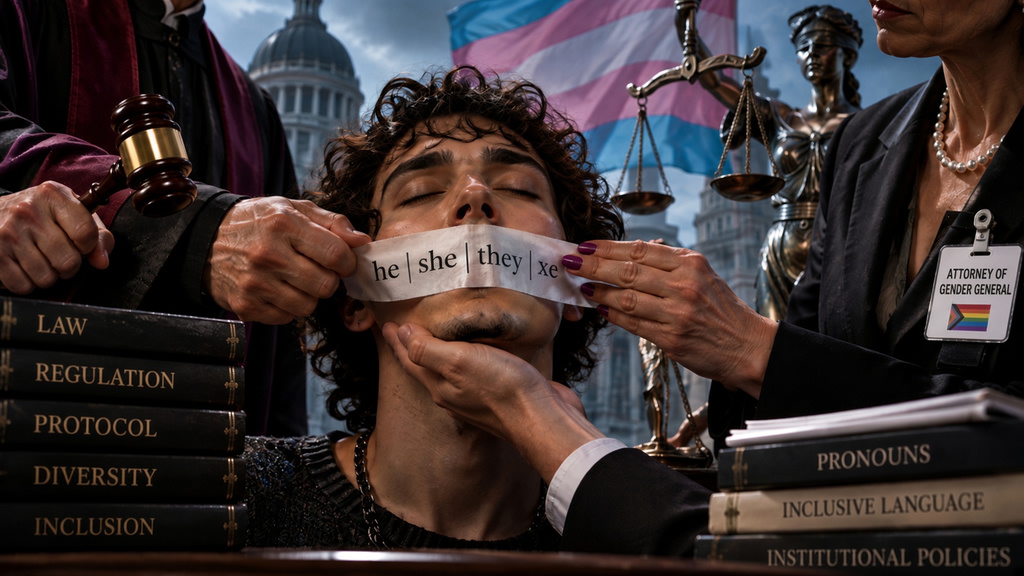
Contemporary identity politics introduced a different sort of claim once recognition stopped referring only to conduct that had to be tolerated and extended to the language third parties were expected to use. Names, pronouns, gender categories and newly coined terms for newly described identities began to find their way into institutional codes, university policies and anti-discrimination law. The change looks trivial so long as it is reduced to a syllable. It looks rather less trivial once declining to use the syllable can become an infringement, and that is where Jordan Peterson found a line he refused to cross.
The Canadian row of 2016 is generally misremembered. Bill C-16 contained no table of pronouns, and it did not say that calling someone ‘he’ when they preferred another word would land anyone in prison. It added ‘gender identity or expression’ to the grounds protected by the Canadian Human Rights Act and extended the Criminal Code’s provisions on hate propaganda and on sentencing for offences motivated by prejudice. That was the text that passed in June 2017.[1]
Reducing the whole controversy to that fact, however, leaves out what Peterson was actually arguing against. Canadian law does not operate through C-16 alone. Provincial human rights codes, and the bodies that interpret them, had already linked gender identity and expression to forms of address. The Ontario Human Rights Commission currently holds that deliberately refusing to use someone’s chosen name, or a pronoun that matches their gender identity, is likely to amount to discrimination in the areas its Human Rights Code covers, among them employment, housing and services such as education. The same Commission concedes that the law remains unsettled on whether a particular gender-neutral pronoun can be demanded.[2] Therein lay the objection that interests me, and with which this series agrees: the state can protect someone from discrimination without thereby acquiring the authority to decide which words another person must utter about him.
The difference between prohibition and obligation matters. Some words can form part of harassment: systematically insulting an employee, making him an object of ridicule, hounding or degrading him at work. The law knew these situations long before xe, xem, fae or any of their cousins appeared. That an expression may form part of discriminatory conduct does not, however, make its preferred alternative compulsory speech. We can stop a boss from calling an employee ‘a fucking faggot’ for six months without drawing up a list of the words by which that employee is entitled to be affirmed. The first restricts conduct aimed at another person; the second prescribes positive linguistic conduct, and the distance between the two is enormous.
Words are communal tools. They are born, change, die, get mangled, and sometimes achieve in five years what a language academy could not manage in fifty. The internet turned google into a verb; technology churns out vocabulary fast enough to make a dictionary look elderly the day it is printed; words from minuscule communities can spread if they solve something millions of speakers find useful. Nobody needed a state commission to make the population say selfie. The word found its object, did its job and reproduced with admirable promiscuity.
A linguistic innovation that needs sanctions to recruit speakers is another matter. Anyone may propose xe or fae. Someone may coin a form tomorrow that captures their experience with great precision and ask those around them to use it. Perhaps their friends will, and the word will leap to other communities and become ordinary within twenty years; or perhaps it will die within the group that coined it. Languages have been running that experiment for centuries without an ethics committee.
To argue that a word’s failure to catch on justifies greater institutional pressure to impose it is to stand the process on its head. A linguistic tool that proves useful enough to a community of speakers circulates because it meets some communicative need better than what was there before. When hardly anyone needs it, hardly anyone meets it outside the setting where it was coined, and it varies besides with the particular identity of each person using it, mass adoption has little reason to happen.
A society of millions cannot keep reorganising its common language around categories used by tiny populations, sometimes further subdivided into new terms whose very existence many speakers discover at the moment someone informs them they are using them incorrectly. The asymmetry is remarkable: the less widespread a word, the more learning it demands of everyone else, and the exceptional character of the category ends up being offered as the reason to impose a general obligation.
The example of Ms is usually wheeled out to show that English has changed its forms of address under social pressure before. The analogy limps. Ms solved a problem that came up constantly for roughly half the population: it allowed a woman to be addressed without the title announcing whether she was married. Millions of people dealt with women every day; millions ran into the same Miss-or-Mrs dilemma; the new tool could be learnt once and reused across an immense number of ordinary exchanges.
A neopronoun attached to an identity claimed by a very small fraction of the population lives in a different linguistic ecosystem. Most speakers can go years without meeting anyone who uses it. Even when they do, the term learnt for that encounter may be useless for the next, because the next person uses a different form. An innovation of that kind may make perfect sense within a small community; it does not follow that the rest of the population owes it a linguistic debt.
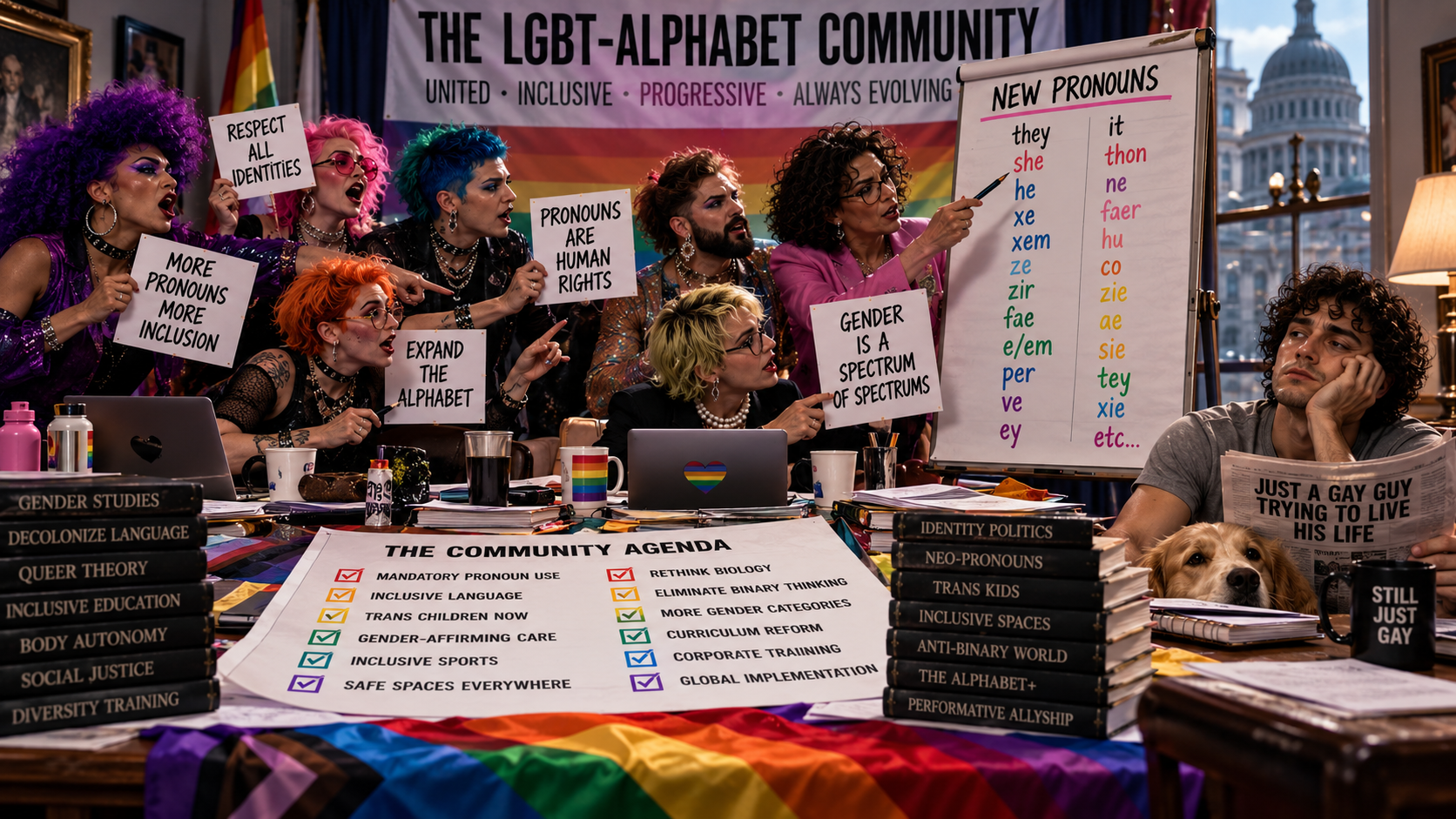
‘Language is always changing’ describes a fact and then smuggles it in as a mandate. Precisely because language changes, no generation controls the outcome by decree. It can promote words, mock them, teach them, write them into official documents and fill PowerPoint presentations with them. Speakers will decide, across millions of exchanges, which survive. Language has the bad manners to ignore five-year plans.
Contemporary identity politics sometimes tries to reverse that relationship: the word is declared morally correct before it has shown any social usefulness, and reluctance to adopt it starts to be construed as harm to the person who requested it. Linguistic disagreement thus acquires a moral weight once reserved for far graver conduct. Someone who refuses may cease to be a person who finds an innovation absurd and become someone who ‘denies the existence’ of another human being.
Nobody vanishes because a third party rejects the theory by which they describe themselves. Someone who holds that there are two sexes, and that certain ordinary pronouns refer to them, may be wrong by the lights of his interlocutor’s theory of gender. He goes on talking, and the other person goes on existing. There is disagreement, perhaps annoyance, possibly a conversation best abandoned before pudding. Recasting that friction as an assault on someone’s existence drives up the moral price of disagreement until it becomes almost unsayable.
Freedom of expression matters most where the categories themselves are in dispute. To think of it only as the heroic right to insult the president from a public square is to waste nearly everything it is for. We speak in order to frame problems, test concepts, find distinctions, discover that a word works less well than we supposed and revise our ideas by exposing them to other people’s. A vocabulary whose correctness has been settled in advance by some authority shuts that process down exactly where it ought still to be able to happen.
Words take part in thinking, because they let us carve reality in particular ways. A new word sometimes opens up a new distinction; it can also bury an old one. If ‘woman’, ‘man’, ‘sex’, ‘gender’, ‘lesbian’ or ‘mother’ are politically contested, obliging everyone to speak as though one definition had already won writes the conclusion into the grammar. The debate remains formally open while one side must borrow the other’s vocabulary to be admitted to it, which is intellectually grotesque.
A university ought to be the last place with any interest in such an arrangement. Its job is to let rival definitions knock each other about until it becomes clear which one takes the punishment best. If one student argues that there are dozens of genders, another that gender names social roles built around sex, and a third that the category has no analytical use at all, that is where the seminar begins. Turning one of those positions into mandatory linguistic protocol before the conversation has started mistakes administrative inclusion for knowledge.
That is where Peterson’s objection was strongest. The state has good reasons to prevent discrimination in employment, housing, education and services, and C-16 brought gender identity and expression into that federal system of protection. Provincial law and policy can then reach much smaller interactions: Ontario counts refusal to use a self-identified name and an appropriate pronoun among possible forms of harassment. Somewhere along that path, protecting a characteristic begins to shade into prescribing the language in which others must acknowledge it.
That current Canadian law contains no federal offence called ‘using the wrong pronoun’ does not erase that boundary. If anything it makes the boundary more important, because modern restrictions seldom arrive under a banner reading CENSORSHIP in Comic Sans. They come scattered across workplace regulations, codes of conduct, administrative rulings, professional standards and duties to accommodate, and each piece looks small until someone asks what happens if you simply decline.
On this point my position is deliberately unaccommodating. If someone would like me to call them xe, they may ask, and if it strikes me as reasonable I may well oblige; I might even oblige while privately regarding it as a linguistic extravagance, because I value the relationship. Someone else may refuse. We may think the refusal betrays poor manners, hostility, obstinacy or a tiresome compulsion to turn every lunch into a philosophy seminar. None of that hands the state a sufficient reason to make the requested word compulsory. Freedom includes other people describing the world in ways one considers profoundly mistaken.
Homosexuals, of all people, should grasp that principle without difficulty. For far too long others had the authority to say what our desires meant, which words might be used for them, and what doctors, teachers, priests and judges were to say about us. The victory lay in cutting that authority down and opening a space in which our lives could exist even among people who never came to understand them. It would be a rather squalid historical reversal if, having won the right to live without asking permission, we accepted a politics in which someone may ask the state’s permission to decide how everyone else must speak.
When the Adult Disappears
Among adults it is already debatable whether a declared identity may turn its vocabulary into other people’s duty. Among children and adolescents the question changes scale altogether, because the premise on which the whole previous scene rested vanishes: the autonomy of a subject who is legally formed, sexually developed and able to bear the consequences of what he does with his body. A forty-year-old man who asks to be called something and a thirteen-year-old around whom a clinical and educational pathway is organised on the strength of that self-description belong to different universes, and no amount of added detail gets you from one to the other.
For years, activism tried to transplant the moral grammar of the sovereign adult onto childhood. If an adult has the right to define himself and may discover who he is, so may a minor; if questioning that self-definition is oppressive on a university campus, questioning it in adolescence starts to sound just as cruel. Thus a rather convenient fiction took hold: a child’s self already sufficiently assembled to pronounce on itself a kind of truth that adults, schools and medicine ought to hurry to acknowledge before time does its damage.
Adolescence has always been anything but that. It is clumsiness, trial runs, shame, posing, desire that arrives before the vocabulary to understand it, hatred of one’s own body and fascination with it, love for the wrong person, rejection of whatever one was expected to love, the need to belong and the urge to set oneself apart from everything in existence, sometimes in the same week. A culture with any seriousness would treat that turbulence with respect, and treat with deep suspicion anyone keen to read it too quickly as proof of a settled truth.
The contemporary rise of youth gender identities went exactly the other way. Where adolescence had long been recognised as a time of instability, experimentation and fraught relations with the body, a political, clinical and educational apparatus appeared that was increasingly ready to read certain kinds of distress as signs of an underlying identity best affirmed as soon as possible. In too many settings the old caution towards a volatile age gave way to a very modern blend of sentimentality, fear of contradicting anyone and institutional infatuation with self-declaration.
The speed at which referrals grew needs little documenting. Within a few years, various Western child and adolescent gender services went from seeing small numbers of cases to receiving floods of referrals, with a visible change in who was being referred. The classic picture that had long dominated the public imagination, boys intensely at odds with masculine roles from a very early age, began to give way to another: adolescents, very often girls, arriving in new waves, frequently against a background of psychological distress, hyper-identitarian social media and a cultural ecosystem in which the word transition had acquired extraordinary narrative pull. One need not recite a statistical table every other page to notice that something moved.
The interpretation of that movement promptly became a war of caricatures. On one side, every rise in referrals was put down to liberation: at last there was language, visibility and access for young people who had previously suffered in silence. On the other, the whole thing could be reduced to social contagion, fashion or ideological capture. The first reading errs on the side of innocence, the second on the side of convenience. A phenomenon on this scale seldom has a single cause, and the present eagerness to simplify it betrays something else: a political need to close down, very quickly, a debate that concerns the bodies of minors.
An adolescent may find relief in a category because it retrospectively makes sense of something he was already experiencing; he may also find in it an attractive, available and socially powerful way of naming a far more confused distress. Both can be true at once. New identities do not circulate through a culture like neutral leaflets in a public library. They supply scripts, narratives, communities, aesthetics, explanations, subcultural prestige, a way of reading oneself and of being read. At a time when the raw experience of growing up is surrounded by platforms devoted to classifying the self with bureaucratic zeal, it would be more surprising if this had no effect than to admit that it does.
The one indispensable virtue medicine ought to have brought to all this was slowness. Instead, part of the public debate began to treat slowness itself as morally suspect. A pause could be cast as denial of identity, caution as harm, clinical hesitation as a symptom of latent transphobia. The old injunction not to rush where a developing body is at stake started to look like a form of violence. An elementary rule of any decent practice was thereby turned upside down: the graver the possible consequences of an intervention, the longer enthusiasm should be made to wait.
What gets called transition, moreover, bundles together very different things. There is social transition, which reorganises a child’s or adolescent’s name, pronouns, clothes, daily treatment and symbolic place in their surroundings. There are puberty blockers, with the whole debate over reversibility, subsequent trajectories and effects on development. There are cross-sex hormones, which begin to inscribe themselves on the voice, the secondary sexual characteristics, potential fertility and the future experience of the body. Surgery is of another order again, though activism has a weakness for wrapping all of it in a single soft word, as though ‘support’ could describe equally well a change of name at school and a cascade of biomedical decisions whose consequences will still be there when the person is no longer fifteen and has to live with what was done to him or with him.
Each step calls for its own judgement. The cultural debate did the opposite: it moralised the whole package, so that questioning any one point allowed the questioner to be cast as an enemy of the entire sequence. The confusion favours the loudest and harms the minor.
Paediatric medicine has always lived between two dangers: intervening too late and letting a condition advance that needed help sooner, or intervening too early and fixing as clinical truth something still in formation, mistaking it for what it merely resembled. Paediatrics has always known that a child’s body is no blank canvas, and no finished manifesto either. The rise of gender clinics and protocols sometimes tipped the balance towards another fantasy: a true self waiting behind the distress, whose emergence depends only on the right adults clearing the obstacle away.
That identitarian romanticism does real damage when applied to homosexual children and adolescents. The effeminate boy existed long before TikTok, and so did the boyish girl. Homosexual history is full of boys who seemed like girls, girls who seemed like boys, adolescents who loathed dresses or the brutality of the male world and who, in time, discovered a minority sexual orientation rather than a wrong sex. They grew up gay or lesbian. Some remained deeply gender-nonconforming and some did not; some kept effeminate mannerisms all their lives, while in others the body, age and sexual culture rearranged those expressions. The variation was always enormous. The constant lay elsewhere: their masculinity or femininity refused to line up obediently with the heterosexual desire expected of them.
Contemporary culture offers that old scene a new reading, one that in certain circles is dangerously ready to hand. The feminine boy no longer appears only as a future poof; from very early on he may appear as a candidate for something else. The butch girl, likewise, is no longer simply a lesbian in the making; she can be drawn quickly into the language of gender, of male identity or of non-binary identity. The system supplies an alternative explanation before desire has finished organising itself, before the adolescent body has run its course, while experience still lacks the depth to tell orientation, presentation and one’s relation to one’s own sex reasonably apart.
This goes to the very heart of this series. Homosexuals know by heart what happens when a society cannot bear gender nonconformity and rushes to read it as the sign of something else. For a long time it did so in order to pathologise: the delicate boy, the effeminate lad, the girl who looked like a boy. Today it may do so in a vocabulary that sounds more compassionate without always being more intelligent. Sometimes the adolescent is just as unable as ever to fit the sexual moulds of his surroundings, and all that has changed is the language in which the mismatch is managed. Where the consulting room once set about correcting the sissy, today it may be all too willing to reinterpret him.
None of this means that all youthful dysphoria or gender distress conceals a future homosexual. That would be as foolish as the thesis that reads every childhood nonconformity as early evidence of a consolidated trans identity; stupidity recruits on both sides. The more serious point is this: a culture that offers an early identitarian and biomedical way out has a duty to show extraordinary prudence when it offers that way out to people in whom desire, relation to the body, social position and the capacity to grasp what a decision will cost over time are all still being assembled at once.
What often prevailed instead was a rather vulgar moral pedagogy. If the adolescent says it, the adult affirms it; too many questions can be read as harm, the school’s doubts as exclusion, the doctor’s delay as violence. Any difficulty in keeping pace with self-declaration becomes suspect. An adult culture unable to tolerate the anxiety of saying ‘I don’t know yet’ ends up demanding of fourteen-year-olds an ontological clarity it would never dream of applying to other areas of life.
Nobody is proposing to abandon adolescents to sermons or brutal denial. An adolescent can suffer terribly over his body and his sexual place in the world, and that suffering is not relieved by mockery, empty prohibitions or the conservative fantasy that everything can be fixed with football, a father on hand and a girlfriend by seventeen. What is at stake is harder to accept, because it rules out off-the-shelf solutions: clinical care means listening without sanctifying, accompanying without hurrying, and telling the difference between relieving a distress and converting it, too soon, into a programme of intervention on the body.
Affirmative zeal tends to sell itself as compassion. Sometimes it is adult panic in the face of a minor’s suffering. Nothing unnerves a parent, a school or a clinician quite like not knowing. Identity then arrives to perform a soothing function: it names, it orders, it promises a trajectory, turning bewilderment into a story and the story into a plan. The plan hands out tasks, paperwork, referrals, protocols, support groups and, in the most intense settings, medical decisions. The machinery gets going fast enough to obscure the fact that there is still an adolescent at its centre.
The adolescent, meanwhile, goes on being an adolescent. He may grow excited, take fright, change, dig in, find his desire turning in another direction, discover a community and then be disappointed by it, radicalise, recant, or stall halfway between several possible accounts of himself. There is nothing scandalous in that instability; the trouble starts when it is asked to carry the solemnity of an essence, and measures are built around that essence whose cost falls on a body that has not yet finished puberty.
In a slightly less stupid age the following would be uncontroversial: minors also need protecting from the premature certainties of adults. Minority sexualities have their own historical reasons to remember it. When the heterosexual world saw the effeminate child, it offered him correction; when the new identitarian bureaucracy sees him, it too often hurries to offer him an interpretation. Correction and interpretation differ in important ways, and neither, by itself, guarantees any understanding of the child in front of it. A boy may need time to become the homosexual he will be. A girl may need time to discover that her distance from expected femininity makes neither her body masculine nor her sex a mistake. Giving them that time abandons no one.
Contemporary activism often repeats that listening to young people saves lives. Perhaps it does. It also ruins them when listening means obeying, obeying requires confirming, and the confirmation turns too quickly into a series of interventions that the person will have to make sense of years later, with gratitude perhaps, perhaps with ambivalence, perhaps with a rage that arrives too late to be of any use.
Medicine has no right to toss a coin over adolescent bodies and then call the result care. The old homosexual politics asked that adult desire be left alone. The new identity politics walked into the teenager’s bedroom with forms, moral algorithms, school protocols and a vocabulary brimming with certainties. This series insists on separating orientation, sex and identity for a reason that has nothing to do with taxonomic fetishism: when those differences are scrambled in the head of an overheated culture, the theory walks away untouched and a kid picks up the bill.
The Community Speaks. Who Gave It the Microphone?
Some sentences pass for normal only because one hears them so often: ‘The LGBT community demands’, ‘The LGBT community rejects’, ‘The LGBT community believes’. The community, apparently, rose early, breakfasted, deliberated, reached a consensus and issued a statement before lunch. Meanwhile a gay man was at work, a lesbian was taking the dog to the vet, a bisexual was arguing with his accountant and another homosexual still had no idea that he had acquired, that very morning, an official position on puberty blockers, pronouns, women’s sport and the epistemology of sex. Nobody rang him.
The trick works because, over decades, a political coalition gradually took on the appearance of a subject. Acronyms built to coordinate disparate demands came to be treated as though they named a coherent collective identity. Once that ‘we’ is in place, the next temptation follows: crediting it with a will.
The procedure saves a great deal of work. Governments need interlocutors, the media need quotes, NGOs need a population to represent, universities need experts, and companies need someone to tell HR what to say in June. It is far more convenient to invite ‘representatives of the LGBT community’ than to admit that behind those letters live millions of people whose political agreement might not survive the choice of restaurant.
Sexual orientation has never produced anything resembling that unanimity. A gay man may be a liberal, a socialist, a conservative, an anarchist, a Catholic, an atheist, a feminist, an anti-feminist, or a citizen whose entire political creed amounts to taxes being too high and gin and tonics carrying too much cucumber. The fact that he desires men tells you nothing like enough to deduce his views on education, paediatric medicine, language, immigration, capitalism, abortion or the proper size of the state. An erection does not come with a manifesto.
Under persecution that diversity could stay partly hidden, because the enemies were all too obvious. If a law criminalised sex between men, two politically incompatible homosexuals could agree on wanting it repealed. If either could be sacked for having a male partner, the ideological argument could wait until both had their jobs back. The threat built a provisional political community because it struck precisely at what they had in common.
Victory changed that. Once many of the prohibitions aimed specifically at homosexuals had gone, the coalition could either scale back its programme or look for new causes to justify its survival and its infrastructure. Institutions are rarely keen to declare their mission accomplished. An organisation founded to solve one set of problems readily discovers new ones whose solution, providentially, requires the organisation to carry on. The acronym grew, and so did the doctrine attached to it. What began as a defence against concrete persecution came to include positions on gender identity, language, education, medicine, sex, single-sex spaces, corporate policy and an ever broader theory of how human differences ought to be understood. Some of those positions may be defensible, some absurd, some dependent on evidence still in dispute. The oddity comes before anyone has sorted out which is which: all of them start circulating under a brand whose first letter still stands for lesbian and whose second still stands for gay.
The package is sold whole, and a homosexual who rejects part of it finds that his disagreement has taken on an unexpected moral colouring. He is no longer simply at odds with an organisation or with another person. He may be cast as betraying ‘his community’, harming ‘his own people’ or parroting those who once persecuted homosexuals. Orientation stops describing the direction of one’s desire and starts operating as a duty of political loyalty.
It is a rather cheap form of discipline. A collective subject is built wide enough to include you though you never applied to join, certain organisations speak in its name, and your disagreement with them ends up proving that you are a defective specimen of what they chose to represent. The arrangement combines the elegance of a sect with the administrative efficiency of an NHS trust.
The dissident homosexual finds himself in a particularly absurd position. For years he had to explain to conservatives that being gay did not determine his character, his morals or his fitness for public life. Having won that autonomy, he may find himself facing progressives who deduce from the very same homosexuality a set of compulsory political opinions. The catechism has changed, but the claim is much the same: ‘You’re gay, so you ought to think this.’ The sentence was unbearable from the priest, the father or the psychiatrist, and it is not much improved by arriving under a flag with more colours.
Campaigning organisations have positions, of course; that is what they are for. One association may champion gender self-identification and another reject it; one federation may push for a piece of legislation and another regard the same legislation as infringing other rights. Nothing obliges them to be neutral. The fiction begins when one of them uses its position to speak for a population defined by characteristics that do not, by themselves, produce that position.
‘Our organisation believes’ is a perfectly honest sentence; ‘the LGBT community believes’ is ventriloquism. The change of grammatical subject looks minor and transforms the authority of the statement. An NGO may have a thousand members, and the word ‘community’ symbolically enrols millions who never gave it any mandate. The journalist gets a punchy quote, the ministry gets an interlocutor, the organisation gains legitimacy, and the homosexual buying washing-up liquid has just taken a position on education reform without leaving the supermarket.
Political representation always selects voices. Unions do not poll every worker before speaking, parties contain dissenters, and no human collective runs on a permanent referendum. There is, however, a decisive difference: one can resign from a union or a party. Sexual orientation remains even when one despises the organisations that claim to represent it. That is where a biographical category becomes a political trap: the homosexual can leave an association, but he cannot stop being counted among homosexuals when someone decides to speak for ‘LGBT people’.
That impossibility of exit produces a particular kind of externality. An organisation adopts a contentious position, and the reputational cost does not fall only on those who adopted it, because the message was presented as the view of an entire community. The political benefit of the acronym lies in adding populations together; its cost appears when the controversies are added together as well. Call it a coalitional externality: a group takes in others to enlarge its representative weight and finds that the same operation spreads across everyone the consequences of decisions taken by some. The coalition socialises legitimacy and socialises rejection along with it. If the package contains positions a large share of the public considers excessive, the backlash does not stop to inquire with any refinement which letter was defending what.
For the gay man who never asked for any of it, the mechanism is peculiarly galling. His orientation can be used to inflate the symbolic size of a cause he does not share, and then used again to measure the backlash that cause provoked. He counts as support without having given any and, when the backlash the package helped to produce duly arrives, he counts once more, this time as a victim.
Solidarity is the word that tends to appear whenever someone tries to slip away. ‘We must support trans people because they stood with gays and lesbians.’ The history of sexual alliances does contain real solidarity and shared struggles: trans people took part in movements alongside homosexuals, just as lesbians nursed sick men through the AIDS crisis and activists from very different groups fought hostile institutions together. A historical debt, though, is no ideological blank cheque. That two populations once fought an injustice side by side does not oblige one of them to accept every theory, strategy or policy later adopted by the other’s organisations. Solidarity is valuable precisely because it can be chosen, cause by cause. Turned into permanent obedience, it starts to work like a tithe.
The contemporary acronym tends to erase that freedom by turning successive alliances into a retrospective identity. It is made to look as though L, G, B, T, Q and whatever comes next had always been different expressions of one deep political reality, merely waiting for someone to find enough letters to spell it. History was a good deal untidier. There were encounters, conflicts, overlaps, common interests and differences that never went away. Today’s disagreements reveal what the acronym had spent years concealing.
A gay man may defend any adult’s right to alter his own body and oppose certain interventions on minors; treat a trans person courteously without accepting that sex and identity are interchangeable; use the name someone asks for and decline to use a neopronoun; or think workplace discrimination against trans people unjust while holding that a law about language goes too far. There is no contradiction in any of that, unless one has first accepted the fiction that all those positions form a single indivisible moral package.
That package produces a curious discipline, because it turns empirical and conceptual questions into tests of belonging. What matters is no longer only the arguments about puberty blockers, the effects of a given policy or which definition of sex best explains certain phenomena. The first question is whose side one is on, and the right answer then determines which doubts are legitimate. That is how a tribe thinks when it dresses up as epistemology.
The homosexual who refuses to play along thus acquires a particularly irritating function. His mere existence breaks an association that identity politics would rather present as natural. It is hard to maintain that a given position is ‘the LGBT position’ while a fag stands in front of you calling it nonsense. That is why the internal dissenter tends to irritate more than the external opponent. Resistance was expected from the conservative, and it confirms the map; the gay man who rejects part of the doctrine ruins it, because he shows that orientation and political programme can come apart within a single person. He cannot easily be dismissed as a stranger to homosexual experience, since he lives it. Nor does it work to make him an honorary heterosexual every time he disagrees. There is a limit to imaginary expulsions before the community starts to resemble a private party whose host keeps ejecting anyone who changes the music.
At this point the word ‘internalised’ tends to make an appearance: internalised homophobia, internalised transphobia, internalised misogyny. Concepts that can describe real processes can also serve as marvellous devices for making a doctrine unfalsifiable. If a member of the group agrees, his experience validates the position; if he disagrees, his disagreement shows how thoroughly he has internalised his oppression. The theory wins even when it loses. A movement confident in its arguments has no need to psychoanalyse its deserters; it can listen to them, answer them or ignore them. The compulsion to turn every internal dissent into a political pathology shows how far the supposed unity depends on certain members keeping quiet.
This series grows out of that refusal. Being homosexual does not oblige me to accept any particular theory of gender. Nor does it oblige me to endorse specific medical interventions, adopt every linguistic innovation activists propose, treat sex and identity as equivalent, or let an organisation speak politically in my name because its initials happen to include a G. My homosexuality determines which men can arouse my desire; everything else will have to be argued for.
That separation ought to be banal. It has become contentious enough to need a whole series because part of contemporary politics decided to turn belonging into obedience and then pass obedience off as solidarity. The old closet demanded silence to hide that one was homosexual. The new one may demand it to hide that a homosexual thinks for himself.
When the Bill Comes
For years, acceptance of homosexuality in the United States seemed capable of moving in only one direction. Every poll added a few points, every new generation showed less interest in arguing over whether two men should be allowed to marry, and the old religious opposition began to take on the faintly museum-piece air of culture wars that still exist but no longer organise the centre of the conversation. In 1996 Gallup found just 27 per cent support for same-sex marriage. By 2016, after Obergefell, it stood at 61 per cent. In 2022 and 2023 it reached 71. Then it stopped rising.
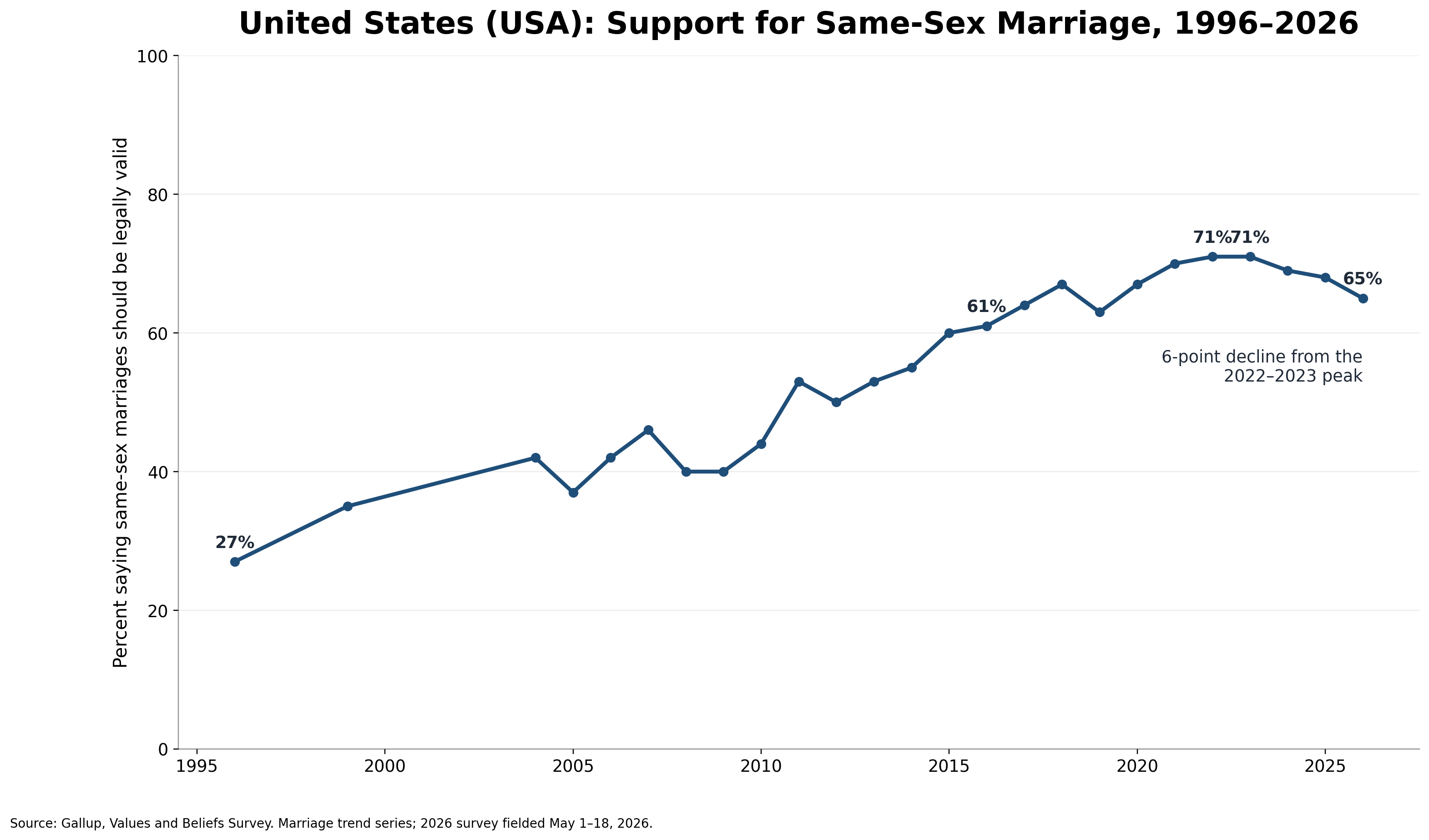
In May 2026 Gallup recorded 65 per cent support for same-sex marriage, six points below the peak of three years earlier. The share of Americans who considered gay or lesbian relations morally acceptable fell to 62 per cent, the lowest since 2016. Among Republicans the shift was considerably steeper: support for same-sex marriage, which had reached 55 per cent in 2021 and 2022, fell to 37 per cent in 2026. Among Democrats it held at 87 per cent.[3]
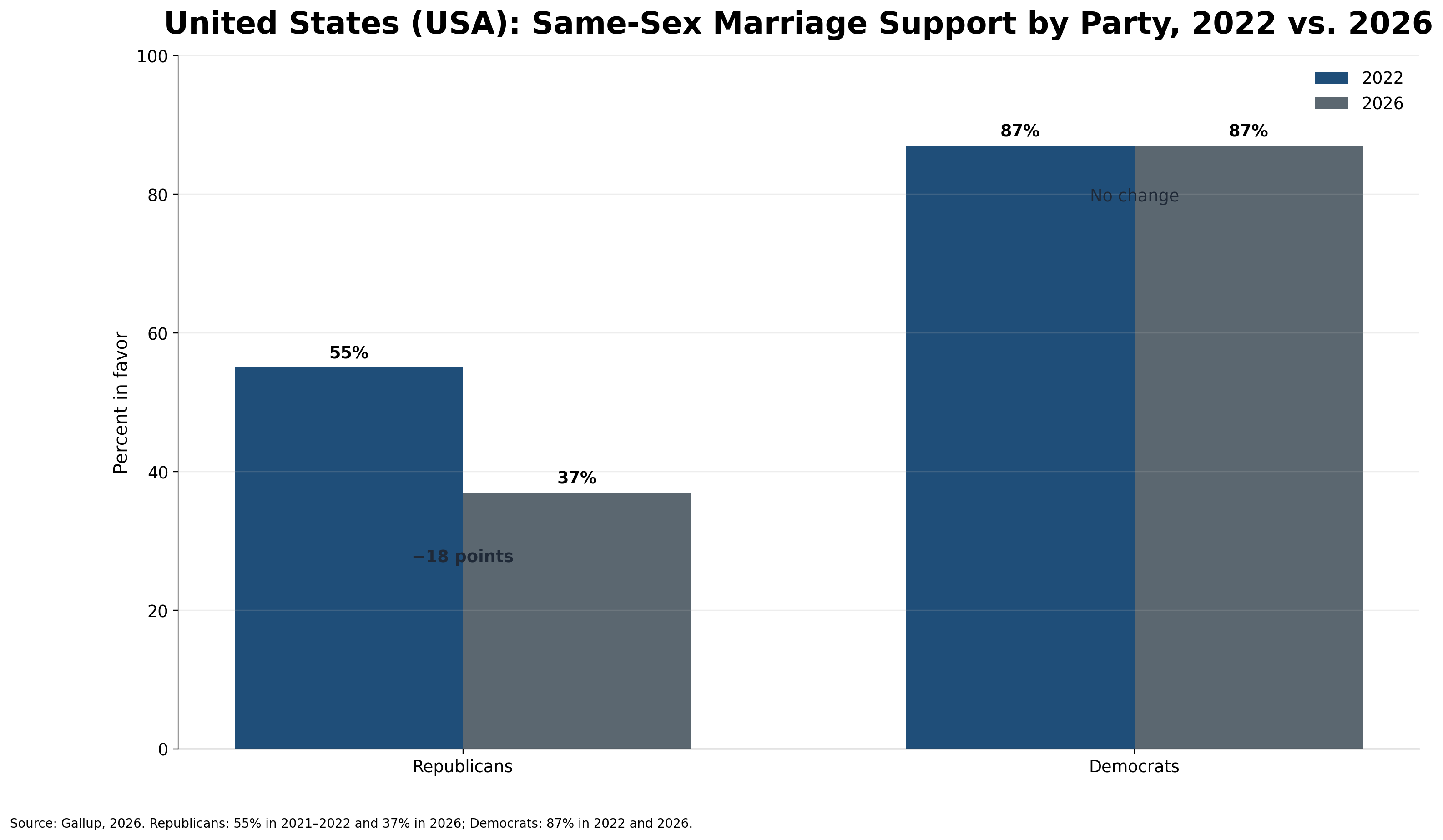
This is no mass return to 1996, and to claim otherwise would be pointless exaggeration. The United States remains far more favourable to same-sex marriage than it was a decade ago, and a majority still regards same-sex relationships as acceptable. What is interesting lies elsewhere: a trend that for twenty years seemed to advance of its own accord hit a ceiling and began to slip back just as the issues bundled under the LGBT brand were becoming markedly more contentious.
Opinion on trans policy follows a different curve. In 2025 Pew found that 66 per cent of Americans favoured requiring trans athletes to compete according to their sex at birth, and 56 per cent backed banning gender-transition medical care for minors. Since 2022, support for those two restrictions had risen by eight and ten points respectively. Nor was the shift confined to Republicans: among Democrats, support for banning such care for minors rose from 26 to 35 per cent, and support for sex-at-birth sports teams reached 45 per cent, up from 37 three years earlier.[4]
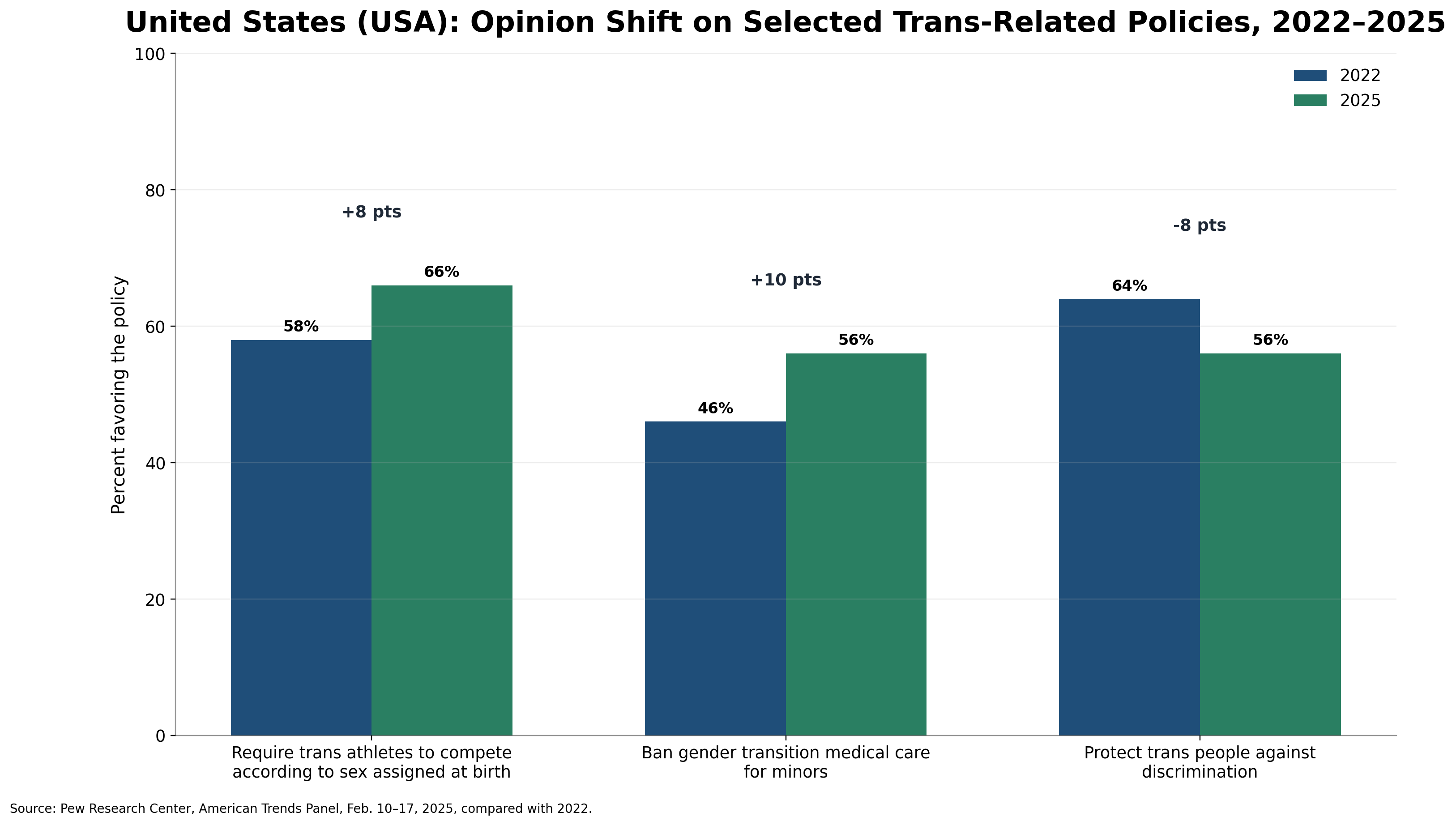
The same public that largely continues to accept same-sex marriage can reject policies promoted under the banner of LGBT rights, and can support protecting a trans person from being sacked while opposing certain medical interventions for a minor. Pew found exactly that combination: 56 per cent supported anti-discrimination protections for trans people, and 56 per cent supported banning transition care for minors.[4]
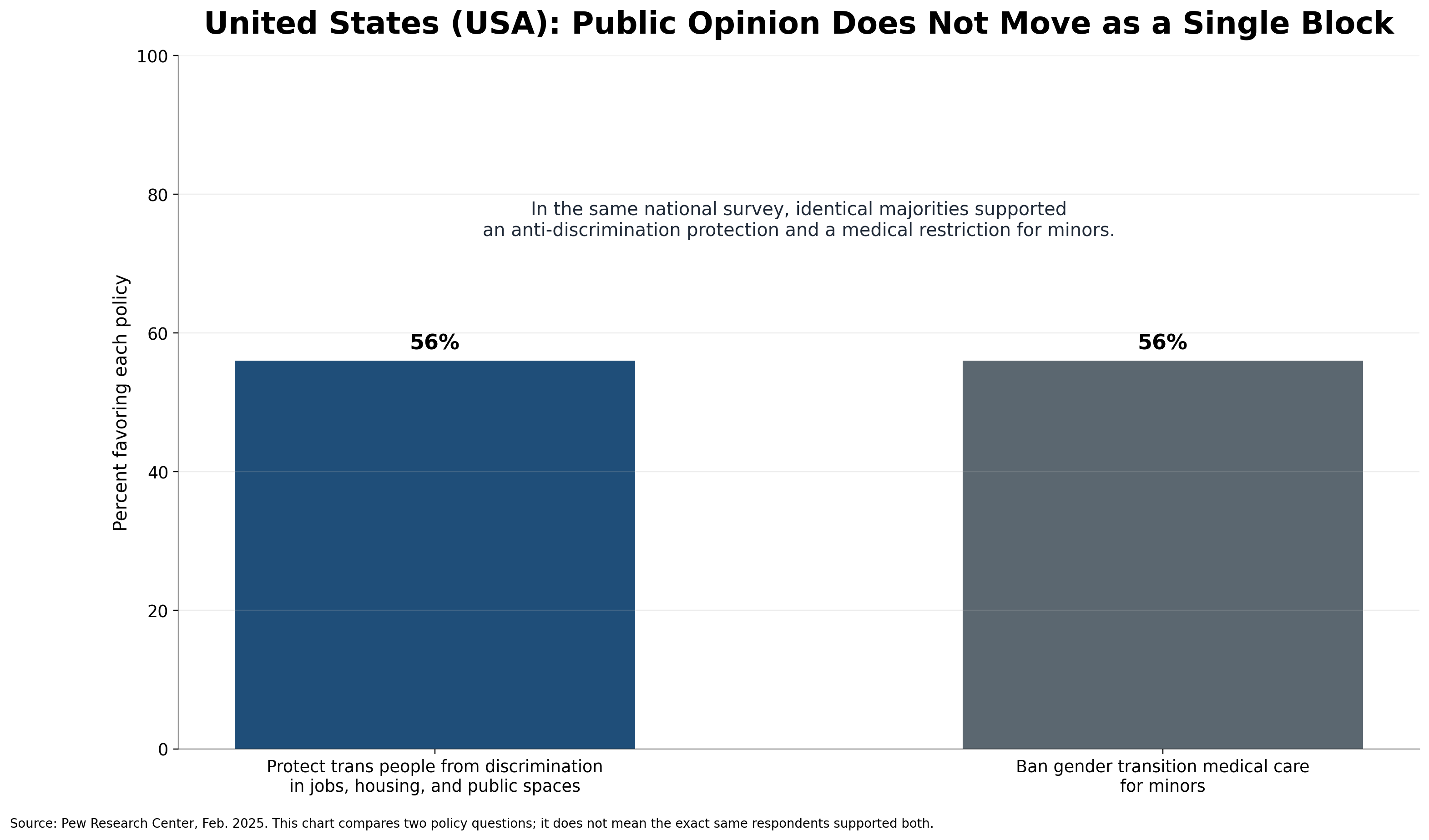
It becomes hard to keep presenting ‘LGBT rights’ as a single variable when the same citizen can support marriage between two men, protect a trans employee, reject hormones for minors and want women’s sport organised by sex. In the communications department it may all fit under one rainbow. In the voter’s head, apparently, it does not.
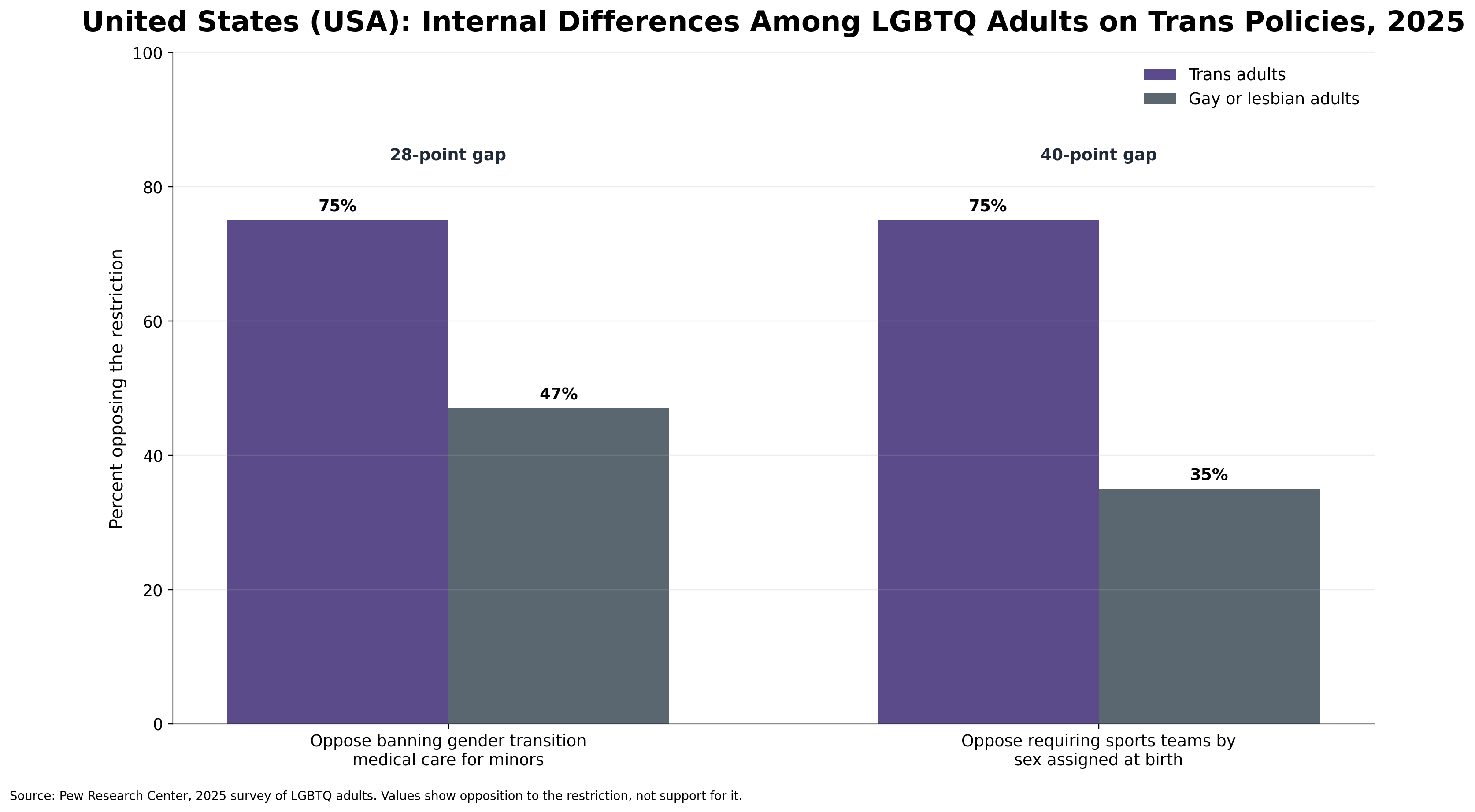
Even within the population gathered under the letters, the fractures are significant. In Pew’s 2025 survey, 75 per cent of trans adults opposed a ban on transition care for minors, against 47 per cent of gay and lesbian adults. On sport, 75 per cent of trans respondents rejected sex-at-birth teams, against 35 per cent of gay and lesbian respondents.[5] Calling these differences of emphasis within a shared doctrine would be generous: on some questions, forty points separate populations that institutional communications routinely present under a single acronym.
Recent history also offers a particularly ugly paradox. The homosexual movement won much of its public legitimacy by shrinking the area of conflict. Two adults wanted to build a life together, and nobody lost a right because they could. Decriminalisation took the state out of the bedroom; equal marriage extended an existing institution; anti-discrimination law stopped a private characteristic from serving as a licence to shut someone out of a job or a service. There were real debates behind each of those victories, but the core of the demand could be grasped without signing up to a general theory of society.
A considerable part of the programme now attached to LGBT works differently. It asks for decisions on who counts as a man or a woman in institutions organised by sex, on what language counts as discriminatory, on what schools must teach, on when a minor is competent to take part in medical decisions with lifelong consequences, and on what criterion should govern certain sporting categories. Each of these brings in third parties, institutions, competing goods and questions that simply did not arise when two adults asked the state to stop preventing them from marrying.
Throwing all of that into one bag and writing ‘rights’ on the outside confers a considerable rhetorical advantage: anyone who rejects any item in the package can be described as opposed to LGBT rights. It also runs up a bill. When claims are presented collectively, rejection can become collective as well. An organisation uses gays, lesbians and bisexuals to swell the political size of the subject it represents while promoting a policy on gender; if that policy meets resistance, the same gays, lesbians and bisexuals are still in the picture. The G adds authority on the way in and cannot vanish on the way out, which is the coalitional externality in its least abstract form.
Over decades, social capital accumulated around homosexuality. Neighbours discovered that the gay couple next door had failed to bring about the Apocalypse. Parents who had once feared for a son ended up getting to know his boyfriend. Equal marriage stopped being a theoretical threat and became two men arguing over who forgot the washing-up liquid. Normalisation did its work because everyday experience deflated fantasies far more spectacular than real life. That capital then began to be pledged as collateral for a much larger brand.
The strategy was understandable. If ‘gay rights’ had acquired legitimacy, folding new demands into ‘LGBT rights’ let them inherit part of it, and the historical continuity between persecuted groups did the rest. Every fresh controversy arrived with a ready-made analogy: you rejected homosexuals too; you also said gay marriage would destroy society; this is simply the next frontier of civil rights.
Analogies work until they start standing in for arguments. That a society was wrong to criminalise homosexuality does not show that it must accept every later policy championed by LGBT organisations. The past persecution of gays and lesbians settles nothing about puberty blockers, sporting categories or compelled speech. Marriage between two men is not a clinical trial whose results can be extrapolated to paediatric endocrinology. Yet for years, disagreeing with the new agenda could be presented as the old homophobia with a new victim.
The comparison also had a remarkable disciplinary power when turned inwards. The homosexual who departed from some position was no mere citizen with a different view; he was collaborating with the people who would once have stripped him of his own rights. The memory of persecution could thus be put to work securing obedience in the present.
The political effect of such a strategy deserves more than retrospective indignation. This series holds that bundling contributes to the current backlash, because it lets distinct controversies share a reputation. On its own it cannot explain the decline in the polls. Over the same years the United States went through intensifying partisan polarisation, organised conservative campaigns, court rulings, religious mobilisation and a presidency that made trans issues a national political theme. Attributing six Gallup points to a single cause would be astrology with a spreadsheet.
When a political brand insists for years that same-sex marriage, child transition, gender identity, sport, language and a growing list of policies are inseparable parts of one cause, it raises the likelihood that people who reject one part will reconsider their relationship with the brand as a whole. For bundling to ease that transfer, it need not be the case that everyone does so, nor that this is the only source of the retreat.
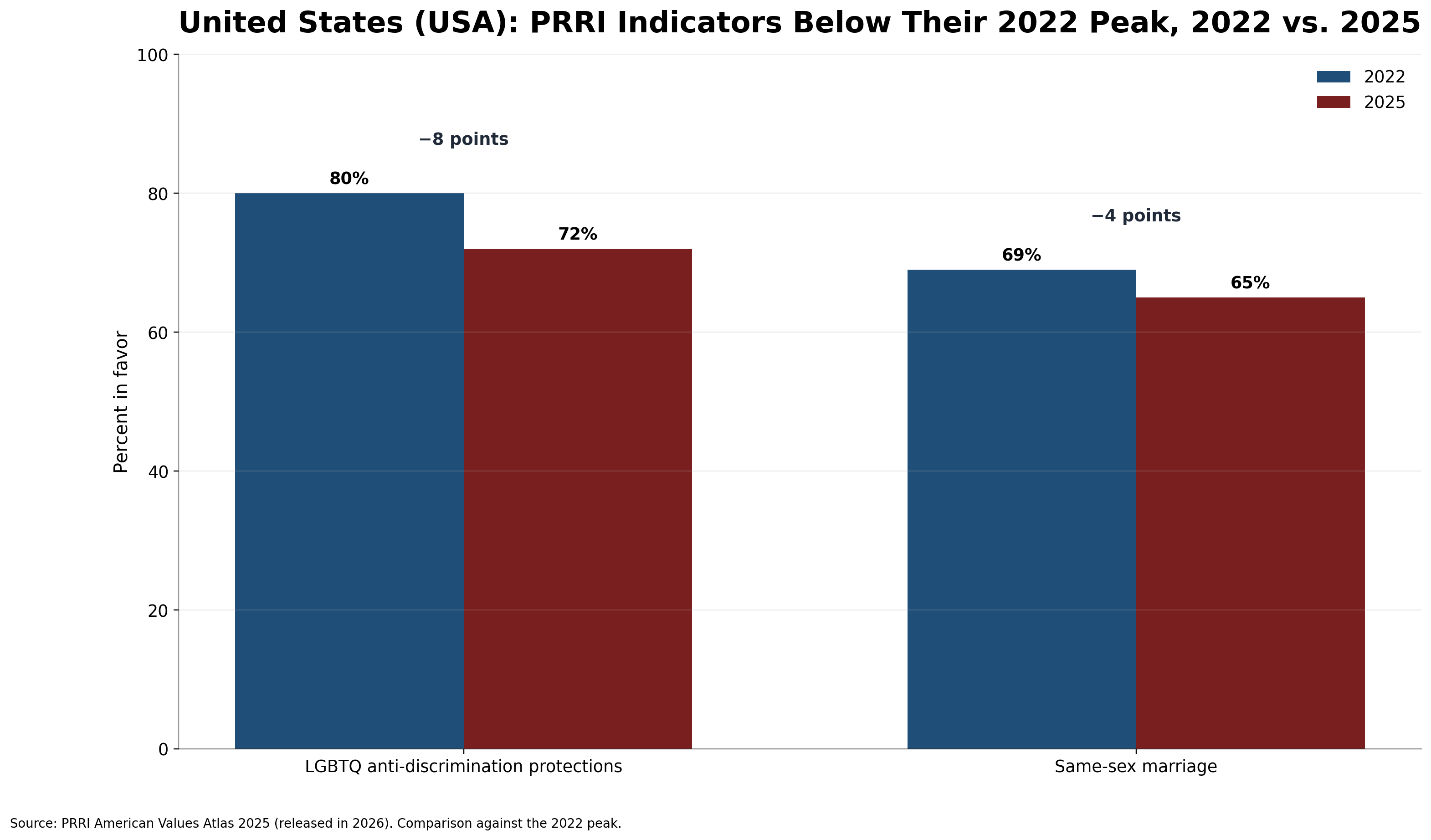
The recent data are consistent with that reading, because they show three movements at once: same-sex marriage keeps majority support; trans policies meet growing resistance, including among Democrats; and some general measures labelled LGBTQ rights have slipped from their peaks. PRRI found in 2025 that 65 per cent supported same-sex marriage and 72 per cent supported general anti-discrimination protections for LGBTQ people, both below their 2022 peaks though still above where they stood a decade earlier.[6] What the data show is a package beginning to come apart, with no sign of a retreat across the board.
That makes it especially unwise to answer the backlash by demanding still more internal conformity. When gays and lesbians say they do not share certain demands, treating them as traitors achieves the exact opposite of what an intelligent coalition would need: it hides information about where consensus has ceased to exist. The dissenter can act as an early-warning sensor, signalling before the polls do where the collective narrative has begun to crack.
He may be wrong, of course. He may also be seeing a fault line the bureaucracy cannot register because its meetings are full of people who have already adopted the institution’s vocabulary. A community that punishes dissent too hard ends up with superb statistics about itself, since everyone left in the room thinks alike. Then comes an election, a poll or a cultural backlash, and it looks as if the country went mad overnight. Perhaps it had been talking outside the meeting for years.
The usual response is to blame every setback on a reactionary offensive. The offensive is real and has identifiable actors, but making it the whole explanation grants the movement a rather childish historical innocence. Political opponents use whatever they find. An effective campaign picks examples that trigger intuitions already present, exaggerates some, invents others and repeats the most profitable until they are worn out. Handing an opponent particularly easy material and then being indignant that he uses it is a strategy roughly as sophisticated as leaving the keys in the ignition and complaining that the thief showed no respect for private property. An opponent’s responsibility for exploiting a controversy does not make the controversy sensible, nor does it oblige the homosexual to sacrifice his own credibility defending it.
Here, perhaps, lies the most uncomfortable consequence of the divorce this series proposes. Separating LGB from TIQ+ does not mean imagining they will never work together again. A coalition can come together over an anti-discrimination law, part company over a paediatric policy and reunite in the face of a common threat. That is how alliances between adults work, adults who need not pretend to an ontological kinship in order to share a cause. Permanent unity demands more obedience. Keeping it up means playing down disagreements, disciplining those who air them and presenting every new claim as the necessary continuation of the last. The movement ends up depending on a gay man who only wanted to live with another man discovering, every few years, a new political obligation retroactively written into his orientation. One day it was marriage; then came the pronoun and the minor, later the definition of woman. When he asks when exactly he signed up to the package, someone informs him that he was always included, because the flag had his letter on it. A G printed among other letters does not amount to power of attorney.
Homosexual acceptance was too hard won to be treated as free capital at the disposal of any subsequent doctrine. Those who wish to defend a given policy on gender identity are welcome to do so with their own arguments, their own evidence, their own organisations and their own names. If the arguments are good, they will not need to hide behind Stonewall or use two men’s marriage as a historical shield. If they are bad, the bill is not ours to pay.
The recent backlash has not taken the United States back to the world before Obergefell. It has shown something more instructive: no social consensus is acquired for good. In 2026 support for same-sex marriage still stood four points above 2016 and twenty-one above 2010, yet six below its peak.[3] A victory can consolidate for twenty years and then discover that the culture has not stopped moving.
It took homosexuals decades to convince much of the West of something fairly simple: two adults of the same sex could live, fuck, fall in love, marry or divorce without that difference giving anyone jurisdiction over their lives. It would be an irony of almost perfect stupidity if we lost part of that consensus because someone decided that, while we were at it, we had also voted as a bloc on everything else.
References
- Canada, Parliament (2017) Bill C-16: An Act to amend the Canadian Human Rights Act and the Criminal Code, S.C. 2017, c. 13. Available at: https://www.parl.ca/DocumentViewer/en/42-1/bill/C-16/royal-assent (Accessed: 29 September 2026). ↩ Back
- Ontario Human Rights Commission (n.d.) Questions and answers about gender identity and pronouns. Available at: https://www.ohrc.on.ca/en/questions-and-answers-about-gender-identity-and-pronouns (Accessed: 29 September 2026). ↩ Back
- Jones, J.M. (2026) ‘U.S. support for LGBTQ+ issues remains down from peak’, Gallup, 3 June. Available at: https://news.gallup.com/poll/710810/support-lgbtq-issues-remains-down-peak.aspx (Accessed: 29 September 2026). ↩ Back: a b
- Pew Research Center (2025) ‘Americans have grown more supportive of restrictions for trans people in recent years’, 26 February. Available at: https://www.pewresearch.org/short-reads/2025/02/26/americans-have-grown-more-supportive-of-restrictions-for-trans-people-in-recent-years/ (Accessed: 29 September 2026). ↩ Back: a b
- Pew Research Center (2025) ‘Most LGBTQ adults expect Trump’s policies to affect gay, lesbian, bisexual and trans people negatively’, 26 February. Available at: https://www.pewresearch.org/short-reads/2025/02/26/most-lgbtq-adults-expect-trumps-policies-to-affect-gay-lesbian-bisexual-and-trans-people-negatively/ (Accessed: 29 September 2026). ↩ Back
- Public Religion Research Institute (2026) ‘Mapping support for LGBTQ rights across the 50 states: insights from PRRI’s 2025 American Values Atlas’, 19 March. Available at: https://www.prri.org/research/mapping-support-for-lgbtq-rights-across-the-50-states-insights-from-prris-2025-american-values-atlas (Accessed: 29 September 2026). ↩ Back


Deja una respuesta