Back Then, It Was Us Fags Who Put Our Bodies on the Line
There was a time when we fags stood at the front and put our bodies on the line. Not because homosexuality somehow came bundled with revolutionary virtue, or because we all woke up one morning with a burning desire to become martyrs, but because we were the ones being arrested, fired, expelled, censored, institutionalized, beaten, and publicly marked.
Lesbians were hardly sitting this one out either. They had already spent decades organizing around women’s rights, feminism, abortion, reproductive freedom, and the role of women in society. They brought with them something the emerging gay movement badly needed: the accumulated experience of an already seasoned social movement.
The criminalization of homosexuality, police raids, Stonewall, AIDS, military exclusion, censorship, marriage equality, and decades of activism all had very concrete human subjects.
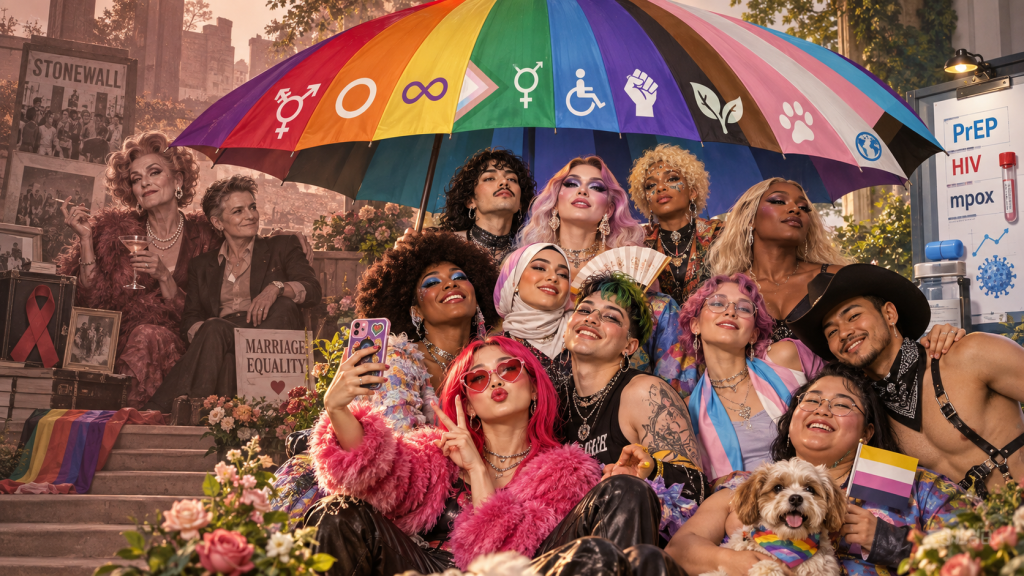
Whenever the LGBT movement tells the story of its origins, the photographs still come through in glorious high definition. They may have been fairy tales, but those fairies were very real. There we were: young, persecuted, defiant, heroic, dying, or dead, depending on which page of the family album happens to be open. We are still remarkably easy to find whenever there is a Pride Parade, a political campaign, or some large public mobilization under the collective acronym.
Things get blurrier once you leave the museum and start looking at how the present is actually administered.
We are still family. Nobody has removed our letters from the acronym, and we are still invited to Christmas dinner. We just started looking like that beloved drunk aunt. Everybody knows her. Everybody tells her stories and remembers her filthy jokes. Then, when it is time for the family picture, she is discreetly invited to sit in the back, safely away from the children and their rosy little cheeks.
My suspicion was simple. We were still doing the heavy lifting as history, crowd, and moral alibi, while becoming less and less necessary to name for the institutions claiming to represent us.
Personal suspicions are a funny thing. A hunch. A conviction. Excellent material for arguments on Twitter, perfectly adequate fuel for a cancellation campaign, and completely useless if you actually want to prove something about reality. So I did something unfortunate.
I started checking.
I collected 389 institutional headlines from ten major LGBT organizations across several countries between 2010 and 2026, reconstructed historical webpages through the Wayback Machine, coded the headlines by their primary subject, and had the beginning and end of the period independently recoded. Agreement on the LGB/non-LGB distinction reached 93.7%, with a Cohen’s kappa of 0.824. I also ran sensitivity analyses, compared public policies across countries, reviewed funding patterns, and carried out an institutional substitution test.
Relax, bitches. I am not going to torture you with Cohen’s kappa, coding rules, sensitivity tests, and all the other statistical paraphernalia. That is what the full academic paper attached at the bottom of this page is for, complete with methods, limitations, references, and all the juicy statistical mumbo jumbo required to establish that none of this was written on a cocktail napkin after the third shot of vodka.
I may be a distinguished cocksucker, but I know my way around a few variables and a spreadsheet.
What matters here are the magnitudes, and they turned out to be considerably less subtle than my original hunch.
Between 2010 and 2013, 72.3% of the thematic headlines in the original sample focused specifically on lesbians, gay men, bisexuals, or LGB subjects. By 2022–2026, that figure had fallen to 5.6%. When the two endpoint periods were independently recoded, the result barely moved: 74.5% at the beginning and 5.2% at the end.
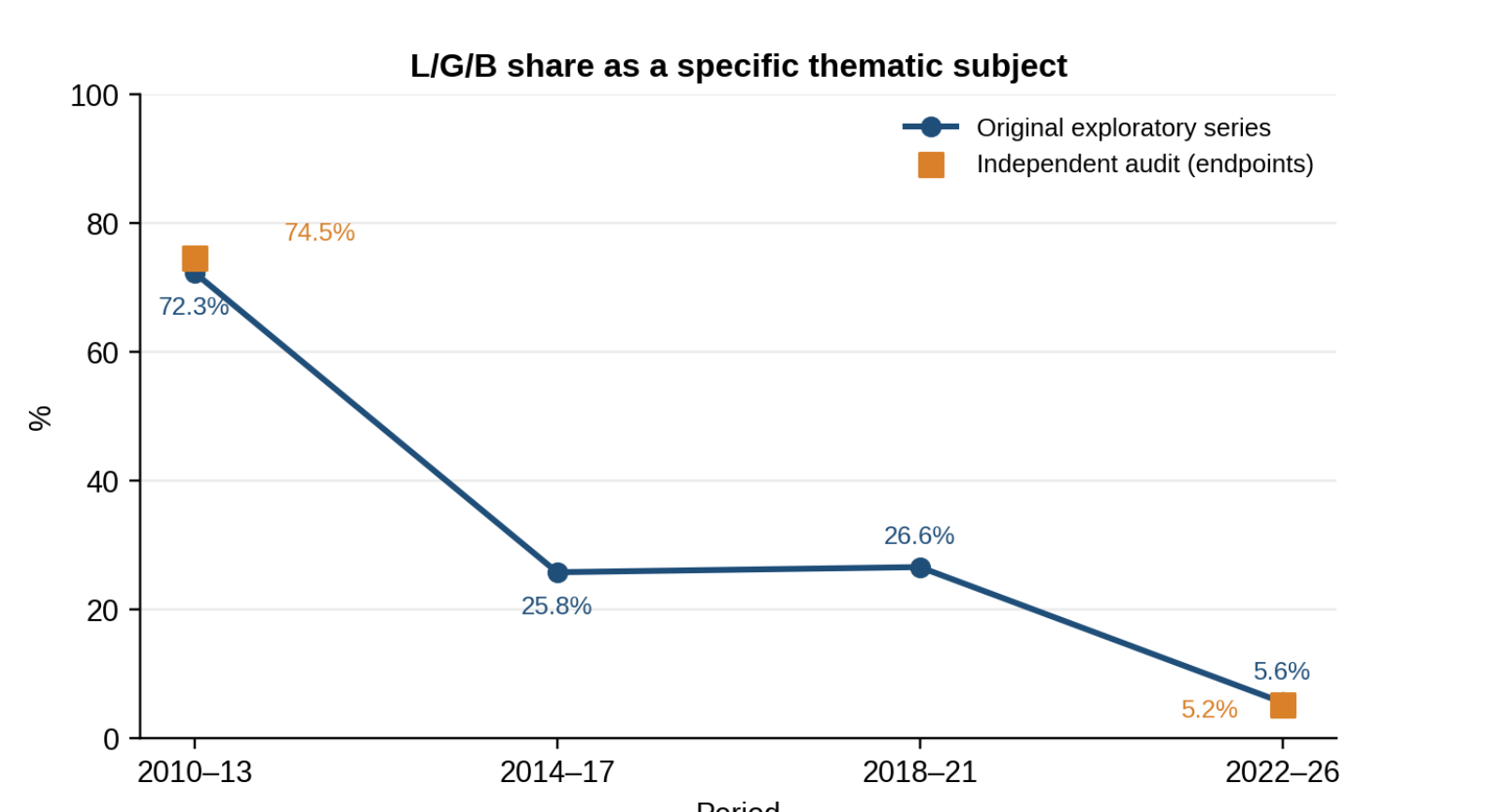
Three quarters became one twentieth. That is not erosion. That is a demolition with a press release.
The obvious explanation was that the early period coincided with the major legal battles around homosexuality: marriage equality, DOMA, civil unions, parenthood, fertility, and family recognition. So I stripped those issues out and checked again. Without marriage, DOMA, and civil unions, early LGB specificity still stood at 67.4%. Excluding parenthood and fertility-related material brought it down to 64.1%, still facing a contemporary figure of 5.2%.
Winning the major legal battles explains part of the decline. Explaining the rest takes a little more than pointing out that the fags are allowed to get married now.
Then the Umbrella Ate Us
My original hunch was wrong in one important way. I assumed that as lesbians, gay men, and bisexuals became less visible as distinct political subjects, the space would have been taken mostly by trans and nonbinary issues.
That is not what happened.
The really dramatic growth was in the catch-all category itself. General LGBT/queer language went from 18.2% of thematic headlines at the beginning of the period to 75.9% at the end.
That was the trick I had been missing.
We had not exactly vanished. We had been absorbed.
Once upon a time, an institution would talk about gay men, lesbians, bisexual people, gay rights, lesbian visibility, or a specifically homosexual political problem. Increasingly, one large word now does the heavy lifting: LGBTQ+. Or, when even that starts to feel embarrassingly specific, queer.
Everybody fits. Nobody needs to be unpacked.
It is the political equivalent of moving house, giving up halfway through, throwing everything into one enormous cardboard box, and writing MISC. across the top in black marker. Technically, nothing has been lost. Your passport, your grandmother’s photographs, three phone chargers, a frying pan, and the ashes of your dead cat are all safely in there somewhere.
Good luck finding them.
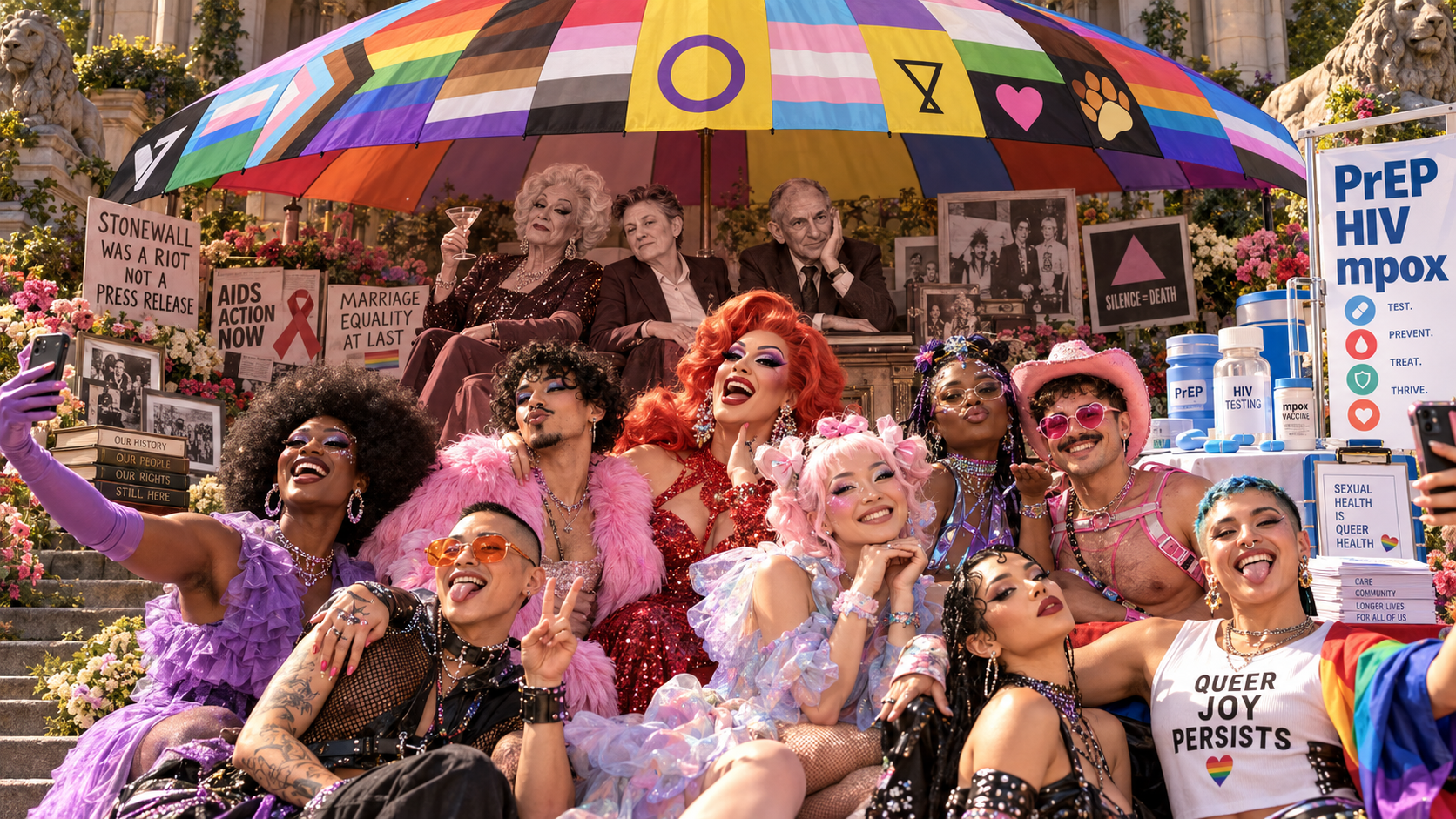
That arrangement would be merely annoying if everybody were being dissolved at roughly the same rate. But they are not.
Some groups live comfortably inside the large LGBTQ+ umbrella while also keeping a smaller umbrella of their own. A trans person can be part of the general LGBTQ+ constituency and still be the explicit subject of a trans-specific strategy, program, funding stream, advisory body, or campaign. The same can happen with Two-Spirit populations in Canada or intersex people under policies dealing specifically with sex characteristics.
Lesbians, gay men, and bisexuals increasingly seem to get the first layer and lose the second.
We are in the acronym. We are in the coalition. We are in the Pride Parade. We are in the fundraising email. We are in the historical montage with the black-and-white photographs and the tasteful piano music.
But when institutions start deciding who still needs to be named separately, things get selective.
In the academic paper I called this relative political de-specification, which sounds wonderfully respectable and probably deserves a conference badge.
In less respectable English, it means this:
You are still in the family. They have just been moving your chair farther from the table.
And the genius of the arrangement is that nobody ever has to throw you out. There is no dramatic expulsion, no villain twirling his moustache, no meeting where someone announces that the gays have been cancelled effective Monday morning.
You simply become increasingly unnecessary to mention.
That is a much cleaner disappearance.
And We May Still Be Most of the Damn Family
Here is where the whole arrangement becomes even stranger. Lesbians, gay men, and bisexuals still appear to make up a very large share of the population gathered under the ever-expanding acronym, although getting a clean number has become surprisingly difficult.
The 2021 Census of England and Wales recorded roughly 748,000 people identifying as gay or lesbian, 624,000 as bisexual, and around 165,000 under other sexual-orientation categories. Among respondents who reported an LGB+ sexual orientation, gay, lesbian, and bisexual people made up roughly 89%. Gender identity was measured separately, so a trans person could also be gay, bisexual, heterosexual, or something else entirely.
Gallup gives us another version of the same family portrait in the United States. In 2025, among adults identifying as LGBTQ+, 58.6% identified as bisexual, 17.4% as gay, 16% as lesbian, 12.1% as trans, and 5.8% used another LGBTQ+ identity. Those numbers cheerfully add up to more than 100%, because people can select more than one identity.
At this point, asking “what percentage of the community is actually LGB?” starts to resemble one of those pub quizzes where halfway through you discover that three answers are simultaneously correct and the quizmaster has changed the rules.
A trans woman can also identify as lesbian. A trans man can identify as gay. A nonbinary person can identify as bisexual. Someone can be queer, bisexual, nonbinary, and trans all at once, and the spreadsheet will accept the whole Christmas tree without so much as blinking.
Statistically, that is not necessarily an error. Conceptually, however, it changes what the categories are doing.
For most of the twentieth century, homosexuality was understood in a brutally simple way: attraction to members of the same sex. That simplicity was not always kind, but it was at least legible. Today, many surveys and institutions increasingly classify sexual orientation through identity labels that may be organized around gender rather than sex, while others distinguish identity, attraction, and behaviour as separate variables.
So when somebody throws an impressive number onto a rainbow infographic and announces that “X percent of the population is LGBTQ+,” I now have an annoying follow-up question.
What exactly did you count?
Did you count sexual attraction? Behaviour? Self-description? Gender identity? A mixture of all four? Did “gay” mean homosexual in the classical sex-based sense, or did it mean “a person who currently uses the word gay”? Those may overlap beautifully in many people. They are not conceptually identical.
The broader and more flexible the identity framework becomes, the harder it is to isolate the historical population that originally made “gay” and “lesbian” political categories in the first place.
We become easier to include and harder to count.
You can keep L, G, and B inside the acronym indefinitely while making the boundaries of L, G, and B increasingly porous. Eventually the letters remain perfectly visible while the population they once described becomes something of a philosophical crime scene.
And then comes the part that irritates me personally.
I strongly suspect that a very large proportion of gay men and lesbians still experience their sexuality primarily as attraction to sexed bodies rather than as attraction to an abstract category of gender identity. I cannot give you a clean percentage, because the large surveys I looked at generally do not isolate that question in a way that would let me answer it properly.
But culturally, the argument is already happening.
A gay man saying, “My homosexuality is about males,” can now find himself defending a proposition that twenty years ago would have sounded less like a political statement and more like the first line of a dictionary definition. In some activist spaces, saying that aloud can acquire the atmosphere of doctrinal heresy, as if Judas had left the Last Supper, downloaded Grindr, and sold the movement for thirty pieces of silver to whichever capitalist, colonialist, heterocispatriarchal empire happened to be open for business that afternoon.
The wider the political definition of our identity becomes, the less certain it becomes who exactly we are talking about when we say gay, lesbian, or bisexual.
The B: Huge in the Headcount, Missing at Checkout
Bisexuals deserve their own section because their political situation borders on administrative slapstick.
According to Gallup, bisexual is by far the most common LGBTQ+ identity in the United States: 58.6% of LGBTQ+ adults surveyed in 2025 identified as bisexual. In other words, if the acronym were a shareholders’ meeting, the B would appear to own half the company.
Then somebody opens the books.
In the 2024 national tracking of LGBTQ foundation giving in the United States, funding specifically earmarked for bisexual people amounted to well under 1% of population-specific funding.
It is an astonishingly efficient letter.
The B helps enlarge the acronym, inflate the demographic estimates, broaden the constituency, fill the Pride Parade, strengthen claims about the size of the community, and provide one more color in the great institutional rainbow. But ask for a policy, program, research agenda, or funding stream specifically concerned with bisexual people and suddenly the room acquires the acoustics of an abandoned cathedral.
You can practically hear the wind moving through the filing cabinets.
Part of the absurdity comes from the way the category itself has expanded. “Bisexual” once had a fairly transparent relationship to bi: attraction to both sexes. In the current identity ecosystem it may coexist with queer, nonbinary, panromantic, trans, gender-fluid, and any number of other descriptors, sometimes all living quite happily inside the same person.
At some point the B stopped being merely a sexual-orientation category and became a particularly accommodating piece of conceptual real estate.
Fine. Human beings are messy and spreadsheets have always suffered for our sins.
But that makes the political contrast even stranger. Bisexual people can be numerically enormous when the movement is counting its constituency and institutionally microscopic when the movement is deciding whose particular problems deserve a folder of their own.
And the same mechanism, in a milder form, affects gays and lesbians. Call a Pride Parade, a protest, an election campaign, a public statement, a fundraiser, or a grand defence of “our community,” and L, G, and B are immediately summoned back into existence. Plenty of us show up because we still understand ourselves as belonging to that political family, even when we spend half the dinner wondering who rearranged the seating plan.
Solidarity is wonderfully inexpensive.
Specificity, apparently, has a budget.
You can put your body into the crowd and still become decorative when the institution starts drawing boxes around who gets what.
When the Umbrella Opens Its Wallet
Political language can remain vague indefinitely. Money is much less philosophical.
Eventually somebody has to enter a number into a spreadsheet, attach a currency symbol, and decide which population gets its own line.
Funders for LGBTQ Issues tracked 5,043 grants from 445 foundations in the United States in 2024, worth US$178.2 million. Roughly 77% of that funding was classified as LGBTQ-general, while about 23% was directed toward specific populations.
So far, perfectly harmonious. Everybody under the umbrella, everybody getting wet together in a spirit of intersectional solidarity.
Then we look inside the population-specific portion.
Trans, gender-nonconforming, and nonbinary communities received US$33.3 million in specifically targeted funding.
Gay/queer men and MSM received less than US$6 million.
Lesbians and queer women received US$1.2 million.
Bisexual-specific funding, our demographic colossus from the previous section, sat comfortably below 1%.
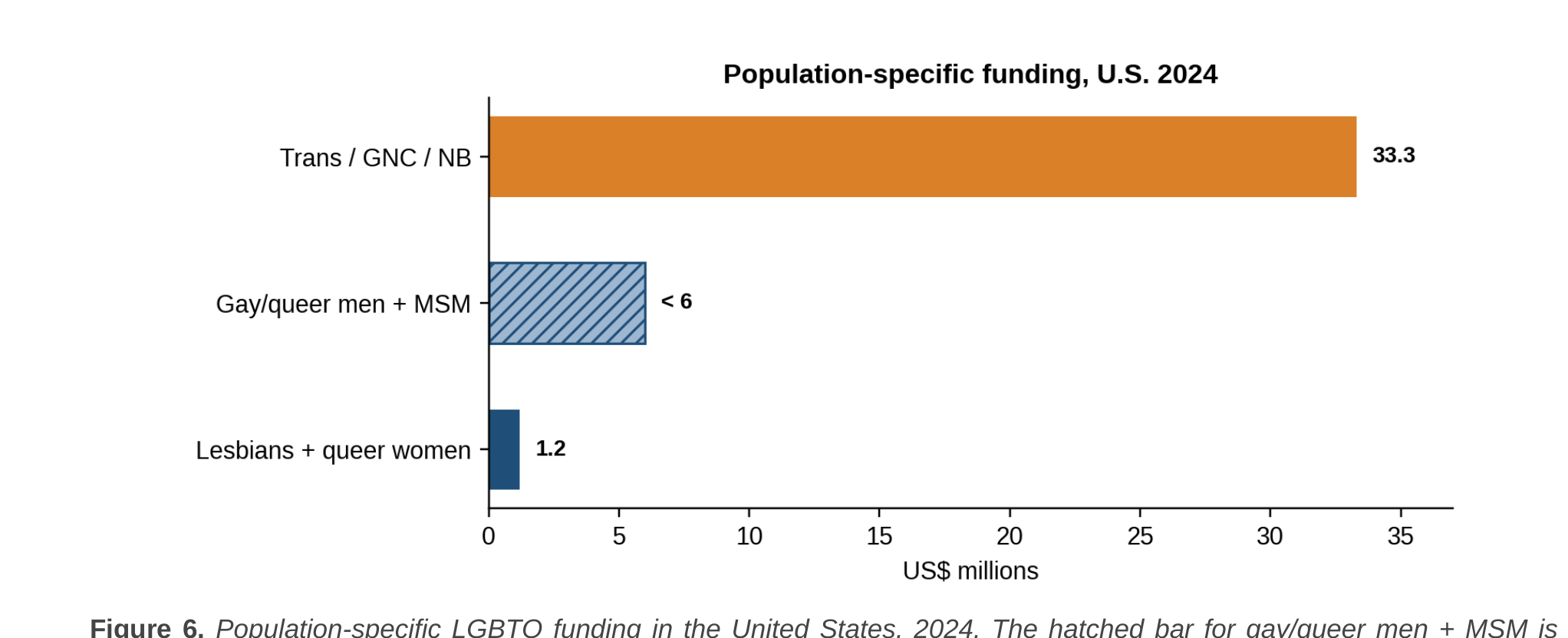
Even if I am extravagantly generous and combine gay men, MSM, lesbians, and queer women into one large L/G pot, the total still comes to less than US$7.2 million. Specific TGNCNBi funding was at least 4.6 times larger.
This is the moment when inclusion starts developing almost theological properties.
We are included in the US$178.2 million general pool. Absolutely. Nobody needs to call Amnesty International. The gays have not been left outside the building banging on the windows.
But when an institution decides that a particular population requires its own name, its own intervention, its own protected pot of money and its own administrative existence, some identities materialize far more successfully than others.
Apparently, the acronym is communal property.
The bank account has assigned seating.
Canada then performs roughly the same trick with public money. Women and Gender Equality Canada published a list of 106 federally funded 2SLGBTQI+ projects. Using the conservative coding rule from my study, I found 15 projects explicitly focused on trans, gender-diverse, Two-Spirit, or intersex populations, worth about CAD$7.21 million. Projects clearly focused on lesbians or gay/bisexual men numbered four, worth roughly CAD$898,000.
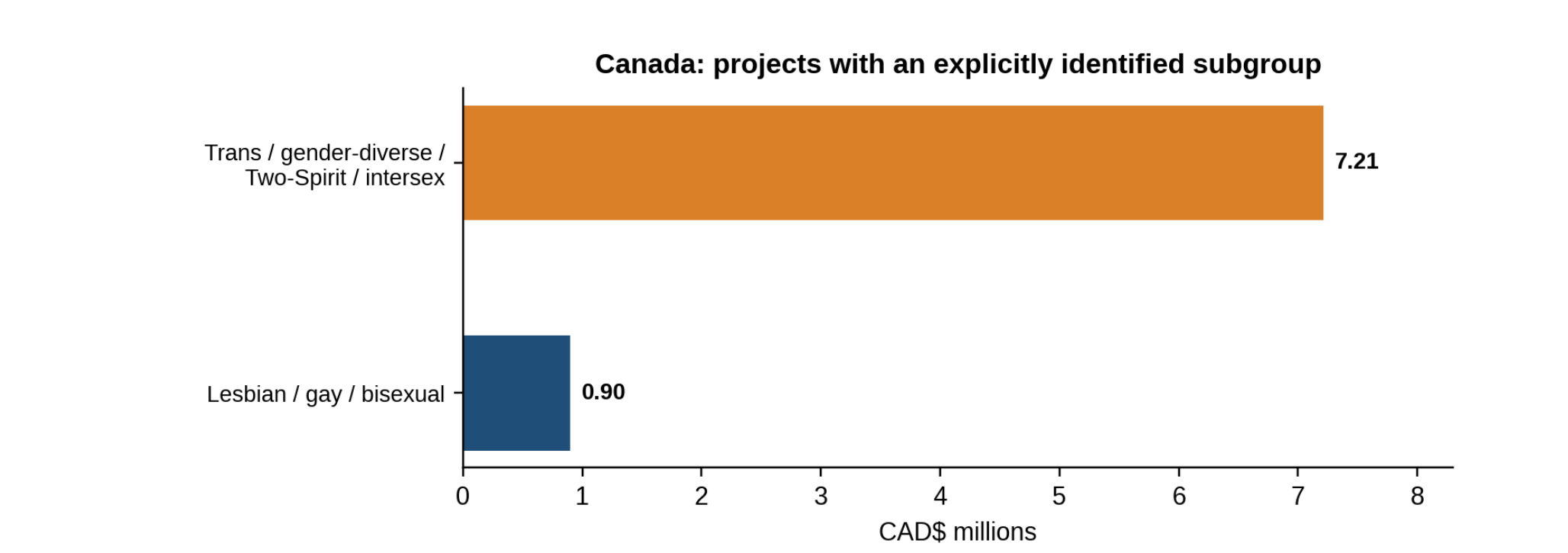
That is close to an eight-to-one difference.
At some point, repeating that everyone is “equally included under the umbrella” starts sounding like a family patriarch announcing that every child is equally loved while reading the will.
Perhaps they are.
But I would still recommend listening carefully when the lawyer starts naming beneficiaries.
Canada: How to Move Backwards Without Ever Leaving the Acronym
Canada deserves its own little chamber in this museum of administrative curiosities because it managed to turn the order of letters into an explicit political statement.
In 2022, the federal government adopted 2SLGBTQI+ in place of LGBTQ2. The Action Plan was perfectly candid about the reasoning: placing 2S at the front was meant to recognize Two-Spirit people as the first 2SLGBTQI+ communities and to place their experiences at the forefront of Canada’s reconciliation agenda with Indigenous peoples.
So this is not me reading tea leaves in the Ministry cafeteria. The government itself said the ordering mattered.
The modern term Two-Spirit emerged in 1990 at a gathering of Indigenous LGBT people in Manitoba. It was developed within Indigenous communities as a way of describing experiences of sexuality, gender, spirituality, and social role that did not fit neatly into imported European categories such as gay, lesbian, or trans.
A culturally specific term, born in a very particular historical and Indigenous context, now sits at the front of the official federal acronym used to describe an enormously broader political constituency.
The same political world that has spent years teaching everyone to be exquisitely careful about cultural context, colonial categories, appropriation, imposed language, and the terrible violence of flattening Indigenous experiences into Western concepts eventually placed an Indigenous cultural term at the front of a national administrative acronym covering millions of people who do not share that cultural background.
I am not even sure satire can improve on the paperwork.
And to be fair, Canada did not do this accidentally. The placement was deliberate, symbolic, and openly political. The whole point was to signal priority.
That is precisely why it interests me.
For decades, the L stood at the front of LGBT. Then the acronym expanded. More letters arrived. More categories became politically legible. In Canada, eventually even the order itself was redesigned to reflect a new symbolic hierarchy.
Nobody lost a civil right because the L got bumped to the second chair. The lesbian police did not arrive at dawn and confiscate anyone’s toaster.
But symbols are not meaningless simply because they are symbolic.
Institutions choose names. Governments choose ordering. Movements choose what appears first, what appears separately, and what can safely be assumed to remain somewhere inside the package.
Meanwhile, lesbians, gay men, and bisexuals are still absolutely there. We remain represented, included, welcomed, commemorated, and tastefully arranged somewhere further down the acronym, gradually acquiring the soft rose-petal tint of an old family photograph left too long in the sun.
Still visible.
Just increasingly sepia.
And perhaps that is the most elegant feature of the entire process. Nobody has to remove us from the picture. They only have to keep adding people in front.
Spain: The Victims Have Names. The Policies Have Preferred Pronouns.
Spain gives us one of the cleanest examples of why the usual explanation, “specific policies simply follow vulnerability,” starts wobbling once you look at the actual architecture.
Law 4/2023 created a general state strategy for LGTBI people and, separately, a specific state strategy for the social inclusion of trans people. Both strategies were approved for the 2025–2028 period. There is no equivalent national strategy specifically for gay men, lesbians, or bisexual people, although the law does contain concrete provisions affecting lesbian and bisexual women in areas such as assisted reproduction and parentage.
So far, that could still be explained as a sensible administrative response to different needs.
Then the decree begins listing who is actually getting hurt.
The preamble to Royal Decree 1034/2025, drawing on a FELGTBI+ report, identifies trans people and lesbian women among the principal victims of harassment. It identifies lesbian women and nonbinary people among the principal victims of discrimination. And when it comes to physical or sexual assault, gay men appear among the principal victims together with asexual people.
The lesbian can be specifically named when the State describes who is being harassed.
The gay man can be specifically named when the State describes who is being physically or sexually assaulted.
Then everybody gets changed into formal wear and escorted back under LGTBI when the architecture of policy is drawn.
A separate study from Spain’s Institute for Women surveyed 4,362 lesbian and bisexual women and found that 81.9% had experienced violence related to their sexual orientation, mostly verbal and psychological.
So the problem is hardly that lesbian victimization is too elusive to detect. The State can find it. It can measure it. It can put it in a report. It can cite it in the legal justification for public action.
The policy architecture includes a trans-specific strategy, a complete line of trans-specific actions, and a €60,000 named grant to Federación Plataforma Trans. Lesbian concerns appear inside shared lines or broader LGTBI structures.
The State can know your suffering by first name and still administer you by family name.
When the statistics describe the wound, gays and lesbians become wonderfully specific again. When policy decides which population requires its own institutional machinery, the specificity goes to somebody else.
You are individualized for the autopsy and collectivized for the treatment plan.
And Spain matters precisely because it complicates the easy moral story. If specific institutional treatment were simply a mechanical response to measured victimization, we would expect the architecture to map neatly onto the populations named in the evidence.
It does not.
Some people are named as victims and then remain under the umbrella. Others are named as victims and retain an additional institutional identity of their own.
The State, like every good maître d’, knows exactly who everyone is.
It simply has different tables reserved for different guests.
Pull Out a Few Letters and See What Still Stands
One of the simplest exercises in the study turned out to be one of the most revealing.
I took seven countries and asked a deliberately artificial question: what would remain if we removed one side of the specific institutional architecture and left the other standing?
Think of it as political Jenga, except instead of wooden blocks we are pulling out strategies, programs, legal instruments, grants, and institutional structures to see which side of the tower starts wobbling first.
When I removed the specific T/NB/I/2S instruments, non-biomedical L/G/B-specific infrastructure remained in only four of the seven countries. Germany was the strongest exception, with a comparatively substantial network of gay- and lesbian-specific services, research, organizations, and historical redress. In Argentina, Uruguay, and Portugal, I did not identify equivalent national LGB-specific infrastructure of that kind within the corpus reviewed.
Then I reversed the experiment.
I removed the L/G/B-specific instruments and looked at what was left.
All seven countries still retained specific T/NB/I/2S infrastructure.
That asymmetry is difficult to make disappear with good intentions.
The contemporary institutional structure can lose much of its specifically gay, lesbian, and bisexual architecture and still remain recognizably intact. Remove the other side and you immediately start taking out things governments, ministries, and organizations have decided require their own named structures.
You can call that prioritization, historical correction, differential need, institutional evolution, or whatever term gets you through the committee meeting without spilling the oat-milk latte.
The building still tilts in the same direction.
And the exceptions matter enormously because they prove that none of this was inevitable.
Germany retains meaningful gay- and lesbian-specific infrastructure. Brazil combines an expansive LGBTQIA+ framework with trans and nonbinary instruments while also maintaining explicitly lesbian initiatives, including LesboCenso.
So the usual bureaucratic shrug, “Well, the umbrella got bigger, what could we possibly do?”, does not survive contact with reality.
Apparently, one can recognize new populations without turning the old ones into archival wallpaper.
Who knew.
Broadening the coalition does not mechanically require dissolving LGB specificity. Some institutions chose to keep both. Others did not.
The blender was optional.
Don’t Worry, They Still Remember Our Asses
There is, however, one magnificent field in which the gay man continues to enjoy crystal-clear institutional recognition.
Epidemiology.
I conducted a targeted search for contemporary institutional material from 2023 to 2026 in which gay men, GBMSM, GBHSH, homens gays, schwule Männer, or equivalent categories were explicitly named as the subject.
I found 17 cases.
Eleven of them were connected to sexual health or sexual-health surveys: HIV, PrEP, sexually transmitted infections, mpox, chemsex, blood donation.
And suddenly the fog lifts.
When the subject is representation, institutional development, diversity strategy, or some grand declaration about equality, LGBTQ+ is perfectly adequate. Everyone can float together in the warm conceptual soup.
But the moment a public-health agency needs to work out who is most likely to need PrEP, who should be targeted for mpox vaccination, or which population warrants a chemsex survey, the category gay men snaps back into focus with the precision of a Swiss watch.
It is almost touching.
The State may occasionally struggle to remember us as a political subject, but it has no trouble whatsoever locating our rectums.
The fags still enjoy impeccable institutional specificity when somebody needs to do epidemiology on our asses.
And, inconveniently for anyone hoping I am simply objecting to targeted policy, I actually approve of that.
I am a physician. I would be spectacularly stupid to argue that public health should stop identifying epidemiologically relevant populations because broad umbrella language feels more inclusive. If gay men are disproportionately affected by HIV, mpox, particular STI patterns, or chemsex-related harms, then gay men should be named.
That is how useful categories work.
Which is precisely why the contrast is so revealing.
The institution clearly retains the ability to distinguish us. It has not forgotten what a gay man is. It simply deploys that precision selectively.
Our political identity can blur into LGBTQ+.
Our anus remains available in 4K.
Which raises the obvious question. If gay men are specific enough to justify separate attention for PrEP, HIV, mpox, chemsex, and blood-donation policy, at what point do we become too conceptually vague to warrant distinct attention for loneliness, ageing, violence, mental health, community formation, social isolation, or the peculiar problems of gay male life?
The administrative eyesight is clearly functioning.
It just seems to improve dramatically below the waist.
Uruguay: Memory Has Its Own Guest List
Uruguay gives the whole question a more intimate twist because some of the people behind these policies are not abstractions to me.
The Tarjeta Uruguay Social began specifically including trans people in 2012, and Law 19.684 of 2018 later created employment quotas, educational measures, scholarships, and a reparations scheme for trans people born before December 31, 1975 who had suffered institutional violence or imprisonment connected to their gender identity.
I think that policy was extraordinary.
And I mean that sincerely.
The number of people who qualified for reparations was tiny, fewer than a hundred, and I have known some of them personally. These are not theoretical victims invented by a diversity office trying to justify next year’s budget. They are people whose biographies carry the fingerprints of the State itself.
The State had used its coercive power against them.
The least it could do, decades later, was have the decency to remember their names.
A reparations law does something far more important than transfer money. It officially identifies a population as the specific historical subject of an injustice. It tells the archive: this happened to these people, and the State did it.
That kind of recognition matters.
Which is why I became curious about the other stories in the same archive.
Within the corpus I reviewed, I did not find an equivalent national reparations mechanism specifically for gay men or lesbians persecuted because of their homosexuality.
And Uruguay certainly does not lack those stories.
There are accounts of lesbians subjected to sexual violence by men convinced they could “straighten them out.” There were homosexual political prisoners whose sexuality added another layer of humiliation to imprisonment. There were men and women whose experience of State repression did not fit neatly into the later institutional vocabulary of diversity.
That deserves its own investigation, and I suspect I will eventually fall down that rabbit hole too, because apparently being a vintage fag now comes with archival responsibilities.
But the distinction already matters.
One history received a specific legal subject.
Another survives mostly inside the broader memory of sexual diversity.
Both can be real. Both can be horrific. Yet only one is formally carved into the legal architecture as a distinct population entitled to reparation.
Memory, it turns out, also has filing categories.
And once a State decides which suffering gets its own folder, history stops being merely about what happened.
It becomes about who gets remembered in bold.
History in the Front Row, Policy in the Back
LGB people still perform an extraordinary amount of political labour for the broader movement.
Our persecution supplies a large part of its moral genealogy. Our numbers help give Pride its scale. Our votes matter. Our bodies fill demonstrations. Our dead populate the memorial speeches. Our legal battles provide the timeline. Our letters survive inside nearly every version of the acronym, no matter how many additional characters get attached before the whole thing starts looking like the factory password on the back of a Wi-Fi router.
We remain extremely useful when the movement needs a past.
Things become less straightforward when the movement has to allocate a present.
That is when the question shifts from “who belongs to this history?” to “whose contemporary problems still deserve an institution with their name on the door?”
A gay man can still be invoked as part of Stonewall, AIDS activism, marriage equality, criminalization, censorship, military exclusion, or decades of social persecution.
Try getting the same institutional enthusiasm for a program that simply says: this is for gay men.
A lesbian can remain central to the movement’s historical memory and still find her present-day problems folded into a broader LGBTQ+ framework.
Bisexuals can apparently be half the guest list and still struggle to locate the room where somebody is discussing bisexual-specific policy.
Somewhere along the way, LGB became a kind of inherited political capital.
The movement still draws legitimacy from our history, numbers from our presence, and emotional power from our dead.
But increasingly, when the paperwork reaches the present tense, our particular problems are expected to fit inside the general folder.
That is a very peculiar kind of success.
We fought for decades to stop being treated as pathological, dangerous, criminal, sick, immoral, or socially defective. We won enormous parts of that battle.
And now, in certain progressive political cultures, the reward appears to be that we have become too normal to require much specific attention.
Too assimilated.
Too integrated.
Too familiar.
And, depending on the room, perhaps too easily filed under white, cis, male, privileged, or some combination thereof before anyone even gets around to asking whether the actual problem being discussed has anything to do with those labels.
We went from social threat to embarrassing relative with astonishing efficiency.
At first the family wanted us gone. Then it learned to love us. Now it is apparently confident enough in that love to stop asking whether we need anything.
That may be the strangest political promotion I have ever received.
Maybe Privilege Means Nobody Has to Name You Anymore
There are perfectly reasonable explanations for part of this decline, and I did consider them, because cheating at solitaire is still cheating even when you are playing alone.
Gay and lesbian politics won some enormous battles. Marriage equality, family recognition, anti-discrimination protections, military service, adoption, legal recognition of same-sex couples: victories have consequences. Once a political demand is settled, it stops generating the same quantity of campaigns, lawsuits, headlines, and emergency meetings.
Organizations also grew. Coalitions expanded. A general term such as LGBTQ+ is administratively convenient when you represent a constituency containing more categories than a particularly ambitious tax form.
All of that matters.
It just does not explain enough.
Even after stripping marriage, DOMA, civil unions, parenthood, and fertility-related material out of the early period, LGB-specific content remained above 64%. The contemporary figure was still around 5%. Germany and Brazil also show that an institution can recognize newer political subjects without reducing gays and lesbians to historical background radiation.
So something else appears to have happened alongside legal success and organizational expansion.
Within parts of contemporary progressive politics, vulnerability itself has developed a hierarchy. Some identities carry a strong presumption that their difference must remain politically visible, separately named, separately funded, and institutionally protected. Gay men and lesbians, meanwhile, can increasingly be treated as sufficiently assimilated, sufficiently normalized, perhaps even sufficiently privileged, that the general umbrella should be enough.
In some rooms the transformation is almost comic.
You spend half a century being told you are diseased, deviant, predatory, sinful, dangerous to children, unfit for military service, incapable of marriage, incapable of parenthood, and probably responsible for the collapse of Western civilization.
Then you win a few court cases.
Suddenly you are establishment.
Congratulations, faggot. Your oppression has expired.
Apparently, social acceptance came with fine print.
First you fight to stop being treated as an abnormality. Then you win rights. Then you integrate. Eventually your integration itself becomes evidence that your problems no longer require quite so much naming.
The fags won the prize for good historical behaviour.
Political success does not merely solve problems. It can also change the moral category into which a population is placed.
Yesterday’s persecuted minority becomes today’s relatively normalized group, and today’s relatively normalized group becomes tomorrow’s vaguely embarrassing reminder that minority politics does not always move in one direction forever.
You become the uncle who survived the war and is now expected to stop mentioning it at dinner.
The medals are still in the drawer.
Nobody is particularly interested in funding a new shelf for them.
The Back Row
When I began this work, I had a fairly simple feeling: the movement I had learned to think of as my own seemed increasingly uninterested in talking about people like me except when it needed to talk about its past.
Then the numbers arrived, which was terribly inconsiderate of them.
LGB-specific thematic headlines fell from roughly three quarters of the material at the beginning of the period to roughly one twentieth at the end. Independent recoding reproduced the shift. Most of the space was absorbed by general umbrella language. In the seven-country substitution test, specific T/NB/I/2S infrastructure remained standing in all seven countries after removing L/G/B-specific instruments, while non-biomedical L/G/B-specific infrastructure survived in only four.
In US philanthropy, specifically targeted TGNCNBi funding in 2024 was at least 4.6 times greater than funding specifically directed to gay/queer men and lesbian/queer women combined. In my coding of Canadian federal projects, the difference was close to eight to one. Bisexuals, meanwhile, can constitute the largest identity group in an LGBTQ+ survey and still receive less than 1% of specifically targeted US philanthropic funding.
At the same time, even answering the question “How many LGB people are there?” has become conceptually messy.
Some surveys measure identity. Others measure attraction. Others behaviour. Sex and gender move in and out of definitions like Pokémon cards being traded during recess, and several categories can occupy the same respondent at once.
Yet through all that conceptual fog, the institutions remain perfectly certain about one thing.
We are still part of the community.
Lovely.
But I am increasingly interested in what being part of the community actually buys you when your history remains available, your letter remains in the acronym, your body remains useful for the crowd, and your existence remains useful for the demographic total, while your visibility as a separately named political subject keeps shrinking.
You do not have to leave the family photograph in order to disappear from it.
You only need to be moved backwards a little at a time.
Lower the saturation.
Soften the contrast.
Apply a tasteful dusty-rose filter.
Keep adding brighter figures to the foreground.
Eventually the people who once occupied the centre of so many old photographs are still technically there, just pale enough that nobody notices how far back they have gone.
The beauty of it is that everyone can truthfully insist that nobody was excluded.
Nobody tore us out of the picture. Nobody crossed out the G. Nobody officially announced that lesbians were now surplus to requirements or that bisexuals had been transferred to the Department of Decorative Letters.
We were simply absorbed into something larger, increasingly spoken for through it, and gradually asked to understand our political invisibility as proof of successful inclusion.
And if one day somebody has trouble finding us in the photograph, I am not worried.
Public Health will know where we are.
Eventually there will be a PrEP campaign, an mpox outbreak, an HIV statistic, or a chemsex survey, and suddenly the gay male population will materialize once again in magnificent administrative focus.
The political subject may fade.
The ass remains fully indexed.
At the bottom of this page you will find the full academic paper in English and Spanish, complete with methods, sensitivity analyses, independent coding, primary sources, limitations, references, and all the respectable apparatus required to behave properly in public.
That is the well-mannered version.
This is the one I needed to write.
The Well-Mannered Version
For methods, coding, sensitivity analyses, primary sources, limitations, references, and all the statistical behaviour expected in polite society, the complete academic paper is here below.


Deja una respuesta