
Philosophy Kombat, in four rounds and a fatality.
Last night Simone de Beauvoir showed up in my dream holding a Super Nintendo controller. She wanted a rematch. Here’s what happened.
In July 2026, Mexico’s president sent the Senate a General Law Against Femicide. Article 6, section VIII, reads: “Woman: any person who identifies as a woman.” In a criminal law that exists to protect women from being killed for being women, a woman is defined by how she sees herself.
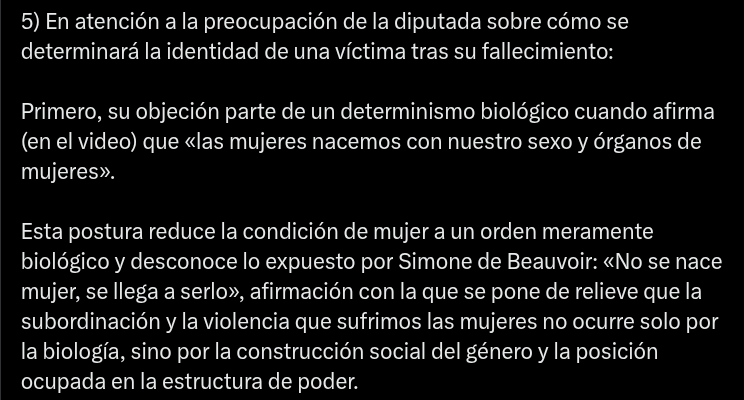
In September, a congresswoman asked the obvious question: how do you establish the self-identification of a victim who is already dead? An activist answered her with a long thread. She cited the UN women’s rights committee (CEDAW) and the Inter-American Court of Human Rights, and in point five she reached for the usual line. She accused the congresswoman of “biological determinism” for saying women are born with a sex, and reminded her of Simone de Beauvoir: “One is not born, but rather becomes, a woman.”
Nobody reads the next sentence. Here it is in the original French:
“Aucun destin biologique, psychique, économique ne définit la figure que revêt au sein de la société la femelle humaine ; c’est l’ensemble de la civilisation qui élabore ce produit intermédiaire entre le mâle et le castrat qu’on qualifie de féminin.”
And in English (my translation):
“No biological, psychological, or economic fate defines the shape the human female takes in society; civilization as a whole produces this intermediate creature, between male and eunuch, that we call feminine.”
Read it again and look at two things. First, who becomes a woman: the human female. Beauvoir isn’t talking about anyone who identifies as one. Second, what makes her become one: civilization as a whole. There’s no inner, individual feeling anywhere in that sentence. For Beauvoir, “becoming” comes from outside and presses down on a body. That’s the exact opposite of self-identification. The line was used to defend that definition, and it says the opposite.
The activists aren’t the only ones misreading her. Their critics get Beauvoir wrong too, just with the sign flipped. To see why, we have to go back to 1986, to Judith Butler, and to a Finnish philosopher who showed in 1997 that Butler had been fighting a Beauvoir who never existed.
Here’s the fight, round by round.

ROUND 1: The Anachronism

(or how to beat someone with a weapon that hadn’t been invented yet)
Dates first, because without dates philosophy turns into astrology.
The Second Sex came out in 1949. “Gender” in the sense you now hear in every diversity training, as something separate from sex, entered scientific vocabulary in 1955, when psychologist John Money at Johns Hopkins started talking about “gender roles.” Robert Stoller made it official in 1968 with a book bluntly titled Sex and Gender. When Beauvoir wrote her most famous sentence, the sex/gender distinction didn’t exist. She didn’t reject it. She just didn’t have it. In French, genre was a grammar term. Beauvoir writes sexe, femme, féminin, féminité. What she doesn’t write is what everyone now has her saying.
It’s worth stopping on where the word came from. Modern “gender” wasn’t born at a protest or in a philosophy seminar. It was born in a clinic, as a way to decide what intersex babies were going to be, with surgery and without asking them. The word now sold as a synonym for freedom started out as a tool for assigning people. It’s the same John Money of the David Reimer case. We’ll get to that another time, because Butler ended up writing about Reimer too.
In 1986, Judith Butler published an article in Yale French Studies called “Sex and Gender in Simone de Beauvoir’s Second Sex.” The title gives the game away. She went looking in Beauvoir for a distinction Beauvoir didn’t have, and of course she found it. Wear tinted glasses and everything comes out that color. In her reading, “becoming a woman” turns into a project: a subject who somehow takes on, adopts, almost chooses a gender on top of a given sex. Four years later, in Gender Trouble, Butler went further and faulted Beauvoir for not going all the way, for leaving a natural sex underneath gender and a Cartesian subject who puts gender on like clothing.
Look at the move. First you credit an author with a tool she never had. Then you fault her for using it badly. It’s like blaming Hippocrates for not ordering a CT scan and concluding he was a negligent doctor. Butler didn’t beat Beauvoir. She beat a Beauvoir translated into Stoller’s vocabulary.
And speaking of translation, here’s a detail English-speaking feminism would rather not look at. The English line, “One is not born, but rather becomes, a woman,” the one on the mugs, the T-shirts and the Twitter bios, wasn’t written by Beauvoir. It was written by her 1953 translator, Howard Madison Parshley, a zoology professor at Smith College whose specialty was Heteroptera. For those of you who, like me, skipped entomology: Heteroptera are true bugs. So the holiest slogan of gender theory in English was worded by a man who spent his career on bugs. No wonder the translation has so many of them. And it’s a nice touch that his field starts with hetero. If the activists ever find out, they’ll demand his posthumous cancellation for heteronormativity. Parshley died in 1953, the year his translation came out. He never got to see what people did with his sentence. Maybe that was a mercy.
To see how far this has spread, I ran a test. I typed little more than Beauvoir’s name into Google. No “gender,” no “woman,” no “identity.” The AI summary helpfully informed me that The Second Sex established “the distinction between biological sex and socially constructed gender.” That’s the anachronism from this very round, served up by a search engine: a distinction that took hold in the 1950s and ’60s, credited to a book from 1949. And it isn’t a fluke. Search “Merleau-Ponty and Beauvoir” and the summary tells you she “applied this to gender.” Butler’s reading doesn’t need Butler anymore. It comes preinstalled.

Round 1 goes to Beauvoir. Butler’s still standing, but her lip is bleeding.
ROUND 2: Describing Is Not Theorizing
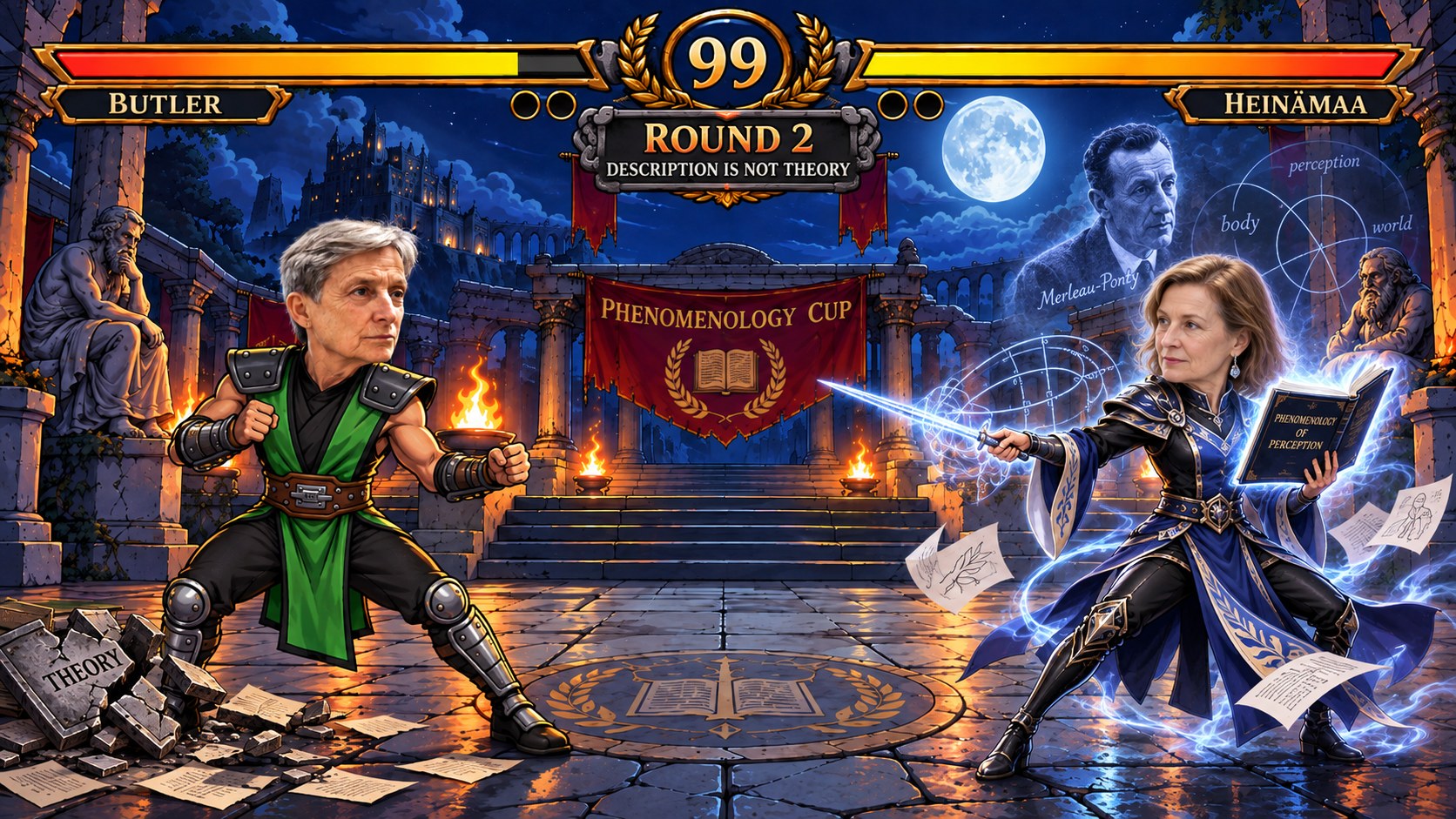
(enter a Finnish philosopher who actually read Husserl)
Here comes our fighter. Sara Heinämaa is a Finnish philosopher who specializes in Husserl and Merleau-Ponty, the kind of scholar who reads phenomenology in German and French, not off a PowerPoint slide. In 1997 she published an article in Hypatia, one of the leading journals of feminist philosophy, with a title that lands like a punch: “What Is a Woman? Butler and Beauvoir on the Foundations of the Sexual Difference.” Her abstract contains the line that frames the whole fight: “Instead of a theory, Beauvoir’s book presents a phenomenological description of the sexual difference.”
It sounds like a fine point. It isn’t. It pulls the floor out from under Butler.
A theory explains: it looks for causes, mechanisms, where something comes from. A phenomenological description explains nothing. It describes how something shows up in experience, what it means to live it. Butler read The Second Sex as a theory of where gender comes from, of how a given sex turns into a constructed identity. Heinämaa shows that Beauvoir never asks about causes. She asks what it means to be a woman, a female, feminine, in the lived experience of a body.
If you’ve ever been near a hospital, here’s the short version: Butler mixed up symptoms with causes. Beauvoir took the patient’s history. She described how the condition presents and how it’s lived. Butler read that as a theory of the underlying disease, then blamed Beauvoir for a cause she never proposed. It’s like reading a doctor’s intake notes and accusing him of having the wrong theory about what causes fever.
The philosophy behind this is Husserl’s. German has two words for the body. Körper is the body as a thing, the one the anatomist weighs and measures. Leib is the lived body, the body through which I have a world at all. Merleau-Ponty built on that idea in Phenomenology of Perception in 1945, four years before The Second Sex, and Beauvoir knew it firsthand: they’d been friends since they were young. In a second article, in 1999, Heinämaa argues that this is exactly Beauvoir’s philosophical starting point, the phenomenological understanding of the lived body. That’s how Beauvoir can write that the body isn’t a thing but a situation without denying biology. In fact, The Second Sex opens with a long chapter on “the data of biology.” Beauvoir doesn’t deny those facts. She says they aren’t enough to settle what a woman’s life means, because a woman’s body is always lived in a situation.
And this is where the fight gets funny, because Beauvoir knocks out both corners with the same move. The activists who quote her against “biological determinism” never read the biology chapter. The critics who say “she’s born female and gender gets built on top” are reading Butler’s Beauvoir with the sign flipped. And Butler read a book of phenomenology as if it were a constructivist manifesto.
Round 2 goes to Beauvoir by a wide margin. Butler’s having trouble finding her corner.
ROUND 3: Becoming Is Not Choosing
(the punch Butler never saw coming because she was busy rehearsing)
Now we’re at the heart of the fight. What does it mean to “become” a woman?
In her 1986 article, Butler reads it through Sartre. Becoming a woman would be a kind of choice. Not a deliberate pick from a catalog, but a choice all the same, a project the subject takes on. In 1990, with Gender Trouble, she changed costumes but kept the same play. Gender became performative: repeated acts, gestures and norms that create the illusion of an essence, with no one behind them doing it. First there was a subject who chose. Then there was a performance with no performer. Beauvoir’s lived body doesn’t show up in either version.
Heinämaa offers another reading, and she draws on an idea from Merleau-Ponty: style. Merleau-Ponty’s example is one anyone can follow. Your handwriting. Write on paper with your hand or on a blackboard with your whole arm, with different muscles and different movements, and it’s still your handwriting. People recognize it. That’s what a style is: the unity that holds across every variation. And it has three properties that ruin Butler’s evening. You don’t choose it: nobody decides on their handwriting one Tuesday morning. You don’t perform it: it isn’t a show for an audience. And it doesn’t float in the air: it’s the style of a body, of that hand and that arm.
I know this firsthand. I’m a doctor, and my handwriting is illegible with any pen, on any prescription, on any shift. I never chose to be illegible. I’m not performing it either: I swear I try to write clearly. It’s my style, and it settled into my hand over years without asking my permission. Any pharmacist in Montevideo can confirm it.
That’s how Heinämaa reads Beauvoir’s “becoming”: being a woman as a style of bodily existence that settles in over time. It isn’t anatomical destiny, which Beauvoir explicitly rejects. But it isn’t a choice or a performance either, because a style is neither decided nor acted out. It’s the way a particular body, in a particular situation, lives in the world. Now think about what that means for the Mexican government. A style isn’t something you declare on a form. It’s lived and it’s seen. That’s my conclusion, not Heinämaa’s, but it follows from her reading: if being a woman is an embodied style, self-identification can’t define it, any more than declaring that I have nice handwriting will help the pharmacist read my prescription.
Someone will say that a style can also be acquired, that over the years a different way of living in a body can settle in. That’s a serious objection, and philosophers who read Beauvoir in order to include trans women argue it seriously. But look at where that argument starts: with a lived body, with sedimentation, with time. In other words, exactly where Butler never wanted to go. What doesn’t survive this reading is the idea that gender is a choice or a performance, let alone a legal definition based on self-identification.
One last thing about performativity. If gender is a repeated performance that creates the illusion of an essence, Butler has been running the same show for more than thirty-five years, repeating the same gestures in every interview. In the last one I watched, she was plugging her book “now in paperback, affordable for students.” If performativity is right, the only thing Butler has built through repetition is the illusion that she read Beauvoir correctly.
Round 3 goes to Beauvoir. Butler hits the mat, with the face of someone who swallowed a ball of wasabi thinking it was guacamole.
TAG TEAM: Enter Toril Moi

(Nordic combo: Finland and Norway vs. Berkeley)
Mortal Kombat has Raiden, the thunder god, who comes down from the sky when the mortals can’t win on their own. I’ve got something better: two Nordic goddesses. Two Valkyries who ride onto the battlefield, choose who gets carried off, and take no prisoners. One is Heinämaa, whom we’ve already seen in action. The other is Toril Moi: Norwegian, a professor at Duke, one of the most respected feminist literary critics in the English-speaking world. Her last name is French for “me,” and she’s the only “me” in this story who didn’t self-identify into it.
In 1999, two years after Heinämaa’s article, Moi published a book whose title will sound familiar: What Is a Woman? and Other Essays. Its central essay reaches the same conclusion by a different road. The sex/gender distinction, Moi argues, doesn’t help us understand Beauvoir and boxes feminism into a dead end: either there’s a biological sex underneath with gender on top, or everything is constructed and the body disappears. Beauvoir fits neither box, because she’s thinking with a different tool: the lived body, the body as a situation. And not just any body. Remember the sentence nobody reads: what becomes a woman is the human female. Beauvoir’s lived body is the body of a human female living in a situation. It isn’t an identity floating free of any body, and it isn’t a costume draped over a slab of meat. Moi wants to go back to that. Along the way she points out that poststructuralism, with Butler leading the charge, theorized about bodies so hard that it ended up talking about everything except actual bodies. A theory of the body with no bodies in it. If that isn’t a fatality, I don’t know what is.
But Moi’s funniest punch is a different one. For years she went after the English translation by our friend the bug man. In a 2002 article in Signs, she showed that Parshley had cut entire passages of The Second Sex and handled its philosophical vocabulary the way you’d sort insects, without realizing he was holding a work of phenomenology. Generations of English-speaking readers met Beauvoir through a version a zoologist had chopped up. Moi spent years asking for a new translation. One finally came out in 2009, and Moi tore into that one too. Some people are never satisfied, and that’s exactly who you want in your corner.
So there’s the Valkyrie combo: a Finn who shows that Beauvoir was doing phenomenology, not gender theory, and a Norwegian who shows that the text the dominant reading relied on was cut up and badly translated. Yes, I know the Finns weren’t Vikings. Heinämaa is an honorary Valkyrie. You don’t argue geography during a fatality.
Nordic combo: Butler’s still on the mat. The crowd is chanting for a fatality.
BRUTALITY: “Non-men loving non-men”

(or how to quote Beauvoir while doing exactly what Beauvoir denounced)
Before the fatality, one extra punishment, because the crowd demands it.
For years now, a new definition of lesbian has been making the rounds online: “non-men loving non-men.” It’s sold as inclusive. Read it slowly. Women have vanished from it. What’s left is a man-shaped hole: a lesbian is defined by what she isn’t, and what she isn’t turns out to be, once again, a man. It doesn’t even work as a definition. A “non-man” who loves “non-men” covers anything without a man involved. Taken literally, a lesbian could be a woman in love with her nightstand.
Now open The Second Sex to the introduction, which is where most people stop reading, so at least they’ve seen that part. Beauvoir says there that humanity is male and that man defines woman relative to himself: “He is the Subject, he is the Absolute; she is the Other.” That’s the book’s central diagnosis: woman thought of as man’s negative, as whatever he isn’t.
Look at the move. More than seventy-five years later, the people with Beauvoir in their Instagram bios have reinvented woman as whatever isn’t a man. A feminism that went so far it came full circle back to patriarchy, this time with a little flag and pronouns in the bio. Beauvoir wrote a thousand pages to get woman out of man’s shadow. Her fans put her back there in four words.
FATALITY: The Next Sentence

Let’s tally up the fight.
Butler read Beauvoir through a distinction Beauvoir didn’t have. She read description as theory. She read an embodied style as a choice, then as a performance. And like generations of English-speaking readers, she worked in a world shaped by a translation an entomologist had chopped up. Two Valkyries showed her all this, one in 1997 and one in 1999. As far as I can tell, Butler never answered either of them. I’ll leave it as a question: almost thirty years without so much as a footnote.

One more detail closes the circle. Heinämaa’s article is called “What Is a Woman?” So is Moi’s book. In 2022, Matt Walsh released a documentary with the same title, in which he put that question to people on the street. Same question, three times. The two philosophers answered with phenomenology. Walsh’s interviewees answered as best they could. And Butler? In a recent interview, someone asked Butler what gender is, and she said she doesn’t have a single definition, even though in the same interview she insists people have a false idea of what gender is. The most famous gender theorist in the world can’t say what gender is, and her reading of Beauvoir is now repeated by Google’s AI summary.
Back to Mexico, where this started. A criminal law defines a woman as “any person who identifies as a woman.” An activist defends it with “one is not born, but rather becomes, a woman.” And Beauvoir’s next sentence, the one nobody reads, says that what becomes a woman is the human female, and that civilization as a whole does it, not an inner feeling. Read in full, the line used to defend self-identification contradicts it. That’s the fatality. No further argument needed. You just have to read the next sentence.
A note for those already sharpening their comments: none of this says how anyone should be treated. Respect for people doesn’t depend on accepting a definition, and I don’t deny it to anyone. What I deny is that Beauvoir says what people make her say.
And to be fair, it wasn’t a flawless victory. Butler got one thing right: biology alone doesn’t settle what our lives mean. The problem is that Butler didn’t discover that. Beauvoir had already written it in 1949, in the chapter on the data of biology that nobody read.
BEAUVOIR WINS. FATALITY.
BONUS TRACK: Madam President Can’t Find Parking for Her Fighter’s Performative Vehicle



Deja una respuesta