
Merleau-Ponty, Beauvoir, and the Utterly Absurd Modern Belief That Reality Ought to Obey Our Self-Perception
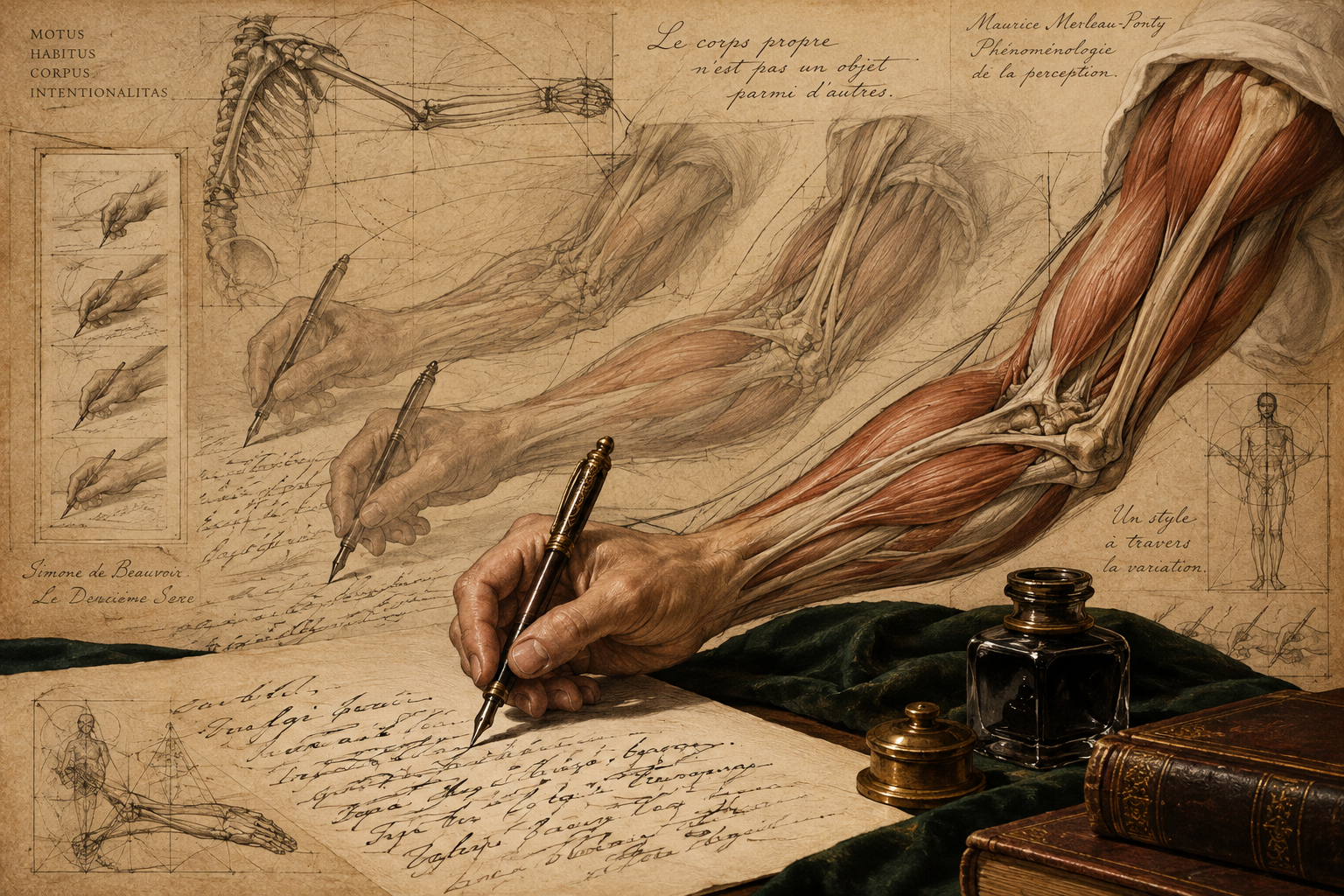
I am a doctor, which means that my handwriting is an offence against written communication. It is not merely untidy, nor does it possess that charming eccentricity occasionally found in the correspondence of distinguished intellectuals. It is genuinely dreadful. I have written with fountain pens, ballpoint pens, pencils, and whatever unfortunate instrument happens to be available during a hospital shift; I have attempted to write slowly, to separate the letters, and even to summon a degree of consideration for the poor pharmacist who must eventually decipher my prescriptions. None of these efforts has produced anything approaching elegance. My handwriting invariably returns to its familiar state of organised catastrophe, as though my hand were determined to preserve a tradition of illegibility against every intervention of conscious reason.
Yet there is something rather interesting about this persistent failure: however I write, and whatever instrument I use, the handwriting remains recognisably mine. On paper the movements are small, confined largely to the fingers and wrist. On a blackboard the shoulder and upper arm take over, the gestures broaden, and the physical conditions of the activity change considerably. Nevertheless, something survives. The shapes are not identical, the muscles involved are different, and the surface has changed, but someone familiar with my handwriting would recognise it in either setting, much as one recognises a familiar voice whether its owner is whispering across a table or shouting from the opposite end of a room.
This continuity offers an accessible introduction to something Maurice Merleau-Ponty understood with considerably greater sophistication than I could ever hope to demonstrate with a prescription pad: the phenomenon of style. A style is not an assortment of visible characteristics, nor a collection of behaviours assembled according to a conscious plan. It is a manner of organisation that persists through variation, a recognisable unity expressed in different acts, gestures, and situations. It emerges through the history of a body and becomes incorporated into its habitual way of engaging with the world.
Three features of this phenomenon make it particularly troublesome for the contemporary cult of self-identification. First, a style is not brought into existence merely because someone decides to possess it. Secondly, its existence does not depend upon being consciously performed before an audience. Finally, it cannot be detached from the material body whose history and capacities make its expression possible. We may cultivate a style, transform it through practice, or deliberately imitate someone else’s, but none of these possibilities establishes the sovereignty of declaration over embodiment. What becomes habitual through years of bodily experience is not instantly replaced by the discovery of a more agreeable description of oneself.
I could announce tomorrow that, after considerable introspection, I have discovered my authentic identity as an exceptionally gifted calligrapher. I might even feel an overwhelming internal certainty that my dreadful handwriting has never adequately represented the elegance of my true self. None of this would be particularly difficult to accomplish, especially in an age when personal declarations enjoy a remarkable degree of protection from unwelcome empirical scrutiny. The difficulty would arise when I attempted to write a prescription, because the pharmacist would still be confronted with the same dreadful sequence of marks that has tormented the pharmaceutical profession of Montevideo for years.
The ink, regrettably, has no interest in my journey of self-discovery.
The Body Is Not a Passive Recipient of Identity
One of the most consequential achievements of twentieth-century phenomenology was its challenge to the notion that the human person could be adequately understood as a consciousness occupying and controlling a physical organism. In Phenomenology of Perception [1], Merleau-Ponty develops an account in which the body is neither a mere biological machine nor an external possession belonging to an otherwise independent mind. It is through the body that the world first becomes accessible to us, and our practical involvement in that world precedes much of what we subsequently formulate in explicit thought.
An accomplished pianist does not calculate the position of every finger before striking each note, just as an experienced driver does not solve a geometrical problem whenever a parking space presents itself. Through repetition and adaptation, the body acquires capacities that become part of its ordinary way of inhabiting its surroundings. Merleau-Ponty describes this through notions such as habit, motor intentionality, and the body schema, and their significance lies in the recognition that our practical relationship with the world possesses an organisation that precedes explicit self-description. Our bodies have histories that continue to operate whether or not we attend to them, and much of what constitutes our manner of being in the world has developed without awaiting our approval.
This does not render us prisoners of our past, for habits can be altered and new capacities acquired. It does, however, establish a distinction between transformation and declaration. The acquisition of a new bodily capacity involves a process through which possibilities become actual; naming the capacity does not accomplish that process. A person who wishes to become a pianist must eventually sit at a piano, and someone who regards himself as an accomplished swimmer must, sooner or later, demonstrate a tolerable relationship with water. In neither case does the sincerity of the aspiration remove the distinction between possessing a capacity and believing oneself to possess it.
The contemporary elevation of self-perception into a sovereign criterion of identity encounters precisely this difficulty. If human existence is embodied, historically constituted, and practically situated, then a description of oneself cannot automatically determine the reality it purports to describe. Consciousness is certainly capable of interpreting bodily existence, but interpretation is not creation, and the body is not an obedient administrative department waiting to update its records whenever consciousness submits a revised account of personal identity.
What Simone de Beauvoir Actually Made Possible
Few philosophical sentences have enjoyed a more extraordinary afterlife than Simone de Beauvoir’s observation that one is not born, but rather becomes, a woman. It has been enlisted in so many arguments that its philosophical content is in considerable danger of disappearing beneath the weight of its political usefulness. The sentence is often made to function as a declaration that womanhood is independent of biological reality, as though Beauvoir had discovered that the human body becomes irrelevant the moment society acquires the vocabulary to describe it differently.
But The Second Sex [2] is considerably more demanding than that. Beauvoir rejects the proposition that female anatomy predetermines a woman’s destiny, character, or possibilities, but that rejection takes place within a philosophical investigation of embodied existence, not within a fantasy of consciousness liberated from the material conditions of its own existence. For Beauvoir, the body is lived. The female body does not contain a complete programme specifying how a woman must live, but neither does it disappear from the situation in which her existence unfolds. A society can transform what it means to possess a particular body without thereby transforming every fact about that body: the social meaning of pregnancy has changed across history, but those changes do not demonstrate that pregnancy itself is a discursive invention. A cultural interpretation can be contingent even when the material phenomenon being interpreted is not.
To become, in Beauvoir’s sense, is to acquire a history, to inhabit circumstances, to encounter restrictions, and to develop ways of acting within a world that was not constructed solely for one’s benefit. Such a process cannot be compressed into the act of announcing an identity, because the history through which an existence takes shape is precisely what the concept of becoming attempts to explain.
Sara Heinämaa’s phenomenological interpretation of Beauvoir develops this point with particular clarity [3]. Heinämaa resists the reduction of Beauvoir’s analysis to a simple distinction between biological sex and socially imposed gender roles, and examines sexual difference through styles of bodily existence, bringing Beauvoir into conversation with Husserl and Merleau-Ponty. A style of bodily existence cannot be described as a list of prescribed behaviours. A woman does not cease to be a woman because she wears masculine clothing, works in an occupation historically associated with men, rejects motherhood, or has no interest whatsoever in conventional femininity. What makes her a woman was never in the wardrobe. The style in question, I would insist, is not a free-floating manner that any body might adopt; it is the style of a sexed body, the characteristic way in which a female body inhabits the world. Style presupposes sex; it does not replace it. Here the handwriting becomes useful again: just as mine remains recognisable despite variations in instrument and circumstance, the recognisability of a bodily style cannot depend upon the uniform repetition of a fixed set of external signs. If it did, style would be nothing more than a costume assembled according to instructions.
To describe womanhood phenomenologically is therefore to investigate embodied existence, its situation, and its historical constitution. It requires rather more than consulting a person’s preferred terminology (one might reasonably expect philosophy to offer something more ambitious than an unusually elaborate registration form), because the terminology itself is among the things whose meaning must be established. Simply asking someone whether they identify as a woman answers none of these questions. It merely records that they have applied the expression to themselves.
Judith Butler and the Disappearing Referent
Judith Butler’s influence upon contemporary discussions of sex and gender is difficult to overstate. Her account of gender performativity, developed most famously in Gender Trouble [4], holds that gender is implicated in the reiterated norms through which socially intelligible subjects are constituted, and challenges the assumption that sex provides an entirely prediscursive foundation for gender.
The difficulty begins when this critical treatment of categories is made to bear conclusions about the reality of the bodies to which those categories refer. It is perfectly possible to demonstrate that our understanding of sex is mediated by language, classification, and institutions; it would be rather astonishing if human beings possessed an entirely unmediated vocabulary for describing anything. But the fact that our descriptions are mediated does not establish that their objects are constituted by the descriptions themselves. A society may regard menstruation as impure, sacred, dangerous, or medically significant, and those beliefs shape how menstruating women are treated. Yet none of the competing interpretations accounts for the physiological existence of the menstrual cycle. Explaining how a phenomenon becomes intelligible within a framework is one thing; establishing that it depends for its existence upon that framework is quite another.
The modern discourse of gender identity has increasingly treated this distinction as an antiquated embarrassment. Womanhood ceases to require an account of the properties that distinguish the category and becomes something established by the act of claiming it. The question of what makes someone a woman is answered by asserting that a woman is someone who identifies as a woman: the predicate appears in the explanation of itself, and the resulting circle is presented as a triumph of conceptual sophistication.
Butler’s theory and the principle of unrestricted self-identification are not identical doctrines; performativity concerns the constitutive force of repeated norms, not an individual’s ability to select an identity through conscious choice. Yet the broader movement that has destabilised the relation between sexed bodies and their classification must still confront the consequences of the concepts it has placed in circulation. Where the material referent is treated as indefinitely subordinate to identity, the theory encounters a question that no sophistication of vocabulary can resolve: what, precisely, is being identified? If the answer is a subjective experience, then the description refers to an experience. If it is a social position, its conditions must be explained in social terms. If it is membership of a material sex category, then material criteria cannot be dismissed as irrelevant. These are different kinds of propositions, and their differences do not evaporate because the same word is employed in each of them.
Instability, moreover, is not unlimited indeterminacy. That classifications possess histories does not make their application arbitrary, and that a concept has contested boundaries does not establish that it has none. The existence of twilight has never persuaded astronomers to abandon the distinction between day and night. There is consequently something rather extravagant about treating the indeterminacy of certain social concepts as permission to dissolve every distinction between the experience of a body and the material characteristics of that body.
It is an extraordinary amount of metaphysical work to ask of a pronoun.
The Extraordinary Promotion of Self-Perception
Human beings have always possessed the capacity to misunderstand themselves. We mistake infatuation for love, confidence for competence, and our most cherished aspirations for established facts. The contemporary doctrine of sovereign self-perception introduces a remarkable exception to this ancient predicament. It compresses three distinct propositions into one. The first concerns experience: a person reports experiencing themselves in a particular way. The second concerns interpretation: the person concludes that the experience establishes membership of a particular category. The third concerns public consequence: others are expected to adopt that conclusion as an authoritative description of reality. There is no logical principle by which the truth of the first establishes the second, or by which acceptance of the second determines the third.
This is elementary in medicine, where subjective experience constitutes indispensable evidence without becoming an infallible account of its own causes. A patient may describe pain with complete accuracy while remaining mistaken about the organ from which it originates. Someone may experience profound exhaustion while attributing it to a cause that investigation does not support. The experience is real; its interpretation is subject to examination. There is no contradiction in affirming the former while questioning the latter, because the two propositions concern different things.
The same distinction operates well beyond the clinic. A person may sincerely believe themselves to be unusually intelligent, artistically gifted, or possessed of remarkable physical abilities, and we do not regard the sincerity of the conviction as sufficient to establish the claim. The possibility of self-deception is so deeply embedded in ordinary experience that it has supplied literature with some of its greatest characters and comedy with practically its entire workforce. Yet the principle is suspended the moment the subject turns to gender identity. A category whose membership is established exclusively through a declaration of membership becomes informationally empty: if there are no conditions by which the assertion might be assessed independently of its utterance, the category tells us nothing beyond the fact that someone has chosen to apply it.
The language of identity conceals this by using the same grammatical form for radically different claims. To say that one identifies with a tradition, aspires to a way of life, experiences oneself through a category, or possesses a material characteristic is to say four different things. They may overlap, but their overlap requires explanation, and treating them as interchangeable merely conceals the work that remains to be done.
If being a woman is a style of embodied existence, as the phenomenological approach to sexual difference suggests, then that style must be investigated through the body and its history; it cannot be established by discovering that someone sincerely wishes to be recognised under the corresponding description. If, alternatively, womanhood is defined simply through identification, then the term is being employed according to a different criterion altogether, one whose relation to sexed embodiment remains entirely unexplained. The supremacy of self-perception insists that this distinction can be abolished by the force of conviction. Where an internal experience and an external description diverge, the divergence is treated as an objectionable feature of the external world rather than as something requiring investigation. Instead of asking whether our descriptions correspond to what exists, we declare that what exists must be redescribed until it corresponds to our preferred interpretation.
We have managed to turn epistemology into a customer satisfaction department.

Recognition Is Not a Metaphysical Miracle
Recognition has acquired a peculiar role in this arrangement. Some statuses are constituted by the relevant social procedures; others refer to facts that exist independently of the procedures used to acknowledge them. A university may confer a degree through an authorised act, but it cannot confer a history of study that never occurred. A court may declare someone legally responsible for an obligation, but it does not thereby acquire the power to reverse the person’s biological age. An act of recognition can be constitutive in one domain and merely descriptive in another, and the fact that both are expressed through language does not render them ontologically equivalent. A society may adopt whatever conventions it likes for addressing individuals or recording their identities; such conventions do not settle whether the category so recognised corresponds to a material characteristic, a social status, a subjective identification, or some combination of these.
The difficulty arises when a social convention is presented as though it had resolved a question about the nature of reality. The individual is said to be what the institution recognises, and the institution is instructed to recognise whatever the individual declares. The structure is circular, though its repetition across increasingly elaborate administrative systems can create an impressive appearance of objectivity. A certificate can establish a recognised status within a system of rules; it cannot establish that the world has undergone a material transformation corresponding to every implication of the status recorded.
What the Body Continues to Know
Merleau-Ponty invites us to abandon the fantasy of a detached consciousness legislating over a passive organism. Beauvoir situates human freedom within the material and historical conditions through which existence unfolds. Heinämaa allows us to approach sexual difference through the notion of style, recognising continuity without reducing a living person to a catalogue of stereotypical traits. Together they suggest that becoming someone involves more than adopting the language associated with an identity, and that the body’s history cannot be eliminated from the description of its present.
The belief in the supremacy of self-perception is intellectually impoverished precisely because it mistakes the authority to describe one’s experience for the authority to determine whatever one believes that experience signifies. It treats sincerity as though it could settle the truth conditions of the proposition asserted, granting consciousness a jurisdiction over material reality that phenomenology spent much of the twentieth century teaching us to question. The deepest irony is that this supposed liberation of identity from the body rests upon a curiously impoverished understanding of embodiment. The body becomes an inconvenient object, a collection of facts to be corrected through interpretation whenever they conflict with a preferred description of oneself. Yet the body is not merely the material upon which identity is inscribed; it is the very condition through which personal existence becomes possible. Interpretation and transformation remain distinguishable activities, and erasing that distinction is not a philosophical achievement. It is merely the substitution of personal conviction for the difficult task of understanding how human beings exist.
I return, therefore, to my unfortunate handwriting. It has accompanied me through medical school, examinations, hospital shifts, and countless other opportunities to inflict unnecessary suffering upon innocent readers. It has survived changes of pen, changes of paper, and repeated efforts at improvement, and it possesses a recognisable continuity that owes remarkably little to my conscious preferences and even less to my aspirations towards elegance. I can dislike it, attempt to improve it, or perhaps someday acquire an entirely different manner of writing through sustained practice. What I cannot do is make it beautiful by asserting that beauty is its authentic identity.
We are entitled to interpretations of our lives, but the existence of an interpretation does not guarantee its truth. The notion that subjective identification possesses sovereign authority over material fact asks us to mistake the declaration for the phenomenon, the description for the object, and the conviction for the evidence. The body has a history that precedes our explanations, a materiality that constrains our possibilities, and a style that may persist despite our most determined efforts to describe it otherwise. None of this prevents us from changing or becoming something we were not before. It simply means that becoming involves more than announcing that the transformation has already occurred.
I may one day become a competent calligrapher. I might even develop a handwriting so exquisite that pharmacists throughout Uruguay would gather to admire my prescriptions as works of art. Such an achievement would require time, practice, and a transformation of bodily habits that decades of medical training have thus far failed to produce. Until then, I shall have to endure the indignity of possessing the handwriting I actually have, rather than the handwriting with which I would prefer to identify. Reality can be terribly inconsiderate in that respect: it continues to exist even when we have developed a far more flattering account of ourselves.
References
[1] Merleau-Ponty, M. (2012) Phenomenology of Perception. Translated by D.A. Landes. London: Routledge. (Originally published 1945.)
[2] Beauvoir, S. de (2009) The Second Sex. Translated by C. Borde and S. Malovany-Chevallier. London: Jonathan Cape. (Originally published 1949.)
[3] Heinämaa, S. (2003) Toward a Phenomenology of Sexual Difference: Husserl, Merleau-Ponty, Beauvoir. Lanham, MD: Rowman & Littlefield.
[4] Butler, J. (1990) Gender Trouble: Feminism and the Subversion of Identity. New York: Routledge.


Deja una respuesta