Beauvoir, Erika Hilton and the human female everyone forgot
I. A Bucket of Cold Water
Last night I watched Breno Altman’s interview with Erika Hilton on 20 Minutos, Opera Mundi’s programme, recorded on 2 March 2026. An hour and a half of it, every minute, and I rather enjoyed it, which is more than I can say for most interviews with politicians.
Hilton spoke about abolishing Brazil’s 6×1 schedule (six days on, one off) with a command of detail few legislators have over their own bills. She described her tour of the ministries and how she won over a government that had initially regarded her as something of a crank. She admitted, quite without embarrassment, that she had proposed a four-day week fully expecting to settle for five: ‘political fat’, she called it, padding for the negotiation. That is not a pamphleteer. That is someone who understands how a parliament works. She drew the line between faith and fundamentalism more carefully than most professional atheists manage, and she declined, intelligently, to be herded into a binary over Iran, Israel and the United States. I came away thinking, in so many words: I would vote for this woman for president. (Brazil’s constitution requires presidents to be thirty-five; she is thirty-three. One would have to wait.)
Then came the final question. Altman flagged it as delicate and read it out from the live chat. A materialist feminist named Isabella Cêpa had been granted refugee status in Europe after being prosecuted, at Hilton’s instigation, for believing that womanhood is grounded in biological sex. Why, the viewer asked, so much litigation against a woman of the left?
I had never heard of Isabella Cêpa. Hilton introduced her in under two minutes: ‘Essa menina é uma criminosa’, this girl is a criminal. There followed the Ku Klux Klan, Hitler, and the demand that whatever one believes should stay inside one’s head or, at most, inside one’s house.
I looked the case up. It was a bucket of cold water. The previous ninety minutes were not erased, but they lost their footing. Everything I had admired in Hilton rested on an assumption: that someone who defends the dignity of others with such conviction grants others the same freedom she claims for herself. She had just shown me otherwise.
This piece comes out of that fall, and out of a question that kept me up: why should a single episode outweigh everything else? The answer involves a sentence from 2020, a sentence from 1949, and a question that, in a liberal republic, ought never to have reached either a courtroom or a parliamentary committee: what a woman is.
II. The Sentence
In November 2020 Erika Hilton was elected to São Paulo’s city council with more than fifty thousand votes, the highest tally for any woman running for a municipal seat in Brazil. That night a graphic designer who described herself as a radical feminist posted on Twitter: ‘Decepcionada. A mulher mais votada é homem.’ Disappointed. The most-voted woman is a man.
Seven words. No threat, no call to action. A claim about a category.
What followed ran rather longer. Hilton filed a police report. The São Paulo state prosecutor’s office formally charged Isabella Cêpa with having practised and incited discrimination and prejudice against transgender women and travestis. It relied on the Supreme Court’s 2019 ruling that brought transphobia under the law against racism, a crime the Brazilian constitution makes unbailable and exempt from any statute of limitations. At the state prosecutors’ own request, the file moved to the federal courts. Federal police meanwhile served Cêpa at Salvador airport. By mid-2024 she had left the country, and in 2025 an undisclosed European state granted her international protection.
The case went nowhere. Federal prosecutors asked for it to be shelved, the 7th Federal Criminal Court in São Paulo obliged, and Hilton appealed and lost. She then took it to the Supreme Court. In August 2025 the Prosecutor-General’s office recommended closing the matter, and on 2 September Justice Gilmar Mendes threw out her complaint. Nor did it die. After the Supreme Court’s ruling, the Federal Regional Court of the 5th Region accepted a request from federal prosecutors in Paraíba and opened a fresh case over the same posts. Of the five publications she was charged over, four were retweets, and the pursuit extended to the women who had written them.
One of them, Isadora Borges, is a veterinary student in Paraíba who had some four thousand followers and had never once named Hilton. Hilton nonetheless joined the proceedings as assistant to the prosecution, in a case brought in 2025 over tweets from 2020 that could have ended in ten years in prison. In March 2026 the same court granted her habeas corpus and quashed the case: none of the posts, the rapporteur wrote, attacked, insulted or threatened trans people.
Six months after the Supreme Court’s ruling, on camera, Hilton said: ‘Essa menina é uma criminosa.’ The following month Cêpa filed a criminal complaint against her for calumny and insult.
On 4 October 2026 Hilton was re-elected with 1,596,472 votes. The Brazilian press, almost to a paper, ran the same words: the most-voted woman in the history of the Chamber.
The same sentence. In 2020 a citizen wrote it in order to deny it, and was rewarded with a criminal file for racism and a set of refugee papers. In 2026 it is a celebratory headline. The sentence has not changed. What has changed is who is permitted to decide what it means.
III. The Sleight of Hand
The answer deserves to be heard in full before it is taken apart.
The question was precise: Cêpa believes that womanhood is grounded in biological sex. That is a thesis about what makes someone a woman. One may dispute it, refute it, think it false. Hilton did none of these things. She answered a different question.
First came authority: the Supreme Court has already settled what transphobia is, and whoever commits it is a criminal. Then the analogy. The Ku Klux Klan believed Black people inferior; Hitler believed Jews inferior; there are those who believe women worth less than men, or northeasterners less than southerners. Hence the conclusion: if you think a trans person less worthy, you may not feel entitled to say so in public.
Note the shift. Every one of Hilton’s examples concerns a hierarchy of worth: who counts for more, who deserves less. Cêpa’s sentence establishes no hierarchy whatever. It classifies. To say that someone does not belong to a category is not to say that he is worth less, any more than saying a man is not a woman demeans him. The Klan analogy works only if ‘a trans woman is not a woman’ means ‘trans people are inferior’. Without that equivalence, Hitler is surplus to requirements.
The equivalence is false, and this essay is the proof. I hold that Erika Hilton is not a woman. And I hold with equal firmness that her mandate, her dignity and her right to chair whatever the Chamber entrusts to her are worth precisely as much as any other deputy’s. At the start of this piece I said I would vote for her. Were Hilton’s equivalence true, my position would be impossible. It exists.
There is a second, subtler shift. When she speaks of women and of Black people, what Hilton forbids is violence: if you think a woman inferior, you may not kill her or strike her. When she reaches trans people, what she forbids is speech: you may not say it publicly. The argument sets out protecting bodies and ends up gagging mouths, without ever announcing the change of object.
The same interview supplies the contrast. Around the forty-nine-minute mark, Altman asks her about left-wing factions that call Lula’s government neoliberal. Hilton observes that some on the left speak ill even of her, and that democracy presupposes the freedom to express oneself according to one’s beliefs.
Half an hour later, thanked by an evangelical viewer, she declares that she has nothing against anyone’s faith, and that every belief should be respected and given room to be practised.
Three beliefs, three regimes. The left-wing critic’s may be voiced freely. The believer’s is respected and practised. The materialist feminist’s stays at home.
The legal order Hilton invokes reproduces the same hierarchy. The ruling that brought transphobia under the racism statute contains an express clause: criminal prosecution does not reach religious freedom. Priests, pastors, rabbis, mullahs and leaders of Afro-Brazilian faiths may preach and disseminate their convictions according to their sacred books, in public or in private, provided they do not incite discrimination, hostility or violence. A pastor who proclaims from the pulpit that God made them male and female, and that a trans woman is a man, enjoys that protection in writing. An atheist feminist who says the same on the strength of biology is nowhere on the list. Revealed conviction carries a safe-conduct that argument does not. For a state that calls itself secular, it is a remarkable ranking: Scripture is a respectable authority on sex; biology, a suspect one.
And there is a fourth regime: Hilton’s own. She too has been sued over what she said about others: by Michelle Bolsonaro in 2024, and in 2026 by a women’s organisation alleging she had called women ‘imbeciles’ and ‘bitches’. Both complaints were thrown out: Michelle Bolsonaro’s because the Supreme Court judged Hilton’s parliamentary immunity ‘unequivocal’, the other because a civil association has no standing to bring such a complaint. The deputy’s words are shielded by immunity. The citizen’s are filed under racism.
IV. Beauvoir Without Anachronism
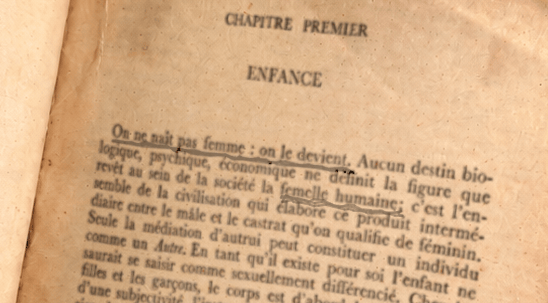
Few sentences in twentieth-century philosophy are quoted so often and read so seldom as ‘One is not born, but rather becomes, a woman.’ It is brandished as a passport: if woman is something one becomes, anyone may become it. The reading is as convenient as it is false, and one need only open the book to see why.
Beauvoir does not open The Second Sex with a slogan. She opens it with a question: what is a woman? Before answering, she dismisses the nominalist escape route, the one that would reduce ‘woman’ to a word. One has only to walk about with one’s eyes open, she observes, to see that humanity is divided into two categories of individuals.
The famous sentence opens the second volume, and the one that follows it tells us whom she is talking about. No biological, psychological or economic destiny, Beauvoir writes, determines the figure that the femelle humaine, the human female, presents in society; it is civilisation as a whole that manufactures the product called feminine. The verb ‘become’ has a subject, and the subject is named. What is constructed is the figure. Who undergoes it is the female. Biology is not destiny, but it is the point of departure: it does not decide where society takes her, it decides who sets out.

The rest of the volume bears this out. It is called Lived Experience, and its spine is the biography of a body: the girl’s childhood, puberty, menstruation, sexual initiation, pregnancy, motherhood, menopause. Beauvoir writes from within Merleau-Ponty’s phenomenology: the body is not a thing but a situation, our grip on the world and the outline of our projects. A situation is neither chosen nor declared. It is inhabited.
English readers laboured under an extra handicap. For more than half a century they read Beauvoir in Howard Parshley’s 1953 translation. Parshley was a zoologist, and his version was abridged and philosophically flattened, as Toril Moi documented in some detail. Much of the phenomenological vocabulary simply did not survive the crossing.
In 1949 the concept now put in her mouth did not exist. ‘Gender’, in the sense of a social role detachable from sex, was introduced by the sexologist John Money in 1955. Robert Stoller popularised it in 1968, and feminist sociology adopted it in the seventies. Beauvoir could not distinguish sex from gender because the distinction had not yet been invented. To read her through that pair is to do what a bad translator does: put into the author’s mouth the word one needed her to say.
Which is precisely what Judith Butler did. In a 1986 essay on The Second Sex in Yale French Studies, she read ‘becoming’ as the choosing of a gender, and the body as an arbitrary site on which that gender is inscribed. Four years later, in Gender Trouble, she completed the operation. Sex, she suggested, had perhaps been gender all along, a ‘perhaps’ her readers have been at some pains to forget. The human female vanished from the very text written to describe her. This is not an alternative reading. It is a misreading that became canon, and it is repeated on every placard that cites Beauvoir to say the opposite of what Beauvoir wrote.
One need not be a conservative to see it. Toril Moi, a feminist who teaches at Duke, argued in the late nineties, in What Is a Woman?, that the sex/gender distinction is of no use for reading Beauvoir, and that the concept which usefully replaces it is the lived body. Moi’s title is the question with which Beauvoir opened her own book. It is also the question that, according to Deputy Hilton, ought to be kept indoors.
Read without anachronism, Cêpa’s sentence ceases to be a provocation. It is what feminism maintained from Beauvoir to Firestone: the oppression of women is rooted in the reproductive function of the female body, and the category ‘woman’ is therefore defined by that body. From there, disputing that Hilton is ‘the most-voted woman’ is no slight upon her. It is a problem of measurement. In 2022 women won 91 of the Chamber’s 513 seats. If the category is defined by declared identity, that figure no longer measures what feminism set out to measure. The record for votes cast for a woman, held by Joice Hasselmann since 2018, now belongs to someone born male. One may celebrate Hilton’s result, and I do, while asking what precisely that statistic is counting. The question is not an aggression. It is Beauvoir’s.
One is not born a woman. But to become anything, one must have set out from somewhere.
V. The Committee: The Other Side of the Same Coin
On 11 March 2026 the Chamber’s Committee for the Defence of Women’s Rights elected Erika Hilton as its chair. She did not defeat a rival candidate. Under the allocation agreed by party leaders, the chair belonged to PSOL, and whoever PSOL put forward was going to sit in it. The opposition voted blank. In the first round blank ballots outnumbered votes in favour, and Julia Zanatta hailed it as a victory for women. In the second round Hilton was elected with eleven votes.
What followed was a campaign. Nikolas Ferreira urged women deputies to obstruct the committee until the chair changed hands, and promoted a petition that gathered nearly a quarter of a million signatures in three days. Chris Tonietto complained that the committee had been handed to an agenda that perverts the very essence of womanhood. Clarissa Tércio demanded a ‘real woman’. Twenty-eight deputies signed a proposal to amend Article 39 of the standing orders and reserve the chair and vice-chairs for female deputies. The Missão party went so far as to petition for her removal from office. At the first session, Pastor Eurico questioned her about her anatomy. And in Curitiba a group of city councillors tabled a measure the press promptly christened the ‘anti-Erika Hilton’ bill.
The whole campaign fits into a single sentence from Deputy Delegada Ione, author of yet another proposal: it is not reasonable for a body devoted to the female condition to be chaired by someone who does not share that condition. The sentence is false. Not because Hilton shares the condition (I hold that she does not), but because chairing a committee does not require sharing the condition it deals with. Nobody insists that the health committee be chaired by the sick, the agriculture committee by someone who has ploughed a field, or the committee on the rights of older people by a pensioner. Nor does anyone ask that the defence committee be chaired by a general. A chair orders the debate, sets the agenda and conducts the votes. The legitimacy to do so comes from the election that put her in the Chamber and the rules that allocate the posts, not from some ontological correspondence with the subject matter.
Political theory has a name for what Brazil’s right defended in that committee: descriptive representation, the idea that to represent is to resemble the represented. It is precisely the premise behind the identitarian notion of a ‘place of speech’ that the same right claims to oppose. Delegada Ione’s sentence could be signed by any identity activist with a single noun changed. The conservatives borrowed their enemies’ premise, laid a Bible verse on top of it and passed it off as a defence of women. What they were defending was an ontology. A parliamentary committee is no place to settle ontologies.
The clearest proof came from the inaugural session itself. The loudest voice demanding ‘a real woman’ in the chair belonged to Éder Mauro, a male deputy who sits on that very committee. By his own criterion, he ought not to be in the room.
Hilton’s camp fared no better. In her inaugural speech she herself asked the parties not to concern themselves with the gender of the chair, which was the right argument. But the same day she dismissed her critics as ‘LGBTphobes’ and ‘red pills’, and her defenders argued that she could chair the committee because she is a woman. That defence makes Hilton’s legitimacy hostage to the ontological dispute: should a majority one day conclude that she is not, the defence collapses. Mine does not. Hilton may chair that committee because she is an elected deputy and her party held the post. Had PSOL put forward a man, he could have chaired it just the same. It is a sturdier defence than her own allies offer, and it comes from someone who does not believe she is a woman.
At the same session, Deputy Erika Kokay of the PT explained that speech ‘is not innocent’, that it is ‘the bridge between thought and action’, and that what the opposition had just said was ‘in conflict with the law itself’. Hilton told her own story: thrown out of her home, sleeping in the rain in a town square, selling sex so as not to starve. Speeches like these, she said, are what is responsible. What she described is atrocious, and I have no reason to doubt it. But Hilton was not thrown out of her home by a sentence about what a woman is. She was thrown out by people, through acts, and acts are what the criminal code is for. Sentences are what replies are for.
That same night, on his SBT programme, the television host Ratinho said what the opposition deputies had said, in the style that made him famous. It did not seem fair: with so many women about, why give it to a trans woman? Erika Hilton is not a woman. To be a woman one must have a uterus, menstruate, be insufferable three or four days a month, go through the pain of childbirth, the smear test, the mammogram. He had nothing against her (he let slip a masculine form and corrected himself at once); she speaks well, she has the gift of the gab; but he wondered whether she understands the problems of someone born a woman. I have no time for Ratinho. He is a vulgarian. But he repays careful listening, because in two minutes of banter he said three different things. The first is an ontological claim, and his list is very nearly the table of contents of Beauvoir’s second volume, rendered in the idiom of a bar room. The criterion is clumsy, since a woman who has had a hysterectomy remains a woman, and Hilton was right to point it out at once. The second is the opposition’s mistake, that one must have been born a woman to chair that committee: the identitarian left’s ‘place of speech’, issuing from the mouth of a conservative entertainer. The third is a wish, that Brazil should modernise and be inclusive, but without overdoing it. None of the three threatens anyone, summons anyone or incites anything. Each may be refuted, and I refute the second. Hilton’s response was to ask the São Paulo prosecutors for a police investigation and the host’s imprisonment, to ask the Ministry of Communications to take his programme off the air for thirty days, and to refer the matter to federal prosecutors, who the next day sued Ratinho and SBT for ten million reais. Six months had passed since the Supreme Court threw out her complaint in the Cêpa case. The reflex was unchanged, with one addition: a television programme suspended by order of the government.
A week later, in committee, Clarissa Tércio flung it back at her at full volume: ‘Go on, have me arrested, like you did with Ratinho. You’ll have to arrest half of Brazil.’ Hilton answered with perfect composure, thanked her and explained what had become of her motions. About Ratinho she said nothing.
The same principle protects those I detest. I do not want pastors in parliament, still less legislating about anyone’s body. But if tomorrow the PL held that post and installed Pastor Eurico at the head of the Women’s Committee, it would be within its rights. One removes a pastor from a committee by winning his seat, not by inventing qualifications the standing orders do not contain. That is what a republic is: places are contested at the ballot box. The curious thing is that Eurico himself knows it. At the session of 18 March he introduced himself ‘as a straight man’ and explained that he sits on the Women’s Committee because 85 per cent of the people who voted for him are women, and he represents them. He is quite right: one represents those who voted for one, not those one resembles. It is precisely my argument. What he fails to see is that, by the same token, Hilton may chair it.
Both sides of the committee fight shared the same premise: that the category determines legitimacy. They merely quarrelled over who belongs in it. The right wanted to write the ontology into the standing orders; Hilton wrote it into the criminal code, and into the broadcasting regulations for good measure. The instrument differs. The gesture does not.
VI. The Principle Nobody Defended
Set the three scenes side by side. A citizen prosecuted for racism over seven words and four retweets. A television host whom a deputy wanted jailed and taken off the air. An elected deputy whom part of Congress wanted removed from a chair the rules had given her, and another part from office altogether. In all three the same thing is at stake: someone’s right to say what she thinks, or to occupy the place she has won, however mistaken we find her ontology.
No political force with seats in Congress passed the test. The left defended Hilton’s mandate and kept quiet about Cêpa and Ratinho: no one in PSOL or the PT stood up to say that seeking prison for a designer over a tweet, or for a host over some banter, was out of all proportion. Nor did it merely keep quiet. At the session of 18 March, when Eurico proposed a motion of applause for Ratinho, Célia Xakriabá, of PSOL and the committee’s chair until a week earlier, announced that they would not allow ‘transphobic people’ to be applauded, and that the committee would not allow the diversity of women to be denied. The right defended Ratinho’s freedom and, in the same week, signed bills to amend the standing orders, petitions to change the chair and a request to strip a deputy of her seat. Each side defended the freedom of its own. That is not a principle. It is a supporters’ club.
The word ‘liberal’ comes off worst of all. The request to remove Hilton from office was lodged by Missão, the party of the MBL, the Free Brazil Movement. The grounds were a post on X in which Hilton had written ‘imbeCIS’, a pun on ‘cis’ and ‘imbeciles’, and ‘let them bark’. In August the Ethics Council admitted the complaint by ten votes to five. It is what Hilton did to Cêpa, returned with the Chamber’s seal upon it: punishing a sentence. The ‘anti-Erika Hilton’ bill in Curitiba was tabled by a councillor from Novo, the party that markets itself as the home of Brazilian liberalism, and who has just been elected to Congress. Those who carry freedom in their very names went furthest in trying to use the institutions to exclude an elected deputy. In Brazil today, ‘liberal’ is a brand, not a doctrine.
Those who did defend the principle hold no seats. They were a federal judge in São Paulo; the Prosecutor-General, who concluded that Cêpa had exercised her freedom of expression; and a Supreme Court justice who let the dismissal stand. In Brazil the liberal principle was upheld by institutions, not by parties. Even that was not enough: after the Supreme Court had spoken, a federal court in another region agreed to open a fresh case over the same posts. That same court eventually found for Isadora Borges, but by then she had spent more than a year accused of racism. A prosecution for opinion need not end in a conviction to punish. The punishment is the prosecution.
The explanation requires no assumption of bad faith. Defending Cêpa’s freedom costs the left votes. Defending Hilton’s legitimacy costs the right votes. The principle that protects them both has no constituency, and so neither side defends it. When I say that this is the left and this is the right, I do not mean what every voter thinks. I mean what they did as political forces when they had to choose between their cause and their opponent’s freedom. They chose the cause. Both of them.
One case should be set apart, lest anyone confuse matters. Cêpa has brought a criminal complaint against Hilton for calumny, and Ratinho has sued her for calling him a ‘rat’. These are not the same. Publicly attributing a crime to a specific person, after the courts have ruled it out, is to impute to her a false fact that damages her reputation: a classic limit, one liberalism has always recognised. Calling someone a rat is an insult, and an insult is answered or ignored. An opinion about a category lies at the opposite extreme: it imputes nothing to anyone. Hilton sought to apply the criminal code to an opinion, and called a woman a criminal whom the courts had found to be nothing of the sort.
Which leaves the final paradox. On 4 October some 1.6 million voters in São Paulo cast their ballots for Hilton. That result refutes two theses at once. The first is the identitarian left’s: a structural exclusion that no trans person can overcome. Hilton herself said her vote had broken structural barriers, and barriers that can be broken at the ballot box were never quite as structural as advertised. The second is the right’s: that the Brazilian people reject ‘gender ideology’. The same electorate that handed Hilton the largest vote ever cast for a woman gave nearly twice as many votes to Lucas Pavanato of the PL. That is the actual society: plural, contradictory, impossible to squeeze into anyone’s slogan. It is what a liberal order is for: so that Pavanato’s voters and Hilton’s can live alongside one another without either needing to put the other in prison.
VII. What Fell
Back to the bucket of cold water. What fell that night was not Hilton’s merit. Her bill against the 6×1 schedule is still a good one, her way of negotiating is still shrewd, and she still speaks better than most of her colleagues. What fell was my confidence in reciprocity. I grant her, without a second thought, the freedom to hold in public an ontology I consider false, and I had assumed she would grant me the same. She does not. She said so in as many words, and she acted on it with Cêpa and with Ratinho.
That is why I would no longer vote for her for president. Not because she is trans, nor because she is of the left, nor because of the 6×1 schedule. Someone who treats a disagreement about what a woman is as a crime would, with the power of the state in hand, treat a good many other disagreements the same way. Nor would I vote for those who tried to remove her from a committee the Chamber’s own rules had given her. Whoever hands out freedoms according to the other side’s ontology will not defend them on the day the other side’s ontology happens to be mine.
The attentive reader will have noticed that in the first part I called her a woman and in the third I said she is not one. I do not contradict myself. In conversation I use words as everyone does, out of courtesy and for economy’s sake. When I am arguing about a category, I use them with precision. That is precisely the freedom I am claiming: that courtesy remain a gesture and not a criminal obligation. Compulsory courtesy is no longer courtesy. It is obedience.
Two propositions remain that neither side can sign in full. The first: it is good news that a trans woman won 1.6 million votes. That is equality in earnest, not the decreed kind but the kind won at the ballot box, with the votes of people who are not trans and had no reason to be. The second: calling her ‘the most-voted woman’ is a contestable claim, and whoever contests it should not pay for it with a criminal prosecution, with exile or with the suspension of a programme. The first is rejected by the right that tried to remove her from the committee. The second, by the left that tried to have Cêpa locked up. Together they are the only thing I think deserves the name liberal.
One may become the most-voted woman. What ought to be impossible is ending up in exile for disputing it.
Coda: The Voter Without a Candidate
I have written that I would vote for Hilton, and then that I would not. Neither sentence had any consequence: I am not Brazilian. I could never vote for her, nor decline to. But the case did not interest me because of Brazil. It interested me because it is a mirror.
In Uruguay I have no one to vote for either. I do not subscribe to the identitarian progressivism of the Frente Amplio, the broad left, which I find hollow: a rhetoric of inclusion that exhausts itself in the gesture. Nor do I subscribe to the project of the centre-right Partido Nacional, most of whose leaders are not equal to a legislative chamber. What I saw in Brazil I see at home under other names: a left that turns its ontology into law, and a right that calls itself liberal until liberty is required for someone else.
To be a liberal and to hold the positions of gender-critical feminism is, these days, an odd place to stand. To the left you are a reactionary, because you maintain that sex exists. To the right you are suspect, because you defend a trans deputy’s right to the chair she was allotted, and because you will not grant the pastor more authority on sex than biology. You are shut out of both clubs, not for eccentricity but for consistency. It is an ostracism one does not choose, with no one waiting on the other side.
I know the objection, because I raised it myself in this very essay: pastors are to be beaten at the ballot box. Quite so, and that is the contradiction I live in. I defend an order whose central instrument I find myself unable to use. Voting is compulsory in Uruguay, so on election day I either spoil my ballot or stay at home and pay the fine. Of all the taxes I pay, it is the only one I pay gladly: the price of lending my vote to no one who has not earned it.
I still place liberal principles at the heart of democratic life. That nobody who calls himself a liberal behaves like one does not oblige me to change my principles. It obliges me to say so. Principles are not suspended for want of a candidate.


Deja una respuesta