On 21 October 2026, the backers of a citizens’ initiative handed the Paraguayan Senate a bill carrying, by their own count, some fifty thousand signatures, 48,600 of them certified the month before. It was received by the President of the Senate, Basilio Núñez. The bill inserts a new article into the Penal Code, 135c, under the heading “Abuse in other forms”. It sets four to ten years in prison for anyone who produces, circulates or publishes material, or who “performs acts that might interfere with, alter or harm the natural perception of the child” regarding sexuality or biological identity. Should the offender be a public official, the sentence rises to ten to fifteen years, and to twenty should he have authorised the material or the acts.
Its backers present it as a bulwark against teaching children about gender, and that is how EFE and Última Hora reported it. SOMOSGAY and the newspaper ABC read it rather differently: a kiss between two men in a public square would sit in the Penal Code alongside child abuse. Nearly fifty Paraguayan organisations signed a statement against it. The wording bears SOMOSGAY out. The article requires no material, no intent, not even a child who actually saw anything; it requires an act that might alter a perception the text itself is pleased to call natural. Two men holding hands outside a school are performing an act, and whether that act might have altered anything is for a prosecutor to decide. This is how laws that never mention homosexuals work: they need not name them to reach them.
Meanwhile, on Oxford Street
On 4 November a Harry Potter shop opened on Oxford Street, and a knot of protesters against J. K. Rowling gathered at its door. Sixteen of them, according to one outlet; a couple of dozen, according to another. Nobody was hurt, nobody was arrested, and the author did not put in an appearance. A few days later it emerged that the child actors from HBO’s new series would not be taking part in the Christmas lights switch-on of 9 November. HBO cited scheduling and school commitments; The Sun, quoting anonymous sources, cited security. All of this played out against a petition from the Good Law Project, launched in October, urging the Mayor, Sadiq Khan, to intervene in a switch-on he does not run: the Oxford Street lights are the business of a traders’ association, the New West End Company.
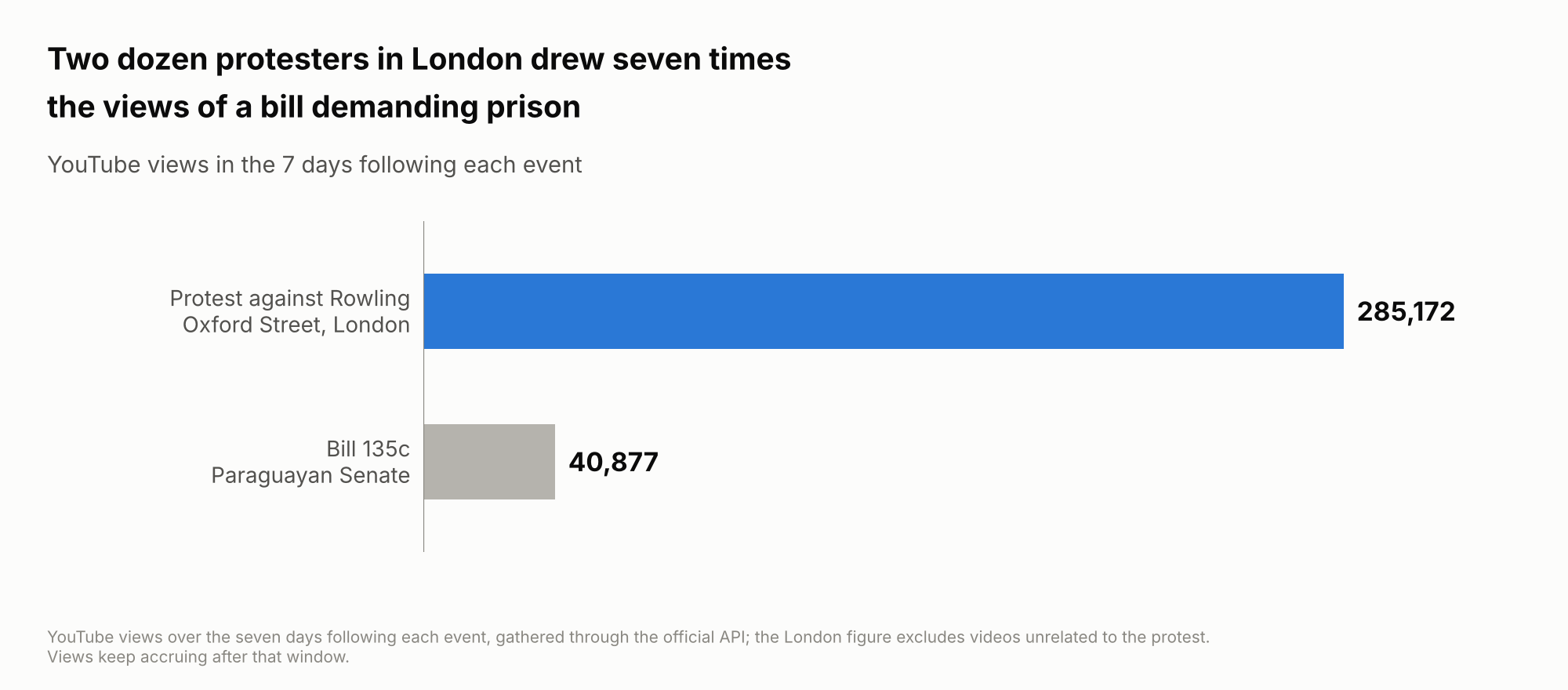
In the week that followed, YouTube videos about the protest drew some 285,000 views, nearly seven times those of the Paraguayan bill. The scene deserves a moment’s attention. A couple of dozen people, on one of the most expensive shopping streets in Europe, protest against a woman who was not there, at the door of a shop selling wands and Gryffindor scarves. The grievance is that Rowling holds that sex exists and that it matters, a view once taught in schools and now sufficient to have her declared a public enemy. Nobody went to prison, nobody lost a right, and nobody was left at a prosecutor’s mercy for holding another man’s hand. There were, to be sure, placards, cameras, and a clip cut to fit every phone.
The Oxford Street protest is a product made for the feed. It has a villain the whole world recognises, a brand that sells on every continent, a set dressed with broomsticks and owls, and a slogan that fits on a placard. Above all, it costs its protagonists nothing: an afternoon on their feet in London in exchange for a clip that pays out for weeks and the warm certainty of being on the right side. The Paraguayan bill offers none of this. Standing up for the gay men of Asunción requires knowing where Asunción is, reading an article of a Penal Code in Spanish, and caring about people who will never return the like. The scales are not hard to read. On one side, a couple of dozen people affronted by a novelist; on the other, four to ten years in prison for two men holding hands in front of a child. The English-speaking world chose to look in the shop window.
Silence in English
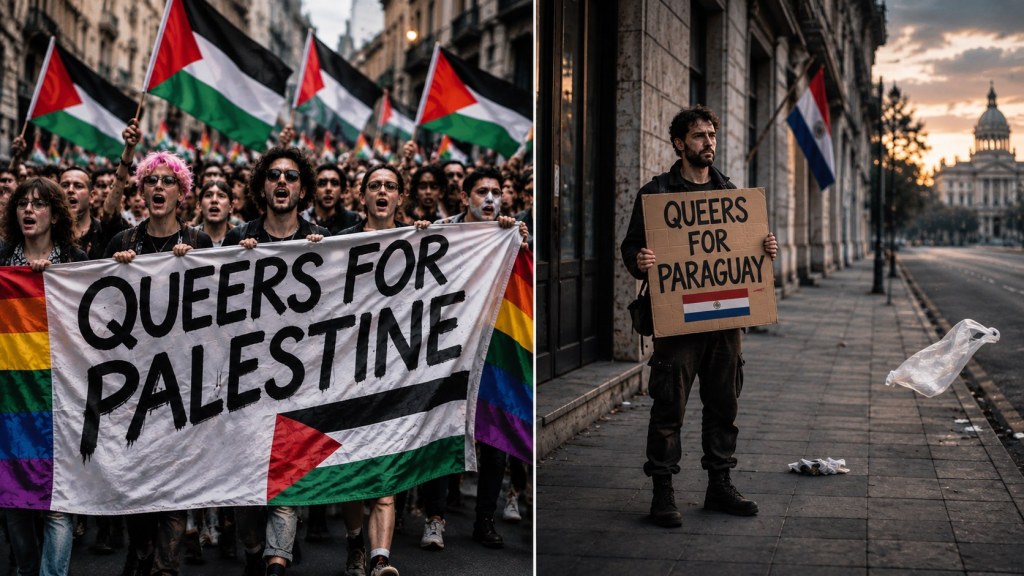
Anyone who has spent five minutes on X or TikTok will have come across “Queers for Palestine” or “Free Palestine” on an account flying the rainbow flag. These accounts hold opinions on nearly everything that happens on the planet. They have views on borders they have never crossed, on wars followed by phone, and on governments whose names they learned last week. Curiously, those very accounts produced not a single post about the gay men of Paraguay. In English, in the fortnight after the bill reached the Senate, there were two in all: one of mine, with 85 views, and another with 201. “Hem, hem. That is utterly peculiar,” as Dolores Umbridge would put it, with the sweetness that always preceded a detention. Call me a bigot, but I am rather inclined to think that all the trans outrage at J. K. Rowling is a performance staged for TikTok and Instagram.
The organisations fared no better. Between 21 October and 8 November, not one LGBT organisation said a word on X about the Paraguayan bill. The most telling case is ILGA-LAC, the Latin American and Caribbean branch of the international federation, whose region includes Paraguay, as any map will confirm. Over those same weeks it reposted the Palermo attack twice. For Asunción it had nothing. Within Paraguay there was a response: nearly fifty organisations signed a statement against the bill. They did so alone, with no one abroad to amplify them.
My reading is that causes, in that ecosystem, are worn as accessories. A cause earns its place by saying something about the wearer, and Palestine says a great deal: anti-imperialism, the right side of history, belonging. Rowling serves as well, offering a villain with a name, a face and a fortune, to be shouted at outside a shop with the cameras rolling. Paraguay says nothing to anyone in London or Brooklyn. It has no famous enemy, no aesthetic, and it does nothing for the feed. It is a country most people could not place without help, where a front of evangelicals and conservatives, Catholics among them, gathered signatures to send men to prison for holding hands. That is a civil rights violation in its most classic form, the very kind the homosexual movement spent half a century fighting. And precisely because it is classic, it is of no use to anyone as decoration for a profile.
A law for kiss-ins
The backers say the bill protects children from gender content. The article’s history tells another story. Kiss-ins have been held in Paraguay for years, and each has come with its scandal. In May 2018, after the Festival Besatón against homophobia in Asunción, the national children’s secretariat declared the presence of minors “inadmissible” and announced it would take action against those responsible. ACI Prensa, the Catholic news agency, called it a “homosexual show”. One young man ended up charged with indecent exposure after a kiss-in. In September 2019, in the town of Hernandarias, a group of residents covered an LGBT march with bedsheets. Their spokesman explained that they were hiding the “kiss-ins between people of the same sex, erotic dancing, caresses in front of children”, since such acts “may break the harmonious development of the child”. Seven years later, article 135c speaks of acts that might alter “the natural perception of the child”. The vocabulary travelled from a neighbourhood spokesman to the Penal Code with scarcely a word changed.
What gave offence in Asunción and in Hernandarias was not a lesson on gender. It was two homosexuals kissing in public, and that is what the backers now wish to punish with prison. The bill will be paid by gay men. They are the ones who will weigh every gesture in a public square, let go of each other’s hand whenever a child walks past, and end up before a prosecutor charged with deciding whether a kiss might have altered somebody’s nature. This law was born against them, though its text never names them.
And here I shall indulge in the divinatory arts I learned from Professor Sybil Trelawney. On the day the world’s press and the international collectives learn of the Paraguayan bill, if they ever do, the headline will read “Paraguay criminalises trans people”. There will be pink and blue flags, indignant threads and a statement or two in three languages about gender identity under threat. Of the man who held his boyfriend’s hand in a square in Asunción, nobody will say a word, though the law was written with him in mind and it is he who will end up across the desk from the prosecutor. I am aware that Trelawney’s crystal ball is a murky one, and that in her entire career she made precisely two genuine prophecies. This time, however, the ball need not strain itself: it has only to recall how attention is shared out whenever a law threatens anyone in the acronym.
By then, of course, it will be too late. International pressure, the very thing these collectives claim to fight with, works while a bill is still finding its way into the Senate. While it sits in committee, a senator is still reckoning what his vote will cost him, and a few headlines in the foreign press may yet persuade a Senate president that the file is best left in a drawer. That moment is now, and now there is nobody. Once the law is passed, they may chant in unison “transphobic law”, “stop criminalising us” or “furia trava”, flood every feed with hashtags and paint every profile pink and blue, and it will avail them nothing. Repealing an enacted law takes years of litigation, and in the meantime the prosecutors apply it. The man in the square in Asunción will not be saved by an indignant thread posted too late.
The boy who cried wolf
The most ridiculous trans activists, to my mind, are doing the so-called “community” real harm, and the bill is footed by people who never stood outside a shop shouting at a novelist. Every operatic feud with J. K. Rowling, every fuss over a string of Christmas lights, teaches the public to look away the moment it hears the acronym. It is the boy who cried wolf, moral and all. When a genuine threat to civil rights turns up, with an article, a sentence and a file number in the Paraguayan Senate, the public has already learned not to listen. Many never even find out what is happening in Paraguay; they see the word “gay” in a headline, think “here we go again with these people and their tantrums”, and scroll on. The wolf has reached Asunción, and the boy who cried loudest was looking the other way.
Sources
- RDN: 50,000 signatures presented to penalise gender content (22 Oct 2026, in Spanish)
- Extra: Pastor seeks punishment for same-sex public displays of affection (September 2026, in Spanish)
- Hoy: the sentences proposed in the bill (21 Oct 2026, in Spanish)
- EFE (via Infobae): Paraguayan conservative groups call for prison sentences (21 Oct 2026, in Spanish)
- Última Hora: Pro-life and pro-family groups call for up to ten years in prison (21 Oct 2026, in Spanish)
- Hoy: SOMOSGAY condemns the attempt at criminalisation (21 Oct 2026, in Spanish)
- ABC Color: Organisations condemn the criminalisation of public displays of affection (21 Oct 2026, in Spanish)
- RDN: Nearly 50 organisations reject the bill (21 Oct 2026, in Spanish)
- PinkNews: protest at the Harry Potter shop on Oxford Street (4 Nov 2026)
- PinkNews: HBO’s child actors pulled from the lights switch-on (3 Nov 2026)
- Gayety: HBO’s explanation and The Sun’s account
- Attitude: the petition to Sadiq Khan (9 Oct 2026)
- ZeroHedge: Khan’s office and the New West End Company
- Última Hora: Children’s secretariat to take action over minors at the kiss-in (18 May 2018, in Spanish)
- ACI Prensa: Paraguayan government condemns “homosexual show” at kiss-in (2018, in Spanish)
- Última Hora: young man charged with indecent exposure after a kiss-in (2018, in Spanish)
- ACI Prensa / EWTN: Hernandarias residents cover an LGBT march with bedsheets (30 Sep 2019, in Spanish)


Deja una respuesta