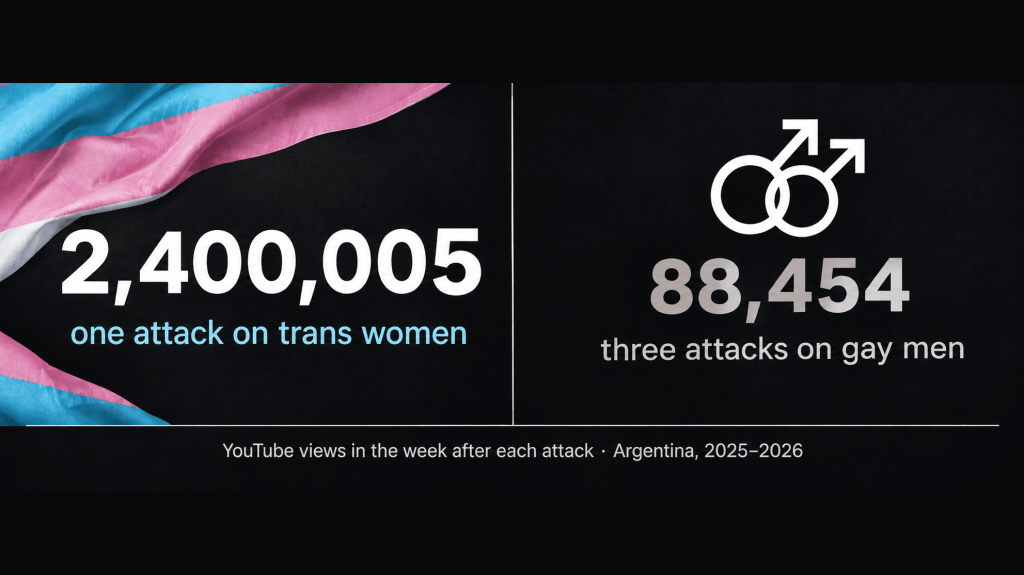
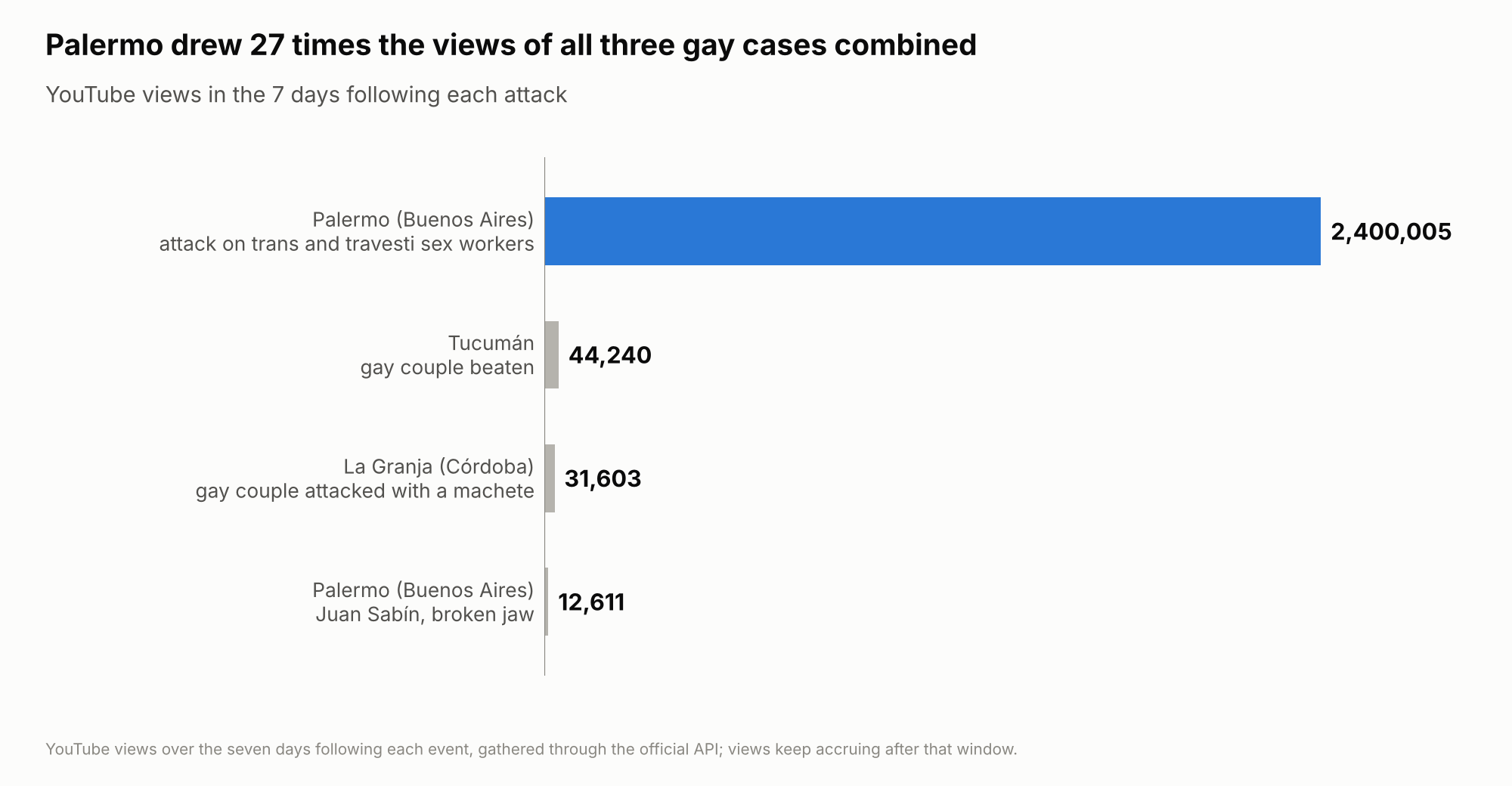
On the night of 1 November 2026, a mob of fifty or sixty young men set upon trans and travesti sex workers in the Bosques de Palermo, Buenos Aires. At least six were injured; one lost an ear. The attackers filmed it themselves and uploaded the footage. Over the following seven days, YouTube videos about the attack drew 2,400,005 views.
A week earlier, on 25 October, in Tucumán, Francisco Blasetti and his partner Iván were beaten after a row over the lift in their building. Francisco ended up in intensive care, and the footage made the rounds on TikTok. On YouTube, the following week brought 44,240 views. Around 2 November, in La Granja, Córdoba, a 54-year-old man went at Juan and Nicolás, a gay couple, with a machete, shouting «fucking faggot, I’m going to kill you». That drew 31,603 views. In August 2025, in Palermo itself, Juan Sabín, a 24-year-old model, had his jaw broken in two places outside a nightclub and left surgery held together with plates. That drew 12,611 views.
Palermo drew more than fifty times the views of the most-watched gay case, and twenty-seven times all three combined. Between them, the attacks on gay men left one man in intensive care, a couple threatened with death at the end of a machete, and a jaw rebuilt in metal. None of them made it past the crime pages. Palermo, by contrast, made it into the mouths of the organisations, into their statements and, a few days later, into the manifesto of the Buenos Aires Pride March.
The explanations to hand
A gap of this size invites explanations that spare everyone any talk of letters. The first is the footage. The Palermo attackers filmed themselves and uploaded the result, and an attack on camera travels further than one merely reported. The beating in Tucumán, however, was filmed as well, and did the rounds on TikTok as well, and on YouTube it never got past 44,240 views. Footage carries a story once somebody already wishes it carried.
The second is geography. Buenos Aires holds the newsrooms, the production houses and the channels, and what happens in Tucumán, or in a village in the Córdoba hills, reaches the capital rather muffled. Juan Sabín, though, had his jaw broken in Palermo, the very neighbourhood of the Bosques, and his case gathered 12,611 views, the lowest of the four. Were the capital enough to make news, Sabín would top the list rather than bring up the rear.
The third is timing. Palermo fell in Pride week, with the movement out on the streets and every microphone switched on. The same holds for La Granja: the machete attack on Juan and Nicolás came that very week, before those very microphones, and the case stalled at 31,603 views.
That leaves scale, and here a concession is due. A mob of fifty or sixty men against a group of sex workers, six injured and an ear torn off, is a larger event than an assault on a couple, and one may reasonably expect it to draw a larger crowd. An event three or four times the size warrants three or four times the attention, ten if one is feeling generous, but fifty-four is another matter altogether. Nor does scale account for what came next, once the choice of what to name no longer rested with an algorithm but with the committee that wrote the Pride March manifesto.
What they chose to name
Views are dealt out by an algorithm; the Pride manifesto is written by people. The organising committee of the 35th Buenos Aires Pride March read it out before Congress on 7 November, and it found room for the IMF, the national debt, a general strike, the Pope’s visit and Cristina Fernández de Kirchner. When it came to actual cases of violence, it named two. The first was Palermo, with its rallying cry: «Justice for our comrades from Palermo!». The second was the fire at the Barracas boarding house, the triple lesbicide of May 2024. Lesbians, for the time being, still stir a flicker of interest, though the great majority of their demands sail straight past the collectives’ megaphones.
Francisco Blasetti had been through intensive care after the beating in Tucumán, and Juan and Nicolás had escaped a machete in La Granja that very week. Neither case made it into the manifesto, and nor did any other gay man who had been attacked. Naming a case costs a single line, and a text with room for the IMF and the Pope found none for two gay couples assaulted within a fortnight. That silence cannot be laid at the door of a platform or of geography. Whoever drafted the manifesto chose whom to name, and within the acronym it claims to speak for, the attention goes to the letters from the T onwards.
A hierarchy of victims
The three cases of 2026 share a detail the coverage took care to erase: in none of them is the motive settled. In Palermo, the organisers of the bike ride from which the mob broke away maintain that a group strayed from the route, and premeditation remains in dispute. In Tucumán, part of the press spoke of a row over the lift; in La Granja, of a rental dispute come to its end. The movement settled the doubt on one side only. In the organising committee’s mouth, Palermo became an attack organised by more than two hundred men, the highest figure in circulation, and proof that the hatred preached from the presidential lectern finds its way onto the street. The beating and the machete were left as the crime pages had filed them: squabbles between neighbours.
This is a hierarchy of victims, and it runs on a simple rule. When the victim is trans, the violence is read as political, as the symptom of a system and as the case for a comprehensive law. When the victim is a gay man, it is read as an individual excess that says nothing about the country and asks nothing of anyone. The movement born to win civil rights for homosexuals reorganised itself around the question of identity, and since then violence against gay men has ceased to be its concern. There is a matter of vocabulary, too. In the grammar now prevailing among the collectives, a gay man resembles the oppressor rather too closely to sit comfortably in the victim’s chair. His assault confirms no narrative, and so nobody turns it into a slogan.
The names nobody spoke
Legislation works rather differently, which is why it is saved for the next instalment. In Asunción, some fifty thousand signatures carried to the Paraguayan Senate a bill which, on its critics’ reading, would punish affection between people of the same sex with years in prison. Not one of the Anglophone organisations that fill their feeds with distant causes spared it a line. That is another story. This one ends with the manifesto read out before Congress on 7 November, in which neither Francisco Blasetti nor Iván appeared, nor Juan and Nicolás, nor Juan Sabín. They got no slogan and no placard, and nobody cried «justice for our brothers». Brothers, mind you: not siblings, not folx, not comrades of every gender, but men. «Penis-bearing individuals», to borrow the idiom of the age, and in the present ecosystem that detail is reason enough for a machete in Córdoba to weigh less than a paragraph on the Pope’s visit.


Deja una respuesta